Yes No Tarot API
Yes no tarot reading API
Included with every plan (at no extra cost)
Ask a specific question and receive a yes, no, or maybe answer based on a single tarot card draw. Upright cards indicate "Yes" with positive energy, reversed cards indicate "No" with caution, and certain inherently ambiguous cards (The Hanged Man, Wheel of Fortune, Temperance, Two of Swords, Four of Swords) return "Maybe" regardless of orientation since their energy signals pause, reflection, or shifting circumstances. Major Arcana cards give strong definitive answers, Minor Arcana cards give qualified nuanced answers. Returns the answer, strength level, drawn card details, and a contextual interpretation explaining why. Perfect for decision-making apps, quick guidance tools, fortune-telling chatbots, and interactive tarot experiences. Optionally provide a seed for reproducible answers.
Request
POST /api/v2/tarot/yes-no
Parameters
| Parameter | Type | Description |
|---|---|---|
| langquery | string enum | Response language (BCP 47). Supported: en, tr, de, es, hi, pt, fr, ru, zh-Hans, zh-Hant. Defaults to en. Coverage varies by domain, and a field with no translation in the requested language returns English. Default en. |
Request body
| Field | Type | Description |
|---|---|---|
| question | string | Your specific yes/no question. Be clear and focused. Good: "Should I move to a new city?" Bad: "What should I do about my life?" The more specific the question, the more useful the tarot guidance. |
| seed | string | Optional seed for reproducible results. Same seed + same question = same answer. Useful for testing, sharing readings, or ensuring consistency. Omit for random draws each time. |
Example request
{
  "question": "Should I accept the job offer?",
  "seed": "reading-2f9c1a"
}
Response
Structured JSON with documented fields, covered by 13,405 automated tests per deploy, 3,620 of them gold-standard tests verified against NASA JPL Horizons. Not hallucinated text.
{
  "question": "Should I accept the job offer?",
  "seed": "reading-2f9c1a",
  "answer": "Yes",
  "strength": "Qualified",
  "card": {
    "id": "eight-of-wands",
    "name": "Eight of Wands",
    "arcana": "minor",
    "reversed": false,
    "keywords": [
      "swift movement",
      "momentum",
      "rapid news",
      "air travel",
      "aligned action"
    ],
    "imageUrl": "https://roxyapi.com/img/tarot/minor/eight-of-wands.jpg"
  },
  "interpretation": "Qualified Yes: Eight of Wands suggests forward momentum. The Eight of Wands is the one pip in the suit of Wands with no human figure in it."
}
Response fields
| Field | Type | Description |
|---|---|---|
| question | string | The querent question that was asked, if one was provided. |
| seed | string | The seed used for this draw, echoed back when one was supplied. Present only if the request carried a seed. Makes a cached or forwarded response self describing, so a reading can be reproduced or shared without the original request beside it. |
| answer* | string enum | Tarot-derived answer. Yes = upright card supports a positive outcome. No = reversed card suggests obstacles. Maybe = inherently ambiguous card drawn (The Hanged Man, Wheel of Fortune, Temperance, Two of Swords, Four of Swords) signaling pause, reflection, or shifting circumstances. Always English, whatever the lang parameter says, so it stays safe to compare against in code. Use answerLocalized for anything a reader sees. |
| answerLocalized | string | Answer in the requested language, for display only. Present only when lang is set to a language other than English, since in English it would repeat its canonical partner field exactly. Never compare against this value, compare against the canonical field beside it. |
| strength* | string enum | Confidence level of the answer. Strong = Major Arcana card drawn (powerful, definitive cosmic energy). Qualified = Minor Arcana card drawn (nuanced, situational guidance). Always English, whatever the lang parameter says. Use strengthLocalized for anything a reader sees. |
| strengthLocalized | string | Answer strength in the requested language, for display only. Present only when lang is set to a language other than English, since in English it would repeat its canonical partner field exactly. Never compare against this value, compare against the canonical field beside it. |
| card* | object | |
| card.id* | string | Unique card identifier in kebab-case (e.g. the-fool, ace-of-cups). |
| card.name* | string | Display name of the tarot card. |
| card.arcana* | string enum | Whether this card belongs to the Major Arcana (22 trump cards, major life themes) or Minor Arcana (56 suit cards, daily situations). |
| card.reversed* | boolean | True if the card was drawn reversed (upside down). Reversed cards carry modified or blocked energy compared to upright position. |
| card.keywords* | array of string | Key themes and concepts associated with this card in its current orientation (upright or reversed). |
| card.imageUrl* | string | URL to the tarot card artwork image. |
| interpretation* | string | Contextual narrative explaining why this card answers the question with this result. Connects card meaning, orientation, and arcana strength into actionable guidance. |
Supported options
lang
Call it in your language.
Every snippet is generated from the live OpenAPI spec, so method names, parameters, and fields always match production.
import { createRoxy } from '@roxyapi/sdk'

const roxy = createRoxy(process.env.ROXY_API_KEY!)
const { data } = await roxy.tarot.castYesNo({ body: { question: 'Should I accept the job offer?', seed: 'reading-2f9c1a' } })
Install: npm install @roxyapi/sdk
from roxy_sdk import create_roxy

roxy = create_roxy("YOUR_API_KEY")
result = roxy.tarot.cast_yes_no(question='Should I accept the job offer?', seed='reading-2f9c1a')
Install: pip install roxy-sdk
use function RoxyAPI\Sdk\createRoxy;

$roxy = createRoxy(getenv('ROXY_API_KEY'));
$result = $roxy->tarot->castYesNo(question: 'Should I accept the job offer?', seed: 'reading-2f9c1a');
Install: composer require roxyapi/sdk
using RoxyApi;

var roxy = new RoxyClient(Environment.GetEnvironmentVariable("ROXY_API_KEY")!);
var result = await roxy.Tarot.YesNo.PostAsync(new() { /* request fields above */ });
Install: dotnet add package RoxyApi.Sdk
import roxyapi "github.com/RoxyAPI/sdk-go"

roxy, _ := roxyapi.NewRoxy(os.Getenv("ROXY_API_KEY"))
resp, _ := roxy.Tarot.CastYesNo(ctx, nil, roxyapi.CastYesNoJSONRequestBody{ /* request fields above */ })
Install: go get github.com/RoxyAPI/sdk-go
curl -X POST "https://roxyapi.com/api/v2/tarot/yes-no" \
  -H "X-API-Key: YOUR_KEY" \
  -H "Content-Type: application/json" \
  -d '{"question":"Should I accept the job offer?","seed":"reading-2f9c1a"}'
Prefer to try before you write code? Run this Tarot endpoint live in the API playground and inspect a real production response.
Remote MCP for AI agents
Every Tarot endpoint is a callable tool on the Remote MCP server over Streamable HTTP. No local setup, no Docker. Claude, ChatGPT, Cursor, and any MCP client auto-discover the tools and ground their answers in verified data.
claude mcp add --transport http \
  roxy-tarot https://roxyapi.com/mcp/tarot \
  --header "X-API-Key: YOUR_KEY"
Tool name for POST /tarot/yes-no: post_tarot_yes_no. Full MCP setup guide
What you can build
Build tarot reading apps with authentic Rider-Waite-Smith interpretations: upright and reversed meanings for all 78 cards with domain-specific guidance for love, career, health, and spiritual growth
Add daily tarot features to wellness and self-discovery platforms: one consistent personalized card per user each day, with shareable results
Build AI tarot chatbots with MCP: your OpenAI, Claude, or Gemini agent auto-discovers tarot endpoints and delivers conversational readings with zero integration code
Power career and life coaching platforms with Celtic Cross (10-card), SWOT career spreads, and yes/no oracle readings for decision-making and guidance features
Create relationship and dating app features with love spreads analyzing emotional dynamics, compatibility, challenges, and partnership potential
Ship fortune-telling and divination platforms combining tarot with astrology, numerology, dreams, and I-Ching for comprehensive spiritual guidance under one API key
Drop-in UI components and no-code widgets.
Render Yes No Tarot API responses without building charts yourself. Install the npm package and drop these into Next.js, React, Vue, Svelte, Angular, or plain HTML, or embed the very same component on Squarespace, Wix, or WordPress by pasting one snippet, with no backend and no build step. They belong to one library that covers the entire spiritual stack rather than astrology alone, MIT licensed and included in every plan at no extra cost, never a separate product and never an upsell. The Yes No Tarot API calculations, the interface that renders them, and the Remote MCP your agent calls, all behind one key, end to end.
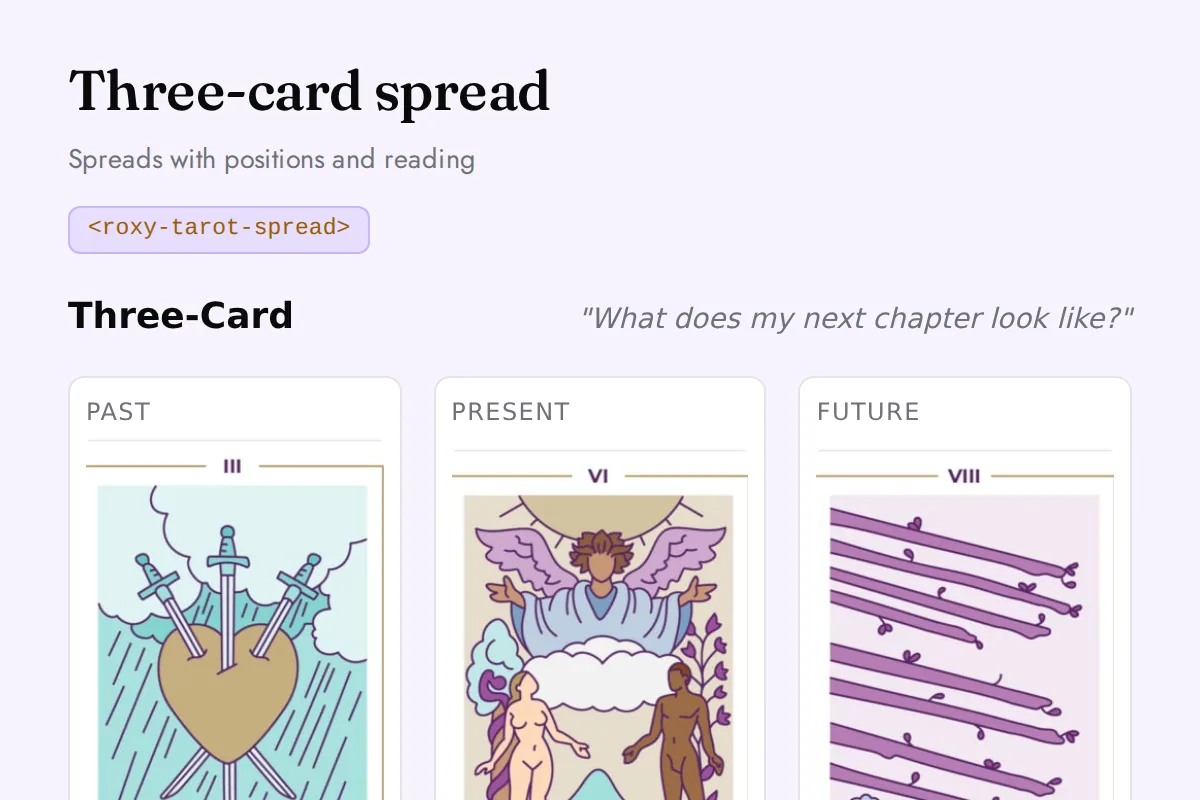
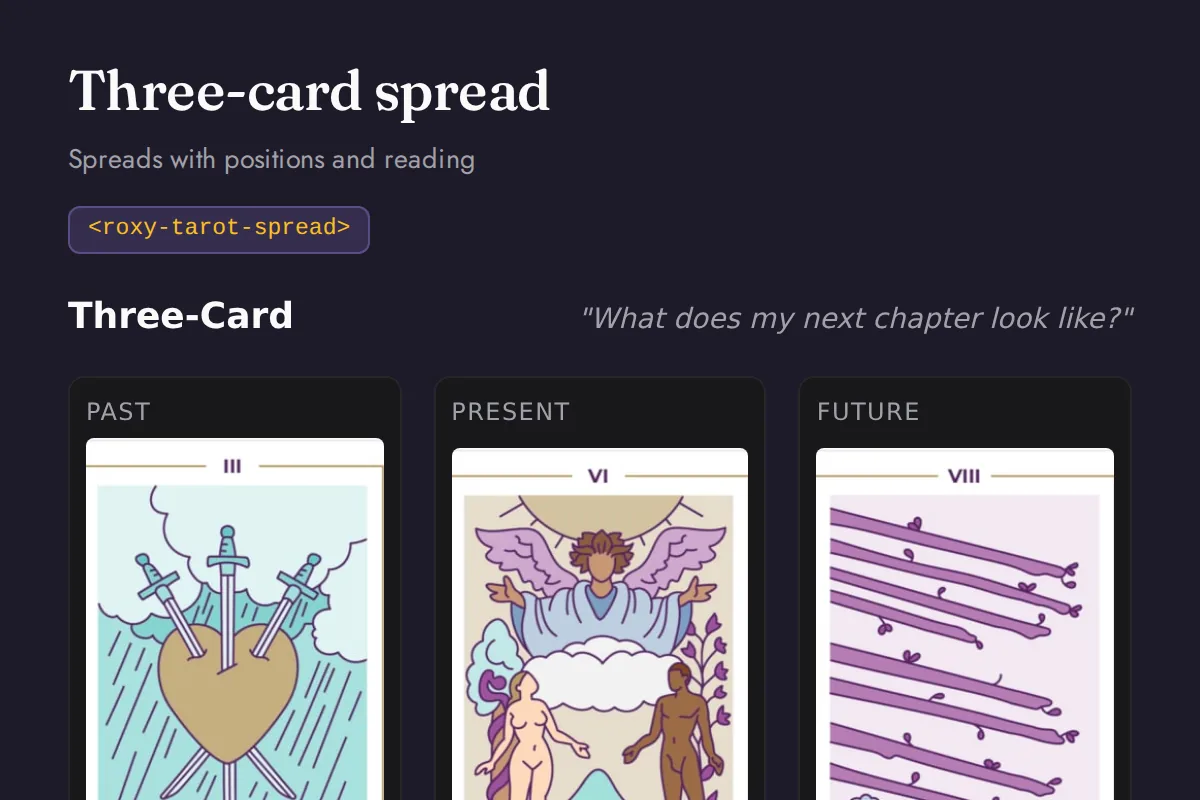
Show all Yes No Tarot UI componentsShow fewer Yes No Tarot UI components
| Element | Renders |
|---|---|
| <roxy-tarot-spread> | Spreads with positions and reading |
Related capabilities
Yes No Tarot API FAQ
What does the Yes No Tarot API return?
Ask a specific question and receive a yes, no, or maybe answer based on a single tarot card draw. Every response is structured JSON with documented fields, not free text, so you map it straight into your product.
How do I authenticate with the Yes No Tarot API?
Pass your key in the X-API-Key header on every request. Keys are delivered instantly at checkout with no approval queue. Use a secret sk key server side, or mint a publishable pk key locked to your origins for browser and no-code use.
Does the Yes No Tarot API support multiple languages?
Yes. Append the lang query parameter to any endpoint for responses in English, German, Spanish, French, Hindi, Portuguese, Russian and Turkish. The translated payload includes the full interpretation text, not just field labels.
Is the Yes No Tarot API available over Remote MCP for AI agents?
Yes. Every endpoint is exposed as a callable tool on the Remote MCP server at https://roxyapi.com/mcp/tarot over Streamable HTTP, so Claude, ChatGPT, Cursor, and any MCP client auto-discover it with no local setup or Docker.
How is the Yes No Tarot API billed?
Flat pricing: 1 request equals 1 quota unit, REST and MCP identical, with no credit weighting or per-token markup. Every plan includes all 18 domains, so the Yes No Tarot API is included at no extra cost.
Start using Yes No Tarot API today.
Tarot readings a user can share and reopen unchanged, every card read upright and reversed for love, career and health.
All 18 domains included with every plan. Every endpoint, MCP server, SDK, and templates.
Plans from $39/mo, starting at $1.80 per domain on annual billing. No credit card required for testing.
View Pricing & Get API Key