
Vastu Shastra entrance, plot and room verdicts that cite their verse, or say plainly they are convention.
Vastu Entrance · Vastu Purusha Mandala · Vastu Plot Analysis · Ayadi Shadvarga · Vastu Room Direction · Griha Pravesh Muhurta · Vastu Directions
Included with every plan (at no extra cost)
Entrance pada from a door position
Classical effect of every perimeter pada
Favourable padas to move a door toward
Chapter and verse behind every verdict
Paramasayika and Manduka grids over a real plot
Devata of every square
Brahmasthan, marma points and vamsa diagonals
Dikpala and devata reference tables
Plot shape, proportion and orientation
Corner extensions and cuts
Ground slope by Brihat Samhita or modern school
Road and water placement
Room direction check for a whole floor plan
Kitchen, puja, master bedroom and toilet zones
Remedy for a misplaced room
Composite score with published weights
Ayadi shadvarga with every remainder shown
Manasara, perimeter texts or Utpala
Hasta, feet or metres with your own cubit
House warming dates over any window
Muhurta Chintamani or Kalaprakasika rules
Nakshatra, tithi and weekday that qualified a day
Unsettled rules left to the astrologer
Vastu Shastra API for directional home and plot analysis: entrance padas with the classical effect of each of the 32 perimeter positions, the Vastu Purusha Mandala projected over a real plot on the 81 pada or the 64 pada grid, room placement checks over a closed room enum, Ayadi shadvarga across three text families, plot shape and ground level under two schools that genuinely disagree, and griha pravesh dates composed over a verified panchang. Every verdict carries the chapter and verse it rests on as a typed field, or says plainly that it is convention. Directional design from Indian architecture, sitting beside our feng shui endpoints on one key, with Remote MCP and typed SDKs.
Every Vastu calculation is covered by 13,405 automated tests per deploy, 3,620 of them gold-standard tests locked to the named references on our methodology page. See how we test.
Interpretations in Deutsch, English, Español, Français, हिन्दी, Português, Русский, Türkçe, one query parameter away.
Typed SDKs for TypeScript, Python, PHP, C#, and Go, generated from the live spec, each with an AGENTS.md so your coding assistant calls the Vastu Shastra API correctly.
A Remote MCP server exposes every endpoint as a tool for Claude, ChatGPT, Cursor and any MCP client, with no local install. Opt-in compact responses cut the tokens your agent reads by roughly 40 to 52 percent, and one call stays one request.
Paste a widget into any site builder, install the WordPress plugin, or start from an MIT template you can white-label. Results render from the Vastu Shastra API with no backend.
The depth behind every line above, written out in full.
Want to try without writing code? Try this domain live in API playground →
npm install @roxyapi/sdkimport { createRoxy } from '@roxyapi/sdk'
const roxy = createRoxy(process.env.ROXY_API_KEY!)
const { data } = await roxy.vastu.get(/* ... */)pip install roxy-sdkfrom roxy_sdk import create_roxy
roxy = create_roxy("your-api-key")
result = roxy.vastu.get(...) # async: await roxy.vastu.get_async(...)composer require roxyapi/sdkuse function RoxyAPI\Sdk\createRoxy;
$roxy = createRoxy(getenv('ROXY_API_KEY'));
$result = $roxy->vastu->get(/* ... */);dotnet add package RoxyApi.Sdkusing RoxyApi;
var roxy = new RoxyClient(Environment.GetEnvironmentVariable("ROXY_API_KEY")!);
// await roxy.Vastu.<resource>.GetAsync() or .PostAsync(new() { ... })go get github.com/RoxyAPI/sdk-goimport roxyapi "github.com/RoxyAPI/sdk-go"
roxy, _ := roxyapi.NewRoxy(os.Getenv("ROXY_API_KEY"))
// resp, err := roxy.Vastu.<Method>(context.Background(), nil)claude mcp add --transport http \
roxy-vastu https://roxyapi.com/mcp/vastu \
--header "X-API-Key: YOUR_KEY"AI agents auto-discover all endpoints as callable tools. Zero configuration. Responses can come back token-optimized and lossless, cutting the tokens your agent spends per call by roughly 40 to 52 percent.
Full MCP setup guidecurl -H "X-API-Key: YOUR_KEY" \
https://roxyapi.com/api/v2/vastu/Want to ship faster? Clone a free template and white-label it as your own app.
Building with Cursor, Claude Code, or Bolt? Use our AI prompts to generate a complete app.
Building on WordPress? Install the RoxyAPI plugin and drop a shortcode, no code required.
{
  "pada": 28,
  "side": "North",
  "startCorner": "Northwest",
  "ordinalOnSide": 4,
  "square": 46,
  "cell": {
    "rowFromNorth": 1,
    "columnFromWest": 4
  },
  "devata": {
    "id": "bhallata",
    "name": "Bhallāṭa",
    "padaCount": 2
  },
  "effect": "Every virtue in the household.",
  "auspiciousness": "auspicious",
  "reading": "The main entrance falls on pada 28 of the North side, counted from the Northwest corner. That pada is the square of Bhallāṭa. The effect the verse gives for this pada: Every virtue in the household.",
  "recommendedPadas": [
    27,
    28,
    29
  ],
  "source": {
    "text": "Brihat Samhita",
    "chapter": 53,
    "verse": "75",
    "translation": "N. Chidambaram Iyer",
    "year": 1884,
    "publicDomain": true
  },
  "conventions": {
    "grid": "81-pada",
    "unit": "feet"
  }
}
Structured JSON with documented fields. Not hallucinated text. See all endpoints
Render Vastu Shastra API responses without building charts yourself. Install the npm package and drop these into Next.js, React, Vue, Svelte, Angular, or plain HTML, or embed the very same component on Squarespace, Wix, or WordPress by pasting one snippet, with no backend and no build step. They belong to one library that covers the entire spiritual stack rather than astrology alone, MIT licensed and included in every plan at no extra cost, never a separate product and never an upsell. The Vastu Shastra API calculations, the interface that renders them, and the Remote MCP your agent calls, all behind one key, end to end.
| Element | Renders |
|---|---|
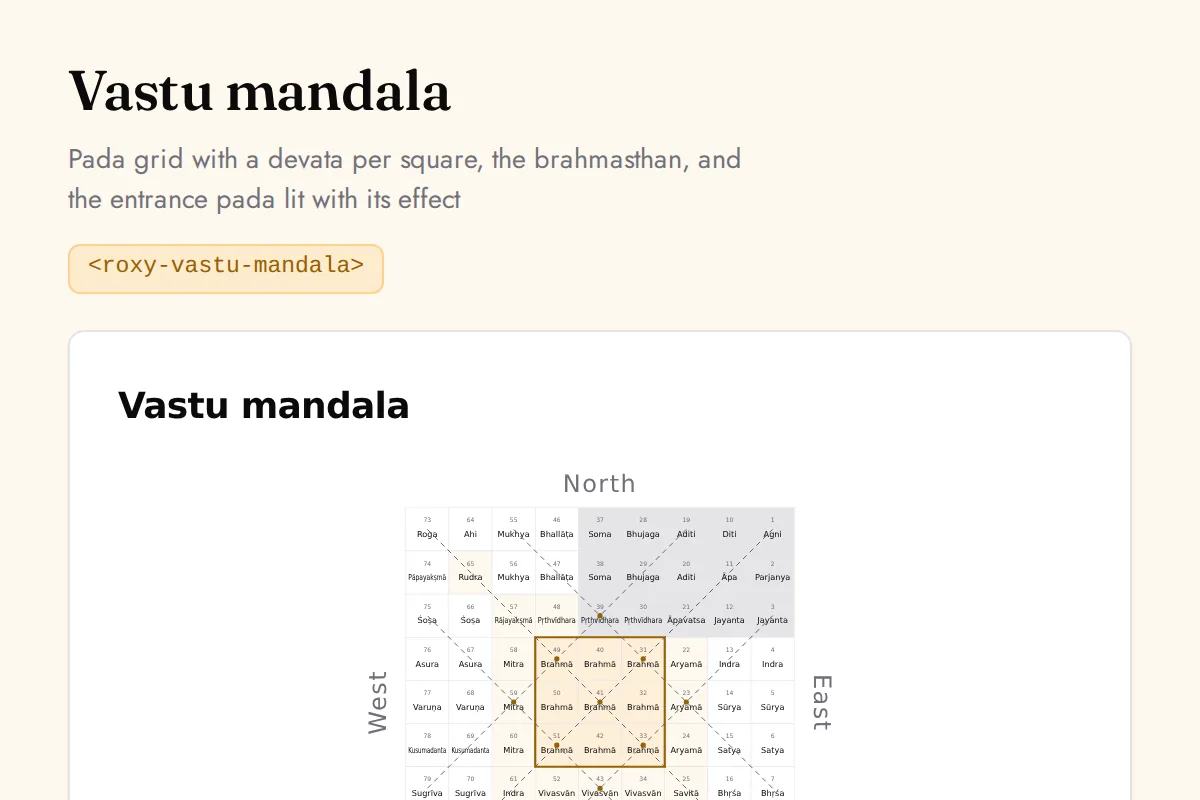
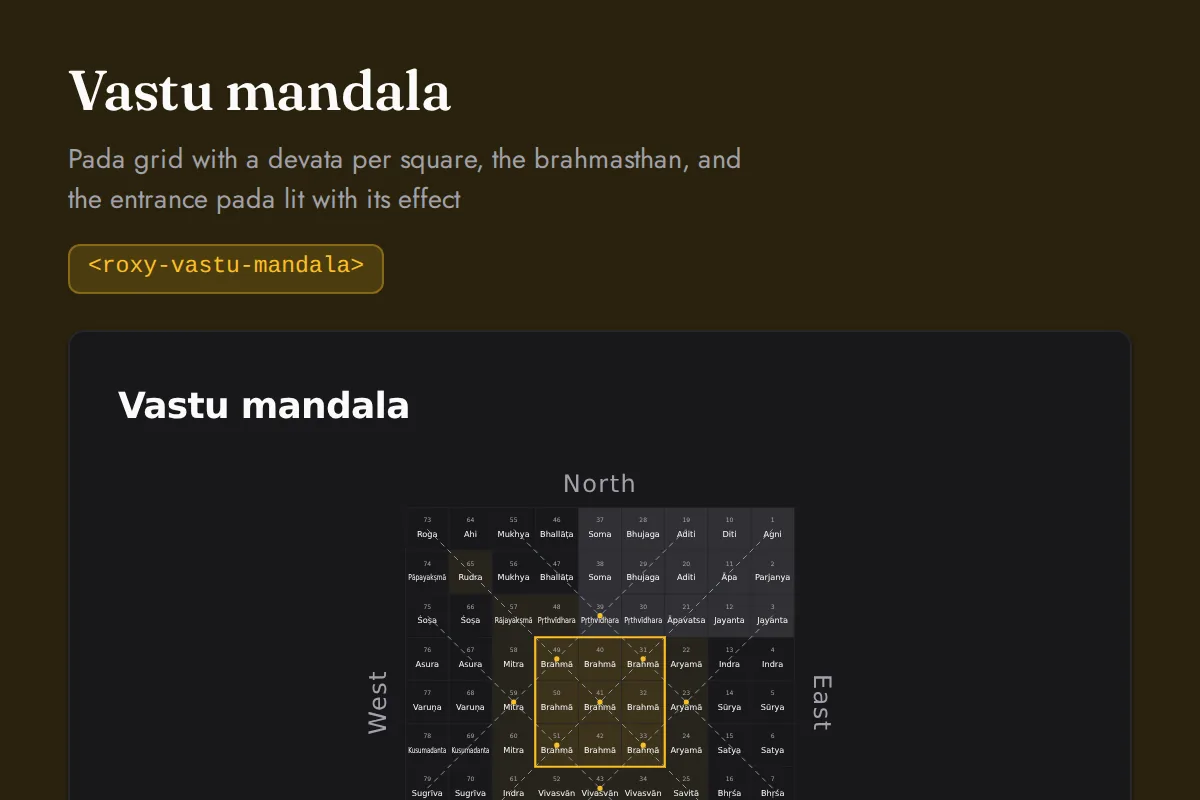
<roxy-vastu-mandala> | Pada grid with a devata per square, the brahmasthan, and the entrance pada lit with its effect |
Clone. Edit. Ship. Free and open source by Team Roxy.
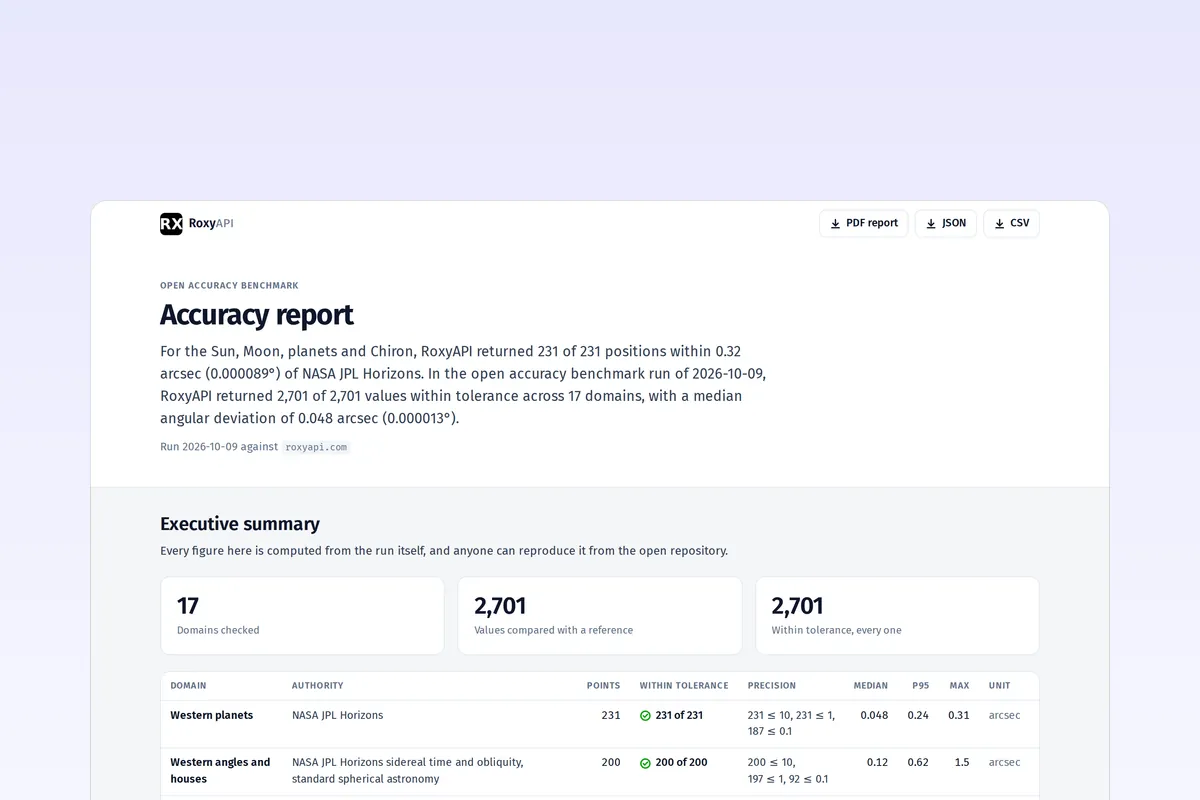
Independent proof, domain by domain. Every reference value cited, rerun monthly.
Browse all template or use AI prompts to generate a custom app.
The products teams ship on the Vastu Shastra API.
Real calls against the production API, no account needed. Every endpoint sits in the public OpenAPI spec and is callable as an MCP tool; open one for its parameters and response examples.
Vastu entrance analysis for a main door: send the plot and where the door sits, and the API returns which of the 32 perimeter padas it falls on, the devata of that square, the effect the classical chapter gives that pada, and the favourable padas on the same side to move toward. Every verdict carries the chapter and verse it comes from as a typed field, and the reading holds on either the 81 pada or the 64 pada division. Built for property and interior design tools, practitioner reports, and any product that has to say whether a front door is well placed.
Vastu Purusha Mandala projected over a real plot: send the ground and the API returns every square with the devata holding it, the brahmasthan as a polygon you can draw, the marma points, the six vamsa diagonals named by their devatas and the nine atimarma crossings. Choose the 81 pada Paramasayika or the 64 pada Manduka, and the response says which verses each part rests on. Built for floor plan overlays, practitioner reports and any tool that has to place rooms against the classical grid.
Vastu plot analysis from typed geometry: send the outline, the facing, where the ground falls and where the water is, and the API returns a verdict on the shape, the proportion, the ground level under two schools, each corner extension and cut, the road and the water. Every verdict names the chapter and verse behind it, or says plainly that it is convention, which matters because the ground level verses and the widely taught modern rule genuinely disagree. Built for listing and land assessment tools, practitioner site reports and buyer facing checks.
Ayadi shadvarga calculator for a building or a room: send the dimensions and the API returns all six proportional formulas with the multiplier, the divisor and the remainder shown, the member each remainder names, and the two verdict rules the texts state. Choose between three text families, which genuinely disagree, and choose your own cubit length, because every remainder is unit sensitive. Built for practitioner tools, plan checking software and anyone who has to justify a dimension rather than assert it.
Vastu room direction check for a whole floor plan: send the plot and a list of rooms, by quarter or by outline, and the API returns a verdict per room with the quarters it belongs in, the quarters to keep it out of, a remedy when it is misplaced, and a composite score with the weights published. Four of the twelve room types carry a chapter and verse and the other eight are labelled convention, so a report can say which half of it is classical. Built for floor plan tools, listing checks and practitioner reports.
Griha pravesh muhurta search over a date window: send the window and the place, and the API returns every day that clears the classical day-level rules, with the nakshatra, tithi, weekday and solar position that qualified it and the rule ids that admitted it. Two Muhurta texts disagree on the admissible nakshatras and you choose which one leads, and the rules a date search cannot settle are published rather than dropped. Built for house warming date pickers, practitioner scheduling and agent assistants that have to answer when a family should move in.
Reference table of the eight Vastu directions: the dikpala who rules each quarter of the horizon, the squares of the mandala it covers with their devatas, what the chapter places on that side, and what standing water there brings. A pure reference endpoint with no plot required, for building a picker or a directions guide. Every row says which verse each part comes from and labels the element as the later convention it is.
Look up one Vastu direction: its dikpala, the mandala squares it covers with their devatas, what the chapter places there, and what standing water in that quarter brings. Case and punctuation in the id are folded, so north-east, northeast and NorthEast all resolve to the same entry, and the id space is the one the feng shui and I Ching endpoints use.
Reference table of the 45 devatas of the Vastu Purusha Mandala: which squares of the 81 pada grid each one holds, which ring and which side, how many padas, and the verses that place it. A pure reference endpoint with no plot required, for building a mandala diagram or a glossary. Where the sources contradict each other, and they do on several rows, the row says so instead of quietly picking a side.
Look up one devata of the Vastu Purusha Mandala: the squares it holds, its ring and side, its pada count, the entrance pada it governs where it sits on the perimeter, and the verses that place it. Case and punctuation in the id are folded, so indra-outer, Indra_Outer and INDRA OUTER all resolve.
The receipts are public: the testing methodology, the open MIT benchmark, the transparency report, and the live API playground. Let ChatGPT, Perplexity, or Claude search the web and tell you what they find about RoxyAPI accuracy, MCP, SDKs, and pricing.
Opens a live web search in a new tab.
Your AI agent
your model, your voice
Remote MCP
auto-discovered, no local setup
Token-optimizedRoxy Ephemeris
13,405 tests, 3620 gold standard
Verified result
18 domains, one flat rate
Your agent uses calculated charts and readings in its replies, with your model and your own voice. Planetary positions are verified against NASA JPL Horizons. No local setup, no AGPL, no hosted-AI markup.
Audit it yourself: every Vastu endpoint runs live in the API playground
The classical answer is not a direction but a pada. The perimeter of the plot divides into 32 positions, eight to a side, and each one carries its own stated effect, so a north facing door on a poor pada is worse than a south facing one on a good pada. Send the plot and where the door sits and the entrance endpoint returns the pada, the devata of that square, the effect and the favourable padas on the same side to move toward.
The brahmasthan is the central block of the mandala, nine squares of the eighty one or four of the sixty four, held by Brahma. It is the part of a plan kept open, and the chapter is blunt about a gate that faces it. The mandala endpoint returns it as a polygon in your own plot coordinates, so it can be drawn straight onto a plan and checked against what stands there.
Ayadi shadvarga is a set of six proportional formulas applied to the dimensions of a building, each multiplying a measure and taking the remainder of a division. The API returns the multiplier, divisor, product and remainder for every one of the six, the member each remainder names where a source names one, and the two verdict rules the texts state. Where the aya and vyaya names are not printed in any public domain source, it returns the remainder and the group size and no invented name.
Because the classical verses and the modern teaching genuinely disagree, and the API returns both rather than choosing. The verses call a higher north-east a loss and expressly allow a slightly higher east or north where level ground is unavoidable; the widely taught modern rule wants the north-east lowest and permits neither. Send the school you want to lead with and the other reading comes back beside it, each with its verse or with a plain statement that it rests on teaching practice.
No. Every route takes geometry, a facing and, for the date search, a place and a window. There is no owner chart route and no numerological facing route, because no primary text ties a birth nakshatra or a radical number to a house facing, and a route that invented one would be the least defensible thing in the domain. The date search does apply owner independent rules and publishes the owner dependent ones it cannot settle.
Yes. The mandala is geometry aligned to the compass, so it projects over a plot in Lisbon exactly as it does over one in Chennai, and the direction identifiers are the same ones the feng shui endpoints use. The date search takes any latitude, longitude and offset and reads every limb at local sunrise, and it falls back to local midnight rather than refusing inside a polar night.
Vastu Shastra entrance, plot and room verdicts that cite their verse, or say plainly they are convention.
All 18 domains included with every plan. Every endpoint, MCP server, SDK, and templates.
Plans from $39/mo, starting at $1.80 per domain on annual billing. No credit card required for testing.
View Pricing & Get API KeyHi, I am Rosie, your guide to the RoxyAPI insight tools.
Ask me to read your birth chart, pull a card, or map your numbers, and I will interpret what it means for you. Unlike most AIs, I never make the numbers up: every reading runs on real, verified calculations. Curious about the API, pricing, or docs instead? Ask me that too.