
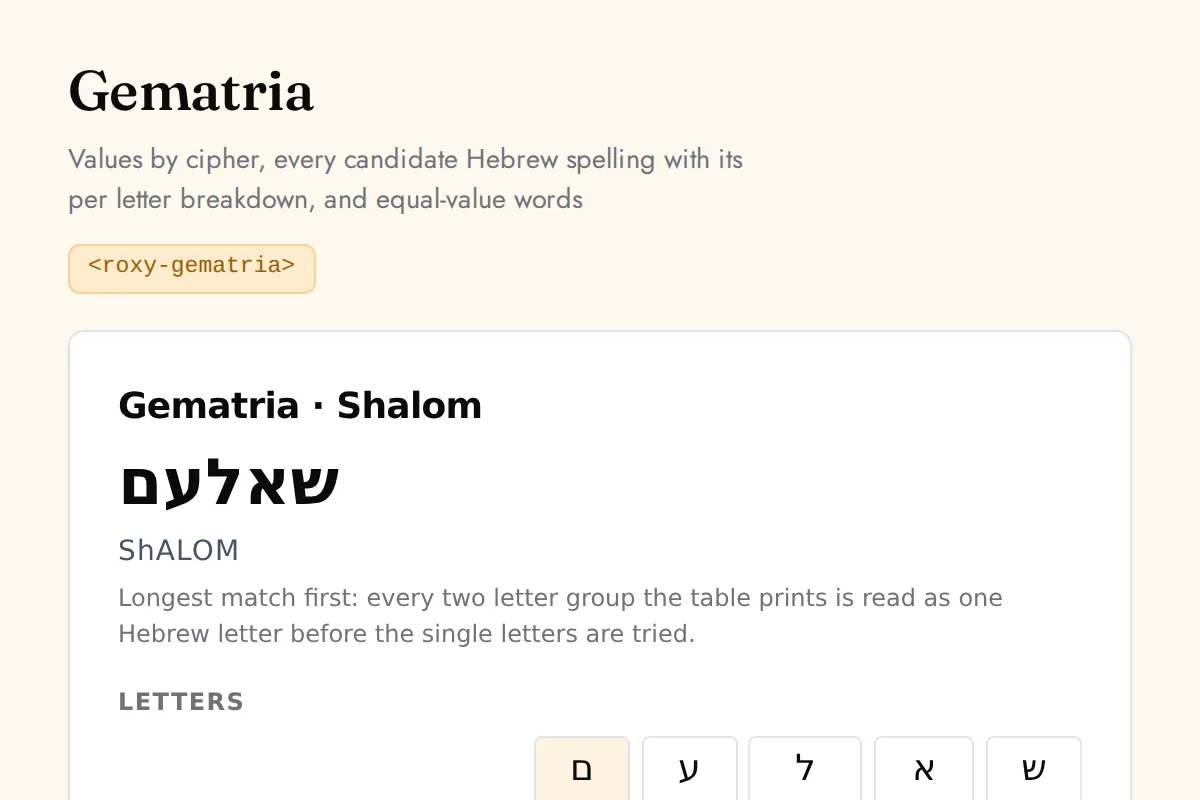
Gematria for any name, with the Hebrew spelling behind the number shown.
Gematria · Hebrew Birthday · Kabbalah Birth Angel · Kabbalah Numerology · Kabbalah Name Compatibility · 72 Names of God · Tree of Life · Hebrew Letters · Omer Count and 1 more
Included with every plan (at no extra cost)
Mispar Hechrachi, Gadol, Katan and Kidmi
Atbash and Albam substitutions
Every candidate Hebrew spelling of a name
Equal value words with their sources
Name profile placed on the Tree of Life
Mathers or modern Israeli letter map
Latin ciphers labelled by lineage
Name compatibility with every component shown
Shem HaMephorash names derived from Exodus
Ecliptic arc, sign and angelic choir per name
The name governing any zodiac degree
Published list differences flagged per row
Hebrew date and Hebrew birthday
Body, character and spirit birth names
Solar longitude or Lenain calendar dating
Sephirah of the birth day
Sephirot, Daat and paths with tarot trumps
Classical or Golden Dawn sephirot system
Four worlds and the lightning flash
Omer count with its sephirot pairing
Mother, double and simple letter classes
Gra, Saadia, short and Golden Dawn readings
Final forms with their values
Element, planet or sign on every letter
Kabbalah API for gematria, the 72 names, the Tree of Life and the Hebrew birthday. Score a Hebrew word or a Latin name across 11 rabbinic ciphers with the per letter breakdown, every candidate Hebrew spelling shown and the rule that chose one, plus a cited equal value lexicon. The 72 names are derived from the verses rather than copied from a table, the birth name is dated by the exact position of the Sun or by the civil wheel as you choose, and the sephirot, the 22 paths and the 22 letters come back under typed school variants cross linked to the tarot deck. One key covers every RoxyAPI domain, with Remote MCP and typed SDKs.
Every Kabbalah calculation is covered by 13,405 automated tests per deploy, 3,620 of them gold-standard tests locked to the named references on our methodology page. See how we test.
Interpretations in English, Deutsch, Español, Français, हिन्दी, Português, Русский, Türkçe, one query parameter away.
Typed SDKs for TypeScript, Python, PHP, C#, and Go, generated from the live spec, each with an AGENTS.md so your coding assistant calls the Kabbalah API correctly.
A Remote MCP server exposes every endpoint as a tool for Claude, ChatGPT, Cursor and any MCP client, with no local install. Opt-in compact responses cut the tokens your agent reads by roughly 40 to 52 percent, and one call stays one request.
Paste a widget into any site builder, install the WordPress plugin, or start from an MIT template you can white-label. Results render from the Kabbalah API with no backend.
The depth behind every line above, written out in full.
Want to try without writing code? Try this domain live in API playground →
npm install @roxyapi/sdkimport { createRoxy } from '@roxyapi/sdk'
const roxy = createRoxy(process.env.ROXY_API_KEY!)
const { data } = await roxy.kabbalah.get(/* ... */)pip install roxy-sdkfrom roxy_sdk import create_roxy
roxy = create_roxy("your-api-key")
result = roxy.kabbalah.get(...) # async: await roxy.kabbalah.get_async(...)composer require roxyapi/sdkuse function RoxyAPI\Sdk\createRoxy;
$roxy = createRoxy(getenv('ROXY_API_KEY'));
$result = $roxy->kabbalah->get(/* ... */);dotnet add package RoxyApi.Sdkusing RoxyApi;
var roxy = new RoxyClient(Environment.GetEnvironmentVariable("ROXY_API_KEY")!);
// await roxy.Kabbalah.<resource>.GetAsync() or .PostAsync(new() { ... })go get github.com/RoxyAPI/sdk-goimport roxyapi "github.com/RoxyAPI/sdk-go"
roxy, _ := roxyapi.NewRoxy(os.Getenv("ROXY_API_KEY"))
// resp, err := roxy.Kabbalah.<Method>(context.Background(), nil)claude mcp add --transport http \
roxy-kabbalah https://roxyapi.com/mcp/kabbalah \
--header "X-API-Key: YOUR_KEY"AI agents auto-discover all endpoints as callable tools. Zero configuration. Responses can come back token-optimized and lossless, cutting the tokens your agent spends per call by roughly 40 to 52 percent.
Full MCP setup guidecurl -H "X-API-Key: YOUR_KEY" \
https://roxyapi.com/api/v2/kabbalah/Want to ship faster? Clone a free template and white-label it as your own app.
Building with Cursor, Claude Code, or Bolt? Use our AI prompts to generate a complete app.
Building on WordPress? Install the RoxyAPI plugin and drop a shortcode, no code required.
{
  "input": {
    "text": "Sarah"
  },
  "hebrewForms": [
    {
      "hebrew": "סאראה",
      "romanization": "SARAH",
      "rule": "Longest match first: every two letter group the table prints is read as one Hebrew letter before the single letters are tried.",
      "values": [
        {
          "id": "mispar-hechrachi",
          "value": 267,
          "tradition": "rabbinic",
          "source": "https://en.wikipedia.org/wiki/Gematria"
        },
        {
          "id": "mispar-gadol",
          "value": 267,
          "tradition": "rabbinic",
          "source": "https://en.wikipedia.org/wiki/Gematria"
        },
        {
          "id": "otiyot-be-milui",
          "value": 858,
          "alternateValues": [
            862,
            867
          ],
          "tradition": "rabbinic",
          "source": "https://en.wikipedia.org/wiki/Gematria"
        },
        {
          "id": "mispar-katan",
          "value": 15,
          "tradition": "rabbinic",
          "source": "https://en.wikipedia.org/wiki/Gematria"
        },
        {
          "id": "mispar-kidmi",
          "value": 1067,
          "tradition": "rabbinic",
          "source": "https://en.wikipedia.org/wiki/Gematria"
        },
        {
          "id": "mispar-prati",
          "value": 43627,
          "tradition": "rabbinic",
          "source": "https://en.wikipedia.org/wiki/Gematria"
        },
        {
          "id": "mispar-ha-merubah-ha-klali",
          "value": 71289,
          "tradition": "rabbinic",
          "source": "https://en.wikipedia.org/wiki/Gematria"
        },
        {
          "id": "mispar-meshulash",
          "value": 8216127,
          "tradition": "rabbinic",
          "source": "https://en.wikipedia.org/wiki/Gematria"
        },
        {
          "id": "mispar-musafi",
          "value": 272,
          "tradition": "rabbinic",
          "source": "https://en.wikipedia.org/wiki/Gematria"
        },
        {
          "id": "kolel",
          "value": 268,
          "tradition": "rabbinic",
          "source": "https://en.wikipedia.org/wiki/Gematria"
        }
      ],
      "letters": [
        {
          "glyph": "ס",
          "letterId": "samekh",
          "name": "Samekh",
          "isFinal": false,
          "value": 60
        },
        {
          "glyph": "א",
          "letterId": "alef",
          "name": "Aleph",
          "isFinal": false,
          "value": 1
        },
        {
          "glyph": "ר",
          "letterId": "resh",
          "name": "Resh",
          "isFinal": false,
          "value": 200
        },
        {
          "glyph": "א",
          "letterId": "alef",
          "name": "Aleph",
          "isFinal": false,
          "value": 1
        },
        {
          "glyph": "ה",
          "letterId": "he",
          "name": "He",
          "isFinal": false,
          "value": 5
        }
      ]
    }
  ],
  "chosen": {
    "hebrew": "סאראה",
    "rule": "Longest match first: every two letter group the table prints is read as one Hebrew letter before the single letters are tried."
  },
  "values": [
    {
      "id": "mispar-hechrachi",
      "name": "Mispar hechrachi (absolute value)",
      "value": 267,
      "tradition": "rabbinic",
      "source": "https://en.wikipedia.org/wiki/Gematria"
    },
    {
      "id": "mispar-gadol",
      "name": "Mispar gadol (large value)",
      "value": 267,
      "tradition": "rabbinic",
      "source": "https://en.wikipedia.org/wiki/Gematria"
    }
  ],
  "transformations": [
    {
      "id": "atbash",
      "name": "AtBash",
      "output": "חתגתץ",
      "outputRomanization": "ChThGThTz",
      "value": 901,
      "tradition": "rabbinic",
      "source": "https://en.wikipedia.org/wiki/Gematria"
    },
    {
      "id": "albam",
      "name": "Albam",
      "output": "דלטלע",
      "outputRomanization": "DLTLO",
      "value": 143,
      "tradition": "rabbinic",
      "source": "https://en.wikipedia.org/wiki/Gematria"
    }
  ],
  "matches": [],
  "conventions": {
    "transliteration": "letter-map-mathers",
    "misparGadol": "finals-500-900",
    "atbashOutput": "both"
  }
}
Structured JSON with documented fields. Not hallucinated text. See all endpoints
Render Kabbalah API responses without building charts yourself. Install the npm package and drop these into Next.js, React, Vue, Svelte, Angular, or plain HTML, or embed the very same component on Squarespace, Wix, or WordPress by pasting one snippet, with no backend and no build step. They belong to one library that covers the entire spiritual stack rather than astrology alone, MIT licensed and included in every plan at no extra cost, never a separate product and never an upsell. The Kabbalah API calculations, the interface that renders them, and the Remote MCP your agent calls, all behind one key, end to end.
| Element | Renders |
|---|---|
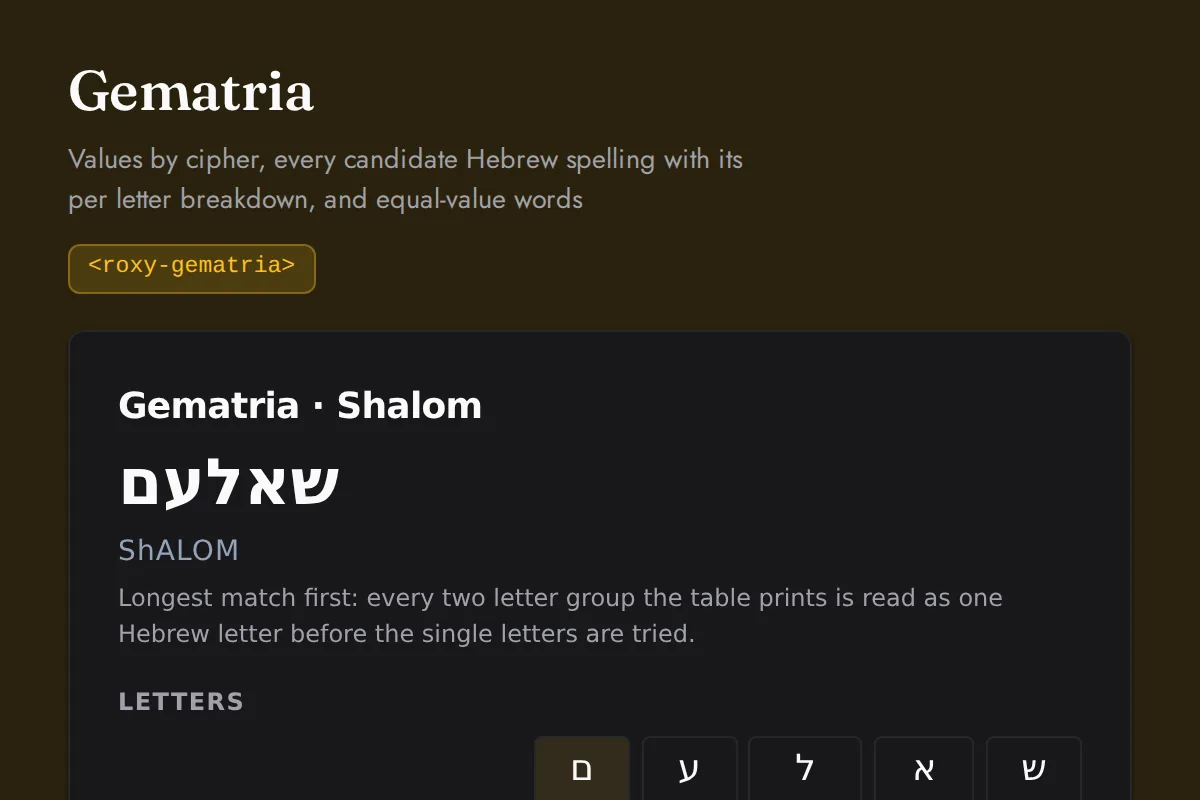
<roxy-gematria> | Values by cipher, every candidate Hebrew spelling with its per letter breakdown, and equal-value words |
Clone. Edit. Ship. Free and open source by Team Roxy.
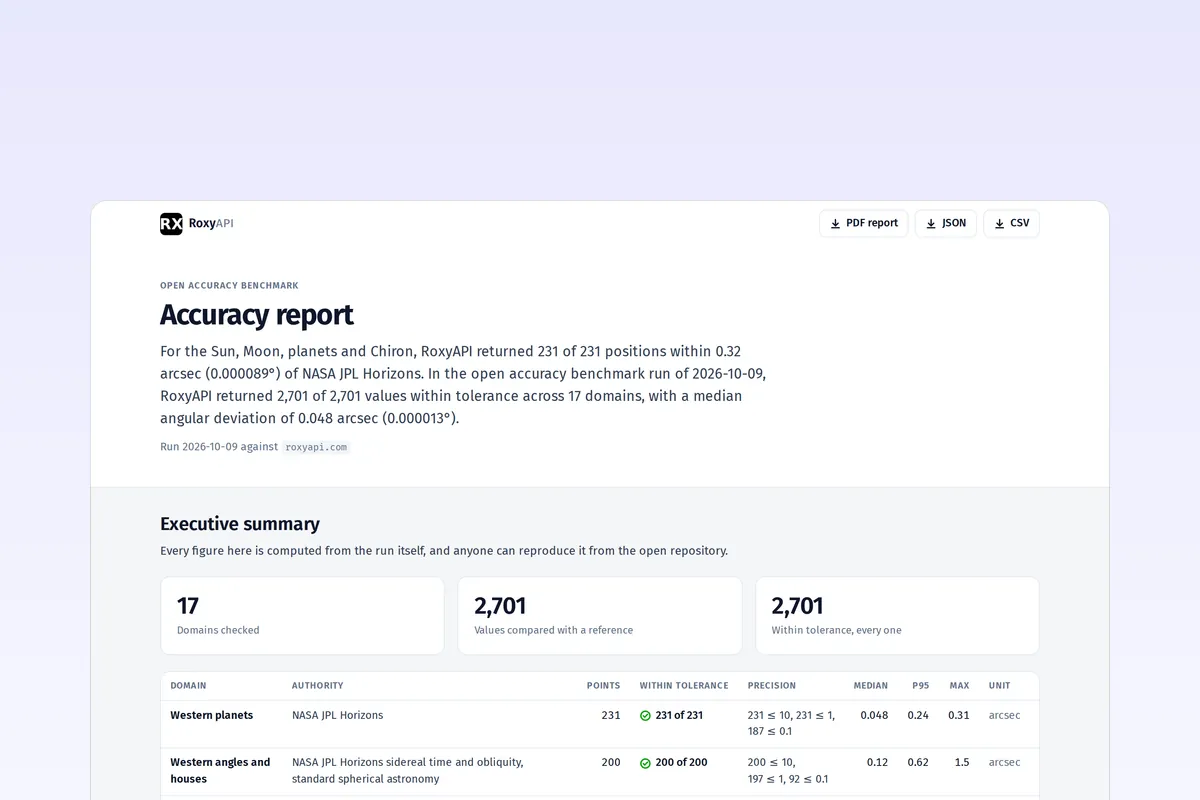
Independent proof, domain by domain. Every reference value cited, rerun monthly.
Browse all template or use AI prompts to generate a custom app.
The products teams ship on the Kabbalah API.
Real calls against the production API, no account needed. Every endpoint sits in the public OpenAPI spec and is callable as an MCP tool; open one for its parameters and response examples.
Score a Hebrew word or a Latin name across ten rabbinic gematria ciphers and two substitution transformations, with the per letter breakdown and the curated equal value matches beside each number. A Latin name has no single Hebrew spelling, so every candidate spelling the transliteration map produces comes back with its own values and the rule that produced it, and the chosen one is named. Built for name meaning features, numerology apps that want the Hebrew reading, and any product that has to show a reader why the number is what it is.
Return the full catalogue of gematria methods this API computes: eleven rabbinic ciphers, two substitution transformations, and the three Latin alphabet ciphers, each with its definition, its provenance class, the century of its tradition and the sources it was taken from. Every entry states whether it is rabbinic or a Renaissance Christian or modern Latin cipher, so a product never presents one tradition as the other. Built for calculators that want to show a reader which method produced a number and where the method comes from.
Score a name across the rabbinic gematria ciphers and place it on the Tree of Life, with every candidate Hebrew spelling shown and the chosen one named. The response carries the standard, the large, the small and the preceding readings with the per letter breakdown, the sephirah the reduced value points at, and the curated words that share the value. Built for name meaning pages, Kabbalah numerology features and any product that wants a name reading it can defend line by line.
Return the Hebrew date of a birth, the Hebrew birthday that follows it, the three birth names of the Renaissance angel tradition and the sephirah of the birth day, from one birth moment. The Hebrew date is computed from the published calendar algorithm rather than looked up, the sunset boundary is a typed request field because it depends on where you were, and the two rival ways of dating the first name are a typed convention the response echoes. Built for Jewish culture and education apps, birth angel features and any product that wants the Hebrew birthday on the same key as the rest of its readings.
Return the seventy two names, each with the three letters it is read from, the divine name suffix, the five degree ecliptic arc it governs, the sign that arc falls in and the angelic choir it belongs to. The names are DERIVED from three verses of Exodus read in the boustrophedon order rather than copied from a table, and any row where a named published list differs is flagged on that row. Pass a longitude to get the single name governing that degree. Built for birth angel features, Shem HaMephorash reference pages and any product that has to show where a name comes from.
Return one of the seventy two names by its index: the three letters read out of the verses, the exact positions they were read from, the suffixed name, the ecliptic arc it governs, the sign and the choir. The positions are on the response so a reader can check the derivation against the verses rather than trust it. Built for birth angel detail pages and reference features.
Return the whole Tree of Life in one call: the ten sephirot with their Hebrew, their pillar, their world and their sphere, Daat beside them, the 22 paths with the letter and the tarot trump on each, the four worlds under both mappings that are in circulation, and the lightning flash order. The school splits are typed request parameters rather than hidden defaults, and the response echoes which arrangement and which reading produced it. Built for Tree of Life diagrams, tarot path features and reference pages that need the structure rather than a picture of it.
Return one sephirah in full: its Hebrew and English names, its pillar, its world, the sphere it carries under the requested system, what the emanation is said to hold, and every path that touches it with the letter and the tarot trump on each. Daat is addressable here as well, and its response says plainly that it is counted in some diagrams and not in others. Built for sephirot detail pages and for tree diagrams that load one node at a time.
Return all 22 Hebrew letters with their numeric value, their final form, their Sefer Yetzirah class, the element or planet or sign they carry under the requested reading, the tarot trump on their path and the path number itself. The letter attributions are a documented school split rather than a fixed table, so the reading is a request parameter and the response echoes which one produced the answer. Built for letter reference pages, tarot apps that render the paths, and any feature that has to say what a letter carries and on whose authority.
Return one Hebrew letter in full: its glyph and final form, its value under the standard and the finals reading, its Sefer Yetzirah class and what that class means, the element or planet or sign it carries under the requested reading, the tarot trump on its path, and the path number. Built for letter detail pages and for any reader who wants one row rather than all 22 letters.
Score two names against each other in gematria and return both profiles, the ciphers they agree on, and a composite with every component and its maximum published beside it. Equal value under the standard reading is the one relation the classical method actually works with and it carries the largest weight; the rest of the composite is ours and the response says so, so a caller can recompute or ignore it. Built for name compatibility features, relationship content and any product that wants a number it can show the arithmetic for.
Return the day of the Omer count for a date, with the sephirah of the week, the sephirah of the day inside it, the printed Hebrew label and a composed reading. The count is a real, dated, forty nine day observance rather than an invented daily, so outside the window the response says the count is not running and gives the date it next opens. Built for daily widgets, Jewish calendar features and lifecycle emails that want a dated reading rather than a random one.
The receipts are public: the testing methodology, the open MIT benchmark, the transparency report, and the live API playground. Let ChatGPT, Perplexity, or Claude search the web and tell you what they find about RoxyAPI accuracy, MCP, SDKs, and pricing.
Opens a live web search in a new tab.
Your AI agent
your model, your voice
Remote MCP
auto-discovered, no local setup
Token-optimizedRoxy Ephemeris
13,405 tests, 3620 gold standard
Verified result
18 domains, one flat rate
Your agent uses calculated charts and readings in its replies, with your model and your own voice. Planetary positions are verified against NASA JPL Horizons. No local setup, no AGPL, no hosted-AI markup.
Audit it yourself: every Kabbalah endpoint runs live in the API playground
Post the name and the API returns every Hebrew spelling the transliteration map produces, each with its values under the rabbinic ciphers and a per letter breakdown, plus the spelling it chose and the rule that chose it. Send the Hebrew yourself instead and it scores exactly that spelling. Vowel points and cantillation marks are removed before scoring, so a pointed and an unpointed spelling of one word give the same number. Two letter maps are offered: the 1887 Hermetic plate, which writes no letter for the vowel e and cannot write c, f, w or x, and the modern Israeli rules, which cover every Latin letter; each spelling states the readings it used, and a letter the chosen map cannot write is named in the error rather than dropped.
Almost always because they wrote it in Hebrew differently and said nothing about it. There is no standard for turning a Latin name into Hebrew: the romanization standards go the other way, and the modern Israeli rules are keyed on sound rather than spelling, so a name still has to be read. This API takes the transliteration scheme as a typed parameter, returns every candidate spelling rather than one, and echoes the convention on the response, so two answers can be compared instead of argued about.
The Renaissance tradition gives a birth three names rather than one: two read from the day of birth by two different cycles, and one from the twenty minute interval of the hour. The name of the day can be dated by the exact arc the Sun stood in or by a fixed civil calendar of five day periods, and the two drift apart by up to about three days by early August. Both are offered, the request chooses, and the response says which one produced the answer.
The 1652 arrangement, in which Malkuth carries three paths, which is the one the Hermetic orders used and the only one with a published table that letters every path. A one path Malkuth arrangement is in circulation, but the diagram it is traced to had seventeen paths and no letters at all, so there is no sourced table to serve. The parameter is typed and echoed so this cannot change under a caller without notice.
Both, and every row says which. The letter values, the ciphers, the substitution methods and the Omer count are rabbinic. The tarot trumps on the paths, the sephirot spheres and the 1887 letter map are Renaissance and Victorian Hermetic, and the modern letter map is the Israeli standard. Each cipher and each table carries a provenance class and the century of its tradition, so a product can present one, the other, or both without misattributing either.
It computes a Hebrew birthday, not a calendar. The Hebrew date of a birth, the anniversary that follows it and the sunset boundary are fields inside the birth profile, worked out from the published calendar algorithm. There are no holidays, no candle times and no Torah readings here: the calendar work is scoped to a birth and to the days of the Omer.
Gematria for any name, with the Hebrew spelling behind the number shown.
All 18 domains included with every plan. Every endpoint, MCP server, SDK, and templates.
Plans from $39/mo, starting at $1.80 per domain on annual billing. No credit card required for testing.
View Pricing & Get API KeyHi, I am Rosie, your guide to the RoxyAPI insight tools.
Ask me to read your birth chart, pull a card, or map your numbers, and I will interpret what it means for you. Unlike most AIs, I never make the numbers up: every reading runs on real, verified calculations. Curious about the API, pricing, or docs instead? Ask me that too.