
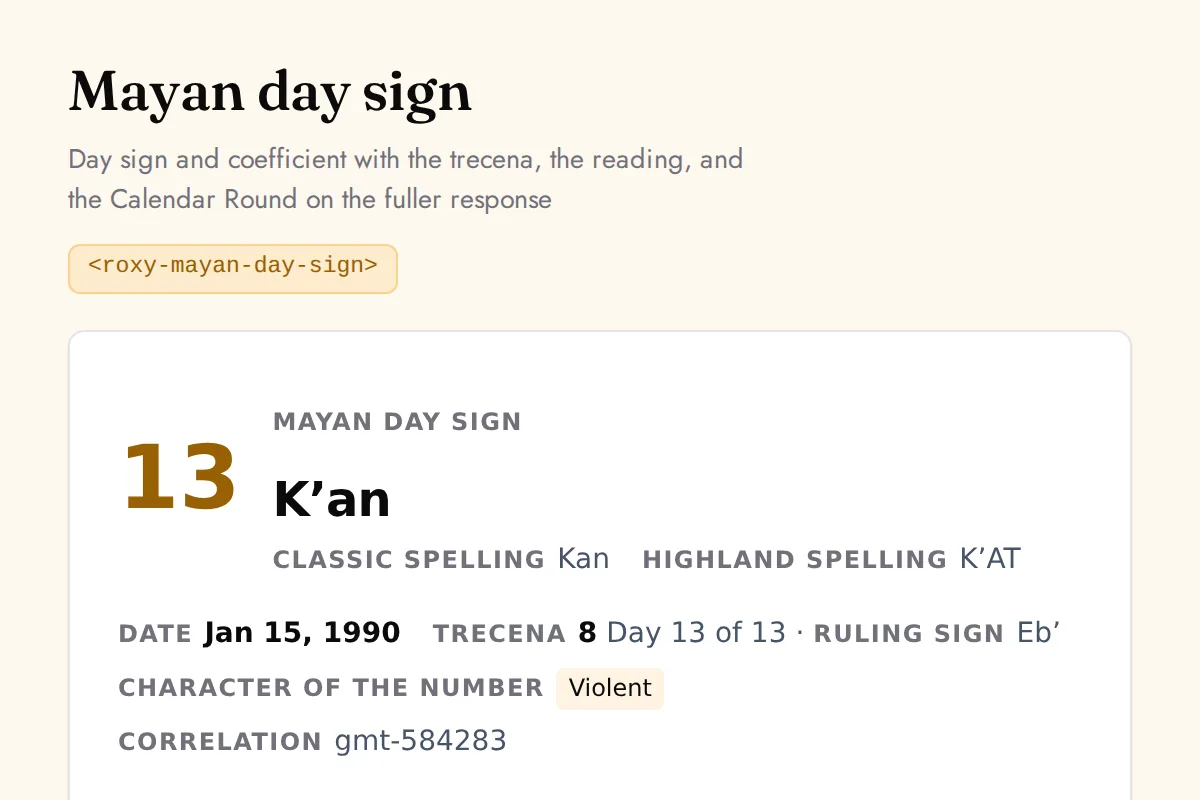

A Mayan Tzolkin day sign that tells you which correlation it came from.
Tzolkin · Mayan Astrology · Long Count Calendar · Mayan Calendar · Nahual Compatibility · Aztec Calendar · Haab Calendar
Included with every plan (at no extra cost)
Day sign, coefficient and trecena for any date
Yucatec, colonial and Kʼicheʼ sign names
Nawal profiles with world direction and colour
Trecena profiles with their ruling sign
Haab date and Calendar Round
Lord of the Night
Year Bearer by classic, Campeche or colonial school
Five-point Cruz Maya around the birth nawal
Long Count to date and date to Long Count
Julian Day Number and elapsed day count
GMT and the alternative correlation constants
Proleptic Gregorian dates with a pre-reform flag
Nawal compatibility for two birth dates
Shared sign, trecena, number and direction ties
Partner on an arm of the Cruz Maya
Madrid Codex or Landa direction scheme
Tzolkin and Aztec day sign of the day
Monthly Tzolkin, Haab and Long Count grid
Haab period profiles in both spellings
Tonalpohualli day sign, coefficient and trecena
Nahuatl sign names with their meaning
Aztec trecena profiles
World direction of every day sign
Calculate Mayan astrology day signs, the Tzolkin sacred round, the Haab year, the full Long Count and the Aztec tonalpohualli from any date: day sign and coefficient, trecena, Calendar Round, Lord of the Night, Year Bearer and the five point Cruz Maya, each with a composed reading. The correlation constant that makes two Mayan calculators disagree is a typed parameter, and every response echoes the conventions it was computed under, so a saved chart stays reproducible. Both naming traditions ship on every sign, the Yucatec spelling and the Kʼicheʼ name daykeepers actually use, and readings come back in every language the API ships. One key covers every RoxyAPI domain, with Remote MCP and typed SDKs.
Every Mesoamerican Astrology calculation is covered by 13,405 automated tests per deploy, 3,620 of them gold-standard tests locked to the named references on our methodology page. See how we test.
Interpretations in English, Deutsch, Español, Français, हिन्दी, Português, Русский, Türkçe, one query parameter away.
Typed SDKs for TypeScript, Python, PHP, C#, and Go, generated from the live spec, each with an AGENTS.md so your coding assistant calls the Mesoamerican Astrology API correctly.
A Remote MCP server exposes every endpoint as a tool for Claude, ChatGPT, Cursor and any MCP client, with no local install. Opt-in compact responses cut the tokens your agent reads by roughly 40 to 52 percent, and one call stays one request.
Paste a widget into any site builder, install the WordPress plugin, or start from an MIT template you can white-label. Results render from the Mesoamerican Astrology API with no backend.
The depth behind every line above, written out in full.
Want to try without writing code? Try this domain live in API playground →
npm install @roxyapi/sdkimport { createRoxy } from '@roxyapi/sdk'
const roxy = createRoxy(process.env.ROXY_API_KEY!)
const { data } = await roxy.mesoamericanAstrology.get(/* ... */)pip install roxy-sdkfrom roxy_sdk import create_roxy
roxy = create_roxy("your-api-key")
result = roxy.mesoamerican_astrology.get(...) # async: await roxy.mesoamerican_astrology.get_async(...)composer require roxyapi/sdkuse function RoxyAPI\Sdk\createRoxy;
$roxy = createRoxy(getenv('ROXY_API_KEY'));
$result = $roxy->mesoamericanAstrology->get(/* ... */);dotnet add package RoxyApi.Sdkusing RoxyApi;
var roxy = new RoxyClient(Environment.GetEnvironmentVariable("ROXY_API_KEY")!);
// await roxy.MesoamericanAstrology.<resource>.GetAsync() or .PostAsync(new() { ... })go get github.com/RoxyAPI/sdk-goimport roxyapi "github.com/RoxyAPI/sdk-go"
roxy, _ := roxyapi.NewRoxy(os.Getenv("ROXY_API_KEY"))
// resp, err := roxy.MesoamericanAstrology.<Method>(context.Background(), nil)claude mcp add --transport http \
roxy-mesoamerican-astrology https://roxyapi.com/mcp/mesoamerican-astrology \
--header "X-API-Key: YOUR_KEY"AI agents auto-discover all endpoints as callable tools. Zero configuration. Responses can come back token-optimized and lossless, cutting the tokens your agent spends per call by roughly 40 to 52 percent.
Full MCP setup guidecurl -H "X-API-Key: YOUR_KEY" \
https://roxyapi.com/api/v2/mesoamerican-astrology/Want to ship faster? Clone a free template and white-label it as your own app.
Building with Cursor, Claude Code, or Bolt? Use our AI prompts to generate a complete app.
Building on WordPress? Install the RoxyAPI plugin and drop a shortcode, no code required.
{
  "date": "2012-12-21",
  "tzolkin": {
    "daySign": "ajaw",
    "daySignName": "Ajaw",
    "daySignClassic": "Ahau",
    "daySignKiche": "AJPUʼ",
    "number": 4,
    "trecena": {
      "number": 13,
      "dayOfTrecena": 4,
      "rulingSign": "kaban",
      "rulingSignName": "Kabʼan"
    },
    "reading": {
      "keynote": "The nawal Ajaw, called AJPUʼ in the highland daykeeping tradition, is the sun at its height, the completed day and the authority that comes with finishing. The sign itself is read as lord, ruler, sun.",
      "numberReading": "The coefficient 4 has no character recorded for it in the sources this API is built on, so no reading is offered for the number alone. The sign carries the day.",
      "strengths": [
        "Finishes what was started and lets the result be seen",
        "Warms a whole room rather than one corner of it"
      ],
      "challenges": [
        "Needs the light on it and dims when the light moves",
        "Treats a finished thing as final and stops asking about it"
      ],
      "guidance": "Give the credit away once today. A sun that shines only on itself lights nothing."
    }
  },
  "haab": {
    "month": "kankin",
    "monthName": "Kʼankʼin",
    "monthClassic": "Kankin",
    "day": 3,
    "dayOfYear": 263,
    "reading": "The Haab date is 3 Kʼankʼin, inside a period read this way: The yellow sun, ripening light, where the year turns toward its harvest."
  },
  "longCount": {
    "formatted": "13.0.0.0.0",
    "baktun": 13,
    "katun": 0,
    "tun": 0,
    "winal": 0,
    "kin": 0,
    "daysSinceEpoch": 1872000,
    "julianDayNumber": 2456283
  },
  "calendarRound": "4 Ajaw 3 Kʼankʼin",
  "lordOfNight": {
    "label": "G9",
    "reading": "The night belongs to G9 of the nine, a cycle that turns one step every day and closes every nine. The Maya names for the nine were never recorded, so the cycle is published by its glyph labels alone."
  },
  "yearBearer": {
    "daySign": "kaban",
    "daySignName": "Kabʼan",
    "number": 1,
    "reading": "The Haab year is carried by 1 Kabʼan, read at the seating of Pop. This is the Classic set, and it is the one highland daykeepers still run today."
  },
  "cross": [
    {
      "position": "center",
      "offsetDays": 0,
      "daySign": "ajaw",
      "daySignName": "Ajaw",
      "daySignKiche": "AJPUʼ",
      "number": 4,
      "reading": "The centre of the cross is the birth nawal itself, 4 Ajaw, and every arm is read against it."
    },
    {
      "position": "conception",
      "offsetDays": -8,
      "daySign": "eb",
      "daySignName": "Ebʼ",
      "daySignKiche": "E",
      "number": 9,
      "reading": "The conception arm, eight days before the birth day, is 9 Ebʼ. It is read as the root the life is drawn from."
    },
    {
      "position": "destiny",
      "offsetDays": 8,
      "daySign": "lamat",
      "daySignName": "Lamat",
      "daySignKiche": "QʼANIL",
      "number": 12,
      "reading": "The destiny arm, eight days after the birth day, is 12 Lamat. It is read as later life and as what is left behind."
    },
    {
      "position": "left",
      "offsetDays": 6,
      "daySign": "kimi",
      "daySignName": "Kimi",
      "daySignKiche": "KAME",
      "number": 10,
      "reading": "The left arm, six days after the birth day, is 10 Kimi. It is read as one of the two sides the life is balanced between."
    },
    {
      "position": "right",
      "offsetDays": -6,
      "daySign": "ix",
      "daySignName": "Ix",
      "daySignKiche": "IʼX",
      "number": 11,
      "reading": "The right arm, six days before the birth day, is 11 Ix. It is read as the other of the two sides."
    }
  ],
  "summary": "This day is 4 Ajaw 3 Kʼankʼin, Long Count 13.0.0.0.0. The nawal is Ajaw, the sun at its height, the completed day and the authority that comes with finishing, carried on the coefficient 4.",
  "conventions": {
    "correlation": "gmt-584283",
    "yearBearerSystem": "classic"
  }
}
Structured JSON with documented fields. Not hallucinated text. See all endpoints
Render Mesoamerican Astrology API responses without building charts yourself. Install the npm package and drop these into Next.js, React, Vue, Svelte, Angular, or plain HTML, or embed the very same component on Squarespace, Wix, or WordPress by pasting one snippet, with no backend and no build step. They belong to one library that covers the entire spiritual stack rather than astrology alone, MIT licensed and included in every plan at no extra cost, never a separate product and never an upsell. The Mesoamerican Astrology API calculations, the interface that renders them, and the Remote MCP your agent calls, all behind one key, end to end.
| Element | Renders |
|---|---|
<roxy-mayan-day-sign> | Day sign and coefficient with the trecena, the reading, and the Calendar Round on the fuller response |
Clone. Edit. Ship. Free and open source by Team Roxy.
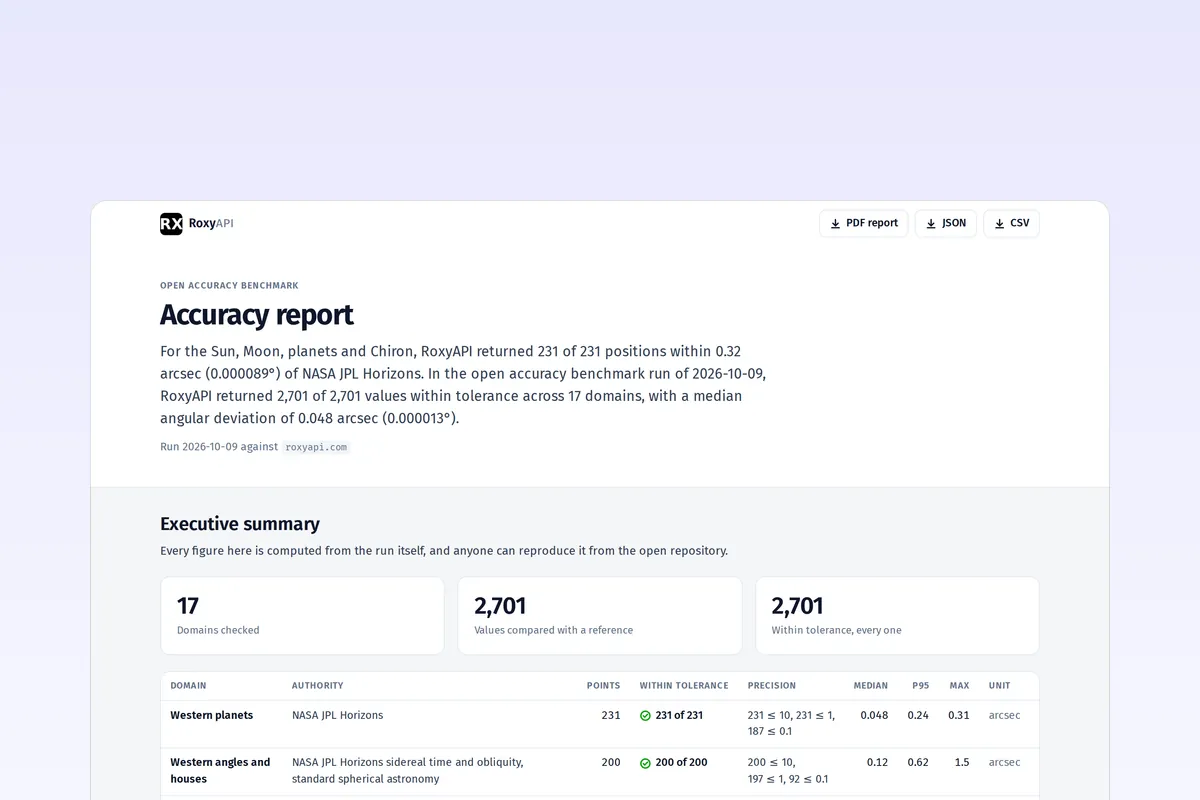
Independent proof, domain by domain. Every reference value cited, rerun monthly.
Browse all template or use AI prompts to generate a custom app.
The products teams ship on the Mesoamerican Astrology API.
Real calls against the production API, no account needed. Every endpoint sits in the public OpenAPI spec and is callable as an MCP tool; open one for its parameters and response examples.
Mayan astrology day sign calculator: returns the Tzolkin day sign, the coefficient 1 to 13 and the trecena for any Gregorian date, under the correlation living daykeepers use, with a composed nawal reading. Built for Mayan zodiac apps, daily energy feeds and AI agents answering what is my Mayan sign. Classical Maya count only, with the correlation echoed on every response so a saved reading stays reproducible.
Mayan astrology birth chart from one date: the Tzolkin day sign and coefficient, the Haab date, the full Long Count with its day count, the Calendar Round, the Lord of the Night, the Year Bearer of the Haab year and the five point Cruz Maya, each with composed readings. Built for nawal readings, birth chart features and multi domain spiritual apps that show a Mayan card beside a natal chart. Every school split in the domain is a typed parameter and comes back echoed, so the chart can be reproduced exactly.
Maya Long Count converter that runs both ways: give it a Gregorian date and it returns the Long Count, give it a dotted Long Count and it returns the date. Every answer carries the Julian Day Number, the elapsed day count and the Calendar Round, and the correlation constant is a typed parameter so a value can be matched against any published inscription reading. Built for epigraphy tools, museum and education apps, and anything that has to place a Maya date on a civil calendar.
Mayan energy of the day: the Tzolkin day sign, its coefficient and its trecena for today or for any date you name, with a composed reading. Content is fixed for a given date and rolls over at midnight UTC, so a daily feed can cache it safely and an editorial calendar can be filled weeks ahead. Built for daily energy widgets, nawal of the day feeds and chatbot answers about what today carries.
Mayan calendar grid for a whole civil month: every day of the month with its Tzolkin day sign and coefficient, its trecena, its Haab date and its Long Count. One call fills a monthly grid that would otherwise take a request per day, and the answer is fixed for any month that has already begun. Built for calendar widgets, editorial planners and any app that shows a month of Maya dates at once.
Mayan compatibility between two birth dates, published as its parts rather than as a verdict: both nawals with their coefficients and trecenas, the five structural ties the pair either has or does not, the weight each tie carries, and a composite score built from them. Built for matchmaking features, relationship reports and compatibility widgets that need to show their working. The scoring weights are stated on every response so a caller can re-derive the number or replace it.
Retrieve all twenty Tzolkin day signs in sequence order from Imix to Ajaw. Each entry returns the machine id, the name in the standard orthography, the sixteenth century spelling and the Kʼicheʼ name from the living daykeeping tradition, both published glosses, and the world direction and colour under the requested scheme. Built for nawal pickers, sign reference pages and any app that needs the whole set in one call.
Retrieve the full profile of one Tzolkin day sign: both naming traditions, both published glosses, the world direction and colour under the requested scheme, a composed keynote, what the sign does well, where the same temperament costs it something, and one line of guidance. Built for nawal detail pages, sign cards and chatbot answers about a single Mayan sign.
Retrieve all twenty trecenas, the thirteen day periods the 260 day Tzolkin divides into. Each entry returns the period number, the day sign it opens on in both naming traditions, and a composed reading of what the period carries. Built for calendar apps, energy period trackers and content planners that work in thirteen day blocks rather than in weeks.
Retrieve one of the twenty trecenas by number, with the day sign it opens on in both naming traditions and a composed reading of the period. Built for period detail pages and for apps that show which thirteen day block a date falls in.
Retrieve all nineteen periods of the Haab, the 365 day Maya year: eighteen months of twenty days plus the five days of Wayebʼ. Each entry returns the machine id, both spellings of the name, the length, what the name means and a composed reading. Built for calendar reference pages and for any app that has to label a Haab date rather than only compute it.
Retrieve one of the nineteen Haab periods by id, with both spellings of its name, its position in the year, its length and a composed reading. Built for calendar detail pages and for labelling a Haab date a chart route has already returned.
Aztec calendar day sign calculator: returns the tonalpohualli day sign, its coefficient 1 to 13 and its trecena for any Gregorian date, with a composed reading. The count is anchored on the recorded day of the fall of Tenochtitlan and runs in step with the Maya count under the default constant, verified on the anchor and on two modern dates. Built for Aztec calendar apps, Mexica day sign features and AI agents answering what is my Aztec sign.
Aztec energy of the day: the tonalpohualli day sign, its coefficient and its trecena for today or for any date you name, with a composed reading. Content is fixed for a given date and rolls over at midnight UTC, so a daily feed can cache it safely and an editorial calendar can be filled weeks ahead. Built for daily energy widgets, Mexica day sign feeds and chatbot answers about what today carries.
Retrieve all twenty tonalpohualli day signs in sequence order from Cipactli to Xochitl. Each entry returns the machine id, the Nahuatl name, what it means, the world direction it belongs to and a composed reading. Built for Aztec sign pickers, Mexica calendar reference pages and any app that needs the whole set in one call.
Retrieve the full profile of one tonalpohualli day sign: the Nahuatl name, what it means, the world direction it belongs to, a composed keynote and one line of guidance. Built for Aztec sign detail pages, day sign cards and chatbot answers about a single Mexica sign.
Retrieve all twenty trecenas, the thirteen day periods the 260 day tonalpohualli divides into. Each entry returns the period number, the day sign it opens on and a composed reading of what the period carries. Built for Aztec calendar apps, energy period trackers and content planners that work in thirteen day blocks.
Retrieve one of the twenty tonalpohualli trecenas by number, with the day sign it opens on and a composed reading of the period. Built for period detail pages and for apps that show which thirteen day block a date falls in.
The receipts are public: the testing methodology, the open MIT benchmark, the transparency report, and the live API playground. Let ChatGPT, Perplexity, or Claude search the web and tell you what they find about RoxyAPI accuracy, MCP, SDKs, and pricing.
Opens a live web search in a new tab.
Your AI agent
your model, your voice
Remote MCP
auto-discovered, no local setup
Token-optimizedRoxy Ephemeris
13,405 tests, 3620 gold standard
Verified result
18 domains, one flat rate
Your agent uses calculated charts and readings in its replies, with your model and your own voice. Planetary positions are verified against NASA JPL Horizons. No local setup, no AGPL, no hosted-AI markup.
Audit it yourself: every Mesoamerican Astrology endpoint runs live in the API playground
Send a birth date to the Tzolkin endpoint and the day sign comes back with its coefficient, its trecena and a composed nawal reading, in one response. The sign arrives in three namings at once: the standard Yucatec spelling, the sixteenth century form older books print, and the Kʼicheʼ name highland daykeepers use, so you can label it the way your audience expects. Typed SDKs and a Remote MCP server are available on the same key, along with every other RoxyAPI domain.
Usually one of two reasons, and both are stated on every response here. The first is the correlation constant, the number that ties the day count to a civil date: several are published, they sit a few days apart, and a calculator that does not say which it used cannot be checked. The second is that some popular tools run the modern Dreamspell or thirteen moon count, which freezes its count on 29 February and has therefore drifted away from the classical day count by a different amount at every date. This API runs the classical count only and names the constant it used.
Use the default unless you have a reason not to. It is the commonly accepted constant, the one the major institutional converter runs on, and the one a highland daykeeper count agrees with. The three alternatives are offered because published inscription readings sometimes use them and a researcher needs to reproduce a printed value; each shifts the Long Count by exactly its difference in days from the default, which makes a disagreement easy to diagnose rather than mysterious.
They are two 260 day counts with the same structure, thirteen coefficients running against twenty day signs, under different names and different anchors. The Maya family returns the Tzolkin plus the Haab year, the Long Count and the Lord of the Night; the Aztec family returns the tonalpohualli day sign, its coefficient and its trecena. The Aztec side deliberately returns fewer fields, and every response says which ones and why: where the reference sources disagree, nothing ships rather than a guess.
The cross has five points around the birth nawal: conception eight days before the birth day, destiny eight days after, and two arms six days after and six days before. Each point returns its own day sign and coefficient with a line on what it is read as. This is a living daykeeper convention rather than an archaeological reconstruction, and the response says so on the field itself, because the academic literature describes the day count and the year bearers but not a five point cross.
Yes, and without losing accuracy, because a Mesoamerican day is a plain count of elapsed days rather than an astronomical lookup. Dates are read as proleptic Gregorian throughout, including before the 1582 reform, so a tool that switches to the Julian calendar below the reform will differ by ten or eleven days on the same input; the conversion endpoint flags any date before the reform for exactly that reason. Long Count conversion runs in both directions, so an inscription date can be placed on a civil calendar and back.
A Mayan Tzolkin day sign that tells you which correlation it came from.
All 18 domains included with every plan. Every endpoint, MCP server, SDK, and templates.
Plans from $39/mo, starting at $1.80 per domain on annual billing. No credit card required for testing.
View Pricing & Get API KeyHi, I am Rosie, your guide to the RoxyAPI insight tools.
Ask me to read your birth chart, pull a card, or map your numbers, and I will interpret what it means for you. Unlike most AIs, I never make the numbers up: every reading runs on real, verified calculations. Curious about the API, pricing, or docs instead? Ask me that too.