

AI Astrology Chatbot
Web App / Open Source30 minAI chatbot with real readings across all domains. Not hallucinations.
AstrologyVedicTarotNumerologyCrystalsDreamsI-ChingAngel Numbers
Kundli, panchang and KP charts that state the ayanamsa they used and the classical rule behind each verdict.
KundliPanchangChoghadiyaVedic HoraVimshottari DashaNakshatraMangal DoshaKaal Sarp DoshaSade SatiKundli MatchingPoruthamPapasamyamNavamsaKP AstrologyKP Ruling PlanetsKP Daily FinanceDaily GocharaMuhurtaKP HoraryDivisional ChartVedic YogaShadbalaAshtakavargaBhava BalaBhav ChalitGraha AstaArudha LagnaAtmakarakaAvasthaUpagrahaVedic TransitDrishtiSidereal EphemerisRashi and 26 more
Included with every plan (at no extra cost)
Vedic astrology (Jyotish) and KP API for kundli generation with the sixteen Shodasavarga divisional charts (D1 to D60), panchang with choghadiya, hora and the classical muhurta windows, kundli matching by Ashtakoot Gun Milan, the South Indian ten porutham with Rajju and Vedha vetoes and Papasamyam, Vimshottari Dasha predictions, dosha detection with remedies, a 301-entry planetary yoga glossary with 48 of them chart-detected and evidenced, and KP horary with 249-level sub-lord analysis. Calculations verified against NASA JPL Horizons at arc-second-level accuracy. Built for matrimonial apps, horoscope platforms, spiritual wellness services, and AI-powered astrology chatbots. One key covers every RoxyAPI domain, with Remote MCP and typed SDKs.
Every Vedic Astrology calculation is covered by 13,405 automated tests per deploy, 3,620 of them gold-standard tests locked to named external references such as NASA JPL Horizons, with a public MIT benchmark repo anyone can clone and re-run. See how we test.
Interpretations in English, Deutsch, Español, Français, हिन्दी, Português, Русский, Türkçe, one query parameter away.
Typed SDKs for TypeScript, Python, PHP, C#, and Go, generated from the live spec, each with an AGENTS.md so your coding assistant calls the Vedic Astrology API correctly.
A Remote MCP server exposes every endpoint as a tool for Claude, ChatGPT, Cursor and any MCP client, with no local install. Opt-in compact responses cut the tokens your agent reads by roughly 40 to 52 percent, and one call stays one request.
Paste a widget into any site builder, install the WordPress plugin, or start from an MIT template you can white-label. Results render from the Vedic Astrology API with no backend.
The depth behind every line above, written out in full.
Want to try without writing code? Try this domain live in API playground →
npm install @roxyapi/sdkimport { createRoxy } from '@roxyapi/sdk'
const roxy = createRoxy(process.env.ROXY_API_KEY!)
const { data } = await roxy.vedicAstrology.get(/* ... */)pip install roxy-sdkfrom roxy_sdk import create_roxy
roxy = create_roxy("your-api-key")
result = roxy.vedic_astrology.get(...) # async: await roxy.vedic_astrology.get_async(...)composer require roxyapi/sdkuse function RoxyAPI\Sdk\createRoxy;
$roxy = createRoxy(getenv('ROXY_API_KEY'));
$result = $roxy->vedicAstrology->get(/* ... */);dotnet add package RoxyApi.Sdkusing RoxyApi;
var roxy = new RoxyClient(Environment.GetEnvironmentVariable("ROXY_API_KEY")!);
// await roxy.VedicAstrology.<resource>.GetAsync() or .PostAsync(new() { ... })go get github.com/RoxyAPI/sdk-goimport roxyapi "github.com/RoxyAPI/sdk-go"
roxy, _ := roxyapi.NewRoxy(os.Getenv("ROXY_API_KEY"))
// resp, err := roxy.VedicAstrology.<Method>(context.Background(), nil)claude mcp add --transport http \
roxy-vedic-astrology https://roxyapi.com/mcp/vedic-astrology \
--header "X-API-Key: YOUR_KEY"AI agents auto-discover all endpoints as callable tools. Zero configuration. Responses can come back token-optimized and lossless, cutting the tokens your agent spends per call by roughly 40 to 52 percent.
Full MCP setup guidecurl -H "X-API-Key: YOUR_KEY" \
https://roxyapi.com/api/v2/vedic-astrology/Want to ship faster? Clone a free template and white-label it as your own app.
Building with Cursor, Claude Code, or Bolt? Use our AI prompts to generate a complete app.
Building on WordPress? Install the RoxyAPI plugin and drop a shortcode, no code required.
{
"frame": {
"ayanamsa": "lahiri",
"ayanamsaDegrees": 23.728208791839048
},
"aries": {
"rashi": "aries",
"signs": [
{
"graha": "Mars",
"nakshatra": {
"anga": "nakshatra",
"key": 1,
"ratio": 0.03861131691362409,
"abhijit": false,
"left": 12.818515774485013,
"name": "Ashwini",
"pada": 1,
"lord": "Ketu"
},
"longitude": 0.5148175588483213,
"isRetrograde": false,
"house": 9,
"awastha": "Bala",
"jagradadi": "Jagrat",
"deeptadi": "Svastha"
}
]
},
"taurus": {
"rashi": "taurus",
"signs": [
{
"graha": "Venus",
"nakshatra": {
"anga": "nakshatra",
"key": 4,
"ratio": 0.5382611176220545,
"abhijit": false,
"left": 6.1565184317059405,
"name": "Rohini",
"pada": 3,
"lord": "Moon"
},
"longitude": 47.176814901627395,
"isRetrograde": false,
"house": 10,
"awastha": "Yuva",
"jagradadi": "Jagrat",
"deeptadi": "Svastha"
}
]
},
"gemini": {
"rashi": "gemini",
"signs": [
{
"graha": "Sun",
"nakshatra": {
"anga": "nakshatra",
"key": 6,
"ratio": 0.8680896274786136,
"abhijit": false,
"left": 1.7588049669518178,
"name": "Ardra",
"pada": 4,
"lord": "Rahu"
},
"longitude": 78.24119503304819,
"isRetrograde": false,
"house": 11,
"awastha": "Vriddha",
"jagradadi": "Swapna",
"deeptadi": "Duhkhita"
},
{
"graha": "Mercury",
"nakshatra": {
"anga": "nakshatra",
"key": 7,
"ratio": 0.002438114262190627,
"abhijit": false,
"left": 13.300825143170792,
"name": "Punarvasu",
"pada": 1,
"lord": "Jupiter"
},
"longitude": 80.03250819016255,
"isRetrograde": false,
"house": 11,
"awastha": "Vriddha",
"jagradadi": "Jagrat",
"deeptadi": "Kopa"
},
{
"graha": "Jupiter",
"nakshatra": {
"anga": "nakshatra",
"key": 7,
"ratio": 0.471566817146049,
"abhijit": false,
"left": 7.045775771386014,
"name": "Punarvasu",
"pada": 2,
"lord": "Jupiter"
},
"longitude": 86.28755756194732,
"isRetrograde": false,
"house": 11,
"awastha": "Mrita",
"jagradadi": "Sushupti",
"deeptadi": "Kopa"
}
]
},
"cancer": {
"rashi": "cancer",
"signs": [
{
"graha": "Ketu",
"nakshatra": {
"anga": "nakshatra",
"key": 8,
"ratio": 0.8734890910423172,
"abhijit": false,
"left": 1.6868121194357713,
"name": "Pushya",
"pada": 4,
"lord": "Saturn"
},
"longitude": 104.9798545472309,
"isRetrograde": true,
"house": 12,
"awastha": "Yuva"
}
]
},
"leo": {
"rashi": "leo",
"signs": []
},
"virgo": {
"rashi": "virgo",
"signs": []
},
"libra": {
"rashi": "libra",
"signs": []
},
"scorpio": {
"rashi": "scorpio",
"signs": [
{
"graha": "Moon",
"nakshatra": {
"anga": "nakshatra",
"key": 17,
"ratio": 0.15018455945281275,
"abhijit": false,
"left": 11.330872540629164,
"name": "Anuradha",
"pada": 1,
"lord": "Saturn"
},
"longitude": 215.3357941260375,
"isRetrograde": false,
"house": 4,
"awastha": "Mrita",
"jagradadi": "Sushupti",
"deeptadi": "Duhkhita"
}
]
},
"sagittarius": {
"rashi": "sagittarius",
"signs": [
{
"graha": "Saturn",
"nakshatra": {
"anga": "nakshatra",
"key": 21,
"ratio": 0.17985597205895854,
"abhijit": false,
"left": 10.935253705880553,
"name": "Uttara Ashadha",
"pada": 1,
"lord": "Sun"
},
"longitude": 269.06474629411946,
"isRetrograde": true,
"house": 5,
"awastha": "Mrita",
"jagradadi": "Swapna",
"deeptadi": "Duhkhita"
}
]
},
"capricorn": {
"rashi": "capricorn",
"signs": [
{
"graha": "Rahu",
"nakshatra": {
"anga": "nakshatra",
"key": 22,
"ratio": 0.3734890910423166,
"abhijit": false,
"left": 8.353478786102446,
"name": "Shravana",
"pada": 2,
"lord": "Moon"
},
"longitude": 284.9798545472309,
"isRetrograde": true,
"house": 6,
"awastha": "Yuva"
}
]
},
"aquarius": {
"rashi": "aquarius",
"signs": []
},
"pisces": {
"rashi": "pisces",
"signs": []
},
"meta": {
"Sun": {
"graha": "Sun",
"rashi": "Gemini",
"longitude": 78.24119503304819,
"latitude": -0.0001328385398282796,
"nakshatra": {
"anga": "nakshatra",
"key": 6,
"ratio": 0.8680896274786136,
"abhijit": false,
"left": 1.7588049669518178,
"name": "Ardra",
"pada": 4,
"lord": "Rahu"
},
"isRetrograde": false,
"house": 11,
"awastha": "Vriddha",
"jagradadi": "Swapna",
"deeptadi": "Duhkhita",
"avasthaInfo": {
"awastha": {
"meaning": "Elder",
"interpretation": "Past its prime, the graha delivers only a negligible share of what it promises."
},
"jagradadi": {
"meaning": "Dreaming",
"interpretation": "In a friendly or neutral sign the graha acts as though half asleep, and its results arrive in moderate measure."
},
"deeptadi": {
"meaning": "Sorrowful",
"interpretation": "In an enemy sign the graha is obstructed at every turn, bringing conflict, dependence on others, and want."
}
}
},
"Moon": {
"graha": "Moon",
"rashi": "Scorpio",
"longitude": 215.3357941260375,
"latitude": -4.85528448436199,
"nakshatra": {
"anga": "nakshatra",
"key": 17,
"ratio": 0.15018455945281275,
"abhijit": false,
"left": 11.330872540629164,
"name": "Anuradha",
"pada": 1,
"lord": "Saturn"
},
"isRetrograde": false,
"house": 4,
"awastha": "Mrita",
"jagradadi": "Sushupti",
"deeptadi": "Duhkhita",
"avasthaInfo": {
"awastha": {
"meaning": "Spent",
"interpretation": "At the far edge of the sign the graha is spent, and the results it signifies do not materialise."
},
"jagradadi": {
"meaning": "Sleeping",
"interpretation": "In an enemy sign or debilitation the graha is asleep, and what it signifies fails to reach the native."
},
"deeptadi": {
"meaning": "Sorrowful",
"interpretation": "In an enemy sign the graha is obstructed at every turn, bringing conflict, dependence on others, and want."
}
}
},
"Mars": {
"graha": "Mars",
"rashi": "Aries",
"longitude": 0.5148175588483213,
"latitude": -2.057998697195424,
"nakshatra": {
"anga": "nakshatra",
"key": 1,
"ratio": 0.03861131691362409,
"abhijit": false,
"left": 12.818515774485013,
"name": "Ashwini",
"pada": 1,
"lord": "Ketu"
},
"isRetrograde": false,
"house": 9,
"awastha": "Bala",
"jagradadi": "Jagrat",
"deeptadi": "Svastha",
"avasthaInfo": {
"awastha": {
"meaning": "Infant",
"interpretation": "Newly entered on its sign, the graha is still gathering force and delivers about a quarter of what it promises."
},
"jagradadi": {
"meaning": "Awake",
"interpretation": "In its own sign or exaltation the graha is fully alert and gives its results without hindrance."
},
"deeptadi": {
"meaning": "At home",
"interpretation": "In its own sign the graha is healthy and settled, granting property, standing among its own people, and steady means."
}
}
},
"Mercury": {
"graha": "Mercury",
"rashi": "Gemini",
"longitude": 80.03250819016255,
"latitude": 1.460070348638619,
"nakshatra": {
"anga": "nakshatra",
"key": 7,
"ratio": 0.002438114262190627,
"abhijit": false,
"left": 13.300825143170792,
"name": "Punarvasu",
"pada": 1,
"lord": "Jupiter"
},
"isRetrograde": false,
"house": 11,
"awastha": "Vriddha",
"jagradadi": "Jagrat",
"deeptadi": "Kopa",
"avasthaInfo": {
"awastha": {
"meaning": "Elder",
"interpretation": "Past its prime, the graha delivers only a negligible share of what it promises."
},
"jagradadi": {
"meaning": "Awake",
"interpretation": "In its own sign or exaltation the graha is fully alert and gives its results without hindrance."
},
"deeptadi": {
"meaning": "Enraged",
"interpretation": "Eclipsed by the Sun the graha loses its light, and the matters it governs are scattered, contested or simply lost."
}
}
},
"Jupiter": {
"graha": "Jupiter",
"rashi": "Gemini",
"longitude": 86.28755756194732,
"latitude": 0.21241046115946105,
"nakshatra": {
"anga": "nakshatra",
"key": 7,
"ratio": 0.471566817146049,
"abhijit": false,
"left": 7.045775771386014,
"name": "Punarvasu",
"pada": 2,
"lord": "Jupiter"
},
"isRetrograde": false,
"house": 11,
"awastha": "Mrita",
"jagradadi": "Sushupti",
"deeptadi": "Kopa",
"avasthaInfo": {
"awastha": {
"meaning": "Spent",
"interpretation": "At the far edge of the sign the graha is spent, and the results it signifies do not materialise."
},
"jagradadi": {
"meaning": "Sleeping",
"interpretation": "In an enemy sign or debilitation the graha is asleep, and what it signifies fails to reach the native."
},
"deeptadi": {
"meaning": "Enraged",
"interpretation": "Eclipsed by the Sun the graha loses its light, and the matters it governs are scattered, contested or simply lost."
}
}
},
"Venus": {
"graha": "Venus",
"rashi": "Taurus",
"longitude": 47.176814901627395,
"latitude": -1.4176921333049444,
"nakshatra": {
"anga": "nakshatra",
"key": 4,
"ratio": 0.5382611176220545,
"abhijit": false,
"left": 6.1565184317059405,
"name": "Rohini",
"pada": 3,
"lord": "Moon"
},
"isRetrograde": false,
"house": 10,
"awastha": "Yuva",
"jagradadi": "Jagrat",
"deeptadi": "Svastha",
"avasthaInfo": {
"awastha": {
"meaning": "Adult",
"interpretation": "At its prime in the middle of the sign, the graha delivers its promise in full and acts most reliably."
},
"jagradadi": {
"meaning": "Awake",
"interpretation": "In its own sign or exaltation the graha is fully alert and gives its results without hindrance."
},
"deeptadi": {
"meaning": "At home",
"interpretation": "In its own sign the graha is healthy and settled, granting property, standing among its own people, and steady means."
}
}
},
"Saturn": {
"graha": "Saturn",
"rashi": "Sagittarius",
"longitude": 269.06474629411946,
"latitude": 0.09065030559754866,
"nakshatra": {
"anga": "nakshatra",
"key": 21,
"ratio": 0.17985597205895854,
"abhijit": false,
"left": 10.935253705880553,
"name": "Uttara Ashadha",
"pada": 1,
"lord": "Sun"
},
"isRetrograde": true,
"house": 5,
"awastha": "Mrita",
"jagradadi": "Swapna",
"deeptadi": "Duhkhita",
"avasthaInfo": {
"awastha": {
"meaning": "Spent",
"interpretation": "At the far edge of the sign the graha is spent, and the results it signifies do not materialise."
},
"jagradadi": {
"meaning": "Dreaming",
"interpretation": "In a friendly or neutral sign the graha acts as though half asleep, and its results arrive in moderate measure."
},
"deeptadi": {
"meaning": "Sorrowful",
"interpretation": "In an enemy sign the graha is obstructed at every turn, bringing conflict, dependence on others, and want."
}
}
},
"Rahu": {
"graha": "Rahu",
"rashi": "Capricorn",
"longitude": 284.9798545472309,
"latitude": 0,
"nakshatra": {
"anga": "nakshatra",
"key": 22,
"ratio": 0.3734890910423166,
"abhijit": false,
"left": 8.353478786102446,
"name": "Shravana",
"pada": 2,
"lord": "Moon"
},
"isRetrograde": true,
"house": 6,
"awastha": "Yuva",
"avasthaInfo": {
"awastha": {
"meaning": "Adult",
"interpretation": "At its prime in the middle of the sign, the graha delivers its promise in full and acts most reliably."
}
}
},
"Ketu": {
"graha": "Ketu",
"rashi": "Cancer",
"longitude": 104.9798545472309,
"latitude": 0,
"nakshatra": {
"anga": "nakshatra",
"key": 8,
"ratio": 0.8734890910423172,
"abhijit": false,
"left": 1.6868121194357713,
"name": "Pushya",
"pada": 4,
"lord": "Saturn"
},
"isRetrograde": true,
"house": 12,
"awastha": "Yuva",
"avasthaInfo": {
"awastha": {
"meaning": "Adult",
"interpretation": "At its prime in the middle of the sign, the graha delivers its promise in full and acts most reliably."
}
}
},
"Lagna": {
"graha": "Lagna",
"rashi": "Leo",
"longitude": 138.37874958931044,
"nakshatra": {
"anga": "nakshatra",
"key": 11,
"ratio": 0.3784062191982829,
"abhijit": false,
"left": 8.287917077356228,
"name": "Purva Phalguni",
"pada": 2,
"lord": "Venus"
},
"isRetrograde": false,
"house": 1,
"awastha": "Vriddha",
"avasthaInfo": {
"awastha": {
"meaning": "Elder",
"interpretation": "Past its prime, the graha delivers only a negligible share of what it promises."
}
}
}
},
"modernPlanets": [
{
"planet": "Uranus",
"sanskritName": "Arun",
"longitude": 253.68632421127586,
"rashi": "Sagittarius",
"degreeInRashi": 13.68632421127586,
"nakshatra": {
"anga": "nakshatra",
"key": 20,
"ratio": 0.026474315845688642,
"abhijit": false,
"left": 12.980342455390819,
"name": "Purva Ashadha",
"pada": 1,
"lord": "Venus"
},
"isRetrograde": true
},
{
"planet": "Neptune",
"sanskritName": "Varun",
"longitude": 259.4969359516857,
"rashi": "Sagittarius",
"degreeInRashi": 19.496935951685714,
"nakshatra": {
"anga": "nakshatra",
"key": 20,
"ratio": 0.4622701963764277,
"abhijit": false,
"left": 7.169730714980965,
"name": "Purva Ashadha",
"pada": 2,
"lord": "Venus"
},
"isRetrograde": true
},
{
"planet": "Pluto",
"sanskritName": "Yam",
"longitude": 201.37138569088694,
"rashi": "Libra",
"degreeInRashi": 21.37138569088694,
"nakshatra": {
"anga": "nakshatra",
"key": 16,
"ratio": 0.10285392681651974,
"abhijit": false,
"left": 11.961947642446404,
"name": "Vishakha",
"pada": 1,
"lord": "Jupiter"
},
"isRetrograde": true
}
],
"houses": [
{
"number": 1,
"name": "Lagna",
"description": "The lagna, or ascendant, is the single most important indicator in Vedic astrology of the charts potential. The Lagna, which is the first house, represents the self, body and personality. We find important clues about a person by examining both the sign that the first house is placed in and the planet that rules the sign. The planet that rules the first house, often referred to as the Lagna Lord, is of paramount importance. A strong Lagna Lord is essential in fulfilling the potential in a chart. A strong Lagna and Lagna Lord can also help us deal with potential difficulties existing in a chart.",
"themes": [
"self",
"body",
"health",
"personality",
"vitality"
]
},
{
"number": 2,
"name": "Dhana Bhava",
"description": "Dhana means wealth and the second house represents acquisition and finances. This house can reveal inheritance and acquisition of metals, and gems. The second house also indicates our values; both material and spiritual. Dhana Bhava also shows family relationships and our extended family. The second house reveals past life connections, particularly within the family. The second house also rules the face, including the chin, mouth, teeth and tongue. It governs what goes into the mouth which means it rules over the quality of the food we eat. The second house also rules what comes out of the mouth, which means it governs our speech and can indicate whether or not we are truthful. Eyesight and vision also belongs to Dhana Bhava.",
"themes": [
"wealth",
"family",
"speech",
"possessions",
"food"
]
},
{
"number": 3,
"name": "Bhatru Bhava",
"description": "The third house shows individual self expression and the effort we put out to accomplish things. This house can reveal talents in writing, music, acting and painting - any form of creative expression. The third house also reveals our courage, hobbies and passions. This is a house of communication and also governs short journeys. Research, lecturing and sales fall under the third house's domain. The third house also represents our brothers and sisters and our relationship with them. It governs our immediate environment as well as our friends, colleagues and neighbors.",
"themes": [
"siblings",
"courage",
"communication",
"short travel",
"skills"
]
},
{
"number": 4,
"name": "Matri Bhava",
"description": "The fourth house represents our home and can reveal our state of mind and inner feelings. Matri means mother, and this house expresses our relationship to the mother. Our sense of being nurtured and supported is also seen here. Benefic planets, such as the Moon or Venus, can indicate contentment and happiness when placed in the fourth house. The fourth house governs education. This house also shows our fixed assets; such as vehicles, houses and real estate. This a moksha house and an interest in self-realization and spiritual enlightenment can be expressed through this house.",
"themes": [
"home",
"mother",
"property",
"vehicles",
"domestic happiness"
]
},
{
"number": 5,
"name": "Putra Bhava",
"description": "The fifth house is a house of creativity and governs education, entertainment and artistic talent. Physically, the creative energy of this house can manifest as our children. Putra means son in Sanskrit, even though in this case it indicates children as a whole. The creative energy of the fifth house gives birth to new ideas, and the \"children\" revealed can also manifest as creative endeavors. The creative mind is intuitive and can sometimes perceive the future. The fifth house is a house of \"purva punya\", which translates as past good deeds. This is an auspicious house and can give good fortune and luck due to previous good karma. The fifth house is a house of dharma. This house governs spiritual tools and techniques for achieving greater awareness, including the use of mantra, meditation and the reading of spiritual texts.",
"themes": [
"children",
"romance",
"creativity",
"education",
"speculation"
]
},
{
"number": 6,
"name": "Ari Bhava",
"description": "The sixth house is a house of karmic difficulties. This house shows blocks and struggles that come in our way and prevent us from moving towards our true goals. These blocks can come in the form of illness, accidents, enemies, competitors or debts. Positive manifestations of the sixth house can be expressed through the service we give to others. Health and healing also belong to the sixth house. When malefic planets are placed in the sixth house they provide the ability to fight back and overcome problems.",
"themes": [
"enemies",
"disease",
"debts",
"service",
"competition"
]
},
{
"number": 7,
"name": "Jaya Bhava",
"description": "Jaya means victory, it also means wife. Opposite the first house, representing the self, is the seventh house which represents others. This is the house of partnership. It is a house of passion, desires and attachments. It rules over married life, as well as divorce. The seventh house governs contacts and agreements. Therefore this is also a house of business and business partners. A career seen in the seventh house can involve marriage counseling or public relations. Since it represents \"the other\" it also rules over foreigners and foreign travel.",
"themes": [
"marriage",
"partner",
"business partnership",
"contracts",
"public dealings"
]
},
{
"number": 8,
"name": "Ayu Bhava",
"description": "The eighth house is a house of transformation and change. Ayu means life span and this house can reveal our longevity. It governs hidden matters and that which is unknown. The eighth house is secretive and private. A house of transformation, it can manifest challenges such as divorce, scandals, addictions, sorrows and long term disease. Intuition is strong in this house. The eighth house rules investigation and research. The metaphysical, the mysterious and the occult belong to the eighth house. It also rules over income from sources such as alimony, insurance benefits and inheritance.",
"themes": [
"longevity",
"inheritance",
"sudden events",
"occult",
"transformation"
]
},
{
"number": 9,
"name": "Dharma Bhava",
"description": "The ninth is the house of grace and good fortune. It is considered to be the most auspicious house and can bring sudden prosperity to a person. It is a house of good ethics and a beneficial ninth house reveals positive karma. It governs higher knowledge and dharma (right action). It represents the father. The ninth house can expand our knowledge and wisdom; through a teacher, through books, higher studies and through travel. Often it will bring a desire for philosophy and opportunities for higher knowledge. The ninth house also represents law. A well placed ninth house indicates a person that is rightly guided and receives good advice.",
"themes": [
"fortune",
"father",
"dharma",
"higher education",
"long travel"
]
},
{
"number": 10,
"name": "Karma Bhava",
"description": "The tenth house represents the action we take in this life in order to fulfill our life direction. Planets get very energized here. The Sun is very strong when placed in the tenth house and will express its natural authority and leadership. Saturn placed in the tenth house can handle responsibility and works well within an organization or structure. Some see the tenth house as the father. The tenth house can also represent government work, administration and business. This is the house where we reach the pinnacle of life, it is the culmination of life's ambition. An auspicious tenth house will give a strong career, success, honor and recognition.",
"themes": [
"career",
"profession",
"status",
"authority",
"karma"
]
},
{
"number": 11,
"name": "Labha Bhava",
"description": "The eleventh house is a house of gain and fulfillment. Labha means profit. This house not only means monetary profit but indicates spiritual profit as well. All planets do well in the eleventh house and will manifest gain according to their nature. This house indicates the result of our effort to make money. It is the fruit of our achievements and the realization of our wishes. It represents social activity, personal pleasures, older siblings, friends and allies. This house also involves networking, community, sangha, organizations and societies",
"themes": [
"gains",
"income",
"friends",
"elder siblings",
"fulfilment of desires"
]
},
{
"number": 12,
"name": "Vyaya Bhava",
"description": "Vyaya means expenditure and this house represents our expenses. The twelfth house is also a house of endings and can bring a sense of loss and sorrow. However this house is also powerful spiritually and is where we find liberation and enlightenment. In the twelfth house we give up our sense of ego in order to merge with a universal and eternal consciousness. The energy moves inward in the twelfth house, and there can be a need for seclusion, meditation and contemplation. This house represents places that are worlds unto themselves, somewhat separate from society. These can include retreats, monasteries and places where people heal themselves, such as hospitals or even prisons. Through this house we can also experience a sense of confinement, isolation and loneliness. The twelfth house can give us the urge to travel to distant locations. There is often a desire to explore the unknown and the foreign. This house governs the subtle energies we feel but do not always understand. Vyaya Bhava governs clairvoyance, healing, sleep and dreams. Intuition and imagination are strong in the twelfth house, and we often find writers, thinkers, actors and clairvoyants having planets in this house. The twelfth house can also manifest careers involving institutions, organizations, charity and healing. People with planets in the twelfth house can be empathic and they often express a great deal of compassion and generosity towards others.",
"themes": [
"losses",
"expenses",
"foreign lands",
"isolation",
"moksha"
]
}
],
"combustion": [
{
"planet": "Mercury",
"distanceFromSun": 1.79,
"orb": 14
},
{
"planet": "Jupiter",
"distanceFromSun": 8.05,
"orb": 11
}
],
"planetaryWar": [],
"interpretations": {
"Sun": {
"rashi": "Sun in Gemini (Mithun) expresses through the energy of the Twins. Compassionate, value friendship and agreements, inclined towards working in groups, liberal, possess an inclusive view of world, intelligent",
"nakshatra": "Sun in Ardra nakshatra combines planetary energy with Rudra (a fierce form of Shiva) deity influence. Ardra natives are known for their intensity and resilience. They often go through transformative life experiences that bring growth and new perspectives."
},
"Moon": {
"rashi": "Moon in Scorpio (Vrischika) expresses through the energy of the Scorpion. Knowledgeable, skilled, able to take huge challenges, good at research work, healers, love to help others",
"nakshatra": "Moon in Anuradha nakshatra combines planetary energy with Mitra (god of friendship) deity influence. Anuradha natives are disciplined, loyal, and cooperative. They have a knack for leadership and teamwork."
},
"Mars": {
"rashi": "Mars in Aries (Mesha) expresses through the energy of the Ram. Creative, idealistic in nature, headstrong, good leader, compassionate, knowledgeable.",
"nakshatra": "Mars in Ashwini nakshatra combines planetary energy with Ashwini Kumaras (celestial healers) deity influence. Ashwini natives are energetic, pioneering, and natural problem-solvers. They often take the lead and show an intrinsic ability to heal, both metaphorically and literally. Ashwini-born individuals are often seen as trailblazers with a strong drive for new beginnings."
},
"Mercury": {
"rashi": "Mercury in Gemini (Mithun) expresses through the energy of the Twins. Compassionate, value friendship and agreements, inclined towards working in groups, liberal, possess an inclusive view of world, intelligent",
"nakshatra": "Mercury in Punarvasu nakshatra combines planetary energy with Aditi (mother of gods) deity influence. These individuals are adaptive, hopeful, and known for their ability to renew themselves after setbacks. They bring optimism and resilience to challenging situations."
},
"Jupiter": {
"rashi": "Jupiter in Gemini (Mithun) expresses through the energy of the Twins. Compassionate, value friendship and agreements, inclined towards working in groups, liberal, possess an inclusive view of world, intelligent",
"nakshatra": "Jupiter in Punarvasu nakshatra combines planetary energy with Aditi (mother of gods) deity influence. These individuals are adaptive, hopeful, and known for their ability to renew themselves after setbacks. They bring optimism and resilience to challenging situations."
},
"Venus": {
"rashi": "Venus in Taurus (Vrishabha) expresses through the energy of the Bull. Value family, traditions, distinguished in nature",
"nakshatra": "Venus in Rohini nakshatra combines planetary energy with Brahma (the creator) deity influence. Rohini individuals are known for their charm, creativity, and nurturing qualities. They are often involved in artistic or design-focused fields, exuding a sense of beauty and refinement."
},
"Saturn": {
"rashi": "Saturn in Sagittarius (Dhanu) expresses through the energy of the Bow and Arrow. Respectful towards religion and spiritual matters, intelligent, excel in chosen subject, liberal attitude, fair",
"nakshatra": "Saturn in Uttara Ashadha nakshatra combines planetary energy with Vishvadevas (universal gods) deity influence. Uttara Ashadha individuals are practical, reliable, and determined. They are known for their ability to achieve long-term goals through patience."
},
"Rahu": {
"rashi": "Rahu in Capricorn (Makar) expresses through the energy of the Sea Monster. Industrious in their goals, love to live good and comfortable life, perfect karma yogis, sometimes overly concerned about inheritance",
"nakshatra": "Rahu in Shravana nakshatra combines planetary energy with Vishnu deity influence. Shravana natives are wise, communicative, and observant. They often excel in teaching and mediation roles."
},
"Ketu": {
"rashi": "Ketu in Cancer (Karka) expresses through the energy of the Crab. Work ethic, goal oriented, authoritative, can fight to uphold their values",
"nakshatra": "Ketu in Pushya nakshatra combines planetary energy with Brihaspati (Jupiter) deity influence. Pushya natives are disciplined, nurturing, and often act as protectors. They are considered one of the most auspicious groups for initiating new projects."
},
"Lagna": {
"rashi": "Lagna in Leo (Simha) expresses through the energy of the Lion. Intellectual, able to show restraint, comfortable with power, indulge in political games, manipulative",
"nakshatra": "Lagna in Purva Phalguni nakshatra combines planetary energy with Bhaga (god of prosperity) deity influence. Purva Phalguni individuals are sociable, indulgent, and creative. They value enjoyment and have a charismatic personality."
}
},
"yogas": [
{
"id": "gajakesari",
"name": "Gajakesari Yoga",
"description": "Jupiter occupies a kendra from the Moon, the 1st, 4th, 7th or 10th house counted from it, is unaspected by a natural malefic, and is not retrograde.",
"result": "Gajakesari Yoga hints that you may have a number of relatives in your life span. In terms of personality, you would be someone who is generous and cares about people in his/her vicinity. You are destined to accomplish development work as a higher authority like a magistrate. This Yoga ensures you a lasting reputation even long after death.",
"quality": "Positive",
"family": "classical",
"present": false,
"evidence": "Jupiter is not in a kendra (1/4/7/10) from the Moon."
},
{
"id": "sunapha",
"name": "Sunapha Yoga",
"description": "A graha other than the Sun and the lunar nodes occupies the 2nd house from the Moon.",
"result": "Sunapha Yoga indicates that you will be the proud owner of several properties which will be earned by you through your perseverance and good decisions. You will be extremely rich and have the luxury of living the life of a king. When it comes to your personality, you are intelligent and rarely make bad decisions. Your reputation will be on par with that of a reputed ruler.",
"quality": "Positive",
"family": "classical",
"present": true,
"evidence": "Non-luminary, non-node planet placed in the 2nd house from Moon."
},
{
"id": "anapha",
"name": "Anapha Yoga",
"description": "A graha other than the Sun and the lunar nodes occupies the 12th house from the Moon.",
"result": "Anapha Yoga suggests that you will enjoy a healthy life with well-formed and properly functioning organs. In terms of your appearance and physique, you will be majestic. By nature, you are polite and generous due to which, you are highly revered. You also have a good reputation which is bolstered through your self-respect and your astute sense of fashion. However, you will experience renunciation and be noted for your austerity in the twilight of your life.",
"quality": "Positive",
"family": "classical",
"present": false,
"evidence": "No qualifying planet in the 12th house from Moon."
},
{
"id": "dhurdhura",
"name": "Dhurdhura Yoga",
"description": "Grahas other than the Sun and the lunar nodes occupy both the 2nd and the 12th houses from the Moon.",
"result": "Dhurdhura Yoga indicates that you will live a life that is filled with generosity and warmth. You will be blessed with a substantial amount of wealth which will allow you to donate or help others when required. In terms of your personality, you will be known for your kindness and charitable nature. You will also acquire fame, power and reputation in your life. Further, your life will be characterized by the conveyances of kindness and wealth.",
"quality": "Positive",
"family": "classical",
"present": false,
"evidence": "Moon is not flanked by qualifying planets in both 2nd and 12th."
},
{
"id": "kemadruma",
"name": "Kemadruma Yoga",
"description": "No graha other than the Sun and the lunar nodes stands with the Moon, in the 2nd or the 12th house from it, or in a kendra from the Lagna.",
"result": "Kemadruma Yoga indicates that you might be an individual who is associated with sorrow and unrighteous deeds. You will likely be considered dirty in a practical sense and people might try to stay away from you in the fear of being scammed or hurt in some way. Your indulgence in unfair deeds will push you towards poverty which will also lead to your dependency on others to make a living. In terms of your personality, you are likely to be considered a rogue and a swindler.",
"quality": "Negative",
"family": "classical",
"present": false,
"evidence": "Moon has at least one qualifying planet adjacent (2nd or 12th)."
},
{
"id": "chandramangala",
"name": "Chandra Mangala Yoga",
"description": "Mars joins the Moon or opposes it, within 10 degrees.",
"result": "Chandra Mangala Yoga indicates that you might be an apathetic person who indulges in unscrupulous works. It is possible that you might sink to a degree where you won't think twice before using women to your profit. This might even include human trafficking. Your lack of respect for yourself and others will make you violent which makes it likely for you to mistreat your mother. You might even cause trouble to her and your relatives.",
"quality": "Negative",
"family": "classical",
"present": false,
"evidence": "Moon and Mars are neither conjunct nor opposed within 10 degree orb."
},
{
"id": "budhaaditya",
"name": "Budha-Aditya Yoga",
"description": "Mercury joins the Sun within 10 degrees.",
"result": "Budha-Aditya Yoga suggests that you will be highly intelligent. You will persevere to hone your skills and you will have an extremely good reputation for your skilful work. You will also have a healthy notion of yourself and have self-respect. Your peers and the people around you revere you. When it comes to your lifestyle, you will be surrounded by all the comforts you can imagine. Your life will be comfortable for the most part and you will experience happiness throughout your life.",
"quality": "Positive",
"family": "classical",
"present": true,
"evidence": "Mercury conjunct Sun within 10 degree orb."
},
{
"id": "ruchaka",
"name": "Ruchaka Yoga",
"description": "Mars occupies a kendra from the Lagna, the 1st, 4th, 7th or 10th house, and that kendra is its own sign or its sign of exaltation.",
"result": "The Ruchaka Yoga overpowers many majestic and distinguished characteristics. You will have a very strong physique, just like a great leader. You will be very much famous over a long period of time. You also tend to be naturally fluent with some ancient lores. Regardless of whether or not you are a King, you make sure to attempt to conform to all the traditions and customs. You will have a ruddy complexion matched with an excellent physique, and charitable disposition. You will be gaining loads of wealth and will have a long and healthy life.",
"quality": "Positive",
"family": "classical",
"present": false,
"evidence": "Mars in own sign Aries; placed in house 9 (not a kendra)."
},
{
"id": "bhadra",
"name": "Bhadra Yoga",
"description": "Mercury occupies a kendra from the Lagna, the 1st, 4th, 7th or 10th house, and that kendra is its own sign or its sign of exaltation.",
"result": "Bhadra Yoga indicates that the native will have a strong physique. In terms of your appearance, your face will have the intricacies of a lion which will make you appear strong as well. You will have a well-developed chest along with well-proportioned limbs. When it comes to your personality, you are reserved and mostly taciturn. However, you are extremely helpful to your relatives. Further, you will also live a long life.",
"quality": "Positive",
"family": "classical",
"present": false,
"evidence": "Mercury in own sign Gemini; placed in house 11 (not a kendra)."
},
{
"id": "hamsa",
"name": "Hamsa Yoga",
"description": "Jupiter occupies a kendra from the Lagna, the 1st, 4th, 7th or 10th house, and that kendra is its own sign or its sign of exaltation.",
"result": "The person having the Hamsa Yoga denotes that they will be having a lot of fascinating physical attributes. Your legs will be indicating four different styles such as the conch, lotus, fish and ankusa. You will be having a handsome body. As mentioned earlier, you will be slightly more attractive than the rest of the people. Everyone around you will absolutely love you and your personality. Your morals will be strictly ethical and decent. Also, your mind will be pure and you are quite innocent when compared to others.",
"quality": "Positive",
"family": "classical",
"present": false,
"evidence": "Jupiter in Gemini (neither own sign Sagittarius/Pisces nor exaltation Cancer); placed in house 11 (not a kendra)."
},
{
"id": "malavya",
"name": "Malavya Yoga",
"description": "Venus occupies a kendra from the Lagna, the 1st, 4th, 7th or 10th house, and that kendra is its own sign or its sign of exaltation.",
"result": "The Malavya Yoga points out at your dignified version of life and happiness. Your body would be a well-maintained and have a proportioned physique. Your mind is very strong and you do not get easily distracted if you are determined to concentrate at something. You will have a simple yet elegant life who will be extremely wealthy along with a wife and children. Your organs will be favored by sterility and purity. Your life morals are very much renowned and you are well developed.",
"quality": "Positive",
"family": "classical",
"present": true,
"evidence": "Venus in own sign Taurus, placed in kendra (house 10) from Lagna."
},
{
"id": "sasa",
"name": "Sasa Yoga",
"description": "Saturn occupies a kendra from the Lagna, the 1st, 4th, 7th or 10th house, and that kendra is its own sign or its sign of exaltation.",
"result": "The Sasa Yoga indicates absolute superiority over others. If you are born with the Sasa Yoga, you will have a strict command over your servant. Yet, you will have a questionable character and people might frown upon that. You are most likely to rule over a village or a town. Or you can even be a King. But you will be the sort of King who desires and fancies for other's wealth and money. You have an extreme temperament which leads you to rage upon the first person you see.",
"quality": "Both",
"family": "classical",
"present": false,
"evidence": "Saturn in Sagittarius (neither own sign Capricorn/Aquarius nor exaltation Libra); placed in house 5 (not a kendra)."
},
{
"id": "dhana",
"name": "Dhana Yoga",
"description": "The 5th house falls in a sign ruled by Venus, Venus occupies that 5th house, and Mars occupies the 11th.",
"result": "Dhana Yoga is a wealth combination and the classical treatment of it is unusually direct: one born to these combinations becomes wealthy. Read that as capacity to accumulate rather than as a promised sum. The pattern favours resources that stay, so earnings convert into assets, assets hold their value, and a standard of living rises without having to be rebuilt after every setback. Wealth of this kind usually comes through strengths the chart already carries rather than through windfall. Scale and timing belong to the rest of the chart and to the periods that bring these houses forward.",
"quality": "Positive",
"family": "classical",
"present": false,
"evidence": "No Dhana Yoga on this chart: all 11 rules evaluated and none holds. The eleven catalogued Dhana rows are BPHS ch. 41 verses 2 to 14, read in Parashara rather than Raman wherever the two name different occupants of the 11th."
},
{
"id": "daridra",
"name": "Daridra Yoga",
"description": "The lord of the 11th house occupies the 6th, the 8th or the 12th.",
"result": "Daridra Yoga is a poverty combination and the classical description of it is unsparing: debts that accumulate, work that stays menial, and standing that erodes along with the finances. Read it as sustained pressure on the flow of gains rather than as a sentence. The 11th house governs income and increase, so placing its lord where results are spent, obstructed or lost tends to mean money leaves faster than it arrives and effort converts poorly into savings. The same source names ear complaints and strained relations with siblings beside the financial reading. No single combination settles a chart. Supporting wealth yogas, a well placed 2nd and 11th lord and favourable periods all temper this one, so the sound reading is of a weakness to manage rather than an outcome to accept.",
"quality": "Negative",
"family": "classical",
"present": true,
"evidence": "Daridra Yoga holds on 2 of the 8 rules evaluated. daridra-7 (BPHS 42.6): the Lagna lord Sun is joined by Jupiter (the 8th lord) and receives drishti from no natural benefic; daridra-11 (BPHS 42.11): the Lagna lord Sun is joined or aspected by the maraka lord Mercury, and the Navamsa Lagna lord Mercury by Saturn. Nine of the eleven catalogued Daridra rows are evaluated, as eight rules: daridra-4 and daridra-5 are the two halves of BPHS 42.4. daridra-8 and daridra-9 are excluded because B.V. Raman is their only authority, and an unverified rule may not decide a verdict."
},
{
"id": "lakshmi",
"name": "Lakshmi Yoga",
"description": "The lord of the 9th house holds its own sign, its moolatrikona sign or its sign of exaltation and stands in a kendra or a trikona, while the lord of the Lagna is strong.",
"result": "Lakshmi Yoga is named for the goddess of fortune and the classical result reads accordingly: wealth in abundance, standing close to that of a ruler, a lasting name, and the conduct that earns it. Fortune here is fortune with a foundation. The 9th house carries merit, patronage and the good that arrives unearned, so a dignified and well placed 9th lord tends to make that support structural rather than occasional, with family, teachers, institutions and circumstance moving in the same direction. The strong Lagna lord is the second half of the combination, and it is what turns that support into a life the native can hold rather than one that passes through. Read the scale of it from the strength of the two lords involved, not from the presence of the combination alone.",
"quality": "Positive",
"family": "classical",
"present": true,
"evidence": "The 9th lord Mars stands in its own sign Aries in the 9th, a trikona, and the Lagna lord Sun is strong. Strength of the Lagna lord is read as freedom from the three classical weaknesses, combustion, debilitation and dusthana placement, because the Shadbala minimum-required-strength reading is not computable from a birth chart alone. BPHS 36.27-28 with the placement widened to Raman 27."
},
{
"id": "dhanamalika",
"name": "Dhana Malika",
"description": "The seven visible grahas fill seven consecutive houses beginning at the 2nd, so every house from the 2nd to the 8th is occupied and none of the seven falls outside that run. Rahu and Ketu are not counted.",
"result": "Dhana Malika is one of the twelve Malika combinations, each named for the house its unbroken run of planets begins from. This one begins at the 2nd, the house of accumulated wealth, family resources and speech, and carries the run forward through the houses of effort, home, intelligence, obstacles, partnership and inheritance. The reading follows that shape. Wealth is tied into everything else rather than held apart from it, so resources, relationships and reputation tend to rise and fall together, and money is rarely a separate department of the life. A concentration of this kind is rare and it is emphatic rather than balanced: the same run that gathers seven grahas onto the wealth axis leaves five houses empty, so the chart tends to be decisive where it is occupied and thin where it is not.",
"quality": "Positive",
"family": "classical",
"present": false,
"evidence": "The seven visible grahas occupy bhavas 4, 5, 9, 10, 11, not the unbroken run from the 2nd to the 8th that Dhana Malika requires (Jataka Parijata 7.132)."
},
{
"id": "gada",
"name": "Gada Yoga",
"description": "The seven grahas occupy two adjacent kendras.",
"result": "The Gada Yoga in your personality demonstrates how much of a religious person you are. There are high chances that you dedicate your entire time and effort for the religion you follow and do the most that you can. Additionally, you will be pretty wealthy and prosperous. There are chances that people might try to take advantage of you because of your money and wealth.",
"quality": "Positive",
"family": "akriti",
"present": false,
"evidence": "The seven visible grahas do not occupy two adjacent kendras"
},
{
"id": "sakata-2",
"name": "Sakata Yoga",
"description": "The seven grahas occupy only the Lagna and the 7th house.",
"result": "The person born in the Sakata Yoga will be poor throughout their entire life. Considering your domestic and social life, you are more of a poor as well as unhappy person. It doesn't seem like you care if you are happy or not in your life. People tend to ignore you because of this behavior of yours.",
"quality": "Negative",
"family": "akriti",
"present": false,
"evidence": "The seven visible grahas do not occupy the 1st and 7th bhavas"
},
{
"id": "vihaga",
"name": "Vihaga Yoga",
"description": "The seven grahas occupy only the 4th and 10th houses.",
"result": "Vihaga Yoga indicates a life spent in motion rather than settled in one place, classically that of a messenger or courier. The native moves continually and is read as quarrelsome, inclined to dispute small matters and to take correction badly.",
"quality": "Negative",
"family": "akriti",
"present": false,
"evidence": "The seven visible grahas do not occupy the 4th and 10th bhavas"
},
{
"id": "sringhataka",
"name": "Sringhataka Yoga",
"description": "All the planets occupy the Lagna and its trines.",
"result": "The Sringhataka Yoga in your chart hints that you will be experiencing happiness and grace in your later life. You tend to be happy throughout your entire life although, when you will be in your later ages, happiness and prosperity will be at par. People and your family will be wondering how you stay happy so much everytime. Your enemies might also envy you because of this feature.",
"quality": "Positive",
"family": "akriti",
"present": false,
"evidence": "The seven visible grahas do not occupy the Lagna and its trines, 1-5-9"
},
{
"id": "hala",
"name": "Hala Yoga",
"description": "All the planets occupy one trine that does not involve the Lagna, the 2nd, 6th and 10th houses, or the 3rd, 7th and 11th, or the 4th, 8th and 12th.",
"result": "The Hala Yoga in your birth chart speaks for the word itself. You tend to be a born agriculturist and even your family is somewhere included in the similar field. You possess all the basic knowledge that takes to become an agriculturist and you are literally born with that talent.",
"quality": "Positive",
"family": "akriti",
"present": false,
"evidence": "The seven visible grahas do not occupy a trine that does not involve the Lagna"
},
{
"id": "kamala",
"name": "Kamala Yoga",
"description": "All the planets occupy all four kendras, the 1st, 4th, 7th and 10th houses.",
"result": "The person who will be having the Kamala Yoga in their chart will possess various kinds of attributes in their life. Firstly, they will not be much wealthy throughout their lifetime. You will be a middle-class person with basic necessities. Although, you will be commanding over ample of high prestige and honour by lots of people. Further, you will be experiencing wide fame throughout your life and people will know you mostly because of your ethics and morals. Lastly, you possess some innumerable virtues which are appreciated by many people.",
"quality": "Positive",
"family": "akriti",
"present": false,
"evidence": "The seven visible grahas do not occupy all four kendras"
},
{
"id": "vapee",
"name": "Vapee Yoga",
"description": "The planets are ranged in the four Panarapas or the four Apoklimas.",
"result": "The Vapee Yoga in your chart demonstrates that you will be making one hoarder of money. Money and wealth comes to you effortlessly and you tend to treasure it. You will never be going through any type of financial problems because of less wealth.",
"quality": "Both",
"family": "akriti",
"present": false,
"evidence": "The seven visible grahas do not occupy the four panaparas or the four apoklimas"
},
{
"id": "yupa",
"name": "Yupa Yoga",
"description": "The seven grahas occupy four successive bhavas counted from the Lagna.",
"result": "The Yupa Yoga in your chart indicates that you are liberal from the time you were born. Also, it is to be believed that you are very much self-possessed and you only think about yourself while ignoring other's matters. You are known for your charitable deeds among many people. You gained fame because of the deeds that you performed regarding charity.",
"quality": "Positive",
"family": "akriti",
"present": false,
"evidence": "The seven visible grahas do not occupy four successive bhavas from the Lagna"
},
{
"id": "ishu",
"name": "Ishu Yoga",
"description": "The seven grahas occupy four successive bhavas counted from the 4th house.",
"result": "Ishu Yoga points to authority exercised over others, classically that of a superintendent or head of a place of detention. The native carries the qualities that make such charge successful, and the texts extend the reading to any post where discipline and strictness are the substance of the work.",
"quality": "Negative",
"family": "akriti",
"present": false,
"evidence": "The seven visible grahas do not occupy four successive bhavas from the 4th"
},
{
"id": "sakti",
"name": "Sakti Yoga",
"description": "The seven grahas occupy four successive bhavas counted from the 7th house.",
"result": "The person having the Sakti Yoga in their chart are considered to be a little unlucky. You tend to be super lazy when it comes to completing your tasks and are always procrastinating things. Also, you are considered to be a slothful person who creates negative energy around everyone. Generally, people do not like you much because of your nature and you always are devoid of rich people.",
"quality": "Negative",
"family": "akriti",
"present": false,
"evidence": "The seven visible grahas do not occupy four successive bhavas from the 7th"
},
{
"id": "danda",
"name": "Danda Yoga",
"description": "The seven grahas occupy four successive bhavas counted from the 10th house.",
"result": "The Danda Yoga points out the vivid natures that you possess. Because of this reason, somewhere you lack happiness and pleasure. People believe that you cannot function properly and hence, they leave you behind and ignore you. Furthermore, you family i. e. your wife and children also tend to upset you more often and you stay upset all the time because of them.",
"quality": "Negative",
"family": "akriti",
"present": false,
"evidence": "The seven visible grahas do not occupy four successive bhavas from the 10th"
},
{
"id": "nav",
"name": "Nav Yoga",
"description": "The seven grahas occupy seven successive bhavas counted from the Lagna.",
"result": "The Nav Yoga in your chart expresses that there are some waves of emotions when you are emotional. Occasionally, you tend to be very happy and confident. But in some time, you get upset. Additionally, you will gain a lot of fame throughout your entire life. Lastly, you tend to experience misery every now and then.",
"quality": "Both",
"family": "akriti",
"present": false,
"evidence": "The seven visible grahas do not occupy seven successive bhavas from the Lagna"
},
{
"id": "kuta",
"name": "Kuta Yoga",
"description": "The seven grahas occupy seven successive bhavas counted from the 4th house.",
"result": "The person who will have the Kuta Yoga in his birth chart has some negative features in him. The person born in the Kuta Yoga will be an experienced liar. You tend to lie literally about each and every thing possible. You are believed to gain a position such that of a jailor.",
"quality": "Negative",
"family": "akriti",
"present": false,
"evidence": "The seven visible grahas do not occupy seven successive bhavas from the 4th"
},
{
"id": "chhatra",
"name": "Chhatra Yoga",
"description": "The seven grahas occupy seven successive bhavas counted from the 7th house.",
"result": "The Chhatra Yoga solely indicates happiness throughout your entire life. This is the best choice that you could choose in your life. You will receive nothing but happiness from each and every person you meet.",
"quality": "Positive",
"family": "akriti",
"present": false,
"evidence": "The seven visible grahas do not occupy seven successive bhavas from the 7th"
},
{
"id": "chapa-2",
"name": "Chapa Yoga",
"description": "The seven grahas occupy seven successive bhavas counted from the 10th house.",
"result": "The person having the Chapa Yoga in their birth chart always have happiness in their relationships and lives. You tend to be brave in any task you perform or even try for. You will experience extreme happiness when you will be in your initial and final period of life. At that time, such circumstances will take place that will definitely make you happy no matter what.",
"quality": "Positive",
"family": "akriti",
"present": false,
"evidence": "The seven visible grahas do not occupy seven successive bhavas from the 10th"
},
{
"id": "ardhachandra",
"name": "Ardha Chandra Yoga",
"description": "All planets occupy the seven houses beginning from a Panapara or Apoklima.",
"result": "The Ardha Chandra Yoga in your chart shows some optimistic results. Talking about your physical features, you will be fair and will have pleasing features. Whenever someone looks at you, they will be allured by your look initially. You will be happy throughout your entire life. Happiness is something that isn't for everyone but you're the lucky one and you have been happy since you were young and will continue to do so.",
"quality": "Positive",
"family": "akriti",
"present": false,
"evidence": "The seven visible grahas do not occupy seven successive bhavas starting from a panapara or apoklima"
},
{
"id": "chandra",
"name": "Chakra Yoga",
"description": "All planets occupy the 1st, 3rd, 5th, 7th, 9th, and 11th houses.",
"result": "Chakra Yoga hints that you will be possessing features similar to that of a King or someone on an equal level to him. You will be gaining an ample amount of attention, respect and support from other people. You also tend to take command or more of a submission over certain people. Further, you will earn a lot throughout your life and also, you will be spending that wealth in a proper place",
"quality": "Positive",
"family": "akriti",
"present": false,
"evidence": "The seven visible grahas do not occupy the six odd bhavas"
},
{
"id": "samudra",
"name": "Samudra Yoga",
"description": "All planets occupy six even houses.",
"result": "The Samudra Yoga in general suggests that the native will be possessing features similar to that of the King. You tend to possess such attributes as a King and in some cases, you are also a king. Also, you like to live your life freely without any doubts. You are not afraid of anyone and also, are not afraid of trying new things in your life. You like to live your life fearlessly and daringly.",
"quality": "Positive",
"family": "akriti",
"present": false,
"evidence": "The seven visible grahas do not occupy the six even bhavas"
},
{
"id": "vajra",
"name": "Vajra Yoga",
"description": "Benefics occupy the Lagna and 7th house, while malefics occupy the 4th and 10th house.",
"result": "The Vajra Yoga in your chart shows that you will be more of a happy person in your life. Such situations always tend to occur in your life that always make you happy no matter what. Additionally, you have handsome and beautiful physical attributes. People tend to attract towards you because of these characteristics.",
"quality": "Positive",
"family": "akriti",
"present": false,
"evidence": "The seven visible grahas do not occupy benefics in the 1st and 7th with malefics in the 4th and 10th"
},
{
"id": "yava",
"name": "Yava Yoga",
"description": "Benefics occupy the 4th and 10th houses, while malefics occupy the Lagna and 7th house.",
"result": "The Yava Yoga in your chart shows that you will be experiencing happiness and grace in your middle life. You tend to be happy throughout your entire life although, when you will be in your middle ages, happiness and prosperity will be at par. People and your family will be wondering how you stay happy so much everytime. Your enemies might also envy you because of this feature.",
"quality": "Positive",
"family": "akriti",
"present": false,
"evidence": "The seven visible grahas do not occupy benefics in the 4th and 10th with malefics in the 1st and 7th"
},
{
"id": "rajju",
"name": "Rajju Yoga",
"description": "All planets exclusively occupy movable signs.",
"result": "The Rajju Yoga in your birth chart indicates that you are a fun-loving person and you do not worry about the future. You love travelling and you are most likely to travel in almost each and every country possible. Considering your physical features, you are a handsome person with attractive qualities and people admire you because of this feature. You are a person that tries to find wealth in a foreign country. Lastly, your nature is a bit cruel and envious and sometimes you cannot stand the fact that someone is doing better than you.",
"quality": "Both",
"family": "asraya",
"present": false,
"evidence": "Not all seven visible grahas are in movable signs"
},
{
"id": "musala",
"name": "Musala Yoga",
"description": "All planets exclusively occupy fixed signs.",
"result": "The Musala Yoga in your chart hints that you are the type of person who endows and esteems self respect. You let nothing stand in the way of your thoughtfulness and estimation. Furthermore, you are believed to be very wealthy and prosperity throughout your life. Also, you will be having a steady mind that lets you learn without any distractions. You tend to be engaged in various works and you are most likely a hustler. Lastly, you earn a lot of fame and pride and people are very much impressed by you.",
"quality": "Positive",
"family": "asraya",
"present": false,
"evidence": "Not all seven visible grahas are in fixed signs"
},
{
"id": "nala",
"name": "Nala Yoga",
"description": "All planets exclusively occupy common signs.",
"result": "The Nala Yoga suggests strongly that you are one of the deformed people. You might look different because of this feature and people might look down on you. You will be a shrewd person, however, this will only lead to great disappointments in your life. Lastly, throughout your life, your body will be entirely defected with different types of diseases.",
"quality": "Negative",
"family": "asraya",
"present": false,
"evidence": "Not all seven visible grahas are in common signs"
},
{
"id": "sarpa",
"name": "Sarpa Yoga",
"description": "All the malefics occupy kendras, with no benefic placed in a kendra.",
"result": "The Sarpa Yoga just indicates misery and pain throughout the life. There will be no enjoyments and you will be miserable all the time. Yor nature is kind of two-faced and people do not like you for that particular reason. Also, you tend to be a stupid person and you make lots of stupid decisions too.",
"quality": "Negative",
"family": "dala",
"present": false,
"evidence": "The malefics do not exclusively occupy the kendras"
},
{
"id": "mala",
"name": "Mala Yoga",
"description": "All three benefics, Mercury, Venus and Jupiter, occupy kendras, with no malefic placed in a kendra.",
"result": "Mala Yoga, the favourable of the two Dala yogas, points to a life supported by comfort rather than struggle. The four pillars of the chart are held by benefics alone, so ease of circumstance, vehicles and domestic enjoyment tend to arrive without being fought for. The Moon is not counted in this yoga.",
"quality": "Positive",
"family": "dala",
"present": false,
"evidence": "The benefics do not exclusively occupy the kendras"
},
{
"id": "gola-2",
"name": "Gola Yoga",
"description": "All seven visible grahas occupy a single sign, leaving the other eleven untenanted.",
"result": "Gola Yoga concentrates every planetary significance into one area of life, leaving the remaining eleven houses untenanted. Classical texts read that extreme concentration unfavourably, indicating restlessness, an unsettled way of living, and effort that scatters rather than accumulates. It is the rarest of the Sankhya yogas.",
"quality": "Negative",
"family": "sankhya",
"present": false,
"evidence": "The seven visible grahas occupy 5 rasis, not 1"
},
{
"id": "yuga",
"name": "Yuga Yoga",
"description": "All seven planets occupy any two signs.",
"result": "The Yuga Yoga in your chart points towards the negative aspects that you possess. You are most likely to be a poor and an indigent person. There are high chances that you do not have any savings and you earn very little. You are also the person that has been ostracised by society. Due to some circumstances, you have been excluded from the community. Also, you are a heretical person. You are a drunkard which means that most of the times you rely on alcohol for all the reasons.",
"quality": "Negative",
"family": "sankhya",
"present": false,
"evidence": "The seven visible grahas occupy 5 rasis, not 2"
},
{
"id": "sula",
"name": "Sula Yoga",
"description": "All seven planets occupy any three signs.",
"result": "The Sula Yoga in your chart indicates different kinds of attributes of your life. Firstly, you will be a person who will be devoid of wealth and prosperity. In some or the other way, it disappears from your life and there is pretty much nothing that you can do about it. You are also a courageous person who doesn't fear in taking multiple risks in their life. Your nature can seem cruel or rude sometimes by many people. Lastly, you possess various wounds and scars on your body due to any battles or similar errands.",
"quality": "Both",
"family": "sankhya",
"present": false,
"evidence": "The seven visible grahas occupy 5 rasis, not 3"
},
{
"id": "kedara",
"name": "Kedara Yoga",
"description": "All planets must occupy any four signs.",
"result": "The Kedara Yoga in your chart strongly suggests that you are one of the people who is involved in agriculture. You earn all of your livelihood and income by the means of agriculture. Further, you will become an agriculturist and your next generation will be too. Also, you are believed to help all the people that are around you in some or the other way. You are also considered to have a poor comprehensive power, which can be a disadvantage sometimes.",
"quality": "Positive",
"family": "sankhya",
"present": false,
"evidence": "The seven visible grahas occupy 5 rasis, not 4"
},
{
"id": "pasa",
"name": "Pasa Yoga",
"description": "All planets must occupy any five signs.",
"result": "Pasa Yoga indicates wealth that accumulates, though the classical texts are explicit that the means by which it comes are not always fair. The native gathers friends, relatives and dependants in numbers and is rarely without company or support. The name means noose, and the reading carries that sense: the ties that supply the wealth also bind.",
"quality": "Both",
"family": "sankhya",
"present": true,
"evidence": "The seven visible grahas occupy exactly 5 rasis and no other Nabhasa yoga applies"
},
{
"id": "damni",
"name": "Damni Yoga",
"description": "All planets must occupy any six signs.",
"result": "The Damni Yoga in your chart points out overall that you will be wealthy throughout your life. It is most likely that whatever you gain, you spend all of it on charity. Your nature is such that you are highly charitable. You are such a person that you love helping other people who are in need. Additionally, you tend to be a protector of the cattle.",
"quality": "Positive",
"family": "sankhya",
"present": false,
"evidence": "The seven visible grahas occupy 5 rasis, not 6"
},
{
"id": "vallaki",
"name": "Vallaki Yoga",
"description": "All planets must occupy any seven signs.",
"result": "The person having the Vallaki Yoga in his/her chart indicates that that person will be a happy person. You will be having a big group and many friends will be close to you. Talking about your likings, you are very much fond of music and arts. You are likely to have a great taste in those subjects too. You are an educationally learned person and you possess the knowledge of that a higher person. Lastly, you will be gaining a lot of fame due to qualities that you possess.",
"quality": "Positive",
"family": "sankhya",
"present": false,
"evidence": "The seven visible grahas occupy 5 rasis, not 7"
}
]
}Structured JSON with documented fields. Not hallucinated text. See all endpoints
Render Vedic Astrology API responses without building charts yourself. Install the npm package and drop these into Next.js, React, Vue, Svelte, Angular, or plain HTML, or embed the very same component on Squarespace, Wix, or WordPress by pasting one snippet, with no backend and no build step. They belong to one library that covers the entire spiritual stack rather than astrology alone, MIT licensed and included in every plan at no extra cost, never a separate product and never an upsell. The Vedic Astrology API calculations, the interface that renders them, and the Remote MCP your agent calls, all behind one key, end to end.
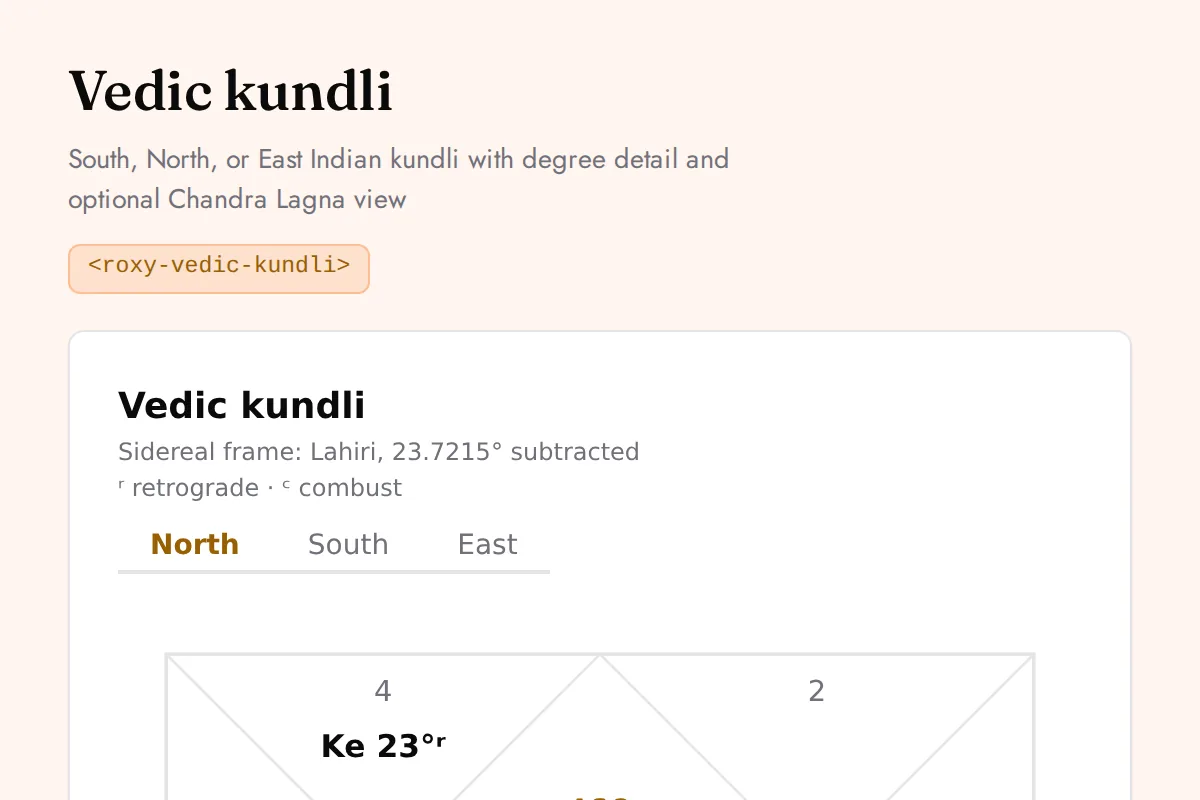
 Vedic kundli widget snippet
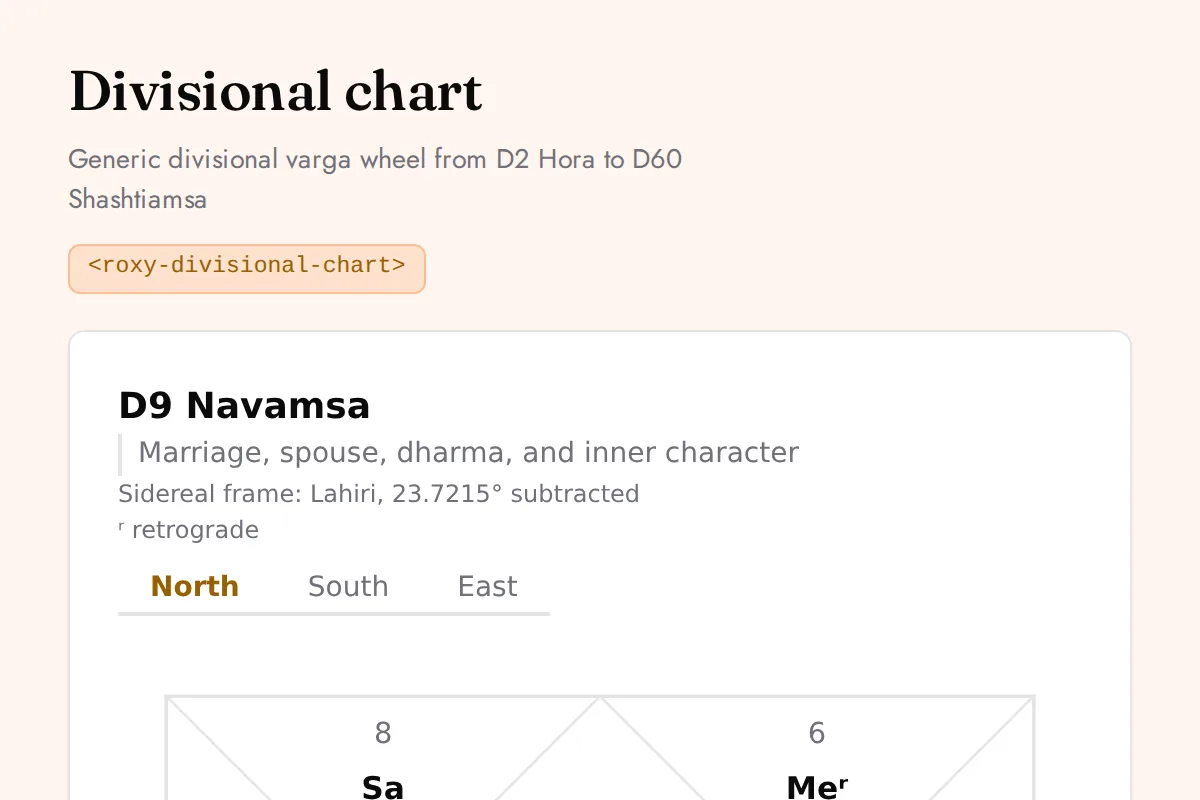
 Divisional chart widget snippet
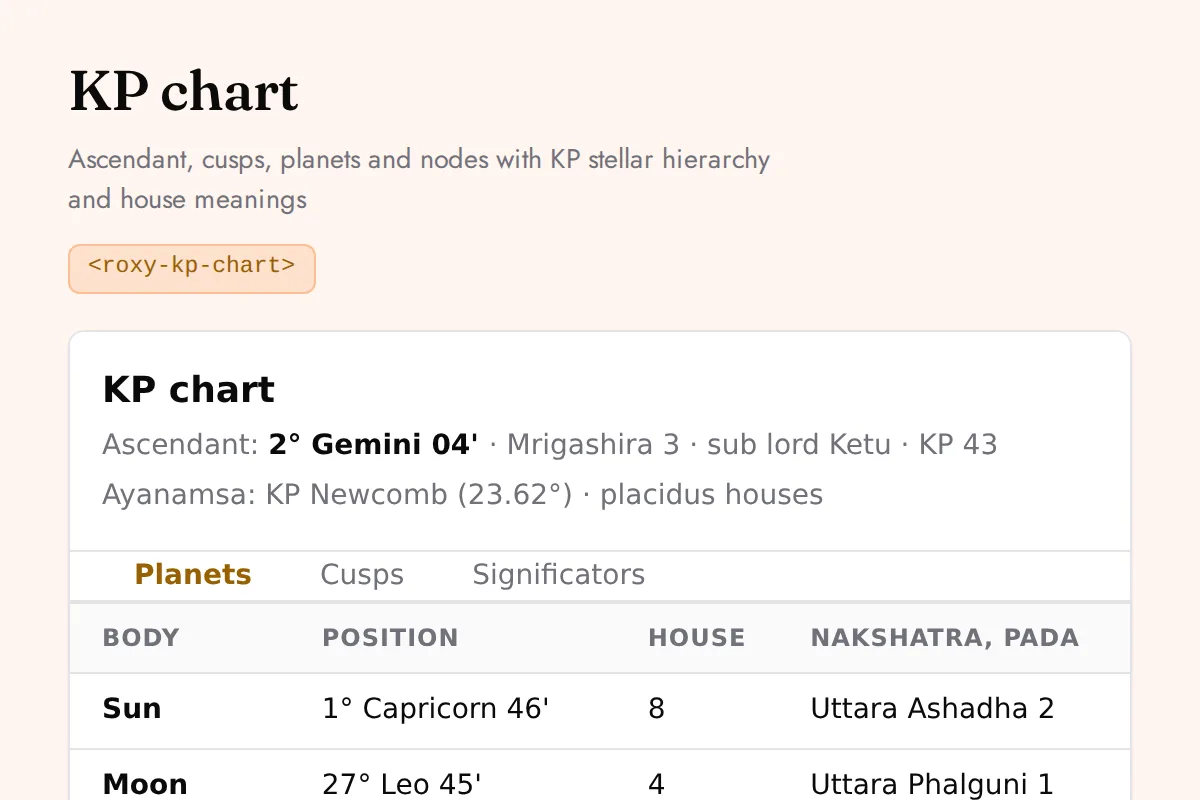
 KP chart widget snippet
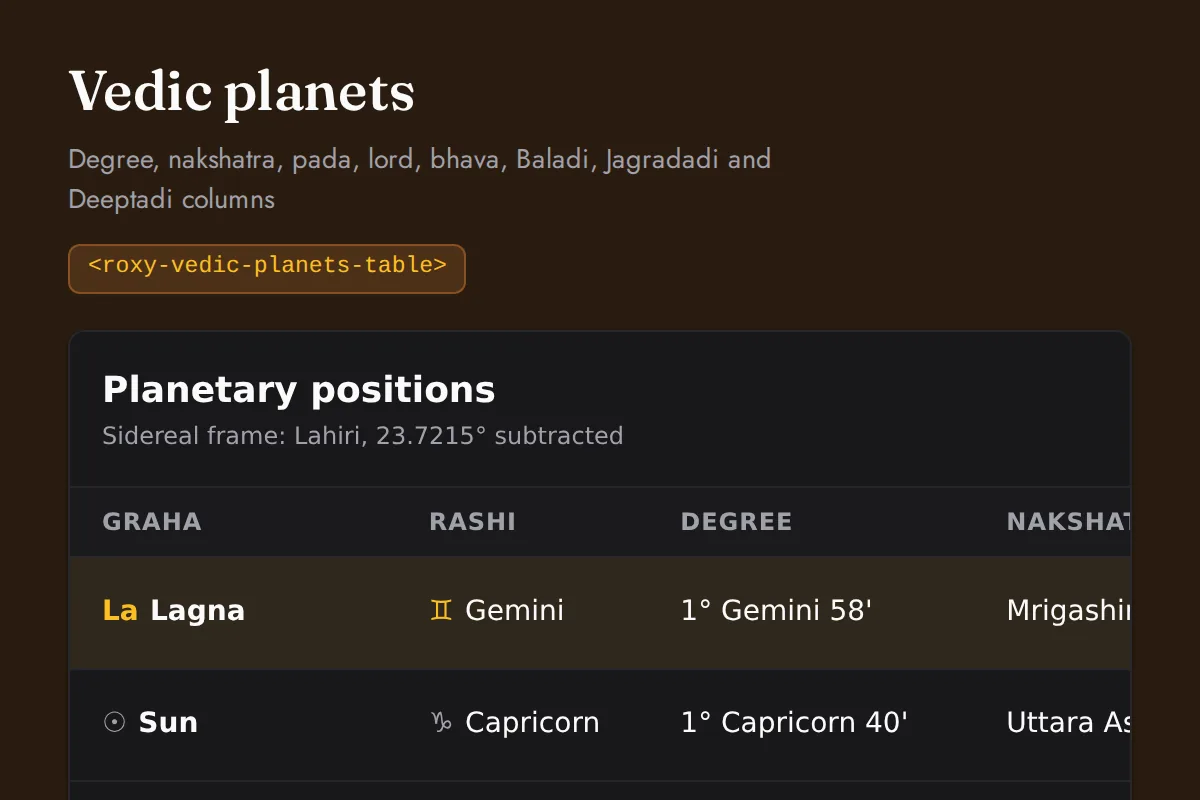
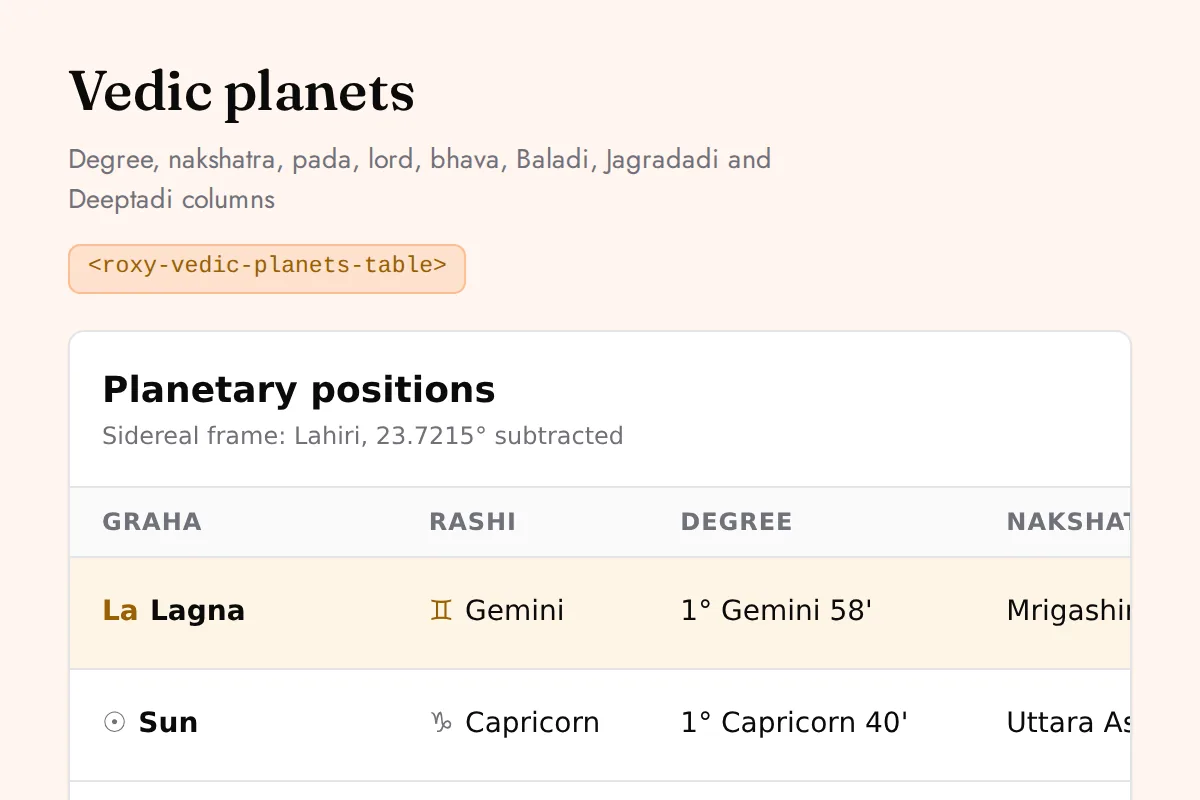
 Vedic planets table widget snippet
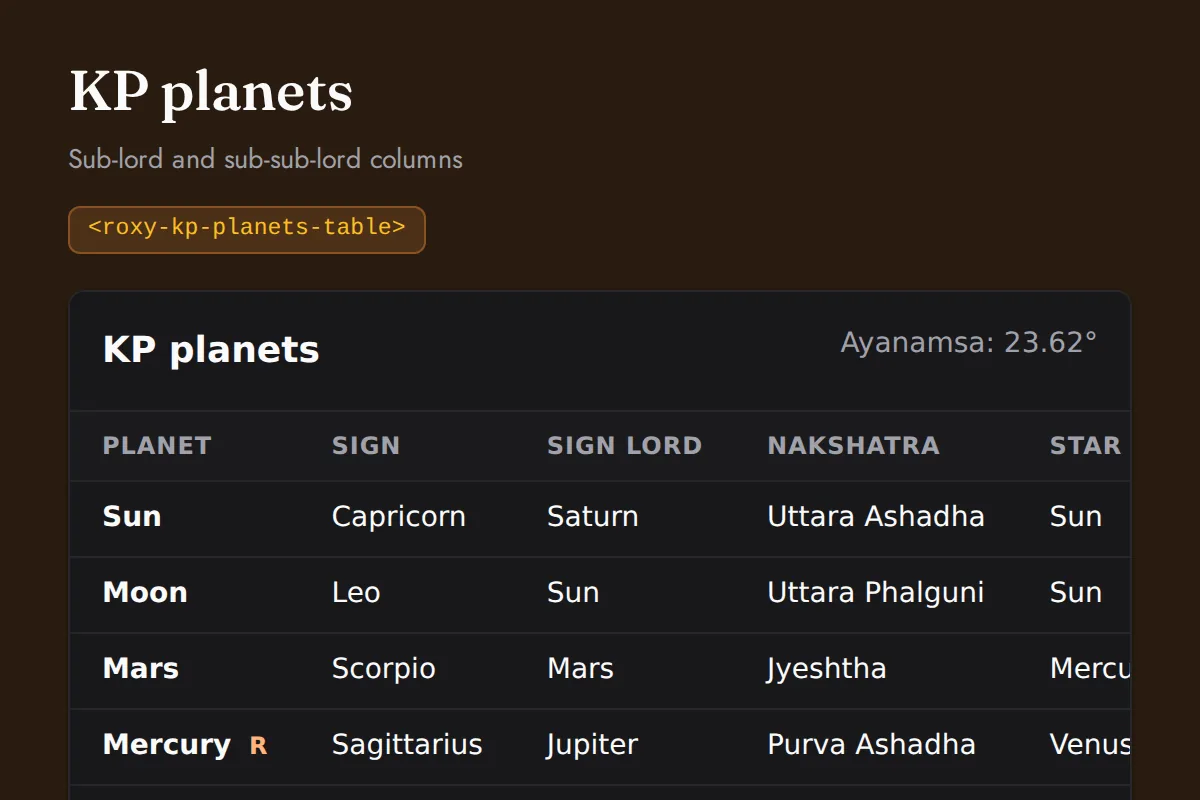
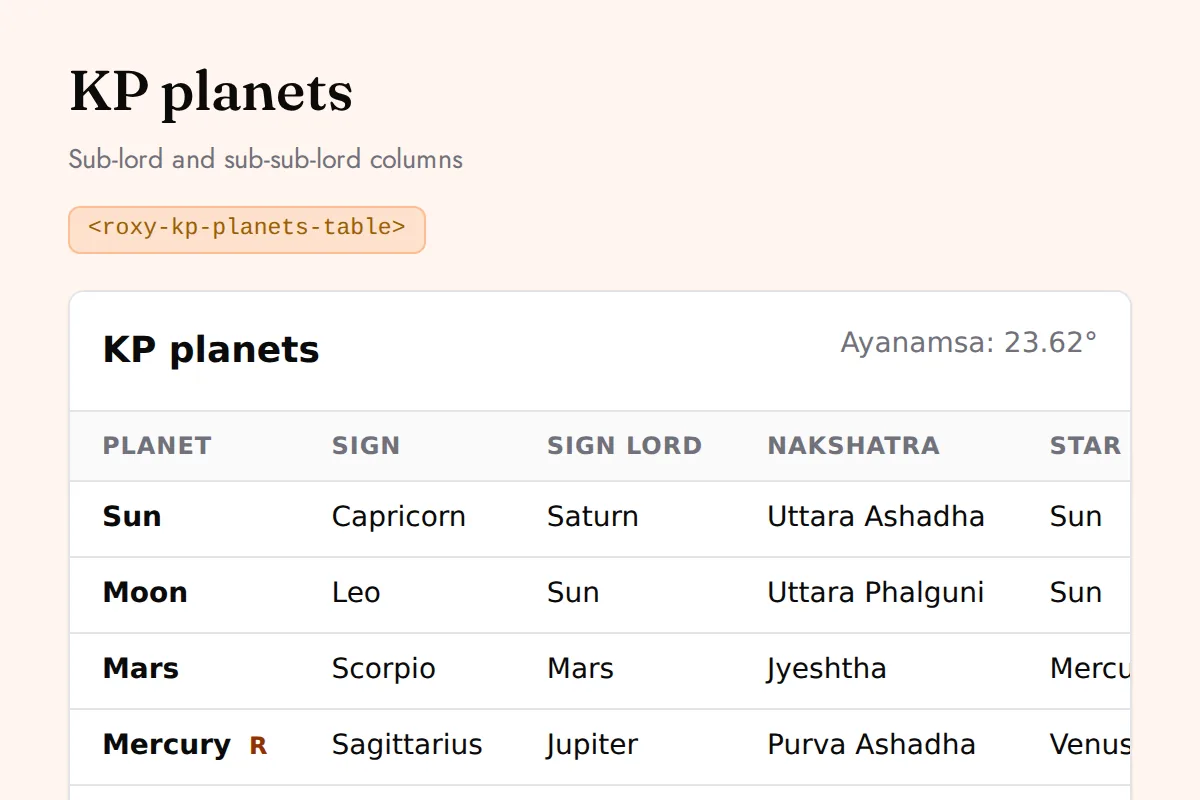
 KP planets table widget snippet
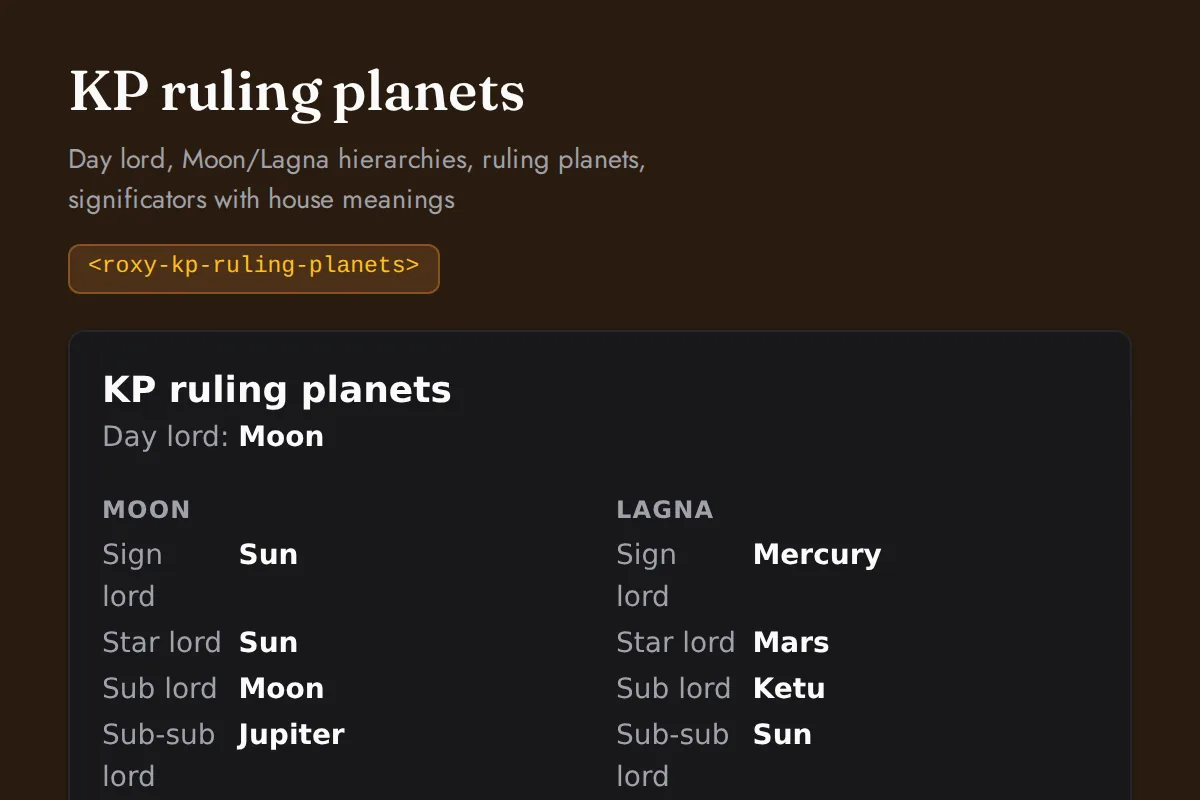
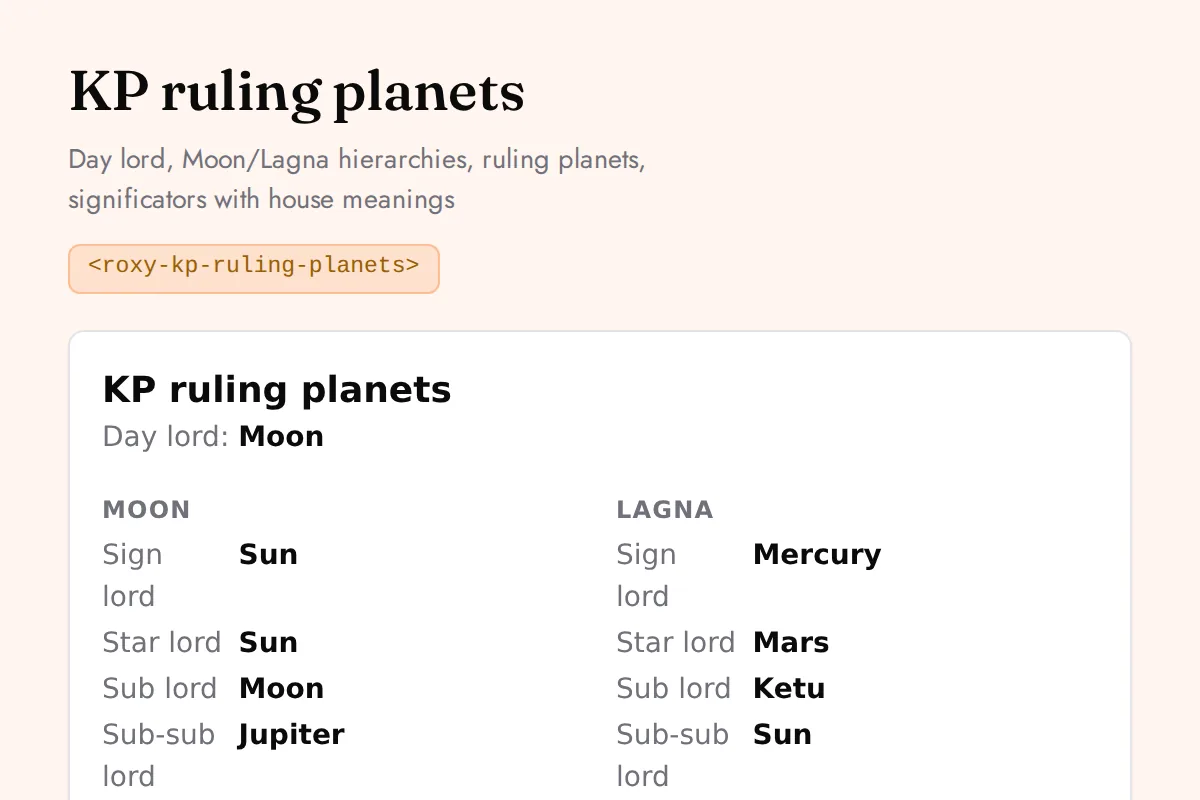
 KP ruling planets widget snippet
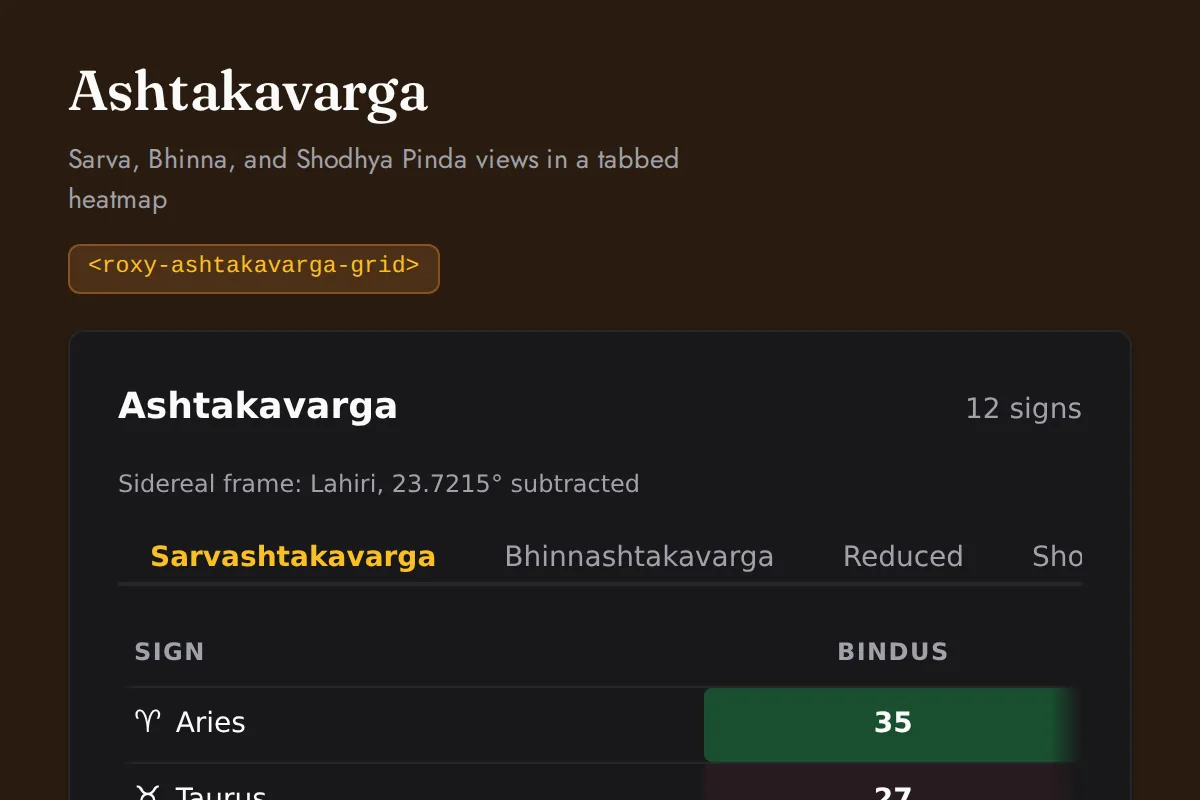
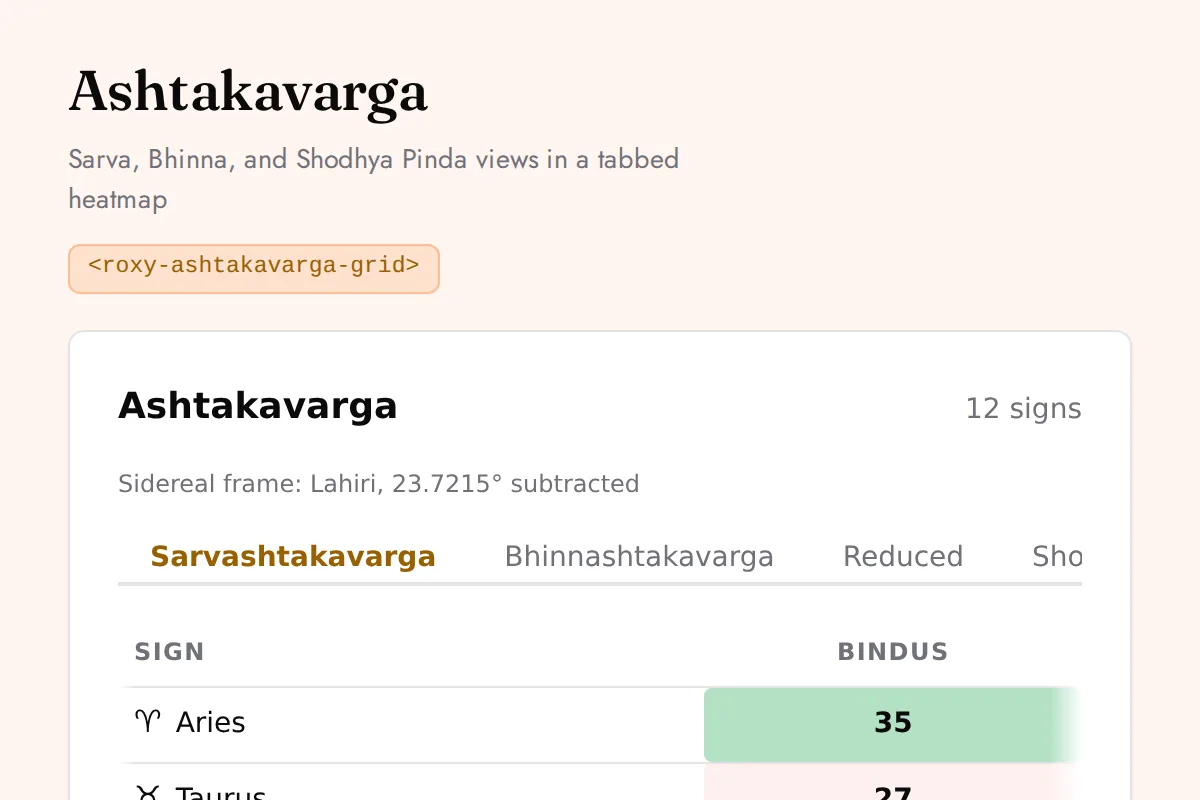
 Ashtakavarga grid widget snippet
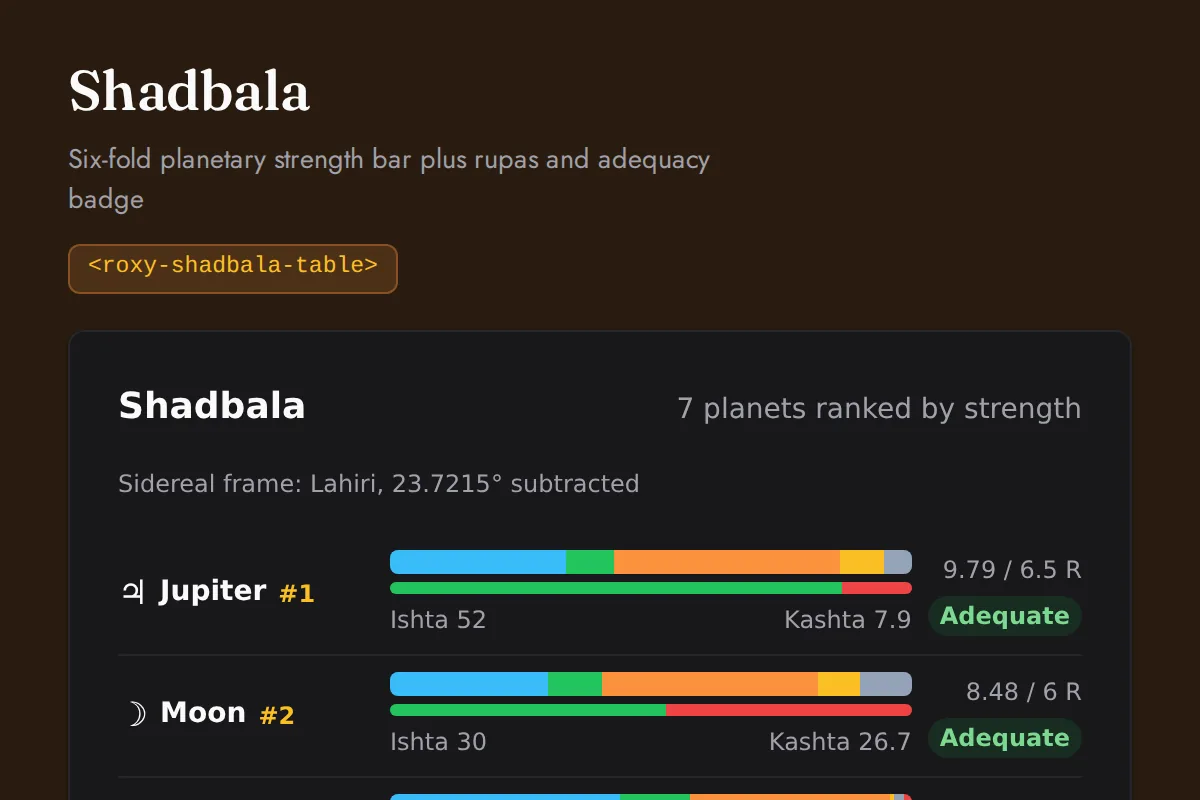
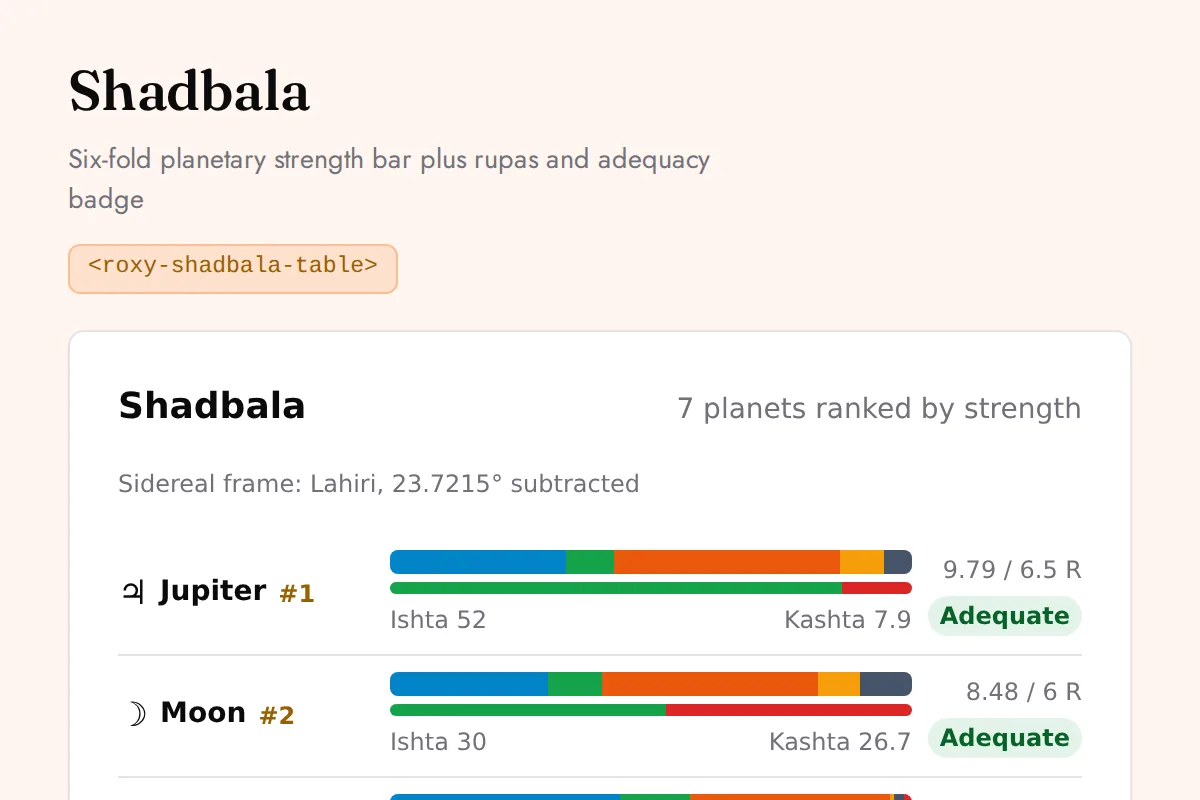
 Shadbala table widget snippet
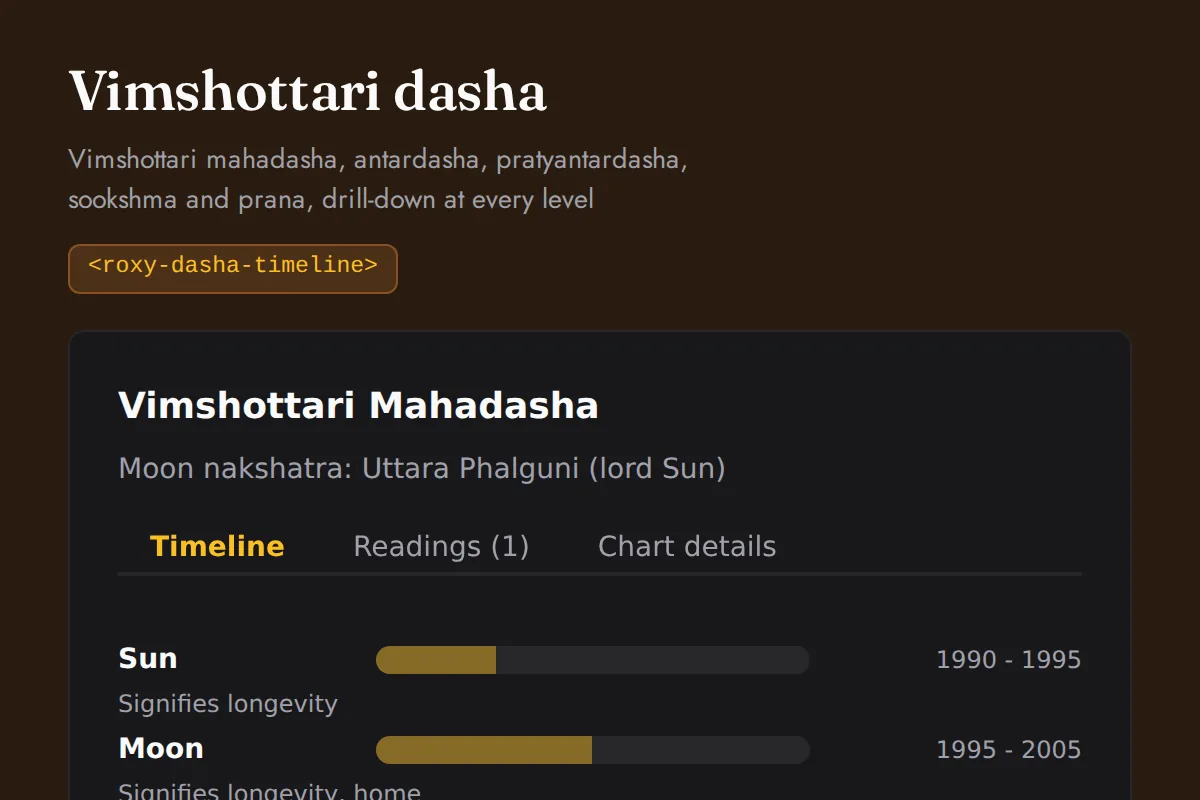
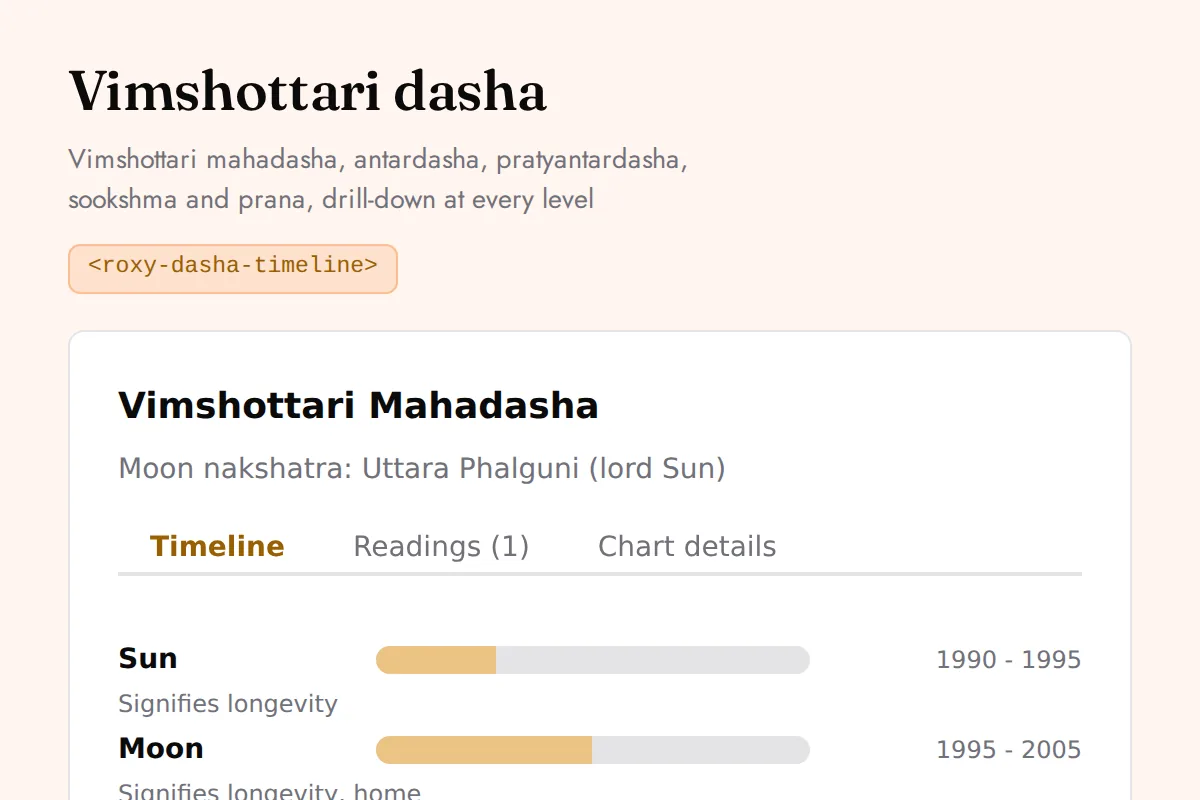
 Dasha timeline widget snippet
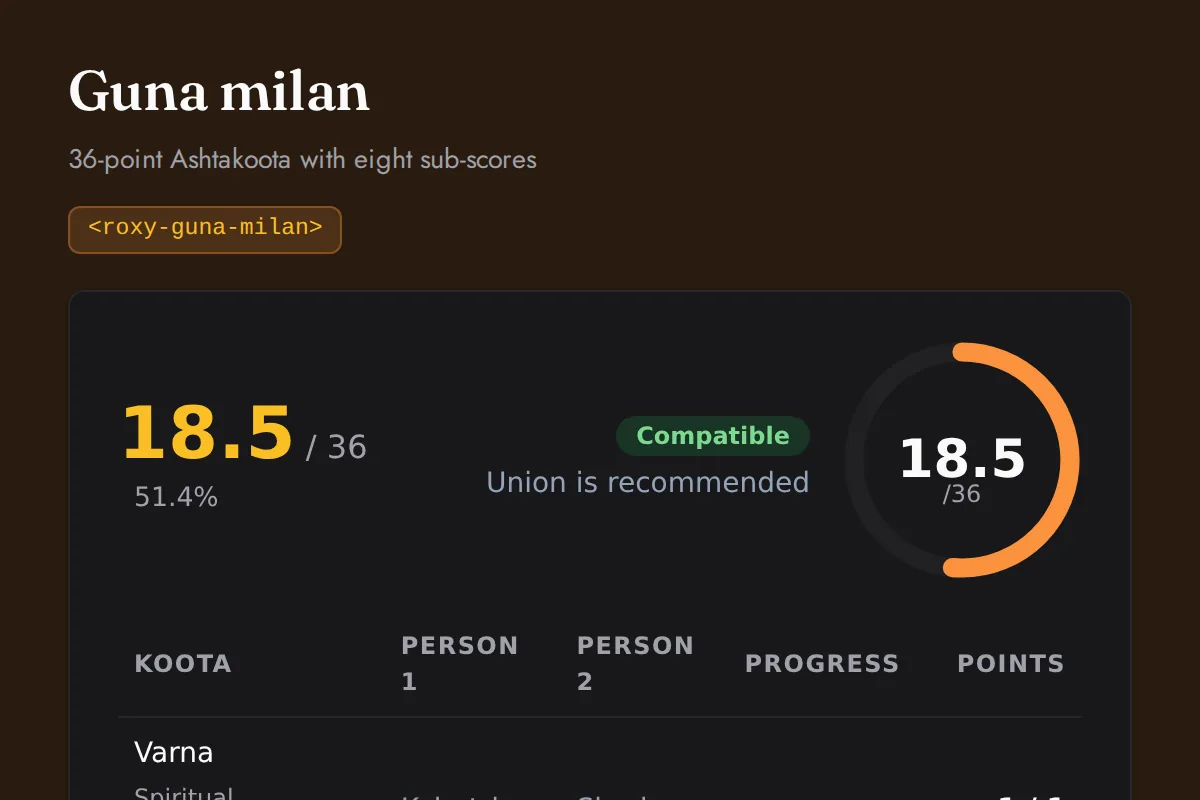
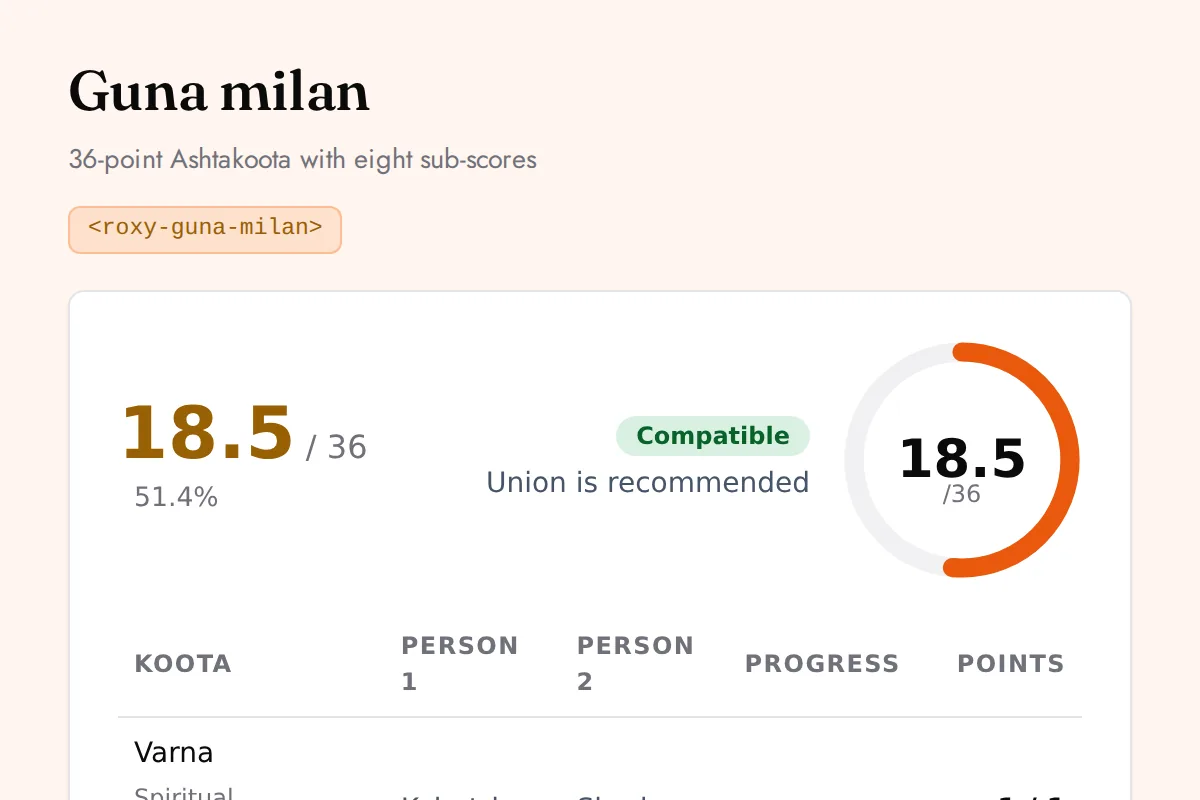
 Guna milan widget snippet
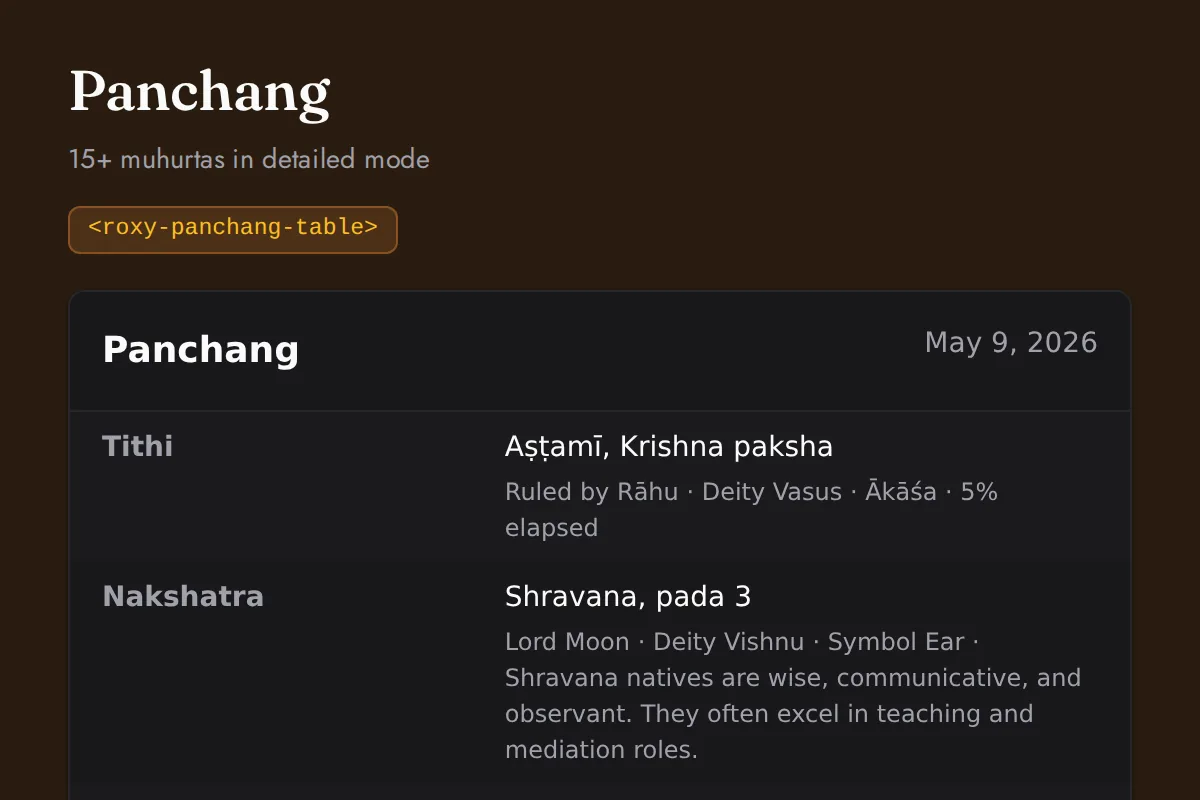
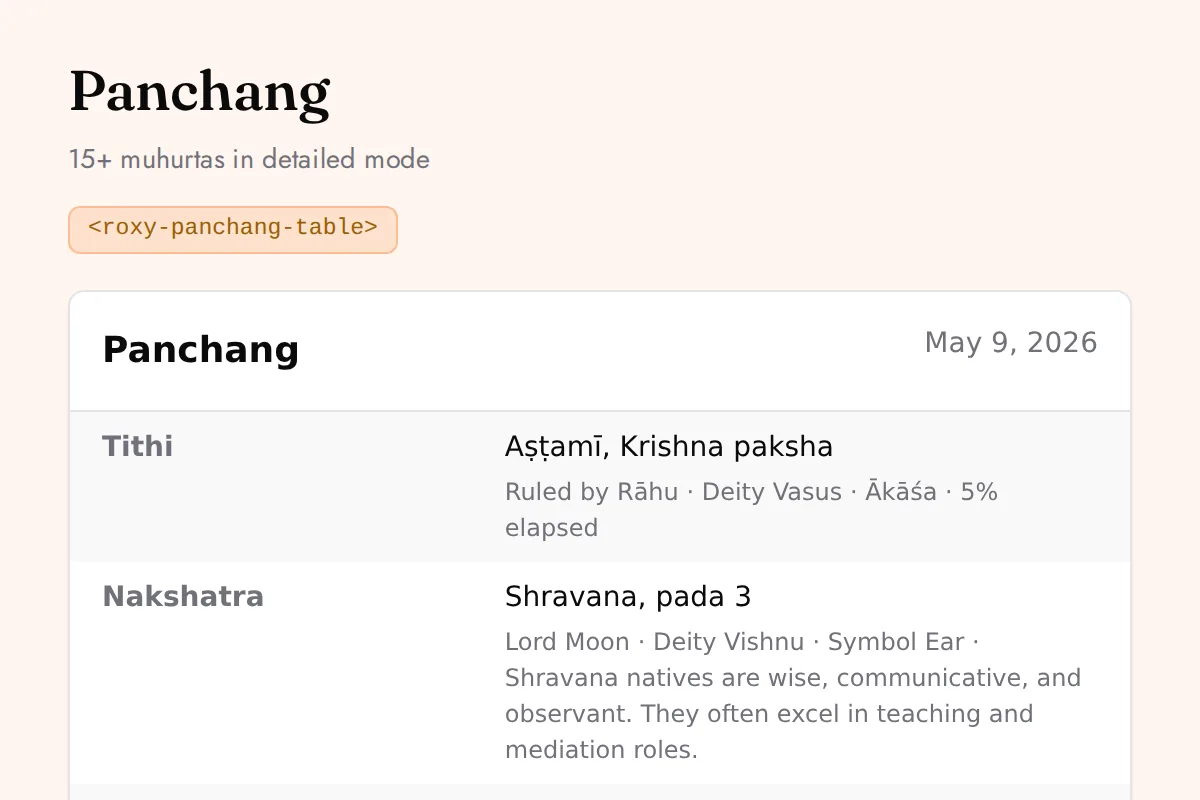
 Panchang table widget snippet
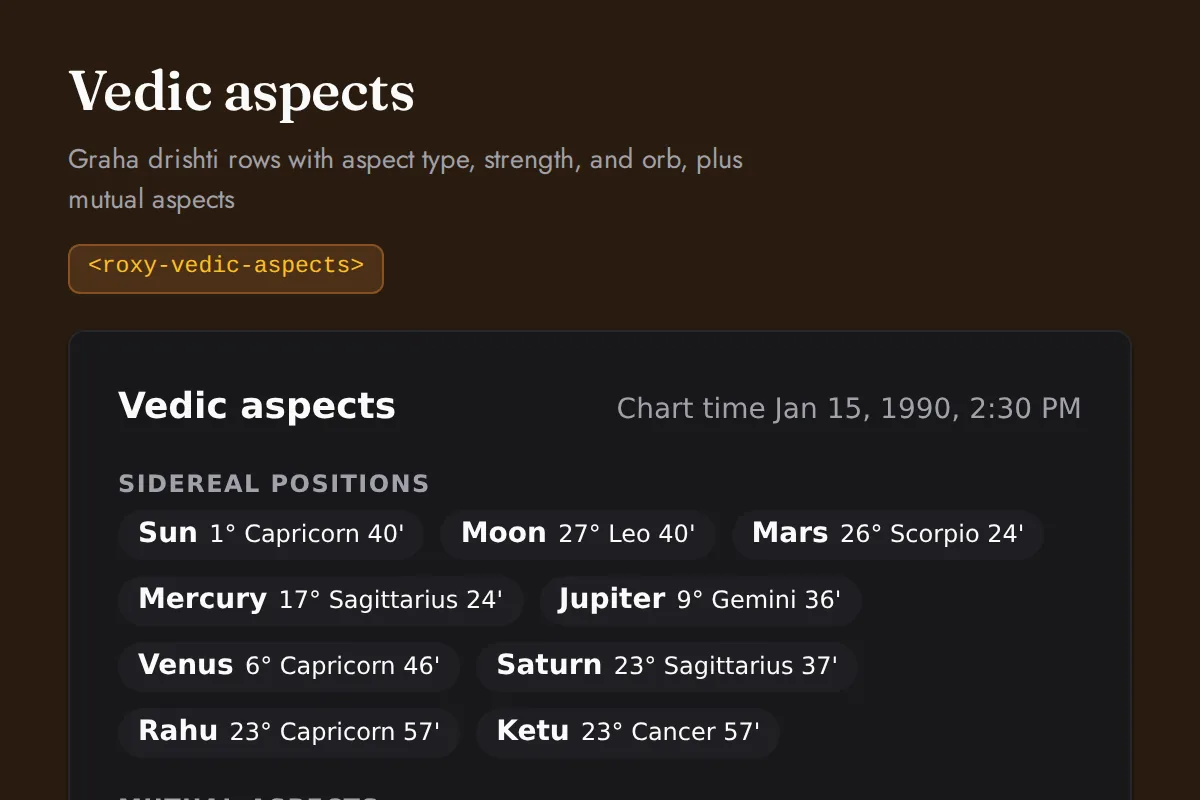
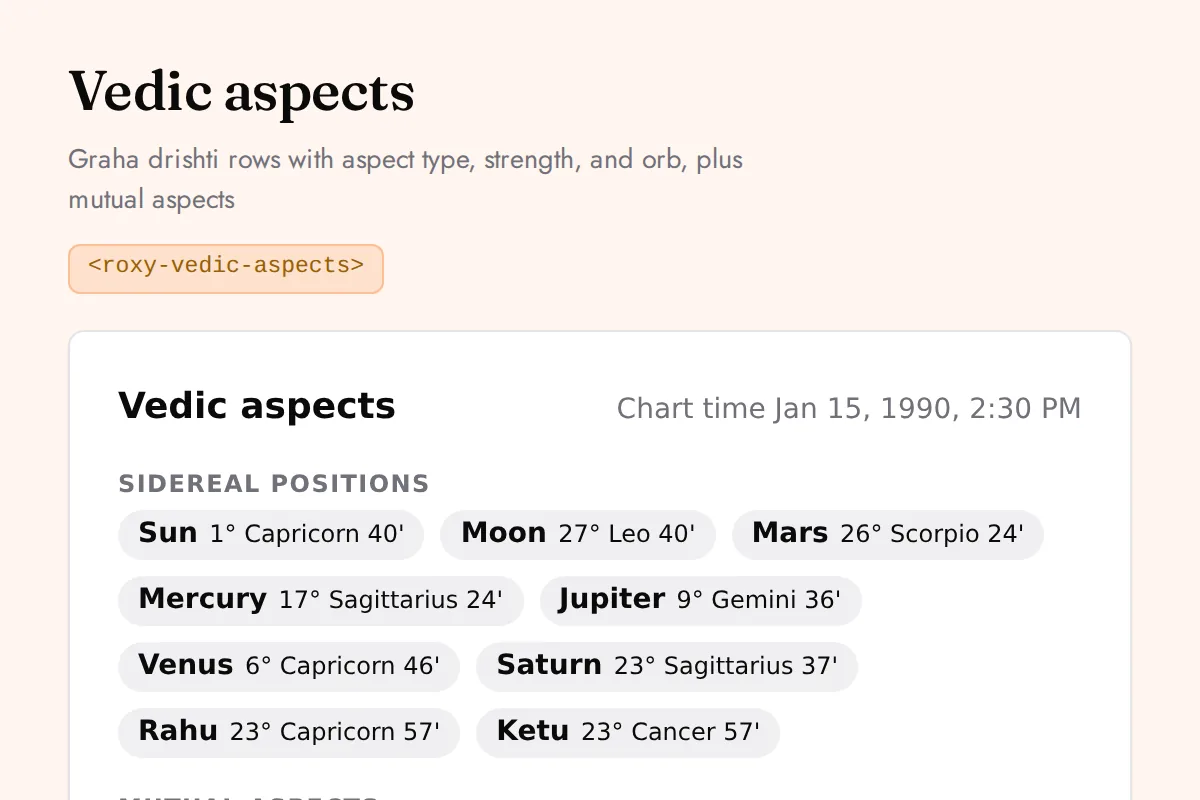
 Vedic aspects widget snippet
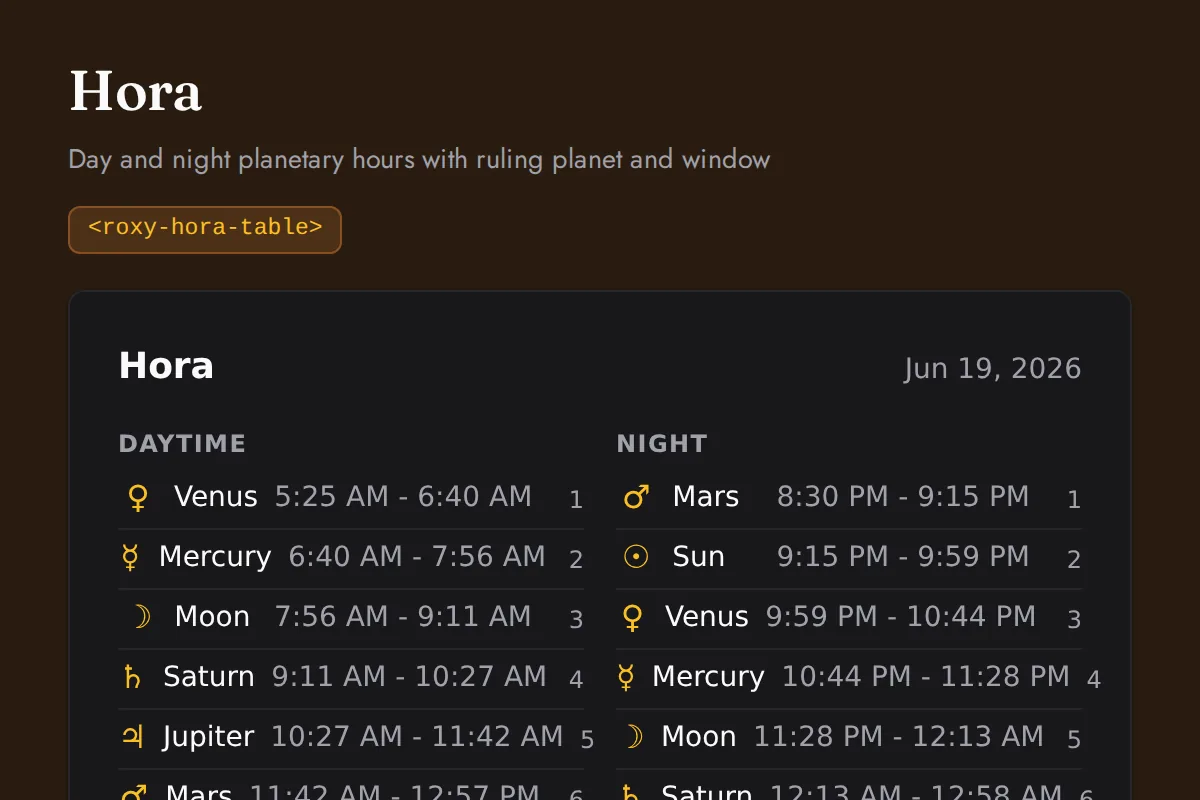
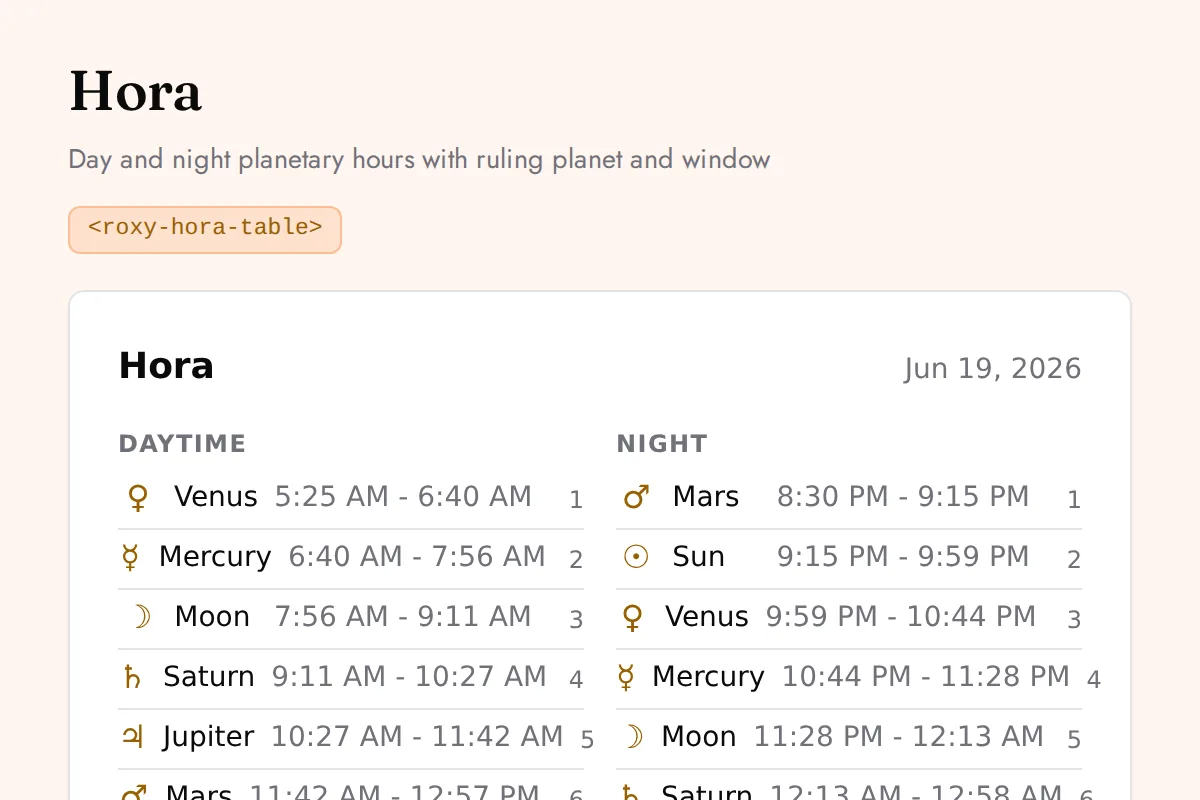
 Hora table widget snippet
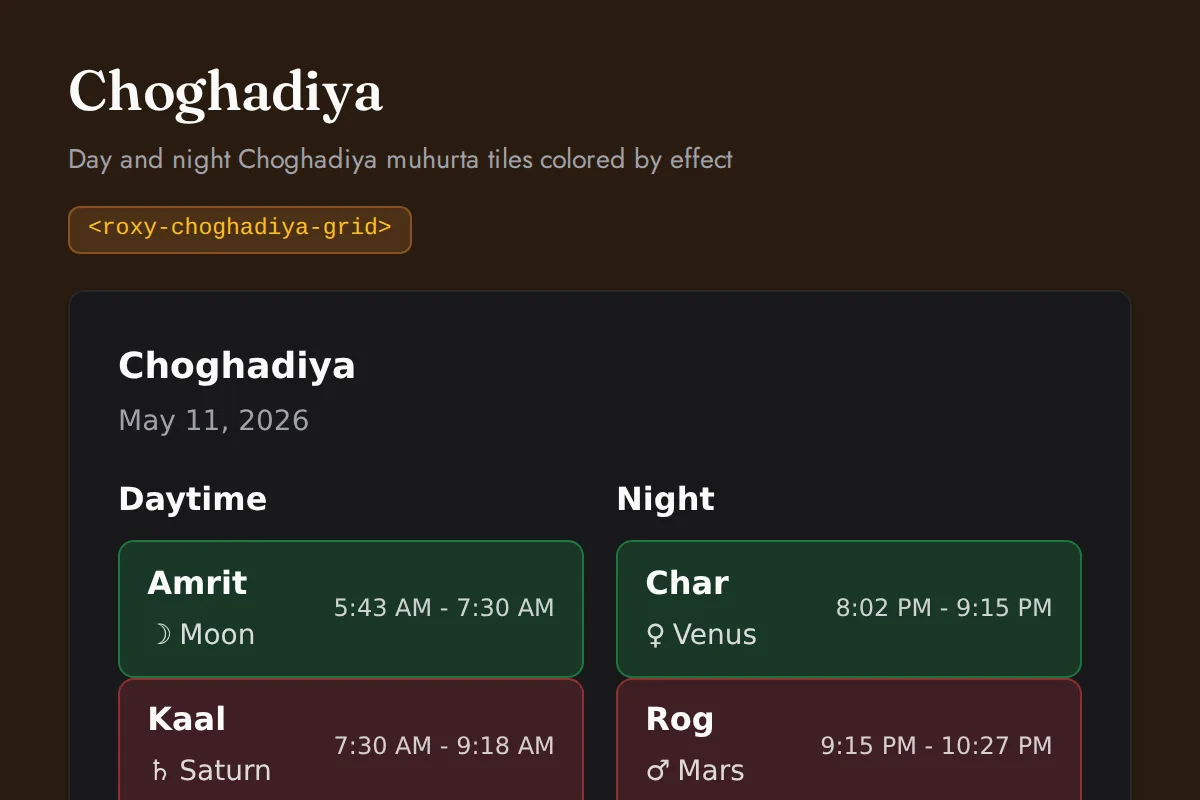
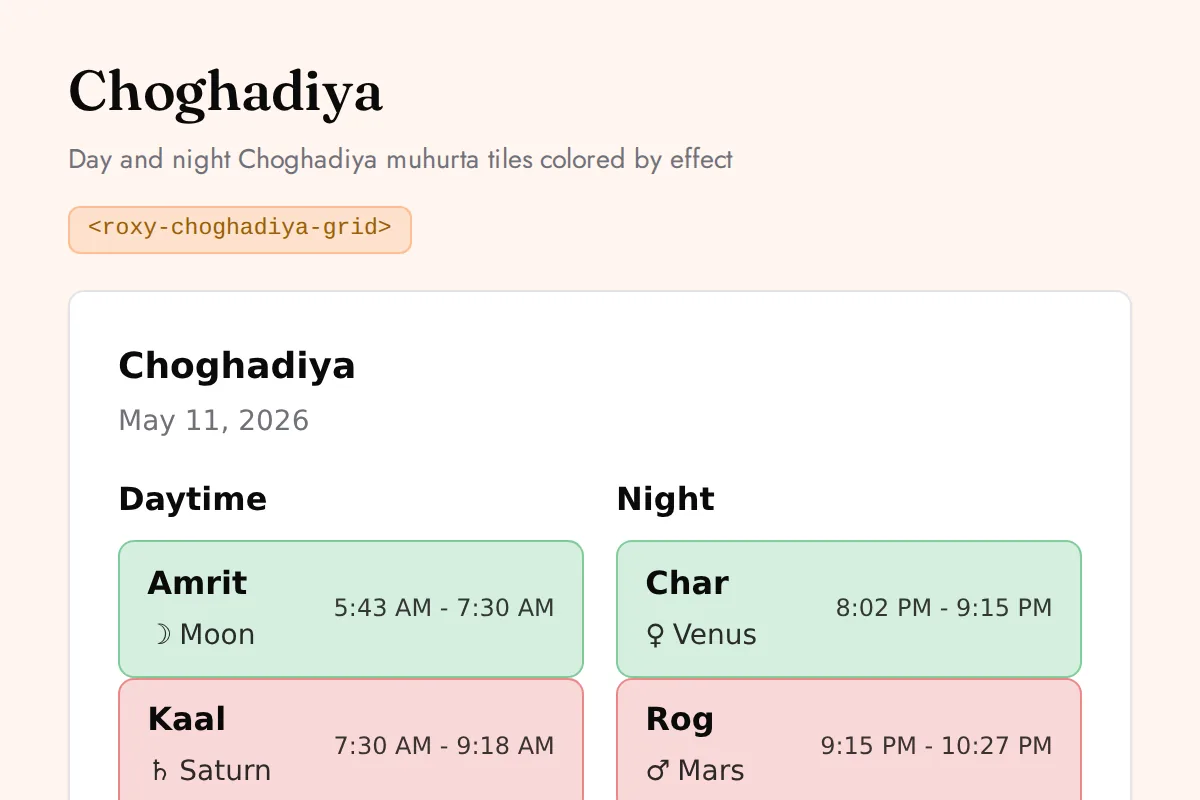
 Choghadiya grid widget snippet
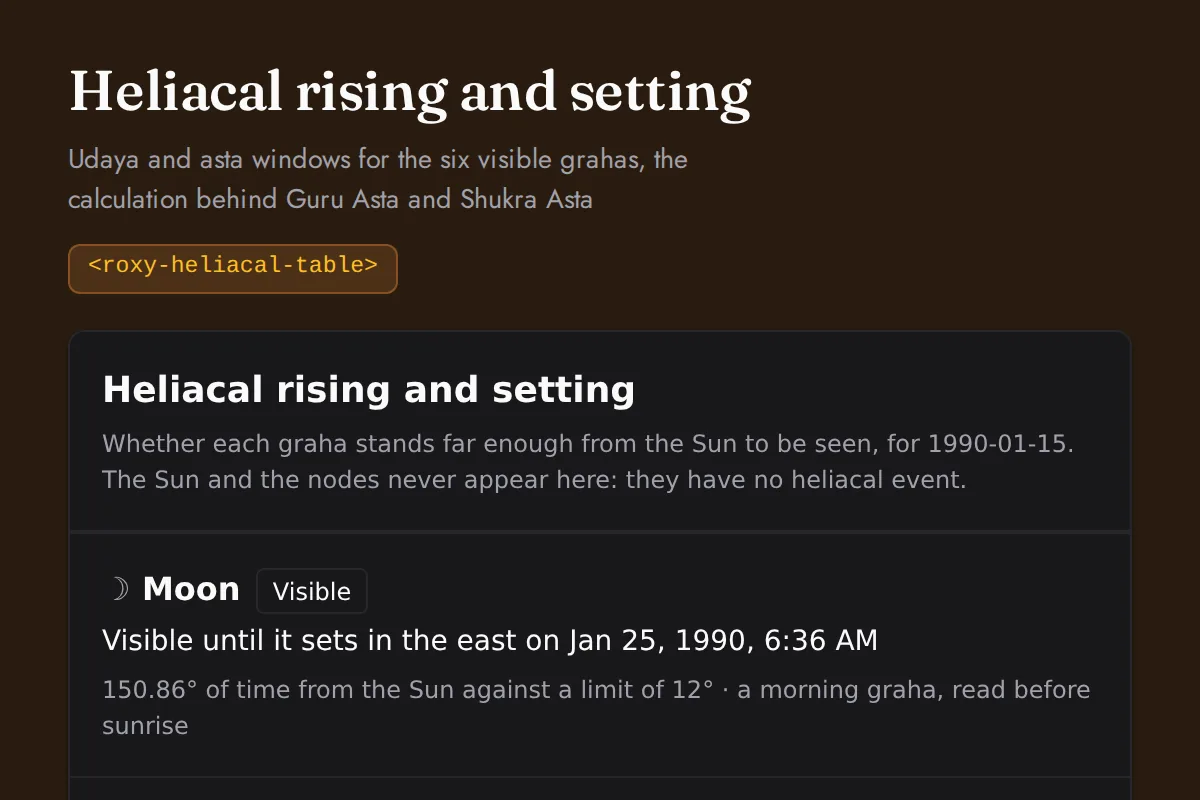
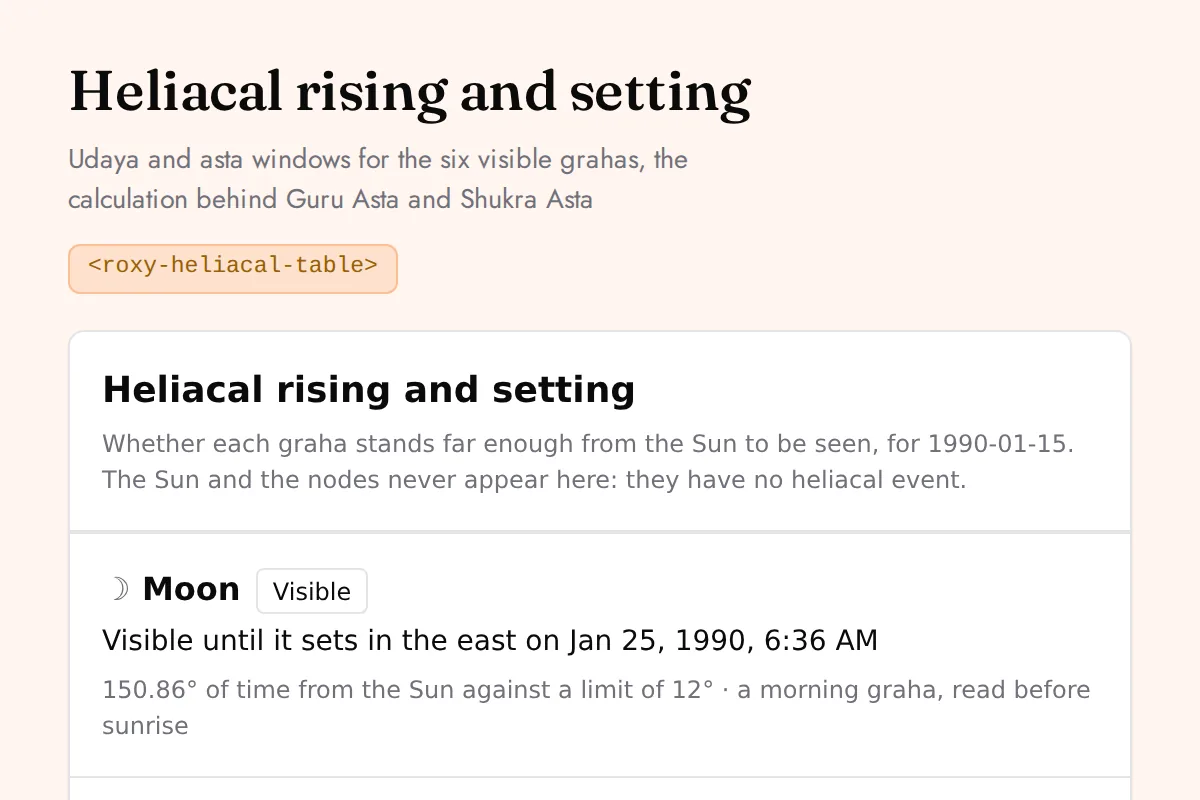
 Heliacal table widget snippet
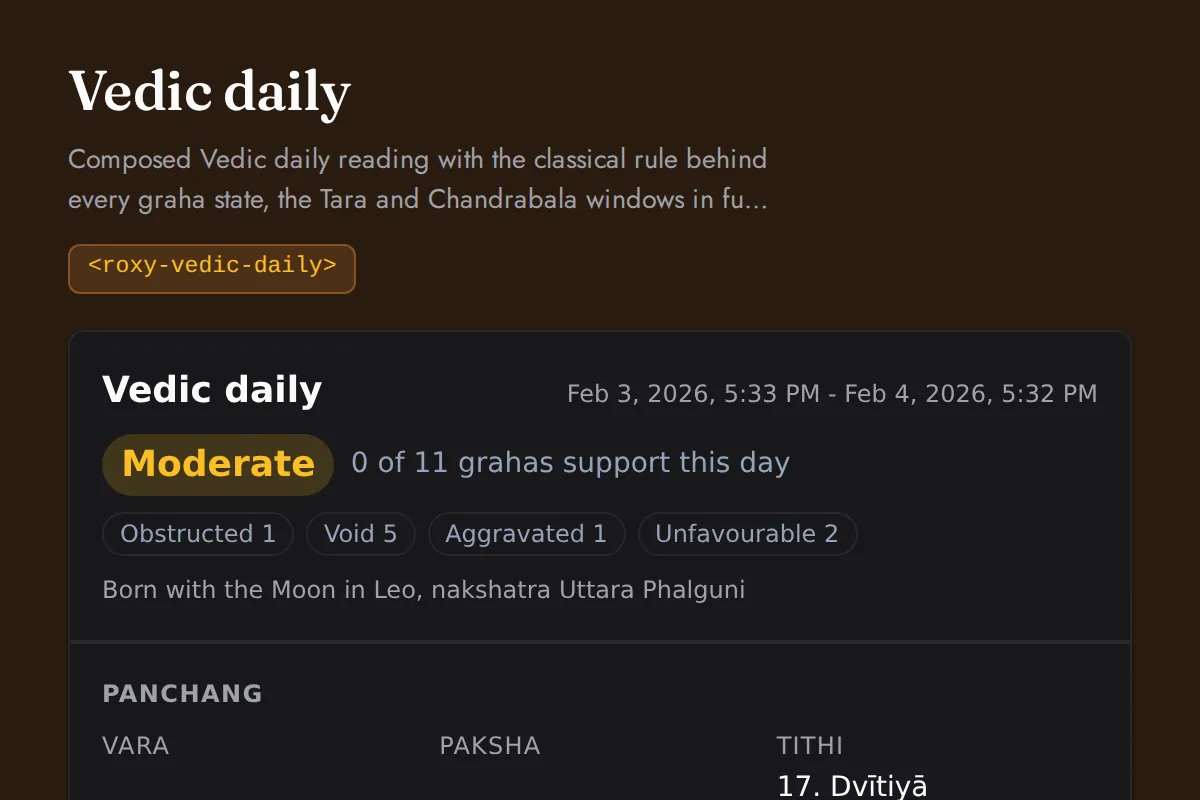
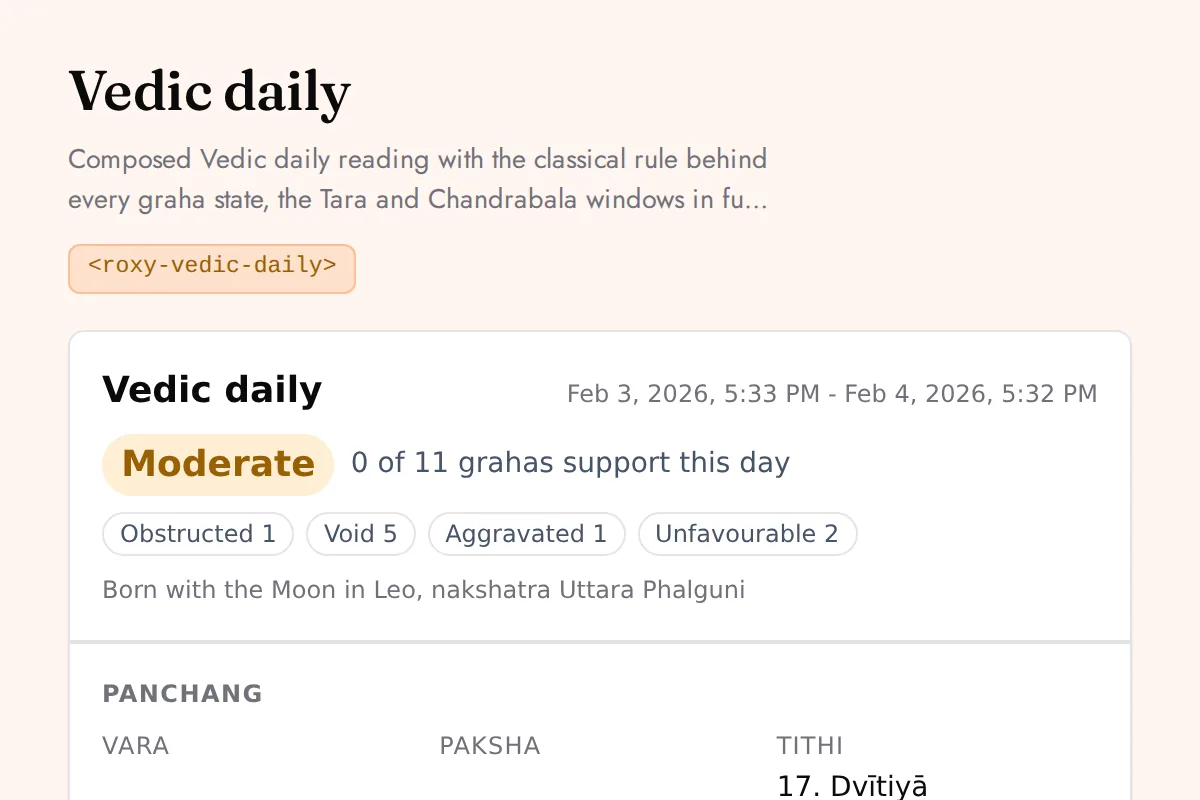
 Vedic daily widget snippet
 KP finance card widget snippet
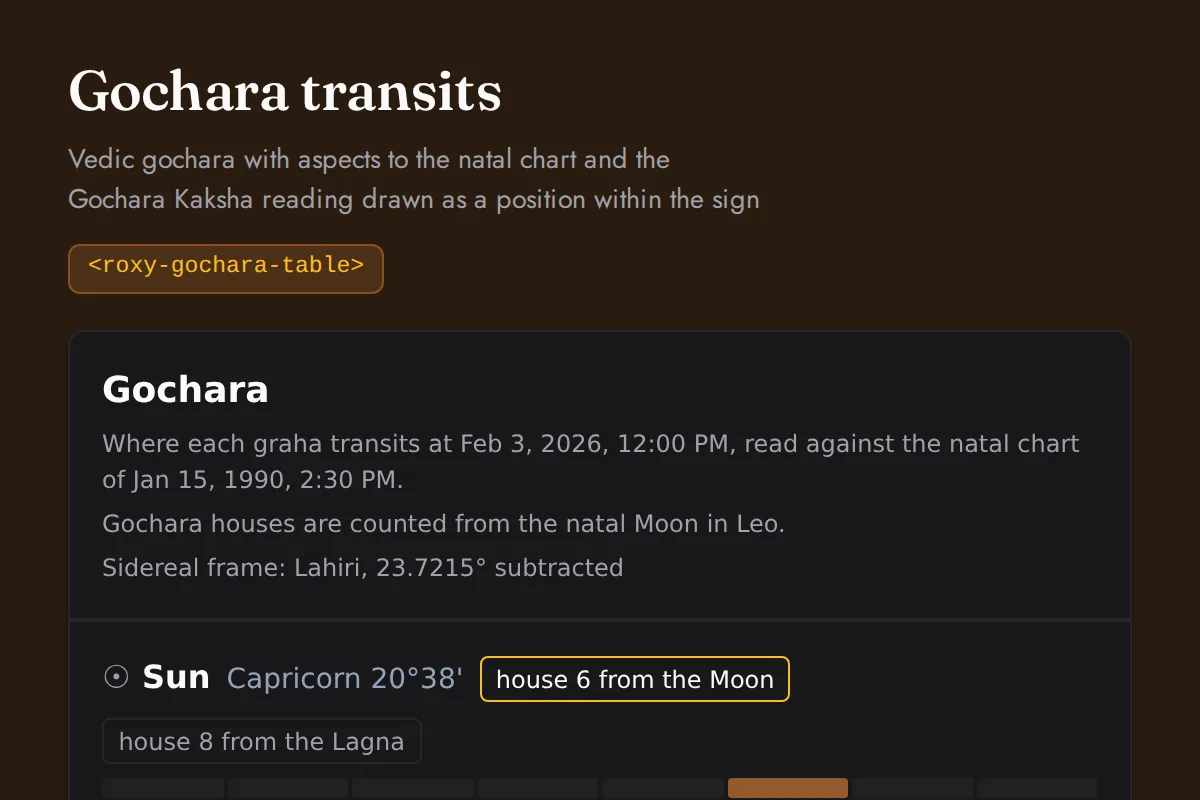
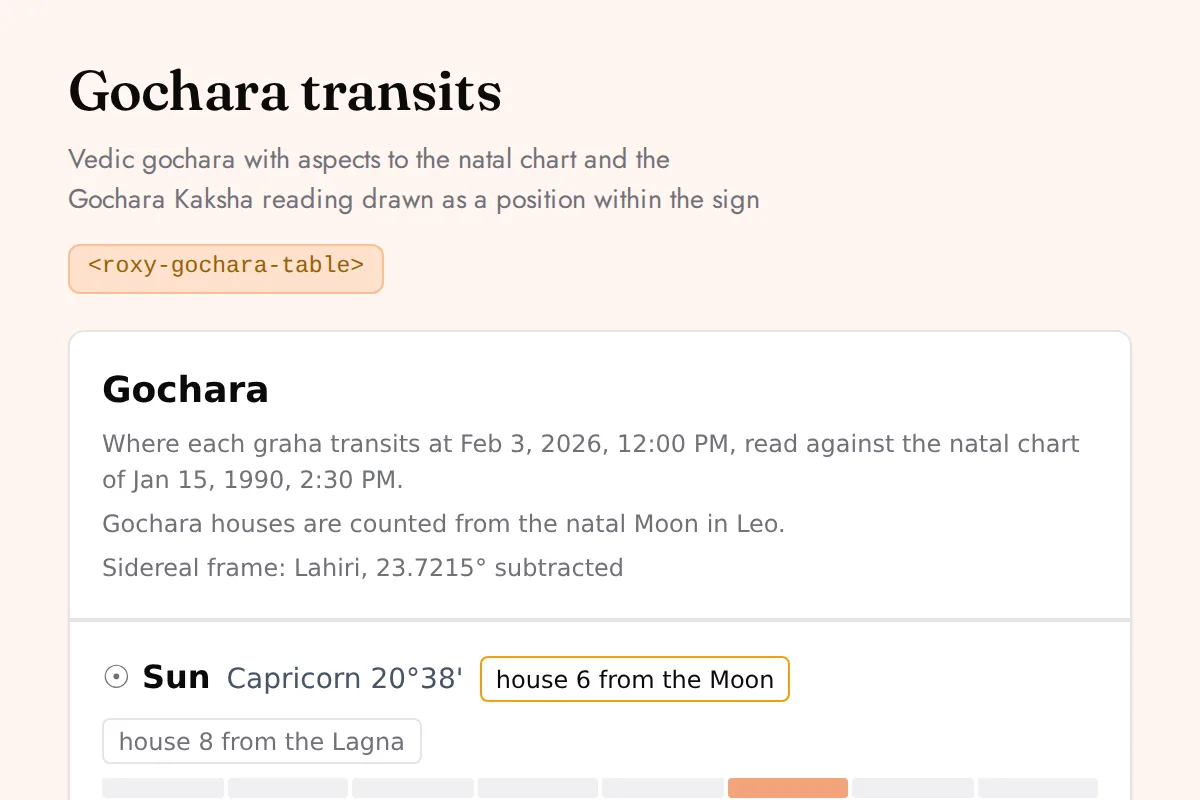
 Gochara table widget snippet
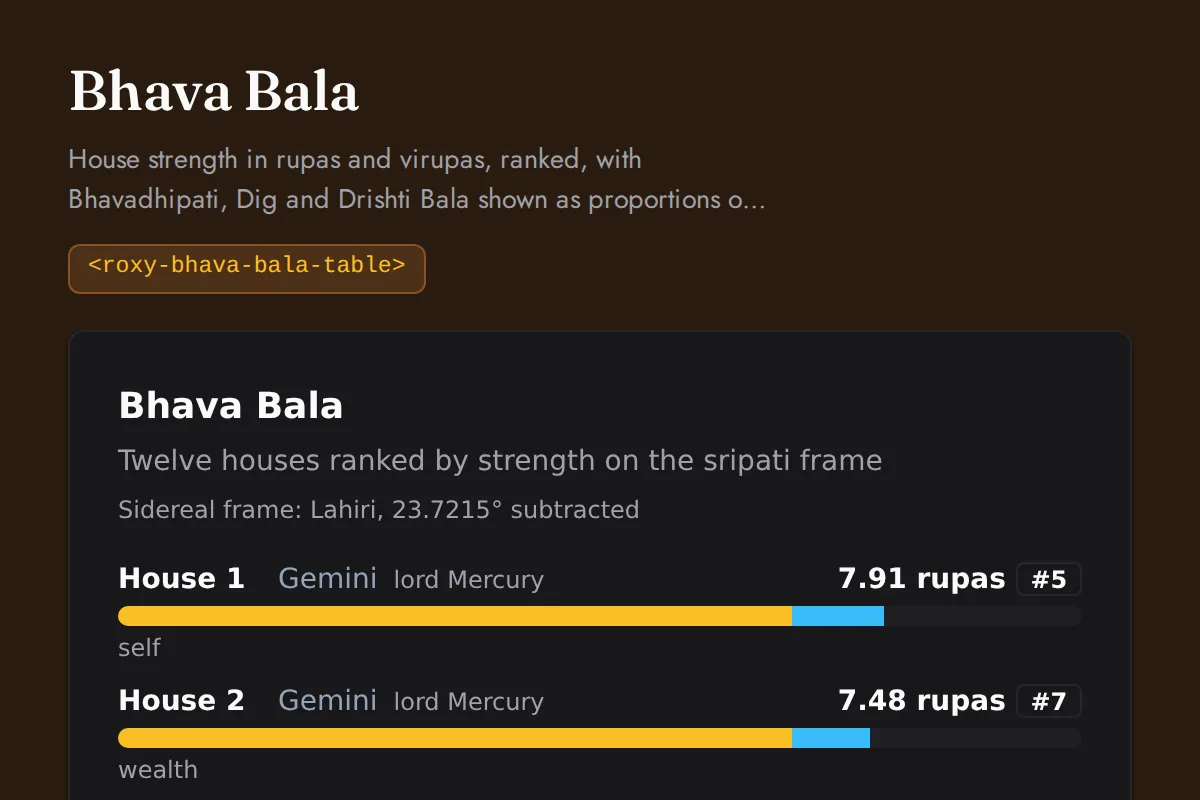
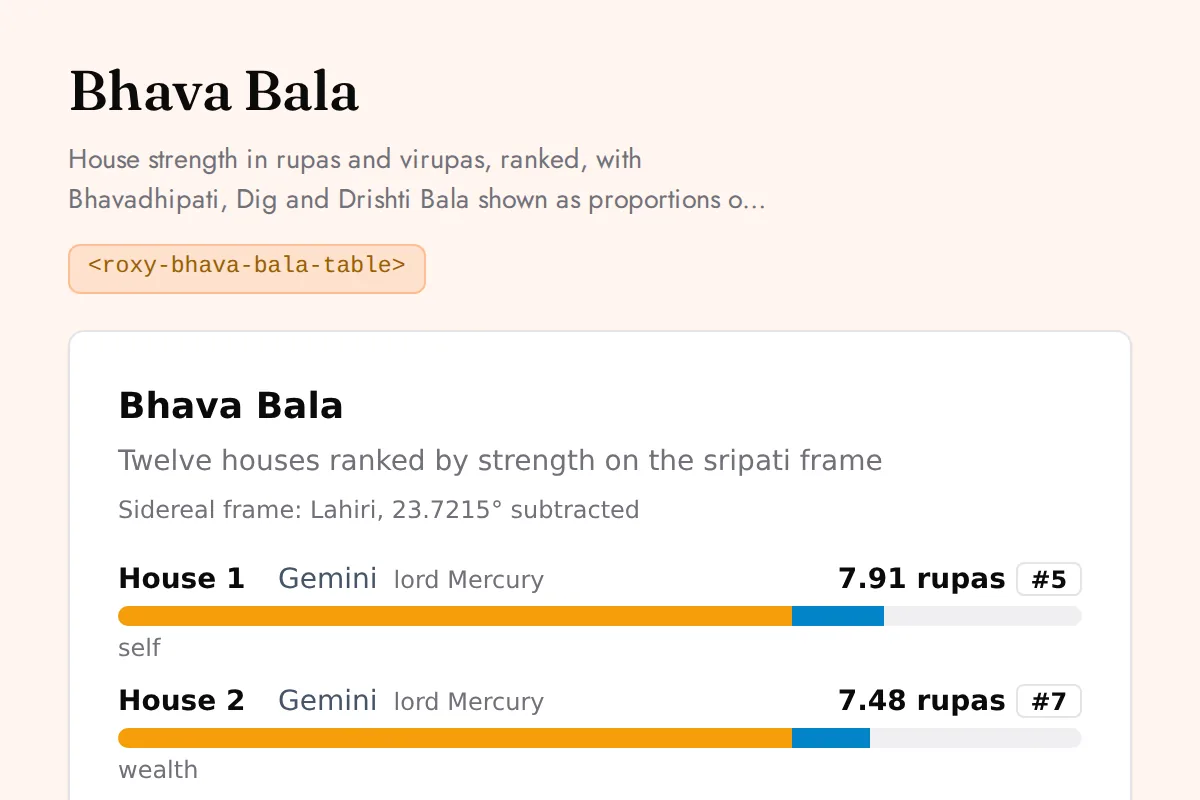
 Bhava bala table widget snippet
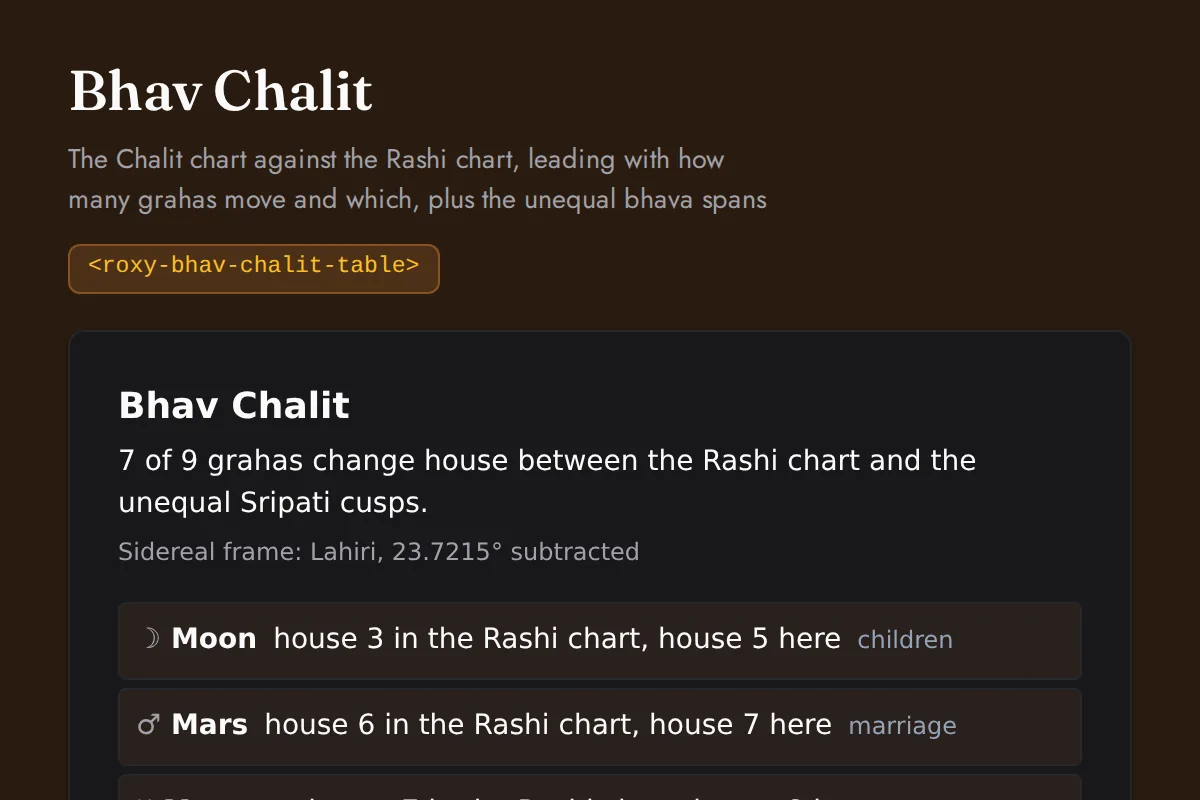
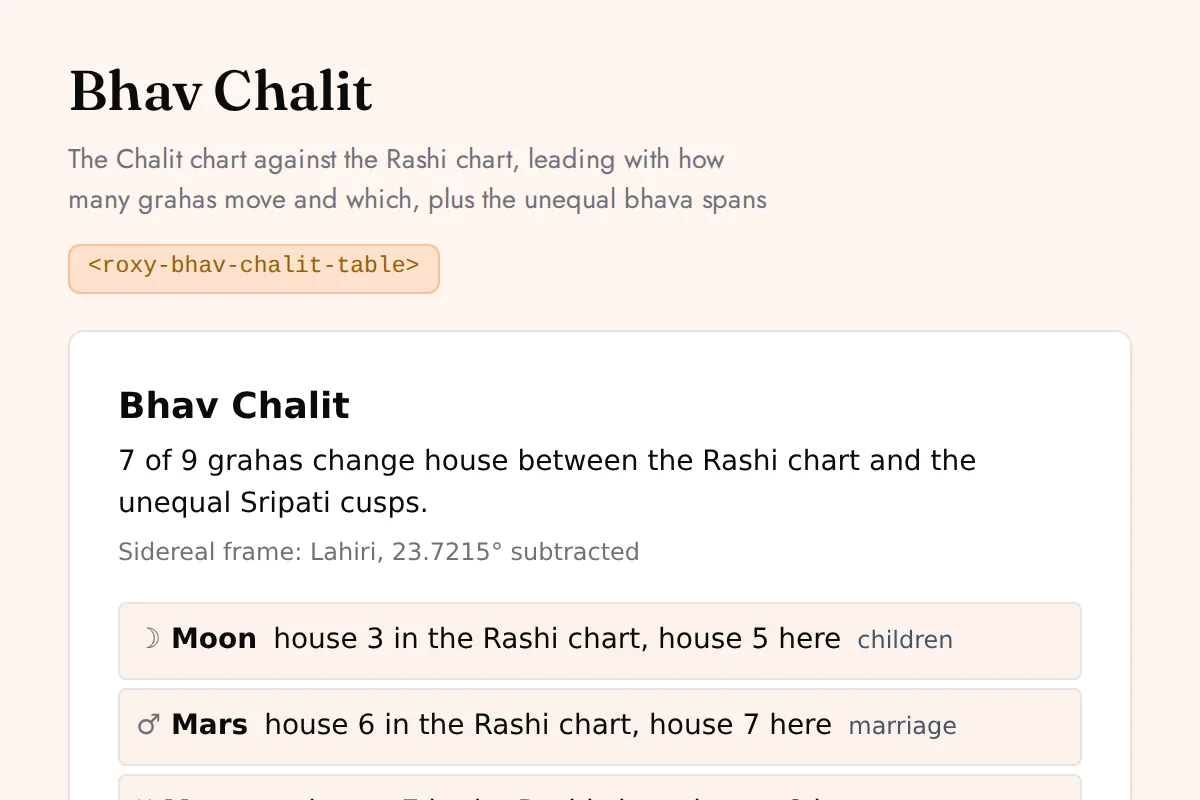
 Bhav chalit table widget snippet
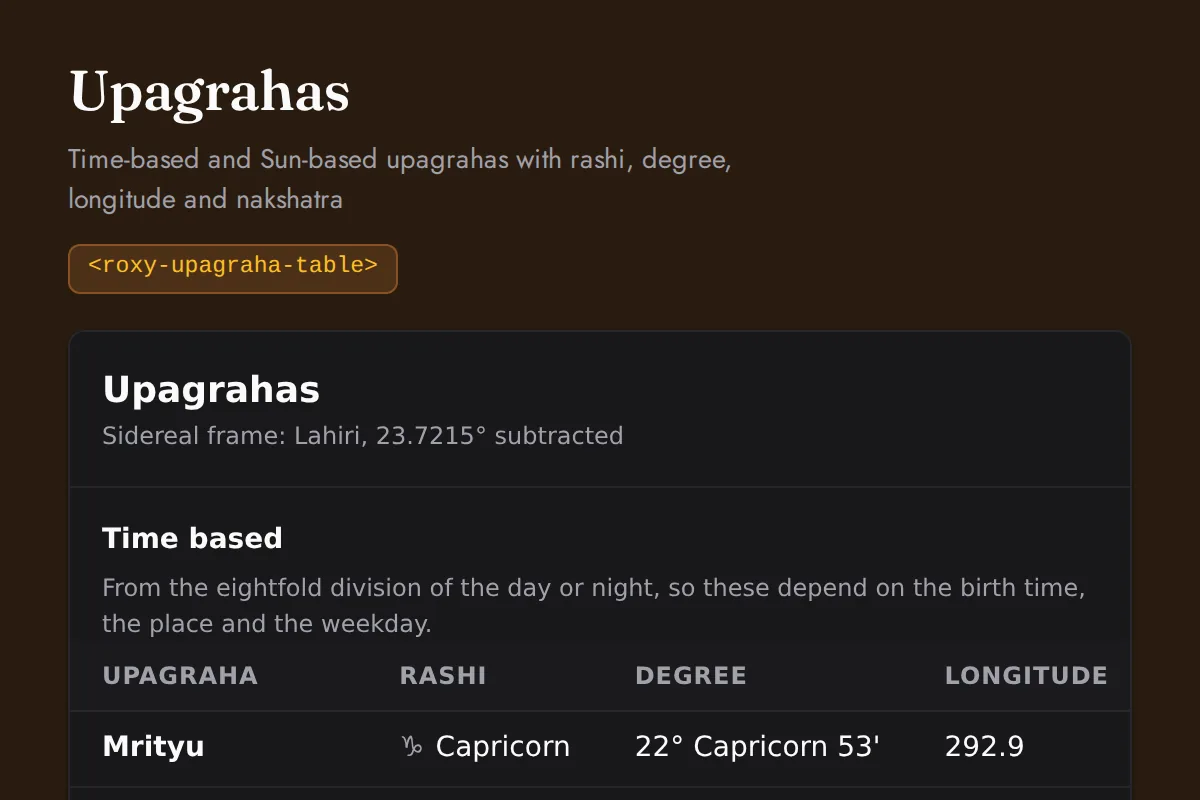
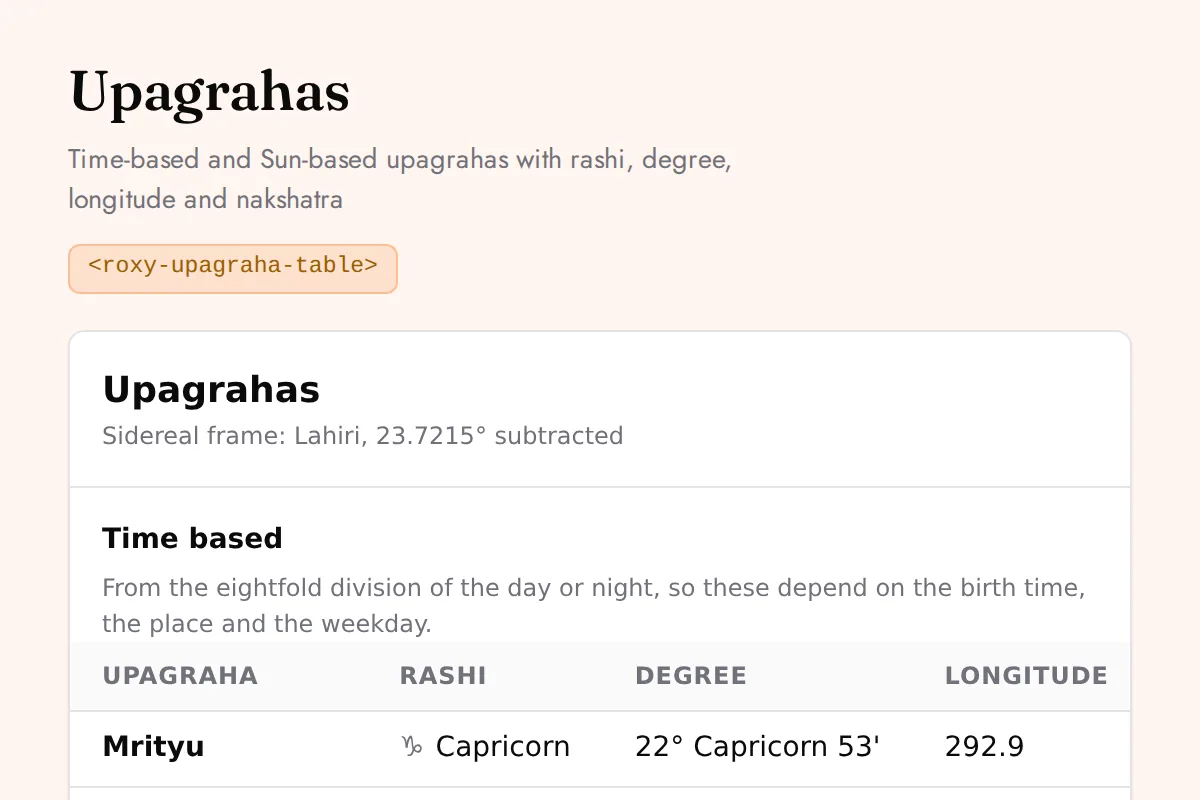
 Upagraha table widget snippet
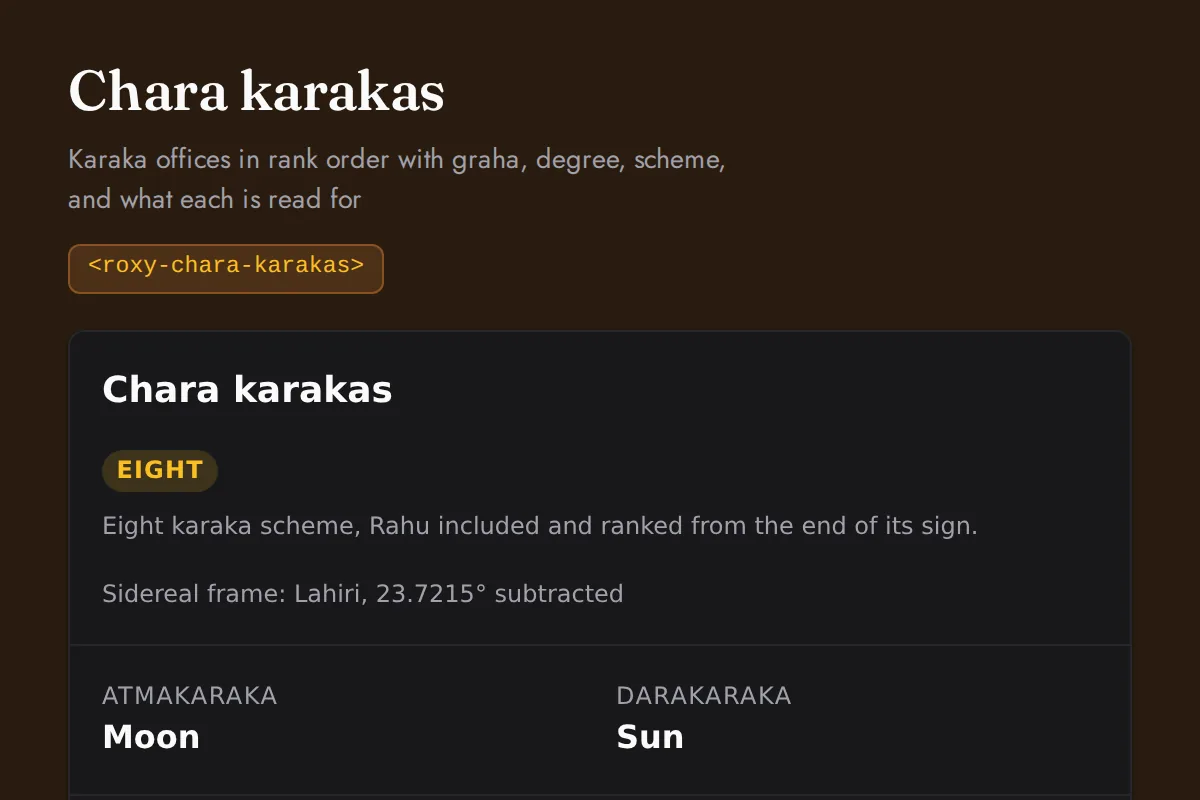
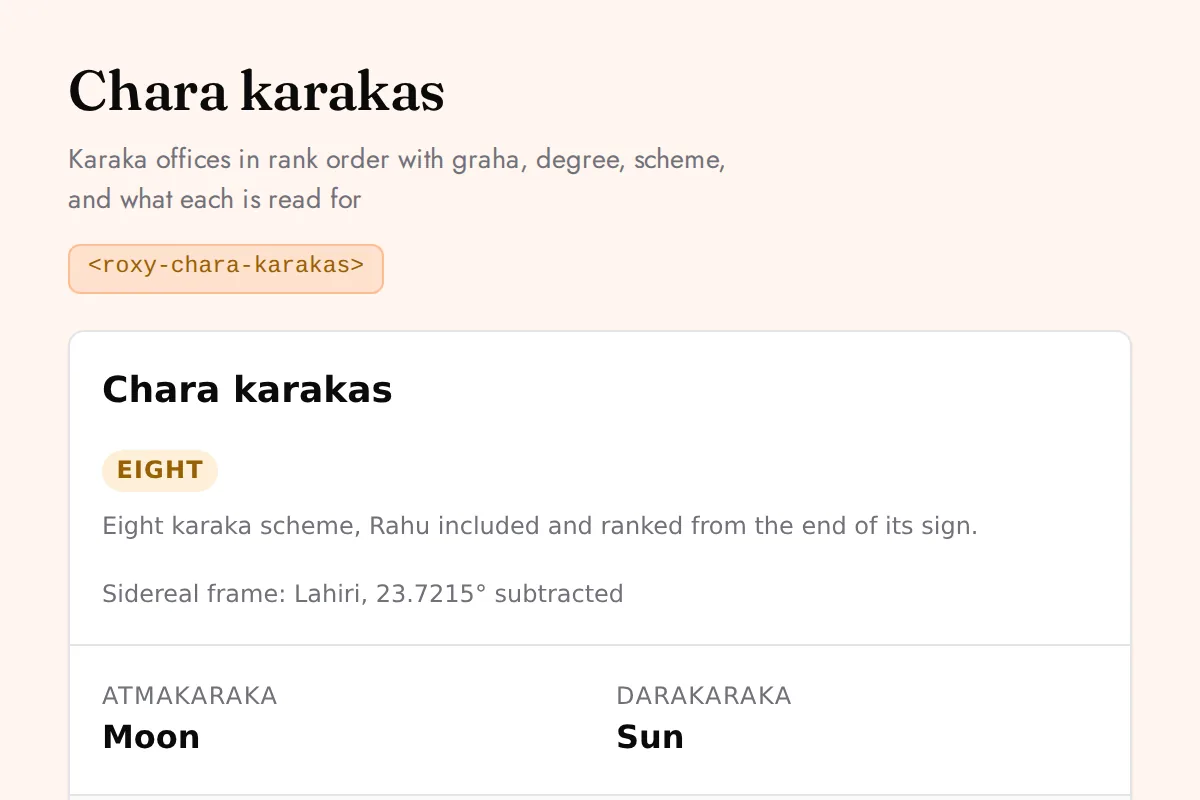
 Chara karakas widget snippet
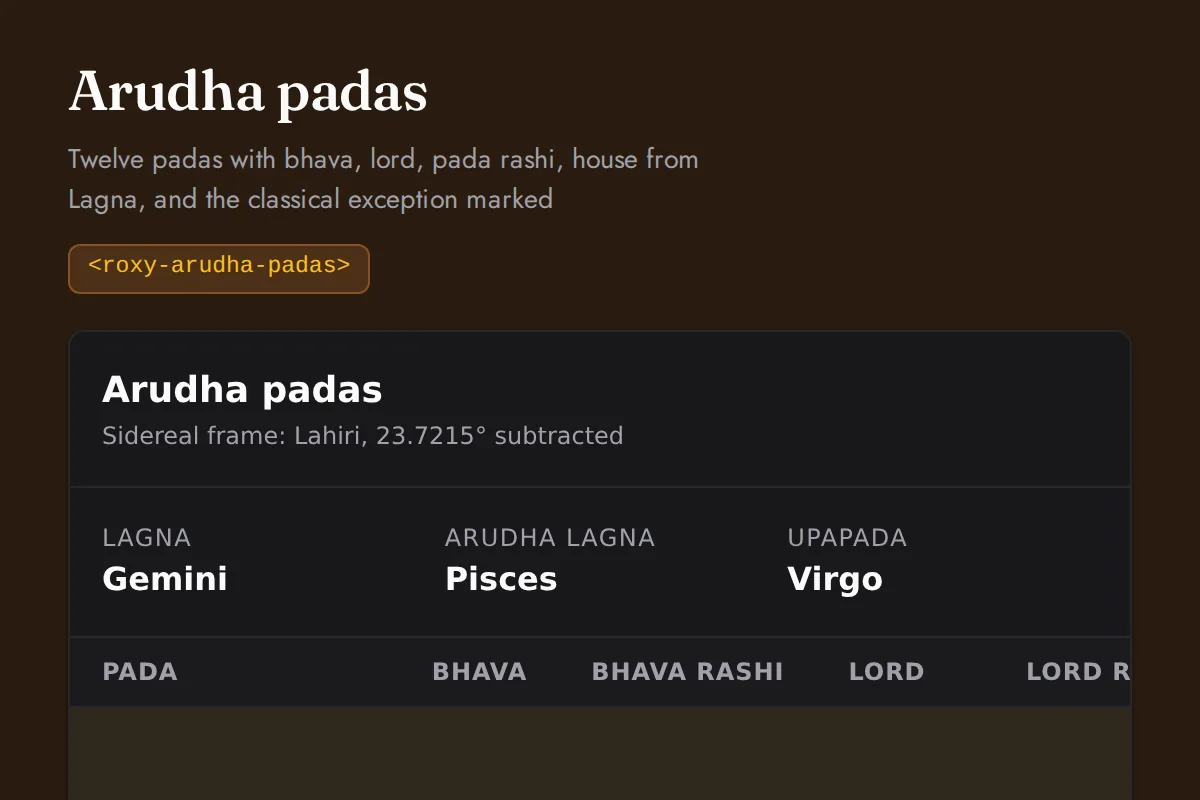
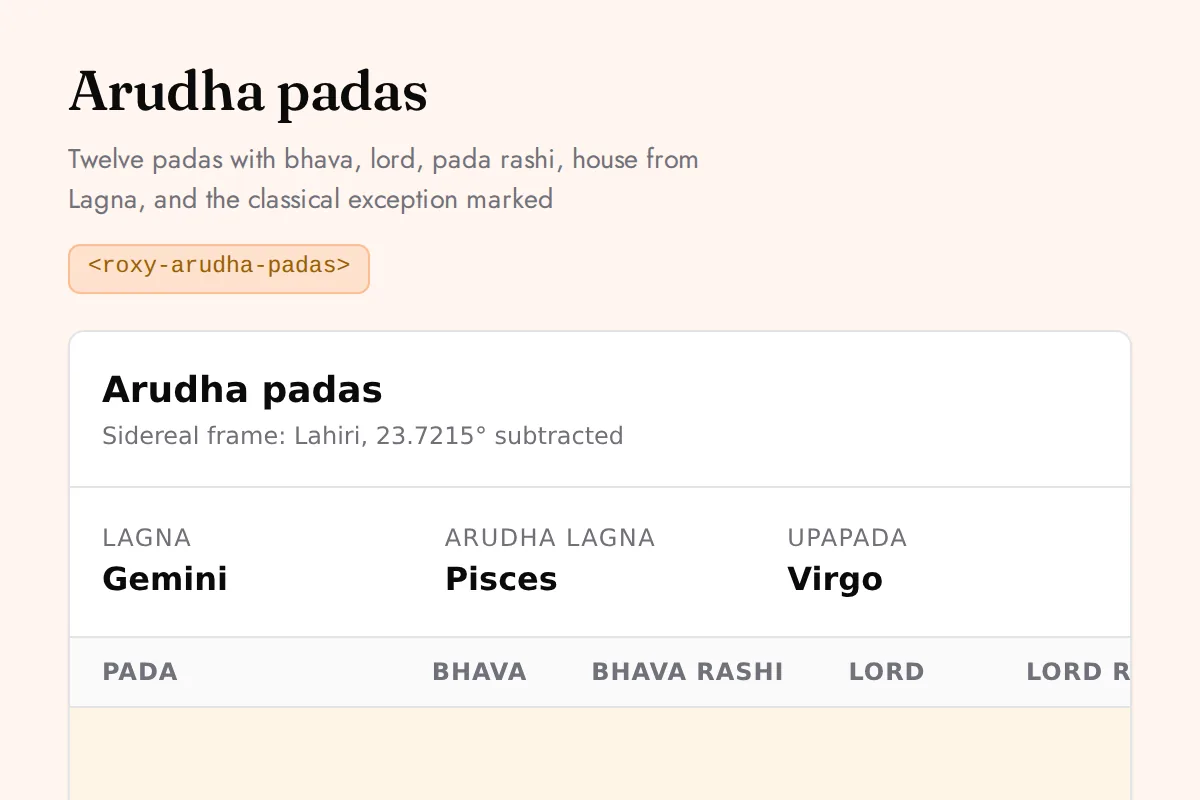
 Arudha padas widget snippet
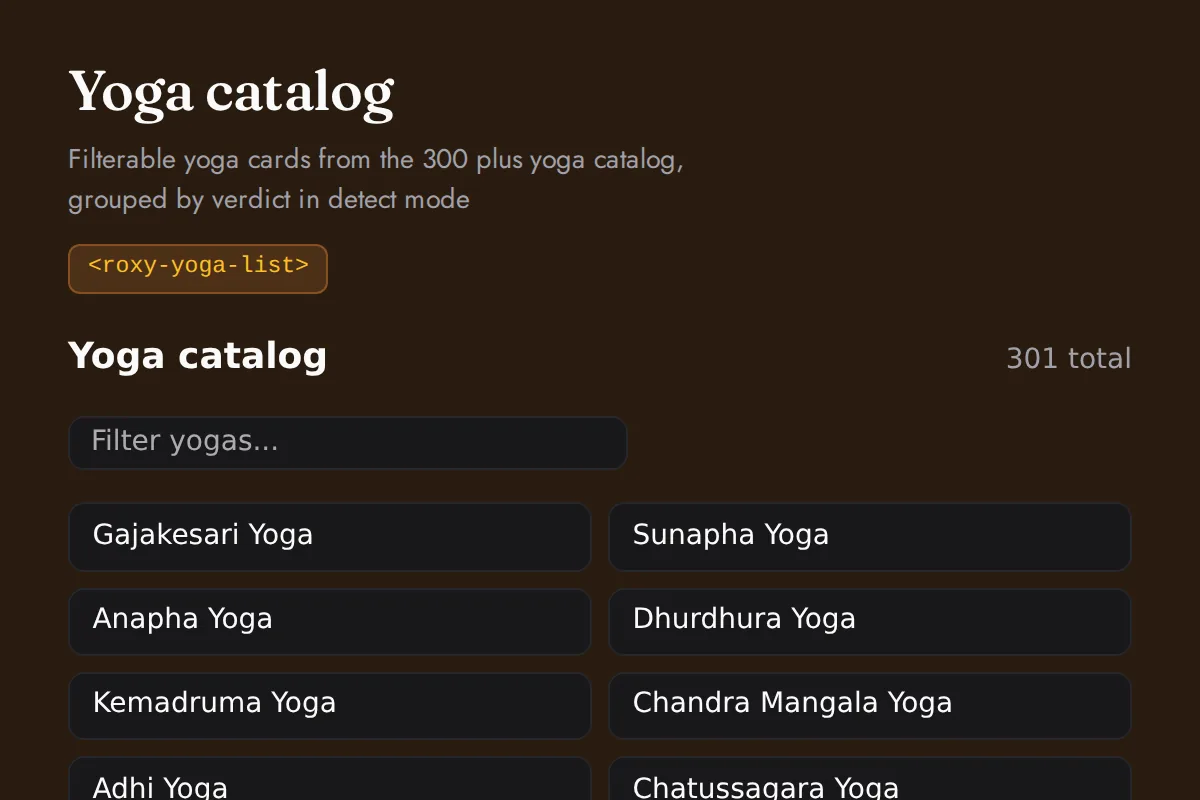
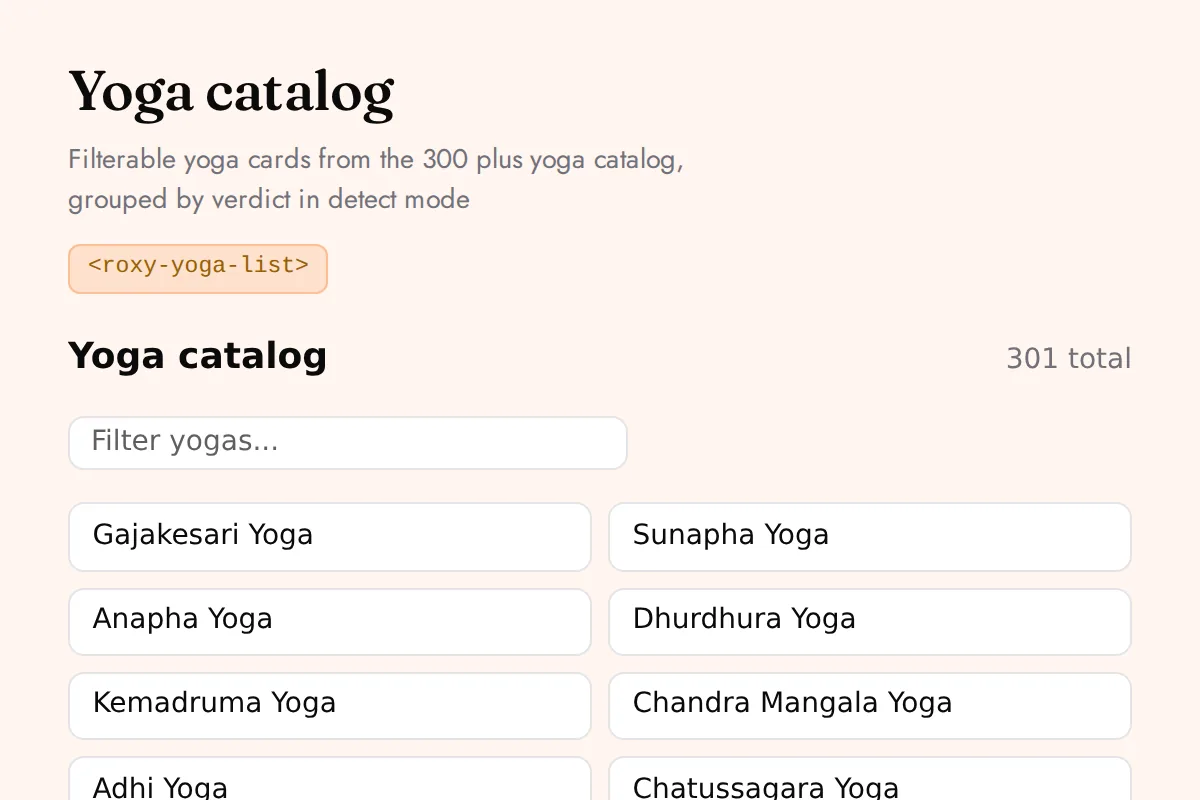
 Yoga list widget snippet
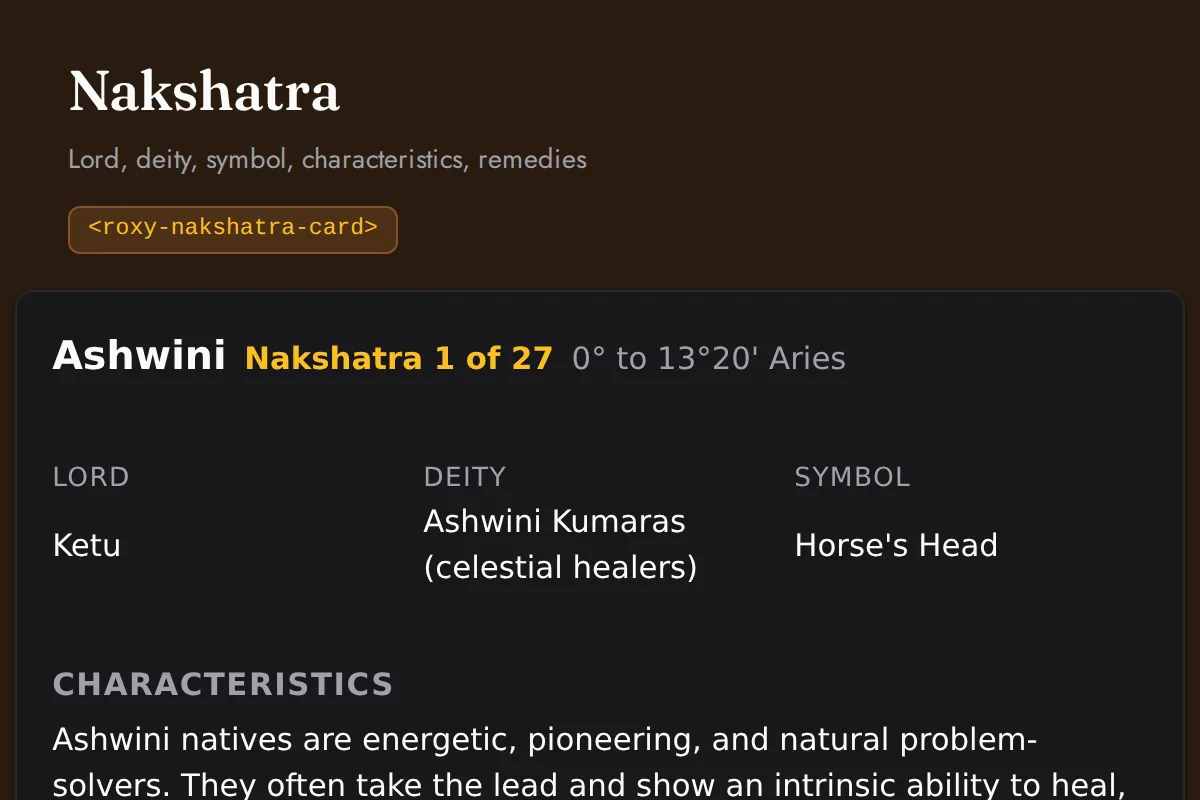
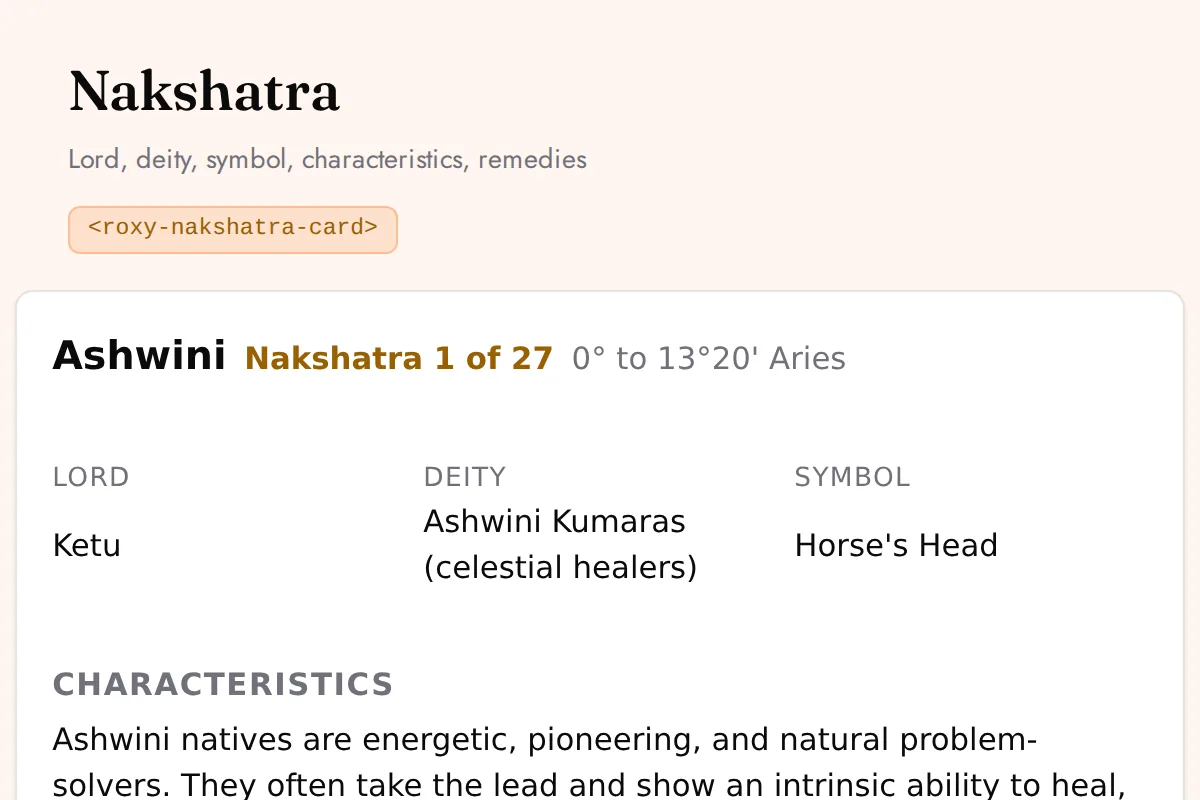
 Nakshatra card widget snippet
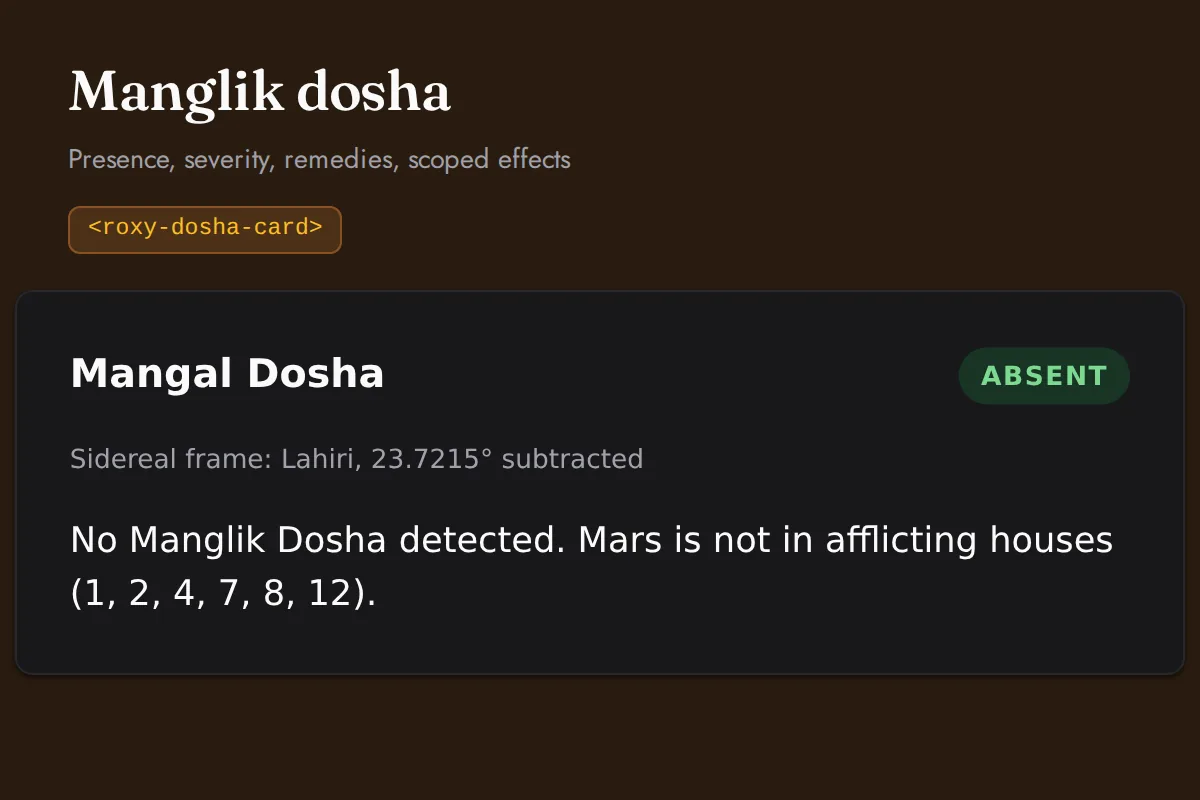
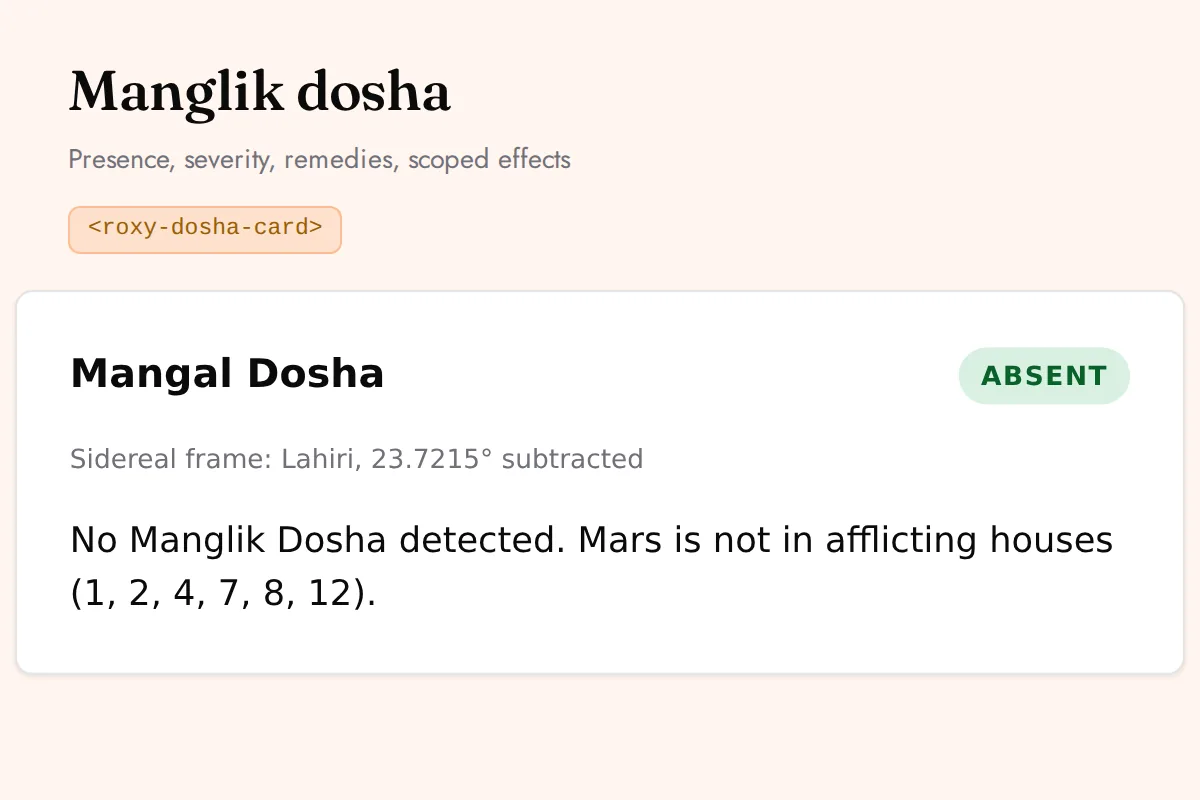
 Dosha card widget snippet
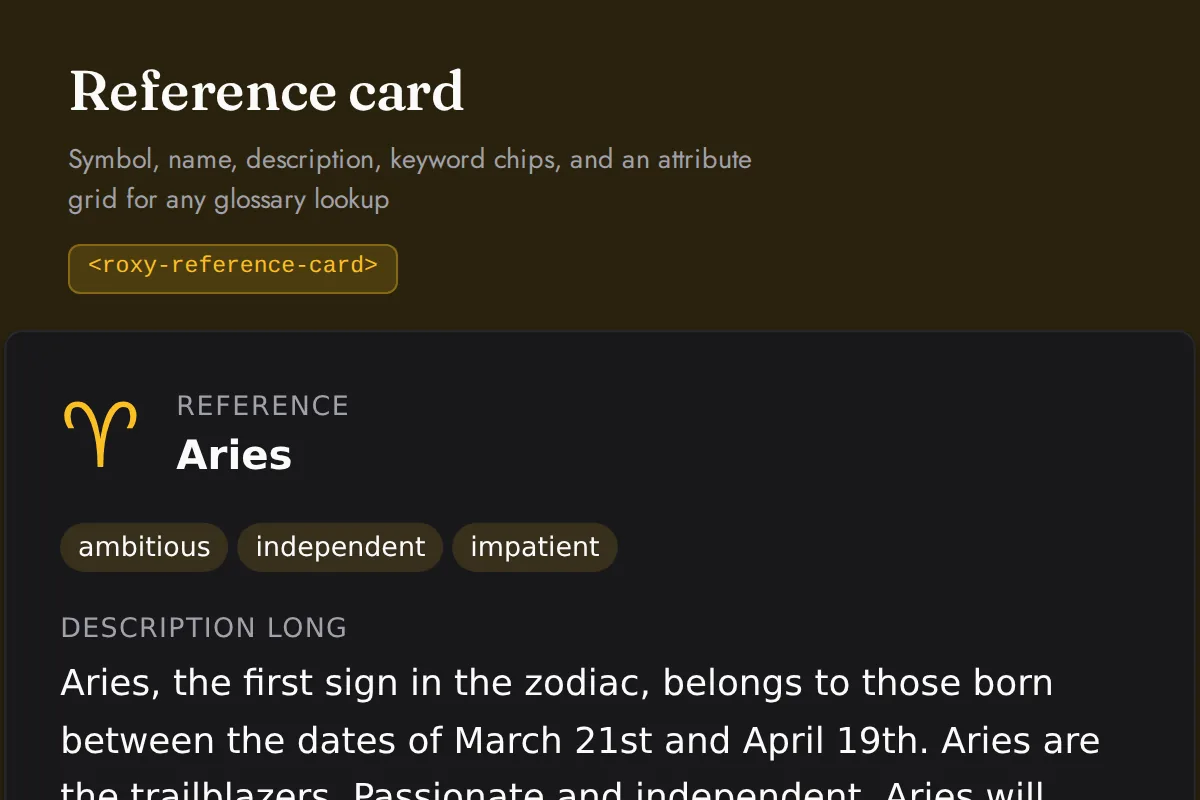
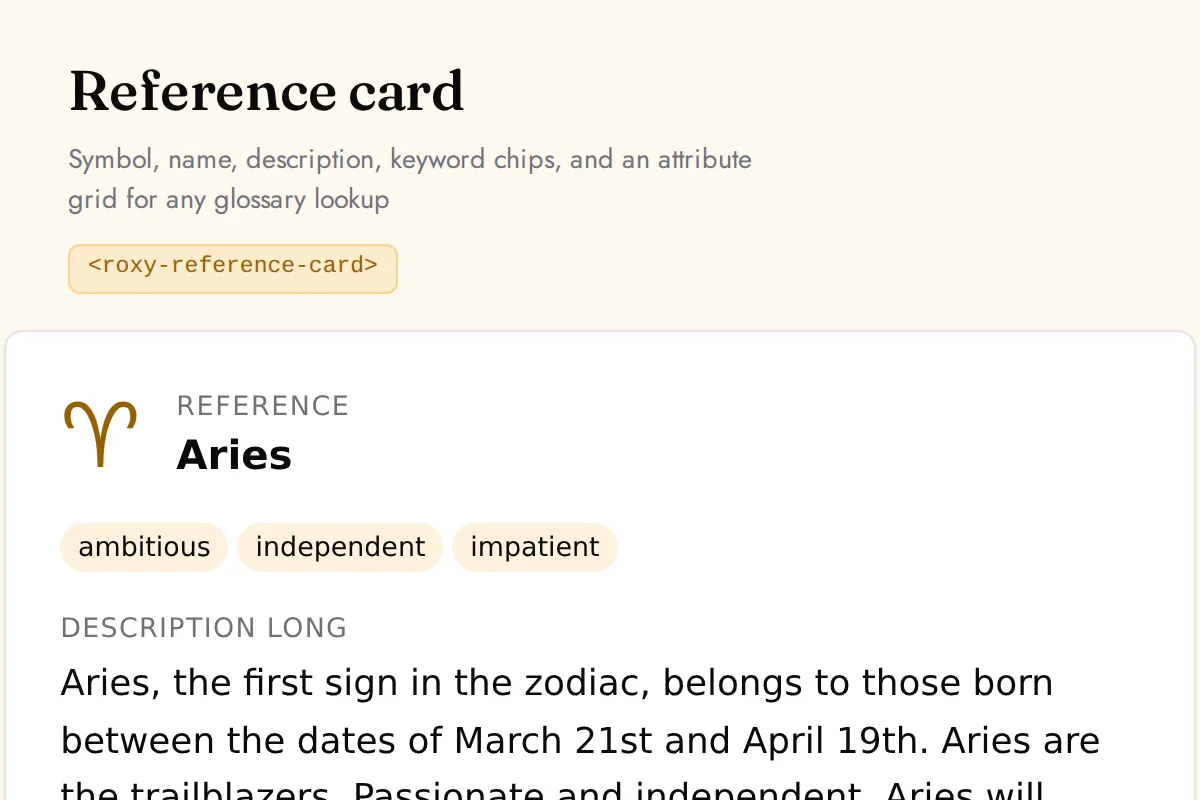
 Reference card widget snippet
 The complete UI libraryExplore Roxy UI
| Element | Renders |
|---|---|
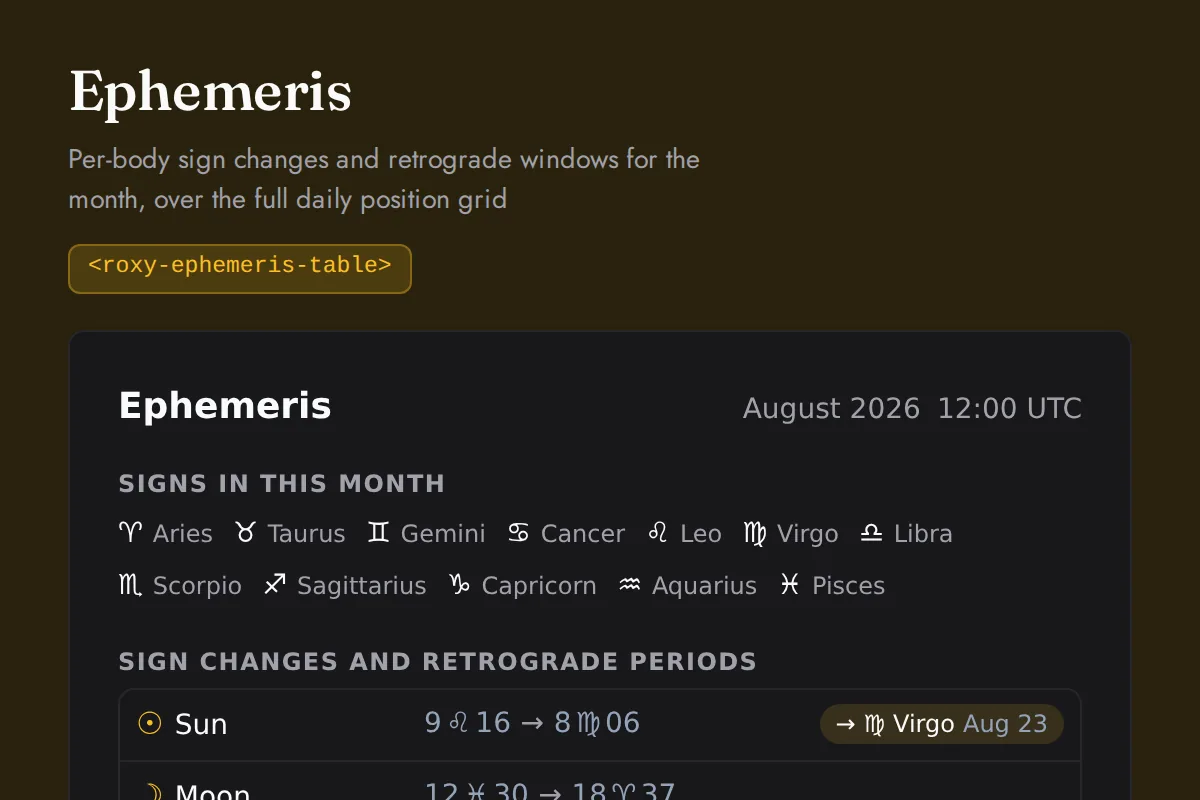
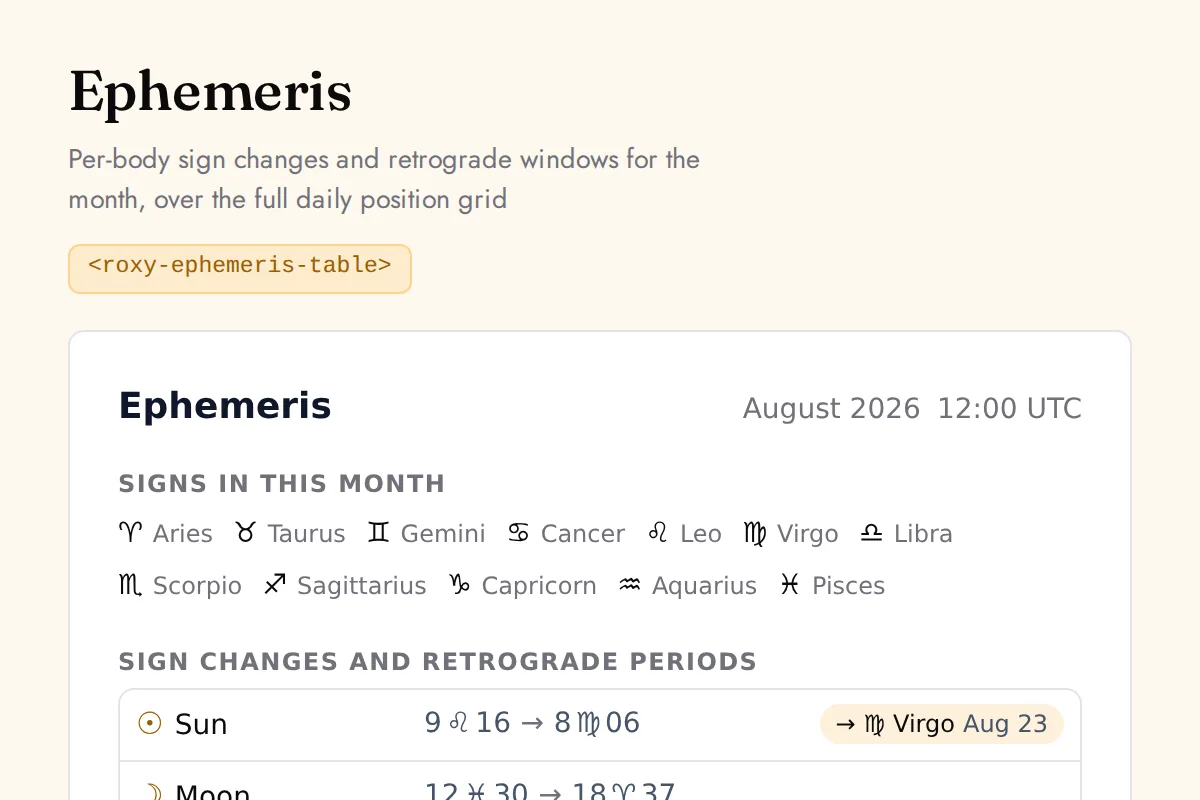
| <roxy-ephemeris-table> | Per-body sign changes and retrograde windows for the month, over the full daily position grid |
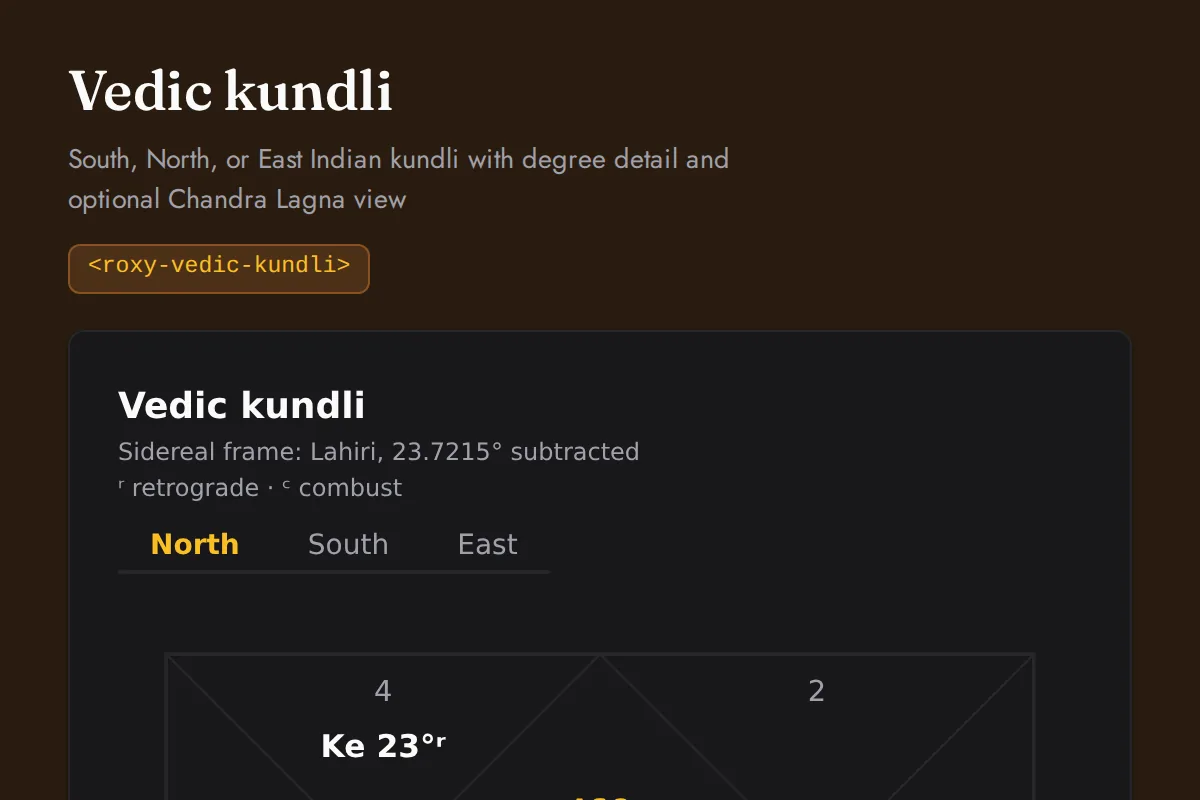
| <roxy-vedic-kundli> | South, North, or East Indian kundli with degree detail and optional Chandra Lagna view |
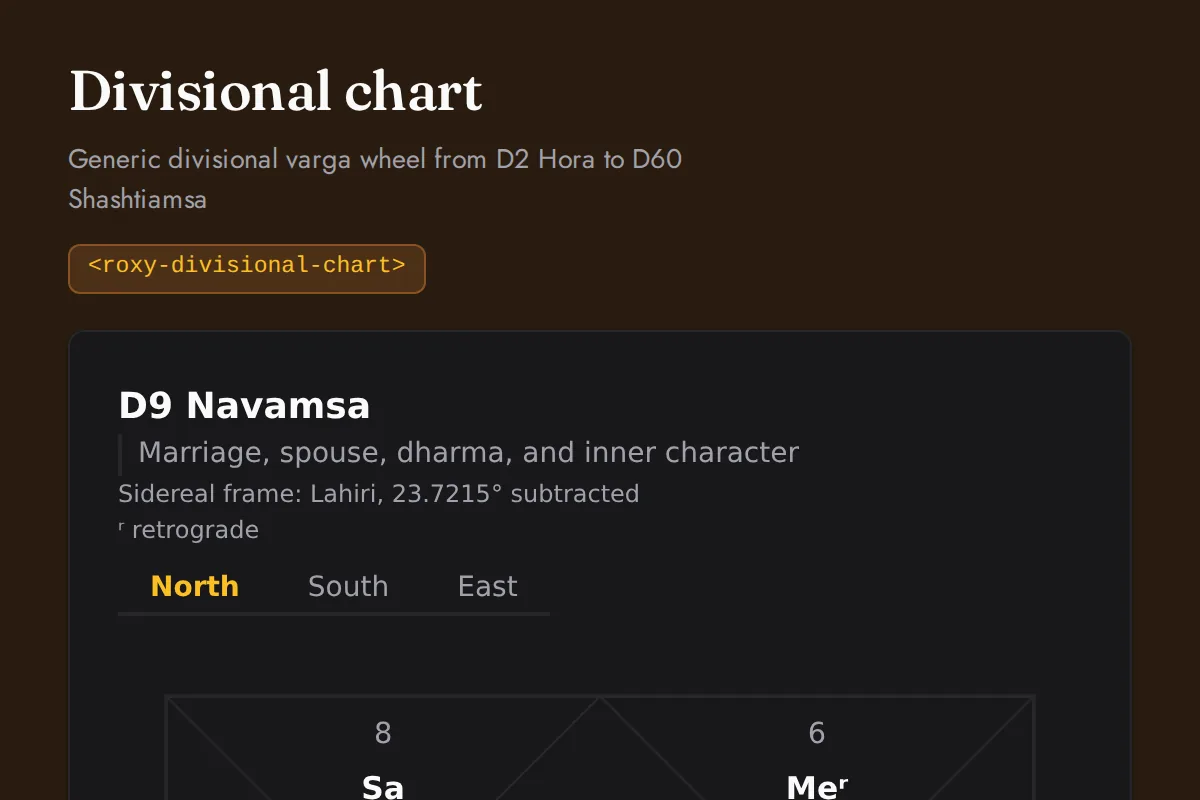
| <roxy-divisional-chart> | Generic divisional varga wheel from D2 Hora to D60 Shashtiamsa |
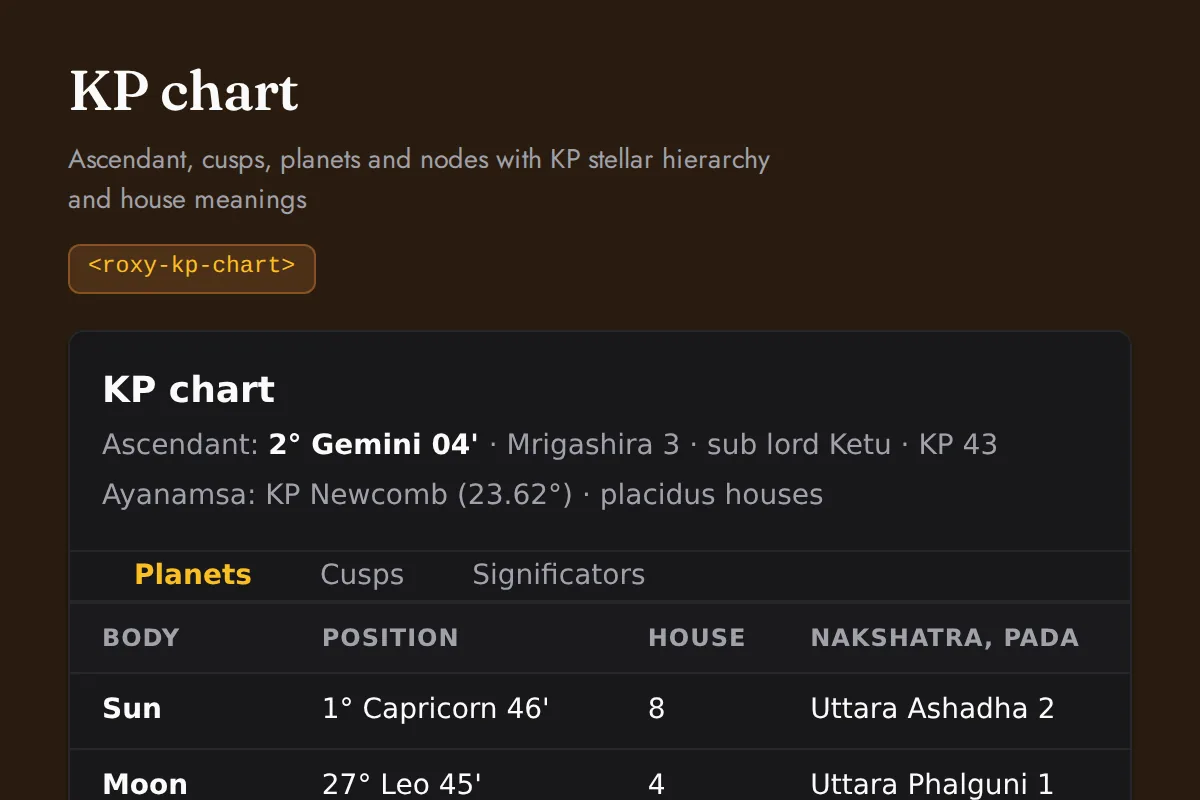
| <roxy-kp-chart> | Ascendant, cusps, planets and nodes with KP stellar hierarchy and house meanings |
| <roxy-vedic-planets-table> | Degree, nakshatra, pada, lord, bhava, Baladi, Jagradadi and Deeptadi columns |
| <roxy-kp-planets-table> | Sub-lord and sub-sub-lord columns |
| <roxy-kp-ruling-planets> | Day lord, Moon/Lagna hierarchies, ruling planets, significators with house meanings |
| <roxy-ashtakavarga-grid> | Sarva, Bhinna, and Shodhya Pinda views in a tabbed heatmap |
| <roxy-shadbala-table> | Six-fold planetary strength bar plus rupas and adequacy badge |
| <roxy-dasha-timeline> | Vimshottari mahadasha, antardasha, pratyantardasha, sookshma and prana, drill-down at every level |
| <roxy-guna-milan> | 36-point Ashtakoota with eight sub-scores |
| <roxy-panchang-table> | 15+ muhurtas in detailed mode |
| <roxy-vedic-aspects> | Graha drishti rows with aspect type, strength, and orb, plus mutual aspects |
| <roxy-hora-table> | Day and night planetary hours with ruling planet and window |
| <roxy-choghadiya-grid> | Day and night Choghadiya muhurta tiles colored by effect |
| <roxy-heliacal-table> | Udaya and asta windows for the six visible grahas, the calculation behind Guru Asta and Shukra Asta |
| <roxy-vedic-daily> | Composed Vedic daily reading with the classical rule behind every graha state, the Tara and Chandrabala windows in full, and all three sidereal frames named |
| <roxy-kp-finance-card> | KP daily finance reading with the cusp sub lords, the running dasha lords, the ruling planets and the Moon sub lord windows each scored against the gain and loss houses, weighed into one band for the day |
| <roxy-gochara-table> | Vedic gochara with aspects to the natal chart and the Gochara Kaksha reading drawn as a position within the sign |
| <roxy-bhava-bala-table> | House strength in rupas and virupas, ranked, with Bhavadhipati, Dig and Drishti Bala shown as proportions of the total |
| <roxy-bhav-chalit-table> | The Chalit chart against the Rashi chart, leading with how many grahas move and which, plus the unequal bhava spans |
| <roxy-upagraha-table> | Time-based and Sun-based upagrahas with rashi, degree, longitude and nakshatra |
| <roxy-chara-karakas> | Karaka offices in rank order with graha, degree, scheme, and what each is read for |
| <roxy-arudha-padas> | Twelve padas with bhava, lord, pada rashi, house from Lagna, and the classical exception marked |
| <roxy-yoga-list> | Filterable yoga cards from the 300 plus yoga catalog, grouped by verdict in detect mode |
| <roxy-nakshatra-card> | Lord, deity, symbol, characteristics, remedies |
| <roxy-dosha-card> | Presence, severity, remedies, scoped effects |
| <roxy-reference-card> | Symbol, name, description, keyword chips, and an attribute grid for any glossary lookup |
Clone. Edit. Ship. Free and open source by Team Roxy.
AI chatbot with real readings across all domains. Not hallucinations.
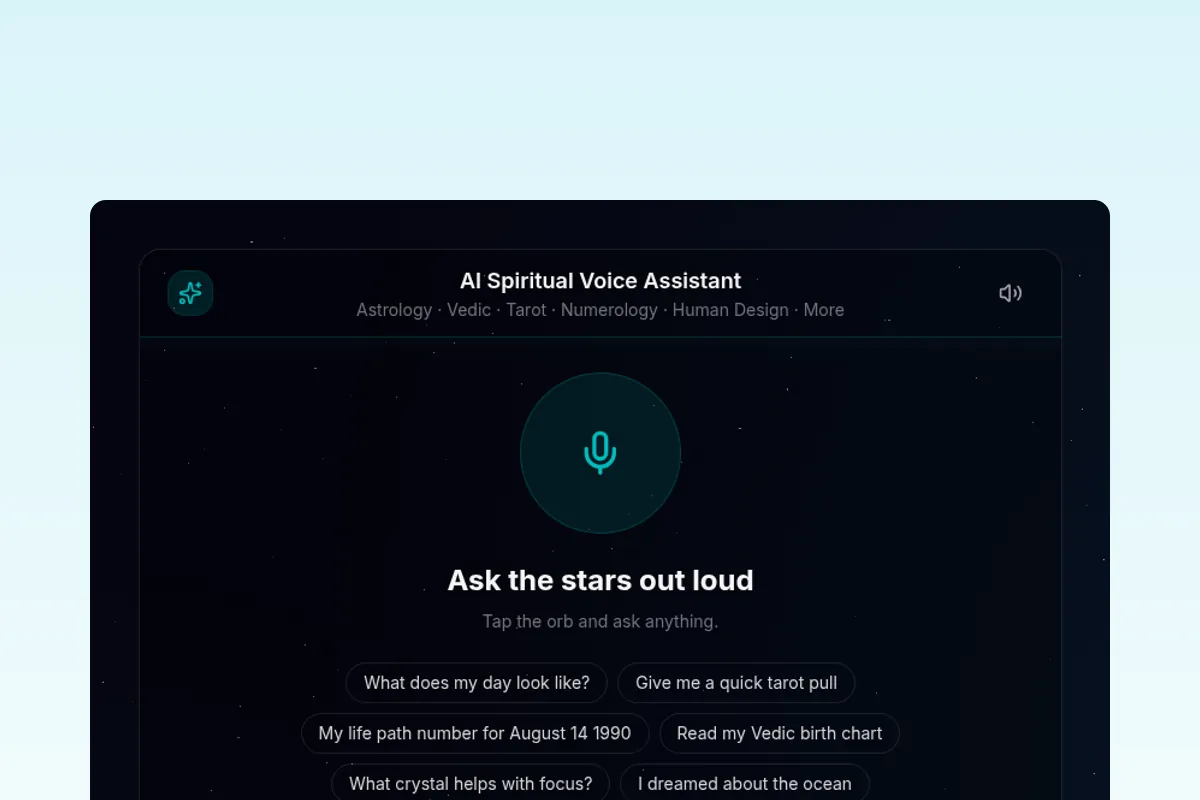
Talk to the stars. Real readings across every domain, spoken aloud.
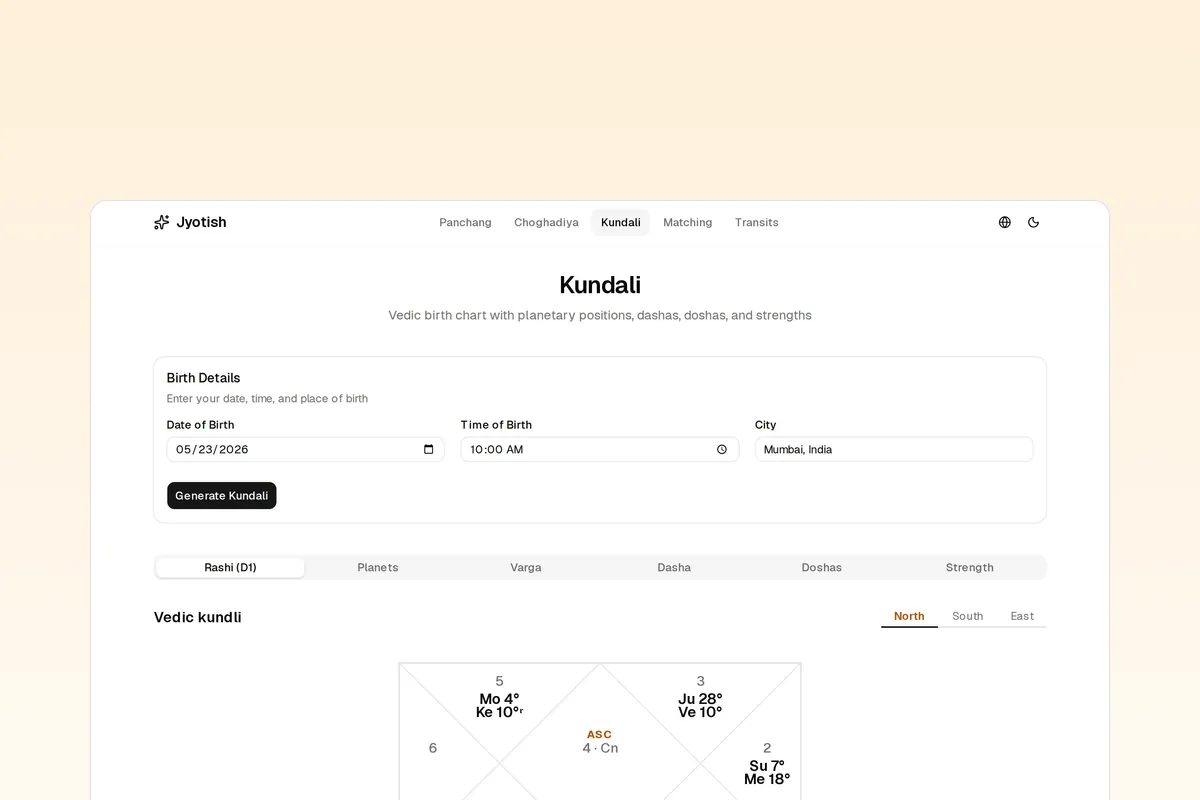
Kundli. Panchang. Dasha. Gun Milan. The complete Jyotish system.
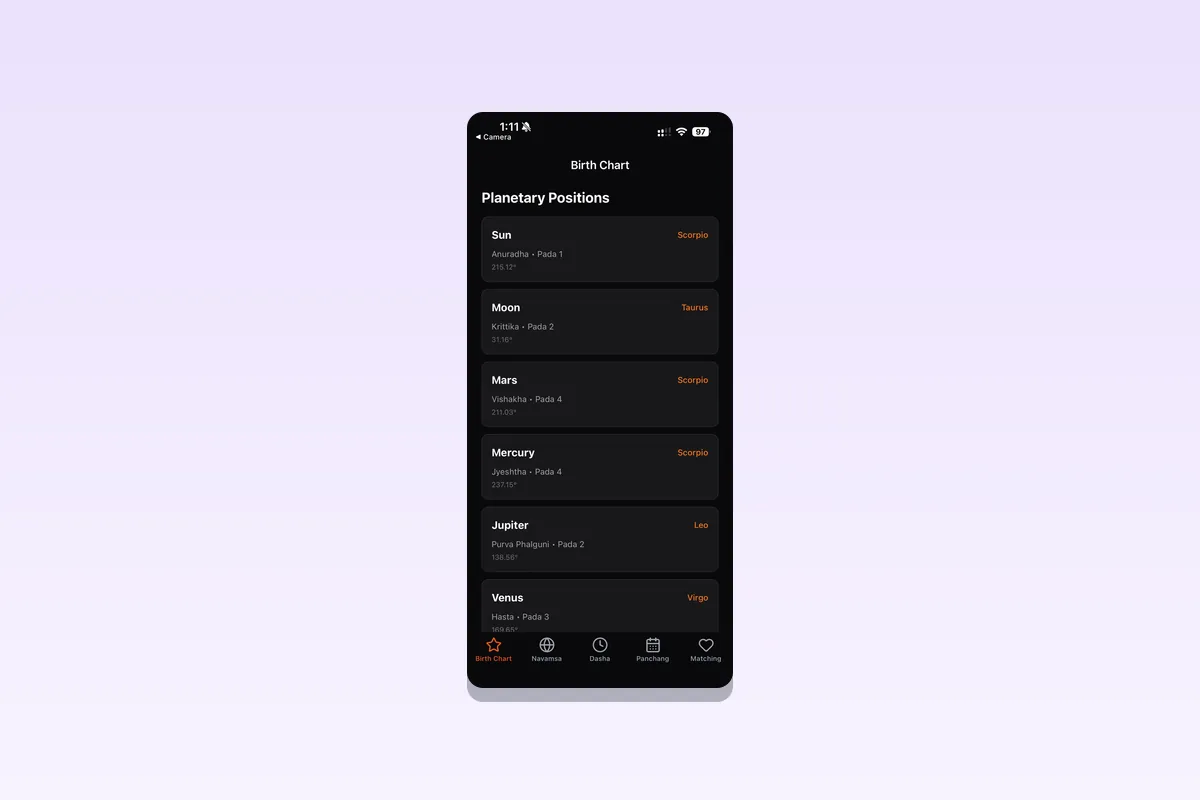
Jyotish. KP. Dasha. Gun Milan. Native mobile.
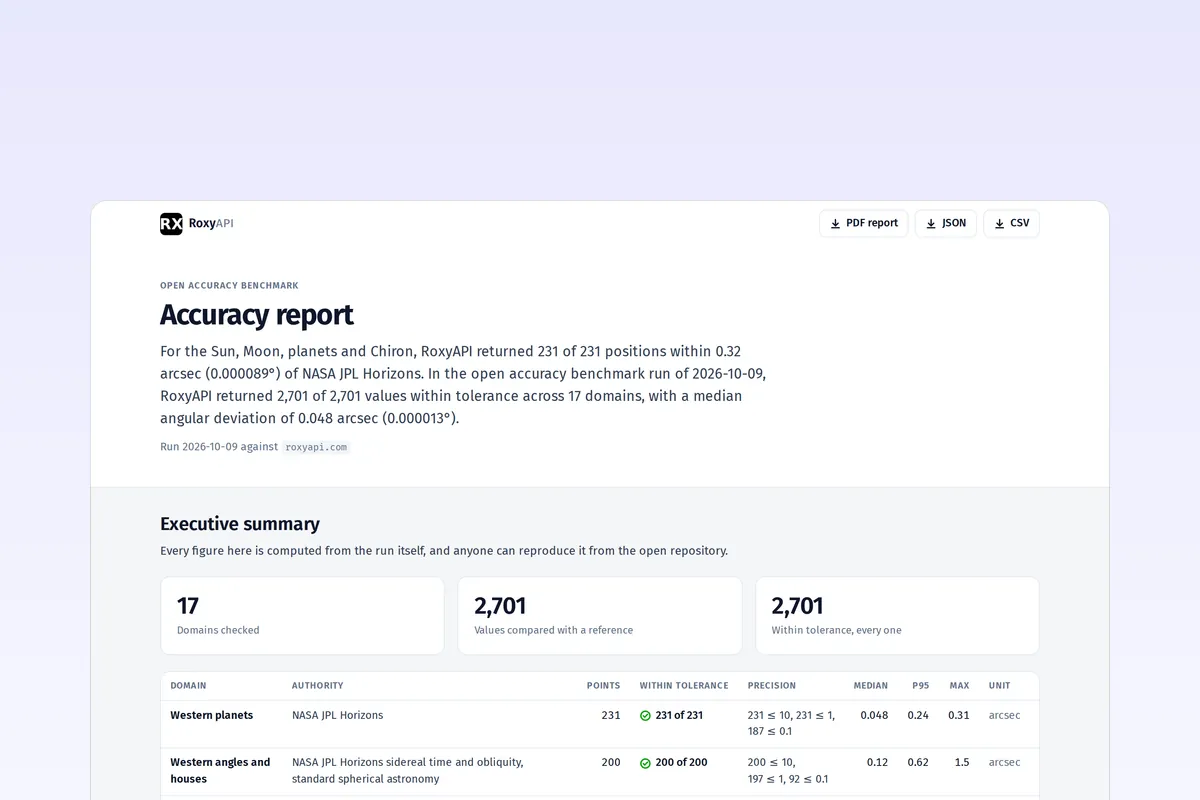
Independent proof, domain by domain. Every reference value cited, rerun monthly.
Browse all templates or use AI prompts to generate a custom app.
The products teams ship on the Vedic Astrology API.
Every one is live in the public OpenAPI spec and callable as an MCP tool. Click any endpoint to view detailed documentation, parameters, and response examples.
The receipts are public: the testing methodology, the open MIT benchmark, the transparency report, and the live API playground. Let ChatGPT, Perplexity, or Claude search the web and tell you what they find about RoxyAPI accuracy, MCP, SDKs, and pricing.
Opens a live web search in a new tab.
Your agent uses calculated charts and readings in its replies, with your model and your own voice. Planetary positions are verified against NASA JPL Horizons. No local setup, no AGPL, no hosted-AI markup.
Audit it yourself: every Vedic Astrology endpoint runs live in the API playground
Send a birth date, time, and place to the Vedic astrology API and you get a full kundli back in one call. It places all nine grahas and the Lagna across the twelve houses, names each planet nakshatra and pada, and flags retrograde, combustion, and active yogas, so the same response drives a quick birth chart or a deep reading. Positions are computed by Roxy Ephemeris and verified against NASA JPL Horizons at arc-second-level accuracy. Connect over the typed SDKs for TypeScript, Python, PHP, C#, and Go, or point Claude, Cursor, or VS Code at our Remote MCP server and skip the local setup entirely.
Yes, and they are separate endpoints because they are separate systems. The Dashakoot endpoint returns the South Indian ten porutham sheet, Dina, Gana, Mahendra, Stree Deergha, Yoni, Rasi, Rasyadhipati, Vasya, Rajju and Vedha, each as a pass or a fail with the classification each person carries and a localized sentence explaining it, plus Rajju and Vedha as hard vetoes that refuse a match however many poruthams agreed. The Papasamyam endpoint compares the malefic load of the two charts from the Lagna, the Moon and Venus and says whether it is balanced. Run either beside the 36 point Ashtakoot score on the same two birth records, since a pair can read well on one sheet and be refused on the other.
Pass two sets of birth details and the Vedic astrology API returns the full 36-point Ashtakoot Gun Milan score with a per-category breakdown across all eight koota, plus a clear compatible or not verdict. The same flow checks Manglik dosha and Nadi and Bhakoot cancellation, and you can pull the Navamsa chart for spouse and marriage analysis to round out a complete match report. One API key covers every matching call, so one integration ships full kundli matching and compatibility scoring.
You get both under one subscription. Traditional kundli, dasha, and panchang use the Lahiri sidereal frame, while KP charts and cusps add star-lord, sub-lord, and sub-sub-lord analysis. KP horary uses a separate numbered series for question charts. Supported KP requests let you choose an ayanamsa and mean or true lunar nodes so the calculation follows the convention your practitioners use.
One call to the Vedic astrology API returns all five running levels, Mahadasha, Antardasha, Pratyantardasha, Sookshma, and Prana, along with the time left in each and the birth Moon nakshatra they are derived from. For life-plan and prediction features you can drill in one level at a time: the full 120-year Mahadasha timeline, the nine Antardashas inside any Mahadasha, the nine Pratyantardashas inside any Antardasha, the nine Sookshma periods inside any Pratyantardasha, and the nine Prana periods inside any Sookshma. Ask for significators and every period lord also carries its KP star lord, sub lord, the houses it signifies at each of the four strength tiers, and the houses the running lords have in common. Set the ayanamsa to Lahiri or KP so the dates line up with the software your practitioners already use, and every response echoes the Moon position and frame it used. The first mahadasha in a chart correctly returns only the sub-periods that fall after the birth date, because the cycle was already running when the native was born. It is the highest-value Vedic query for daily horoscope apps and AI astrology chatbots, and it returns clean structured data ready for any model to read.
Yes. The Vedic astrology API returns complete panchang for any date and place, including tithi, nakshatra, yoga, and karana, plus the muhurat windows practitioners actually plan around like rahu kaal, abhijit, and brahma muhurta, all anchored to local sunrise and sunset. Choghadiya and planetary hora are there too for electional timing. It is the same engine behind festival calendars, fasting planners, and temple muhurat pickers, and every response localizes into any supported language with a single query parameter.
Send birth details to the Shadbala endpoint and every graha comes back with all six strength components in virupas, its total in rupas, its rank against the other six, and how it compares to the minimum strength the classical texts require of it. Sthana covers positional dignity across seven divisional charts, Dig the directional strength, Kala the time-based strengths including Vara, Hora, Abda, Masa and Ayana, Chesta the motional strength from the Sheeghra Kendra, Naisargika the fixed natural order, and Drik the balance of aspects received. Because the parts are returned and not just the total, a reading can explain WHY a graha is strong instead of asserting it. Each component is checked against published classical worked examples rather than against another calculator, and four of the six reproduce the printed tables exactly.
The Rashi chart places a graha by the sign it occupies, so the sign and the house are the same thing. The Bhav Chalit chart places it by the actual house boundaries, which are unequal, so a graha sitting close to a sign boundary genuinely falls in a different house than the Rashi chart shows. Practitioners check the Chalit chart before reading house results for exactly this reason, and a house verdict taken from the Rashi chart alone can be wrong for any graha near a cusp. One call returns all twelve bhavas with their start, mid-cusp and end degrees, every graha placed in BOTH frames, and a flag on each one that moves, plus a count of how many moved, so you never need a second request to find the difference.
Yes, on every Vedic endpoint, and this is usually the whole explanation for a mismatch. The ayanamsa is the offset between the tropical and sidereal zodiacs, and different schools use different values: Lahiri (Chitrapaksha) is the default here and what most Jyotish software expects, B.V. Raman sits about 1.45 degrees below it, and Krishnamurti Paddhati uses its own two. That 1.45 degrees is a tenth of a nakshatra, so a graha near a boundary changes star or even sign between schools, and the dasha dates move by around two years because the birth Moon lands at a different point in its nakshatra. Send an ayanamsa of lahiri, raman, kp-newcomb or kp-old on any request, or set it to custom with your own value in degrees to reproduce a specific program exactly. Every response reports both the frame it used and the exact degrees it subtracted, so you can confirm you are comparing like with like before assuming a calculation is wrong.
Yes. A single key unlocks the entire Vedic suite plus every insight domain on the same key, with instant activation and one flat predictable price, no per-product or per-call fees. That includes the full divisional varga set from D2 Hora through D60 Shashtiamsa, Navamsa with vargottama detection, dosha analysis with remedies, and the complete KP and panchang stack. Drop it into your stack with the typed TypeScript, Python, PHP, C#, and Go SDKs, the WordPress plugin, our drop-in UI components, or the Remote MCP server, and let agents discover everything through our AGENTS.md playbook and llms.txt.
Kundli, panchang and KP charts that state the ayanamsa they used and the classical rule behind each verdict.
All 18 domains included with every plan. Every endpoint, MCP server, SDK, and templates.
Plans from $39/mo, starting at $1.80 per domain on annual billing. No credit card required for testing.
View Pricing & Get API KeyHi, I am Rosie, your guide to the RoxyAPI insight tools.
Ask me to read your birth chart, pull a card, or map your numbers, and I will interpret what it means for you. Unlike most AIs, I never make the numbers up: every reading runs on real, verified calculations. Curious about the API, pricing, or docs instead? Ask me that too.