Vimshottari Dasha API
Dasha Calculator API
Included with every plan (at no extra cost)
Calculate all five running Vimshottari Dasha levels with remaining time in each. The levels are Mahadasha, Antardasha, Pratyantardasha, Sookshma, and Prana. Accurate dasha calculator API for life phase prediction and planetary period analysis. Returns the dasha timeline with start/end dates for every level, ready for a current DBA readout down to hour-level timing. Pass datetime to read the five lords at any moment instead of now, which is what a reading prepared for tomorrow or a backtest over a past day needs. Set significators true to add the KP star lord, sub lord, signified houses and strength grade of each running lord, plus the houses they have in common. Essential for understanding current planetary influences, dasha transitions, and timing events in Vedic astrology. 120-year dasha system based on moon nakshatra at birth, with selectable Lahiri or KP ayanamsa.
Location first, chart second
The Vimshottari Dasha API needs latitude, longitude, and timezone. Never ask users to type coordinates. Resolve a city with the Location endpoint first, then feed the result into the request. Timezone accepts a decimal offset or an IANA name.
1 Resolve the location
curl "https://roxyapi.com/api/v2/location/search?q=New York" \
  -H "X-API-Key: YOUR_KEY"
# -> cities[0]: { latitude, longitude, timezone: "America/New_York" }
2 Call the Vimshottari Dasha endpoint
# feed latitude, longitude and timezone from step 1
POST https://roxyapi.com/api/v2/vedic-astrology/dasha/current
Request
POST /api/v2/vedic-astrology/dasha/current
Parameters
| Parameter | Type | Description |
|---|---|---|
| langquery | string enum | Response language (BCP 47). Supported: en, tr, de, es, hi, pt, fr, ru, zh-Hans, zh-Hant. Defaults to en. Coverage varies by domain, and a field with no translation in the requested language returns English. Default en. |
| focusquery | string enum | Which signification vocabulary the houseThemes map returns. "general" gives the classical bhava significations (self, wealth, siblings, home, and so on). "finance" gives the money reading of the same twelve bhavas, so house 2 returns income and savings, 5 speculation and risk appetite, 8 sudden money and leverage, 11 gains and profits, and 12 expenses and capital outflow. Use "finance" for wealth, income, business and market timing questions in Krishnamurti Paddhati, where the significator house groups 2, 6, 10, 11 for earned income and 5, 8, 11 for speculation are read against a running dasha. Defaults to "general". Default general. |
Request body
| Field | Type | Description |
|---|---|---|
| date* | string (date) | Birth date in YYYY-MM-DD format. Date determines planetary positions and nakshatra calculations for Vedic kundli (janam patri). Accurate birth date is essential for dashas, yoga calculations, and divisional charts (vargas). |
| time* | string (time) | Birth time in 24-hour HH:MM:SS format. Time is CRITICAL for Lagna (Ascendant) calculation and house divisions. It changes every two hours roughly. Even minutes matter for accurate nakshatra pada and divisional chart (D9, D10) calculations. Without exact time, Lagna and house-based predictions will be incorrect. |
| latitude* | number | Birth location latitude in decimal degrees. Location determines local sidereal time for Lagna calculation and affects bhava (house) cusps. Example: Delhi 28.6139, Mumbai 19.0760, Kathmandu 27.7172. |
| longitude* | number | Birth location longitude in decimal degrees. Affects local time calculations and ayanamsha adjustments. Example: Delhi 77.2090, Mumbai 72.8777, Kathmandu 85.3240. |
| timezone | number or string | Timezone: an IANA name (e.g. "America/New_York", "Europe/London", or `cities[0].timezone` from /location/search) or decimal hours from UTC (e.g. -5 for EST, 5.5 for IST). An IANA name is resolved to the offset in force at the given date and time. Defaults to 5.5. |
| ayanamsa | string enum | Ayanamsa system used to place the birth Moon in its nakshatra, which sets every dasha start and end date. "lahiri" uses Lahiri/Chitrapaksha, the traditional Vedic standard, and is the default. "kp-newcomb" uses the KP-Newcomb dynamic formula, matching Krishnamurti Paddhati software. "kp-old" uses the Krishnamurti original table from KP Reader-1. "raman" uses the B.V. Raman ayanamsa, the second frame traditional Indian software commonly offers beside Lahiri. "custom" takes your own value in degrees via ayanamsaValue, for reconciling exactly against a specific reference program. Switching frames shifts every dasha boundary by weeks, so pick the one your reference software uses. |
| ayanamsaValue | number | Custom ayanamsa value in degrees. When provided, overrides the computed ayanamsa from the selected type. Use for testing with specific ayanamsa values or matching a particular reference source. |
| significators | boolean | Set true to attach the KP significators of each period lord: its star lord, sub lord, occupied house, the houses it signifies at levels L1 to L4, and a strength grade. Off by default, so responses stay exactly as they are for clients that only need dates. Requires the birth latitude and longitude, since significators are read off a Placidus house chart, and uses the same ayanamsa frame selected above. |
| nodeType | string enum | Lunar node type for Rahu and Ketu, used ONLY when "significators" is true. Dasha dates themselves come from the Moon and never move with this field. "mean" uses the smooth mean node (traditional default). "true" uses the osculating node, which swings up to 1.5 degrees either side of mean over a 173-day cycle and can therefore change which house or star a node falls in. Defaults to "mean". |
| datetime | string (date-time) | ISO 8601 datetime (YYYY-MM-DDTHH:MM:SS) to read the running periods at, for a reading prepared for a future day, a backtest, or a chart cast for a past moment. Defaults to the current instant. Interpreted as local time in the request timezone (a trailing Z is accepted but ignored); with timezone 0 it is UTC. |
Example request
{
  "date": "1990-07-04",
  "time": "10:12:00",
  "latitude": 28.6139,
  "longitude": 77.209,
  "timezone": 5.5,
  "ayanamsa": "lahiri",
  "ayanamsaValue": 24,
  "significators": false,
  "nodeType": "mean",
  "datetime": "2026-08-23T13:47:46Z"
}
Response
Structured JSON with documented fields, covered by 13,405 automated tests per deploy, 3,620 of them gold-standard tests verified against NASA JPL Horizons. Not hallucinated text.
{
  "moonNakshatra": 17,
  "nakshatraName": "Anuradha",
  "nakshatraLord": "Saturn",
  "moonLongitude": 215.3357941260375,
  "ayanamsa": 23.72820879,
  "ayanamsaType": "lahiri",
  "mahadasha": {
    "planet": "Ketu",
    "startDate": "2023-08-27T10:12:00",
    "endDate": "2030-08-27T10:12:00",
    "durationYears": 7,
    "interpretation": "This period is often spiritually oriented, emphasizing detachment, introspection, and self-realization. It may bring unique experiences and insights."
  },
  "antardasha": {
    "planet": "Rahu",
    "startDate": "2026-07-27T20:12:00",
    "endDate": "2027-08-15T09:24:00",
    "durationYears": 1.0501026694045175,
    "mahadashaLord": "Ketu",
    "interpretation": "This period can bring both positive and negative experiences. It may signify sudden changes, ambitions, and material desires. Spiritual growth is also possible during this period."
  },
  "pratyantardasha": {
    "planet": "Rahu",
    "startDate": "2026-07-27T20:12:00",
    "endDate": "2026-09-23T08:59:00",
    "durationYears": 0.15751540041067763,
    "mahadashaLord": "Ketu",
    "antardashaLord": "Rahu",
    "interpretation": "This period can bring both positive and negative experiences. It may signify sudden changes, ambitions, and material desires. Spiritual growth is also possible during this period."
  },
  "sookshmaDasha": {
    "planet": "Mercury",
    "startDate": "2026-08-22T06:03:00",
    "endDate": "2026-08-30T09:39:00",
    "durationYears": 0.022314681724845995,
    "mahadashaLord": "Ketu",
    "antardashaLord": "Rahu",
    "pratyantardashaLord": "Rahu",
    "interpretation": "It is a period of intellectual growth, communication skills, and adaptability. Success in education, business, and creative pursuits may be prominent."
  },
  "pranaDasha": {
    "planet": "Ketu",
    "startDate": "2026-08-23T09:45:00",
    "endDate": "2026-08-23T21:10:00",
    "durationYears": 0.001301689767282683,
    "mahadashaLord": "Ketu",
    "antardashaLord": "Rahu",
    "pratyantardashaLord": "Rahu",
    "sookshmaLord": "Mercury",
    "interpretation": "This period is often spiritually oriented, emphasizing detachment, introspection, and self-realization. It may bring unique experiences and insights."
  },
  "remainingInMahadasha": {
    "years": 4,
    "months": 0,
    "days": 4,
    "totalDays": 1465
  },
  "remainingInAntardasha": {
    "years": 0,
    "months": 11,
    "days": 22,
    "totalDays": 357
  },
  "remainingInPratyantardasha": {
    "years": 0,
    "months": 1,
    "days": 1,
    "totalDays": 31
  },
  "remainingInSookshma": {
    "years": 0,
    "months": 0,
    "days": 7,
    "totalDays": 7
  },
  "remainingInPrana": {
    "years": 0,
    "months": 0,
    "days": 1,
    "totalDays": 1
  }
}
Response fields
| Field | Type | Description |
|---|---|---|
| houseThemes | object | Significations of each of the twelve bhavas (houses), keyed by house number 1 to 12, as short keywords. Bhava 1 is the Lagna (self, body, vitality), 2 wealth and speech, 4 home and mother, 7 marriage and partnership, 10 career and status, 11 gains. Use it to label the house numbers returned elsewhere in the response: a Vimshottari dasha period signifying houses 2, 7 and 8, or a KP significator carrying houses 11 and 6, becomes readable text without a separate lookup call. Returned once per response rather than repeated per period, and localized by the lang query parameter alongside every other interpretation field. |
| focus | string enum | Which signification vocabulary produced the houseThemes keywords in this response, echoing the focus query parameter. Always present, and "general" when the parameter was omitted. Read it to label a rendered house legend, or to tell two cached responses apart when only one asked for the finance lens. |
| moonNakshatra* | integer | Birth Moon nakshatra number (1-27). This nakshatra determines the starting dasha lord in the Vimshottari 120-year cycle. |
| nakshatraName* | string | Name of the birth Moon nakshatra (lunar mansion). One of 27 Vedic nakshatras from Ashwini to Revati. |
| nakshatraLord* | string enum | Vimshottari dasha lord of the birth nakshatra. This planet rules the first Mahadasha in the native life cycle. |
| moonLongitude* | number | Sidereal (nirayana) longitude of the birth Moon in degrees, 0 to 360, measured in the ayanamsa frame reported below. This single value determines the birth nakshatra and therefore every dasha start and end date in this response. Compare it against a reference chart to reconcile any date difference at its source. |
| ayanamsa* | number | Ayanamsa actually applied, in degrees. The precession offset subtracted from the tropical (sayana) longitude to get the sidereal (nirayana) one. Lahiri sits near 23 deg 43 min for a 1990 birth, KP-Newcomb near 23 deg 38 min. |
| ayanamsaType* | string enum | Ayanamsa system used, echoing the request field. One of "lahiri", "kp-newcomb", "kp-old" or "custom". Echoed so a client can confirm which frame produced these dates without re-deriving it. When it reads "custom" the ayanamsa field above carries the exact value you supplied. |
| mahadasha* | object | Mahadasha (major planetary period) in the 120-year Vimshottari dasha cycle. Start and end dates are determined by Moon nakshatra at birth. |
| mahadasha.planet* | string enum | Ruling graha of this Vimshottari dasha period. One of 9 planets in the Ketu-Venus-Sun-Moon-Mars-Rahu-Jupiter-Saturn-Mercury sequence. |
| mahadasha.startDate* | string | Start datetime of this dasha period. Adjusted to the requested timezone offset. |
| mahadasha.endDate* | string | End datetime of this dasha period. Adjusted to the requested timezone offset. |
| mahadasha.durationYears* | number | Duration of this dasha period in years. Mahadasha durations range from 6 years (Sun) to 20 years (Venus). |
| mahadasha.nominalStartDate | string | Theoretical start of this period, present ONLY when the birth date truncated it. The Vimshottari cycle is already running when a native is born, so the period in force at birth began earlier: startDate is clipped to the birth moment while this field keeps the real start. Its presence is also why the first period of a chart can contain fewer than 9 sub-periods, the earlier ones having finished before birth. Absent on every period that runs its full length. |
Show all fieldsShow fewer fields
| Field | Type | Description |
|---|---|---|
| mahadasha.interpretation | string | Vedic interpretation of the planetary period describing themes, karmic lessons, and life areas affected by this graha. |
| mahadasha.significators | object | KP significators of this period lord, read from the Placidus birth chart in the requested ayanamsa. Present only when the request sets "significators": true. |
| mahadasha.significators.house* | integer | House 1-12 this lord occupies in the Placidus birth chart. Its own Level 2 signification, repeated here because the occupied house is the first thing a KP reading looks at. |
| mahadasha.significators.starLord* | string | Lord of the nakshatra this planet sits in, one of the 9 grahas. In KP the star lord outranks the planet itself: a period lord mainly delivers the houses its star lord occupies and owns, which is why those appear at L1 and L3 rather than the planet own house. |
| mahadasha.significators.subLord | string | KP sub lord of this planet, the 1 of 249 subdivision its longitude falls in, one of the 9 grahas. The star lord says WHAT results the period gives, the sub lord says WHETHER they materialize, so KP judgement checks both. |
| mahadasha.significators.signifies* | object | KP 4-level significator breakdown showing which houses (1-12) this planet signifies at each strength tier. L1 is strongest, L4 is weakest. |
| mahadasha.significators.signifies.L1* | array of integer | Level 1, the strongest signification (grade A). Houses influenced because this planet sits in the nakshatra (star) of a planet occupying those houses. For Rahu and Ketu, also includes the L1 houses of their agent planets (conjoined, aspecting, sign lord). |
| mahadasha.significators.signifies.L2* | array of integer | Level 2 (grade B). The house this planet physically occupies. For Rahu and Ketu, also includes houses occupied by their agent planets. |
| mahadasha.significators.signifies.L3* | array of integer | Level 3 (grade C). Houses influenced because this planet sits in the nakshatra of the sign lord (owner) of those houses. For Rahu and Ketu, also includes the L3 houses of their agent planets. |
| mahadasha.significators.signifies.L4* | array of integer | Level 4, the weakest signification (grade D). Houses this planet rules by zodiac sign ownership, up to 2 for Sun through Saturn and 3 where a sign is intercepted. Rahu and Ketu own no sign, so their L4 comes entirely from their agent planets. |
| mahadasha.significators.signifiedHouses* | array of integer | Every house this lord signifies, deduplicated and ordered strongest tier first. Where a house is reached at more than one level it is listed once, at its strongest. This is the flat "houses signified" column of a KP dasha table. |
| mahadasha.significators.strongHouses* | array of integer | Subset of signifiedHouses reached at grade A or B (levels L1 and L2). These are the houses a KP reading acts on for this period; the rest are supporting connections. |
| mahadasha.significators.strength* | object | How firmly this lord is tied to the houses it signifies, on the KP A to D significator grading. Reproducible from the significator levels alone, in two steps. STEP 1, per house keep only the strongest level: a planet routinely reaches the same house at more than one level, for example its star lord occupies house 11 and it also owns house 11, and KP cites a significator by its best connection, so that house counts once at grade A. This is why signifiedHouses is shorter than the four level arrays concatenated, and omitting it is what makes a hand calculation disagree. STEP 2, average the surviving weights: each house contributes 100, 75, 50 or 25 for grade A, B, C or D, and the mean is the score. Worked example, a lord signifying house 11 at level 1, house 6 at level 2 and house 2 at level 4 scores (100 + 75 + 25) / 3 = 66.7, which lands in band B because the band edges are the midpoints 87.5, 62.5 and 37.5. The score says how firmly the lord is connected, never whether the houses are favourable, which depends on the matter being judged. |
| mahadasha.significators.strength.score* | number | Mean KP percentage weight across signifiedHouses, each house counted at its strongest level (A 100, B 75, C 50, D 25). A mean rather than a total, so signifying many houses weakly does not outrank signifying two houses at grade A. |
| mahadasha.significators.strength.grade* | string enum | Band the score falls in, on the standard KP significator grading: A planets in the constellation of the occupant, B occupants, C planets in the constellation of the house owner, D the house owner. Band edges are the midpoints between the four weights. |
| mahadasha.significators.strength.label* | string enum | Plain-language form of grade: "very-strong" for A, "strong" for B, "moderate" for C, "weak" for D. Says how firmly this lord is connected to the houses it signifies, NOT whether those houses are favourable, which depends on the matter being judged. |
| antardasha* | object | Antardasha (bhukti), sub-period within a Mahadasha. Each Mahadasha contains 9 Antardashas proportional to the Vimshottari years of each planet. |
| antardasha.planet* | string enum | Ruling graha of this Vimshottari dasha period. One of 9 planets in the Ketu-Venus-Sun-Moon-Mars-Rahu-Jupiter-Saturn-Mercury sequence. |
| antardasha.startDate* | string | Start datetime of this dasha period. Adjusted to the requested timezone offset. |
| antardasha.endDate* | string | End datetime of this dasha period. Adjusted to the requested timezone offset. |
| antardasha.durationYears* | number | Duration of this dasha period in years. Mahadasha durations range from 6 years (Sun) to 20 years (Venus). |
| antardasha.nominalStartDate | string | Theoretical start of this period, present ONLY when the birth date truncated it. The Vimshottari cycle is already running when a native is born, so the period in force at birth began earlier: startDate is clipped to the birth moment while this field keeps the real start. Its presence is also why the first period of a chart can contain fewer than 9 sub-periods, the earlier ones having finished before birth. Absent on every period that runs its full length. |
| antardasha.interpretation | string | Vedic interpretation of the planetary period describing themes, karmic lessons, and life areas affected by this graha. |
| antardasha.significators | object | KP significators of this period lord, read from the Placidus birth chart in the requested ayanamsa. Present only when the request sets "significators": true. |
| antardasha.significators.house* | integer | House 1-12 this lord occupies in the Placidus birth chart. Its own Level 2 signification, repeated here because the occupied house is the first thing a KP reading looks at. |
| antardasha.significators.starLord* | string | Lord of the nakshatra this planet sits in, one of the 9 grahas. In KP the star lord outranks the planet itself: a period lord mainly delivers the houses its star lord occupies and owns, which is why those appear at L1 and L3 rather than the planet own house. |
| antardasha.significators.subLord | string | KP sub lord of this planet, the 1 of 249 subdivision its longitude falls in, one of the 9 grahas. The star lord says WHAT results the period gives, the sub lord says WHETHER they materialize, so KP judgement checks both. |
| antardasha.significators.signifies* | object | KP 4-level significator breakdown showing which houses (1-12) this planet signifies at each strength tier. L1 is strongest, L4 is weakest. |
| antardasha.significators.signifies.L1* | array of integer | Level 1, the strongest signification (grade A). Houses influenced because this planet sits in the nakshatra (star) of a planet occupying those houses. For Rahu and Ketu, also includes the L1 houses of their agent planets (conjoined, aspecting, sign lord). |
| antardasha.significators.signifies.L2* | array of integer | Level 2 (grade B). The house this planet physically occupies. For Rahu and Ketu, also includes houses occupied by their agent planets. |
| antardasha.significators.signifies.L3* | array of integer | Level 3 (grade C). Houses influenced because this planet sits in the nakshatra of the sign lord (owner) of those houses. For Rahu and Ketu, also includes the L3 houses of their agent planets. |
| antardasha.significators.signifies.L4* | array of integer | Level 4, the weakest signification (grade D). Houses this planet rules by zodiac sign ownership, up to 2 for Sun through Saturn and 3 where a sign is intercepted. Rahu and Ketu own no sign, so their L4 comes entirely from their agent planets. |
| antardasha.significators.signifiedHouses* | array of integer | Every house this lord signifies, deduplicated and ordered strongest tier first. Where a house is reached at more than one level it is listed once, at its strongest. This is the flat "houses signified" column of a KP dasha table. |
| antardasha.significators.strongHouses* | array of integer | Subset of signifiedHouses reached at grade A or B (levels L1 and L2). These are the houses a KP reading acts on for this period; the rest are supporting connections. |
| antardasha.significators.strength* | object | How firmly this lord is tied to the houses it signifies, on the KP A to D significator grading. Reproducible from the significator levels alone, in two steps. STEP 1, per house keep only the strongest level: a planet routinely reaches the same house at more than one level, for example its star lord occupies house 11 and it also owns house 11, and KP cites a significator by its best connection, so that house counts once at grade A. This is why signifiedHouses is shorter than the four level arrays concatenated, and omitting it is what makes a hand calculation disagree. STEP 2, average the surviving weights: each house contributes 100, 75, 50 or 25 for grade A, B, C or D, and the mean is the score. Worked example, a lord signifying house 11 at level 1, house 6 at level 2 and house 2 at level 4 scores (100 + 75 + 25) / 3 = 66.7, which lands in band B because the band edges are the midpoints 87.5, 62.5 and 37.5. The score says how firmly the lord is connected, never whether the houses are favourable, which depends on the matter being judged. |
| antardasha.significators.strength.score* | number | Mean KP percentage weight across signifiedHouses, each house counted at its strongest level (A 100, B 75, C 50, D 25). A mean rather than a total, so signifying many houses weakly does not outrank signifying two houses at grade A. |
| antardasha.significators.strength.grade* | string enum | Band the score falls in, on the standard KP significator grading: A planets in the constellation of the occupant, B occupants, C planets in the constellation of the house owner, D the house owner. Band edges are the midpoints between the four weights. |
| antardasha.significators.strength.label* | string enum | Plain-language form of grade: "very-strong" for A, "strong" for B, "moderate" for C, "weak" for D. Says how firmly this lord is connected to the houses it signifies, NOT whether those houses are favourable, which depends on the matter being judged. |
| antardasha.mahadashaLord* | string enum | Parent Mahadasha lord under which this Antardasha sub-period runs. |
| pratyantardasha* | object | Pratyantardasha (sub-sub-period), the third level of the Vimshottari dasha hierarchy, Provides finer timing within each Antardasha for event prediction. |
| pratyantardasha.planet* | string enum | Ruling graha of this Vimshottari dasha period. One of 9 planets in the Ketu-Venus-Sun-Moon-Mars-Rahu-Jupiter-Saturn-Mercury sequence. |
| pratyantardasha.startDate* | string | Start datetime of this dasha period. Adjusted to the requested timezone offset. |
| pratyantardasha.endDate* | string | End datetime of this dasha period. Adjusted to the requested timezone offset. |
| pratyantardasha.durationYears* | number | Duration of this dasha period in years. Mahadasha durations range from 6 years (Sun) to 20 years (Venus). |
| pratyantardasha.nominalStartDate | string | Theoretical start of this period, present ONLY when the birth date truncated it. The Vimshottari cycle is already running when a native is born, so the period in force at birth began earlier: startDate is clipped to the birth moment while this field keeps the real start. Its presence is also why the first period of a chart can contain fewer than 9 sub-periods, the earlier ones having finished before birth. Absent on every period that runs its full length. |
| pratyantardasha.interpretation | string | Vedic interpretation of the planetary period describing themes, karmic lessons, and life areas affected by this graha. |
| pratyantardasha.significators | object | KP significators of this period lord, read from the Placidus birth chart in the requested ayanamsa. Present only when the request sets "significators": true. |
| pratyantardasha.significators.house* | integer | House 1-12 this lord occupies in the Placidus birth chart. Its own Level 2 signification, repeated here because the occupied house is the first thing a KP reading looks at. |
| pratyantardasha.significators.starLord* | string | Lord of the nakshatra this planet sits in, one of the 9 grahas. In KP the star lord outranks the planet itself: a period lord mainly delivers the houses its star lord occupies and owns, which is why those appear at L1 and L3 rather than the planet own house. |
| pratyantardasha.significators.subLord | string | KP sub lord of this planet, the 1 of 249 subdivision its longitude falls in, one of the 9 grahas. The star lord says WHAT results the period gives, the sub lord says WHETHER they materialize, so KP judgement checks both. |
| pratyantardasha.significators.signifies* | object | KP 4-level significator breakdown showing which houses (1-12) this planet signifies at each strength tier. L1 is strongest, L4 is weakest. |
| pratyantardasha.significators.signifies.L1* | array of integer | Level 1, the strongest signification (grade A). Houses influenced because this planet sits in the nakshatra (star) of a planet occupying those houses. For Rahu and Ketu, also includes the L1 houses of their agent planets (conjoined, aspecting, sign lord). |
| pratyantardasha.significators.signifies.L2* | array of integer | Level 2 (grade B). The house this planet physically occupies. For Rahu and Ketu, also includes houses occupied by their agent planets. |
| pratyantardasha.significators.signifies.L3* | array of integer | Level 3 (grade C). Houses influenced because this planet sits in the nakshatra of the sign lord (owner) of those houses. For Rahu and Ketu, also includes the L3 houses of their agent planets. |
| pratyantardasha.significators.signifies.L4* | array of integer | Level 4, the weakest signification (grade D). Houses this planet rules by zodiac sign ownership, up to 2 for Sun through Saturn and 3 where a sign is intercepted. Rahu and Ketu own no sign, so their L4 comes entirely from their agent planets. |
| pratyantardasha.significators.signifiedHouses* | array of integer | Every house this lord signifies, deduplicated and ordered strongest tier first. Where a house is reached at more than one level it is listed once, at its strongest. This is the flat "houses signified" column of a KP dasha table. |
| pratyantardasha.significators.strongHouses* | array of integer | Subset of signifiedHouses reached at grade A or B (levels L1 and L2). These are the houses a KP reading acts on for this period; the rest are supporting connections. |
| pratyantardasha.significators.strength* | object | How firmly this lord is tied to the houses it signifies, on the KP A to D significator grading. Reproducible from the significator levels alone, in two steps. STEP 1, per house keep only the strongest level: a planet routinely reaches the same house at more than one level, for example its star lord occupies house 11 and it also owns house 11, and KP cites a significator by its best connection, so that house counts once at grade A. This is why signifiedHouses is shorter than the four level arrays concatenated, and omitting it is what makes a hand calculation disagree. STEP 2, average the surviving weights: each house contributes 100, 75, 50 or 25 for grade A, B, C or D, and the mean is the score. Worked example, a lord signifying house 11 at level 1, house 6 at level 2 and house 2 at level 4 scores (100 + 75 + 25) / 3 = 66.7, which lands in band B because the band edges are the midpoints 87.5, 62.5 and 37.5. The score says how firmly the lord is connected, never whether the houses are favourable, which depends on the matter being judged. |
| pratyantardasha.significators.strength.score* | number | Mean KP percentage weight across signifiedHouses, each house counted at its strongest level (A 100, B 75, C 50, D 25). A mean rather than a total, so signifying many houses weakly does not outrank signifying two houses at grade A. |
| pratyantardasha.significators.strength.grade* | string enum | Band the score falls in, on the standard KP significator grading: A planets in the constellation of the occupant, B occupants, C planets in the constellation of the house owner, D the house owner. Band edges are the midpoints between the four weights. |
| pratyantardasha.significators.strength.label* | string enum | Plain-language form of grade: "very-strong" for A, "strong" for B, "moderate" for C, "weak" for D. Says how firmly this lord is connected to the houses it signifies, NOT whether those houses are favourable, which depends on the matter being judged. |
| pratyantardasha.mahadashaLord* | string enum | Parent Mahadasha lord under which this Antardasha sub-period runs. |
| pratyantardasha.antardashaLord* | string enum | Parent Antardasha lord under which this Pratyantardasha runs. |
| sookshmaDasha* | object | Sookshma dasha (sookshma antardasha), the fourth level of the Vimshottari dasha hierarchy. Each Pratyantardasha divides into 9 Sookshma periods running roughly 3 to 30 days each, used for day-level event timing and muhurta style selection. |
| sookshmaDasha.planet* | string enum | Ruling graha of this Vimshottari dasha period. One of 9 planets in the Ketu-Venus-Sun-Moon-Mars-Rahu-Jupiter-Saturn-Mercury sequence. |
| sookshmaDasha.startDate* | string | Start datetime of this dasha period. Adjusted to the requested timezone offset. |
Supported options
lang
focus
ayanamsa
nodeType
Call it in your language.
Every snippet is generated from the live OpenAPI spec, so method names, parameters, and fields always match production.
import { createRoxy } from '@roxyapi/sdk'

const roxy = createRoxy(process.env.ROXY_API_KEY!)
const { data } = await roxy.vedicAstrology.getCurrentDasha({ body: { date: '1990-07-04', time: '10:12:00', latitude: 28.6139, longitude: 77.209 } })
Install: npm install @roxyapi/sdk
from roxy_sdk import create_roxy

roxy = create_roxy("YOUR_API_KEY")
result = roxy.vedic_astrology.get_current_dasha(date='1990-07-04', time='10:12:00', latitude=28.6139, longitude=77.209)
Install: pip install roxy-sdk
use function RoxyAPI\Sdk\createRoxy;

$roxy = createRoxy(getenv('ROXY_API_KEY'));
$result = $roxy->vedicAstrology->getCurrentDasha(date: '1990-07-04', time: '10:12:00', latitude: 28.6139, longitude: 77.209);
Install: composer require roxyapi/sdk
using RoxyApi;

var roxy = new RoxyClient(Environment.GetEnvironmentVariable("ROXY_API_KEY")!);
var result = await roxy.VedicAstrology.Dasha.Current.PostAsync(new() { /* request fields above */ });
Install: dotnet add package RoxyApi.Sdk
import roxyapi "github.com/RoxyAPI/sdk-go"

roxy, _ := roxyapi.NewRoxy(os.Getenv("ROXY_API_KEY"))
resp, _ := roxy.VedicAstrology.GetCurrentDasha(ctx, nil, roxyapi.GetCurrentDashaJSONRequestBody{ /* request fields above */ })
Install: go get github.com/RoxyAPI/sdk-go
curl -X POST "https://roxyapi.com/api/v2/vedic-astrology/dasha/current" \
  -H "X-API-Key: YOUR_KEY" \
  -H "Content-Type: application/json" \
  -d '{"date":"1990-07-04","time":"10:12:00","latitude":28.6139,"longitude":77.209}'
Prefer to try before you write code? Run this Vedic Astrology endpoint live in the API playground and inspect a real production response.
More Vimshottari Dasha endpoints
The Vimshottari Dasha API bundles these related endpoints under one key.
Get all 9 Mahadasha periods (120-year cycle)
Returns the complete Vimshottari dasha cycle from birth, all 9 Mahadasha periods across the full 120 year span. Each period carries its ruling graha, exact start and end dates, and the houses it signifies, with the birth dasha balance and Moon nakshatra that anchor the sequence. This is the top level timeline a Vedic astrology report opens with, and the entry point for drilling into Antardasha and finer sub periods.
Try it liveGet all Antardashas (sub-periods) for a specific Mahadasha
Returns the 9 Antardasha sub periods inside a chosen Mahadasha, each proportional to the Vimshottari years of its lord. Every period carries its ruling graha, exact start and end dates, and the houses it signifies, alongside the parent Mahadasha it sits in. Use it to narrow a multi year Mahadasha down to the months that matter for event prediction, muhurta selection, and dasha timeline UIs.
Try it liveGet all Pratyantardashas (antara periods) for a Mahadasha and Antardasha
Pratyantardasha calculator API for Vedic astrology. Returns the 9 Pratyantardasha (antara) periods inside a chosen Antardasha, the third level of the Vimshottari dasha hierarchy. Use it to drill from a Mahadasha into month level timing for event prediction, muhurta selection, and dasha timeline UIs. Each period is proportional to the Vimshottari years of its lord.
Try it liveGet all Sookshma dashas for a Mahadasha, Antardasha and Pratyantardasha
Sookshma dasha API. Returns the 9 Sookshma periods inside a chosen Pratyantardasha, the fourth and finest level of the Vimshottari dasha hierarchy. Completes a full vimshottari drill down from the 120-year cycle to day level timing, typically 3 to 30 days per period. Built for dasha drill down tables, current DBA readouts, and precise event timing in Vedic astrology software.
Try it liveGet all Prana dashas for a Mahadasha, Antardasha, Pratyantardasha and Sookshma
Prana dasha API for Vedic astrology. Returns the 9 Prana periods inside a chosen Sookshma dasha, the fifth and finest level of the Vimshottari dasha hierarchy. Completes the full vimshottari drill down from the 120-year cycle to hour level timing, typically 20 minutes to 4 days per period depending on the parent Mahadasha. Built for five column dasha drill down tables, muhurta selection, and pinpointing the trigger moment inside an event window already found at the Sookshma level.
Try it liveRemote MCP for AI agents
Every Vedic Astrology endpoint is a callable tool on the Remote MCP server over Streamable HTTP. No local setup, no Docker. Claude, ChatGPT, Cursor, and any MCP client auto-discover the tools and ground their answers in verified data.
claude mcp add --transport http \
  roxy-vedic-astrology https://roxyapi.com/mcp/vedic-astrology \
  --header "X-API-Key: YOUR_KEY"
Tool name for POST /vedic-astrology/dasha/current: post_vedic_astrology_dasha_current. Full MCP setup guide
What you can build
Kundli generation and PDF report services - combine D1/D9 charts, planetary positions, Dasha timelines, yoga detection, and dosha analysis into automated birth chart reports
Matrimonial matchmaking platforms - automate Gun Milan compatibility scoring, the South Indian ten porutham sheet with its Rajju and Vedha vetoes, Papasamyam malefic balance, Manglik dosha checks, Navamsa spouse analysis, and generate match reports with remedies for Shaadi.com-style features
Daily horoscope and prediction apps - one call composes the gochara verdicts, the panchang limbs with their validity windows, the running Dasha chain and the per-native tarabala and chandrabala into a single dated reading with a reproducible strength score, so a consumer-app daily screen is one request rather than five stitched together
AI astrology chatbots and virtual consultants - power conversational AI with structured Vedic calculations, compatibility queries, Dasha predictions, and remedy suggestions via ChatGPT plugins or MCP integration
Spiritual wellness and calendar apps - integrate Panchang for Hindu festival dates, fasting calendars, temple muhurat selection, and Nakshatra-based meditation schedules
KP horary and event prediction apps - build stellar astrology software with significator analysis, cusp sub-lords, and 249-level precision for answering when/yes-no questions
Drop-in UI components and no-code widgets.
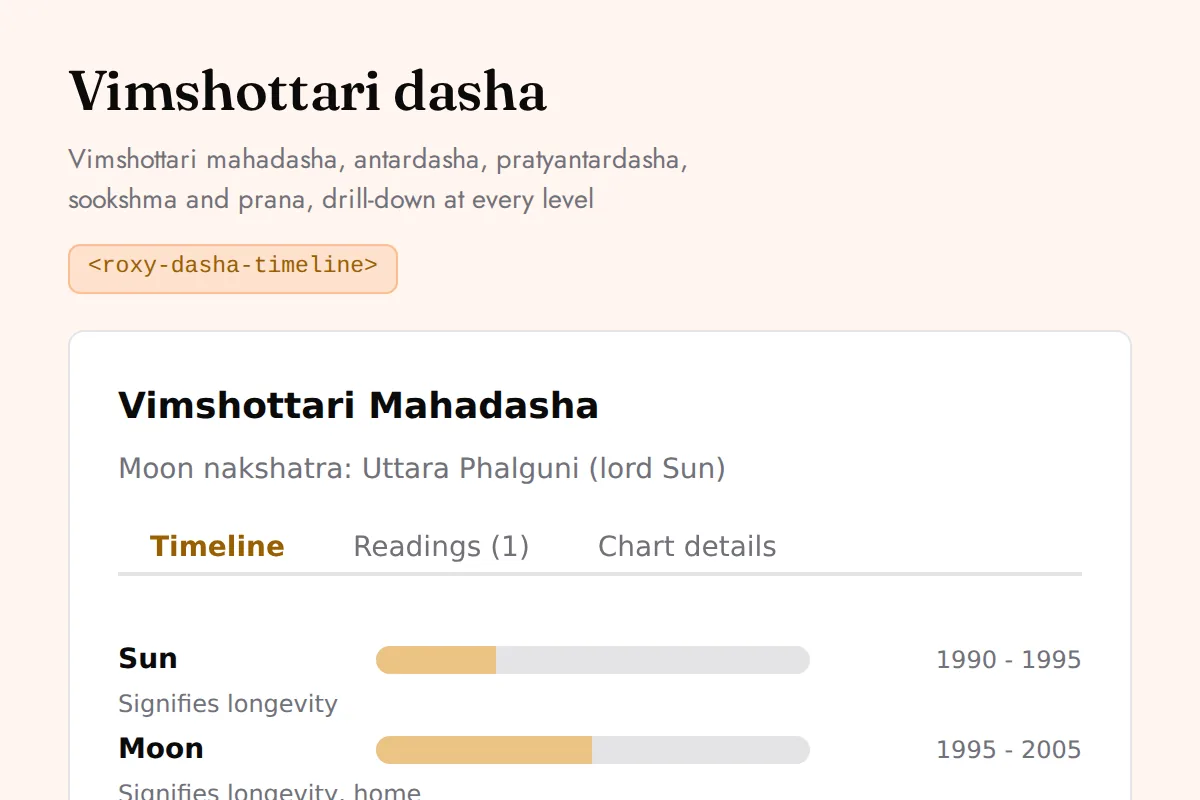
Render Vimshottari Dasha API responses without building charts yourself. Install the npm package and drop these into Next.js, React, Vue, Svelte, Angular, or plain HTML, or embed the very same component on Squarespace, Wix, or WordPress by pasting one snippet, with no backend and no build step. They belong to one library that covers the entire spiritual stack rather than astrology alone, MIT licensed and included in every plan at no extra cost, never a separate product and never an upsell. The Vimshottari Dasha API calculations, the interface that renders them, and the Remote MCP your agent calls, all behind one key, end to end.
Show all Vimshottari Dasha UI componentsShow fewer Vimshottari Dasha UI components
| Element | Renders |
|---|---|
| <roxy-dasha-timeline> | Vimshottari mahadasha, antardasha, pratyantardasha, sookshma and prana, drill-down at every level |
Related capabilities
Vimshottari Dasha API FAQ
What does the Vimshottari Dasha API return?
Calculate all five running Vimshottari Dasha levels with remaining time in each. Every response is structured JSON with documented fields, not free text, so you map it straight into your product.
How do I authenticate with the Vimshottari Dasha API?
Pass your key in the X-API-Key header on every request. Keys are delivered instantly at checkout with no approval queue. Use a secret sk key server side, or mint a publishable pk key locked to your origins for browser and no-code use.
Does the Vimshottari Dasha API support multiple languages?
Yes. Append the lang query parameter to any endpoint for responses in English, German, Spanish, French, Hindi, Portuguese, Russian and Turkish. The translated payload includes the full interpretation text, not just field labels.
Do I need coordinates to call the Vimshottari Dasha API?
No. Call GET /location/search with a city name first, then pass latitude, longitude, and timezone from the first result into the request. Never ask users to type coordinates. Timezone accepts a decimal offset or an IANA name.
Is the Vimshottari Dasha API available over Remote MCP for AI agents?
Yes. Every endpoint is exposed as a callable tool on the Remote MCP server at https://roxyapi.com/mcp/vedic-astrology over Streamable HTTP, so Claude, ChatGPT, Cursor, and any MCP client auto-discover it with no local setup or Docker.
How is the Vimshottari Dasha API billed?
Flat pricing: 1 request equals 1 quota unit, REST and MCP identical, with no credit weighting or per-token markup. Every plan includes all 18 domains, so the Vimshottari Dasha API is included at no extra cost.
What focus values does the Vimshottari Dasha API accept?
The focus parameter accepts general, finance. Case-insensitive where it is a path value.
Start using Vimshottari Dasha API today.
Kundli, panchang and KP charts that state the ayanamsa they used and the classical rule behind each verdict.
All 18 domains included with every plan. Every endpoint, MCP server, SDK, and templates.
Plans from $39/mo, starting at $1.80 per domain on annual billing. No credit card required for testing.
View Pricing & Get API Key