Panchang API
Tithi Nakshatra Yoga Karana Calculator
Included with every plan (at no extra cost)
Calculate Panchang elements (Hindu calendar) for any date: Tithi (lunar day), Nakshatra (lunar mansion), Yoga, and Karana. Daily panchang API for determining auspicious timings (muhurta), festival dates, and planetary influences. Tithi calculator with Shukla/Krishna paksha. Accurate nakshatra today with ruling planet. Essential for Hindu calendar integration, muhurta selection, and Vedic timekeeping in astrology apps.
Location first, chart second
The Panchang API needs latitude, longitude, and timezone. Never ask users to type coordinates. Resolve a city with the Location endpoint first, then feed the result into the request. Timezone accepts a decimal offset or an IANA name.
1 Resolve the location
curl "https://roxyapi.com/api/v2/location/search?q=New York" \
  -H "X-API-Key: YOUR_KEY"
# -> cities[0]: { latitude, longitude, timezone: "America/New_York" }
2 Call the Panchang endpoint
# feed latitude, longitude and timezone from step 1
POST https://roxyapi.com/api/v2/vedic-astrology/panchang/basic
Request
POST /api/v2/vedic-astrology/panchang/basic
Parameters
| Parameter | Type | Description |
|---|---|---|
| langquery | string enum | Response language (BCP 47). Supported: en, tr, de, es, hi, pt, fr, ru, zh-Hans, zh-Hant. Defaults to en. Coverage varies by domain, and a field with no translation in the requested language returns English. Default en. |
Request body
| Field | Type | Description |
|---|---|---|
| date* | string (date) | Date in YYYY-MM-DD format. Panchang elements (Tithi, Nakshatra, Yoga, Karana) are calculated for this date. |
| time* | string (time) | Time in HH:MM:SS format (24-hour). Determines the exact Moon and Sun positions for tithi and nakshatra calculation. |
| latitude* | number | Observer latitude in decimal degrees. Determines sunrise/sunset times which define the Vara (weekday) and muhurta boundaries. |
| longitude* | number | Observer longitude in decimal degrees. Affects local time calculations for sunrise/sunset-dependent panchang elements. |
| timezone | number or string | Timezone: an IANA name (e.g. "America/New_York", "Europe/London", or `cities[0].timezone` from /location/search) or decimal hours from UTC (e.g. -5 for EST, 5.5 for IST). An IANA name is resolved to the offset in force at the given date and time. Defaults to 5.5 (IST). |
Example request
{
  "date": "2025-12-17",
  "time": "12:00:00",
  "latitude": 28.6139,
  "longitude": 77.209,
  "timezone": 5.5
}
Response
Structured JSON with documented fields, covered by 13,405 automated tests per deploy, 3,620 of them gold-standard tests verified against NASA JPL Horizons. Not hallucinated text.
{
  "tithi": {
    "number": 28,
    "name": "Trayodaśī",
    "paksha": "Krishna",
    "percent": 45.2204213850673,
    "deity": "Manmatha (Bhaga)",
    "rulingPlanet": "Jupiter",
    "element": "Ākāśa"
  },
  "nakshatra": {
    "number": 16,
    "name": "Vishakha",
    "lord": "Jupiter",
    "pada": 4,
    "deity": "Indra and Agni",
    "symbol": "Triumphal Arch",
    "characteristics": "Vishakha individuals are ambitious, determined, and often exhibit a competitive spirit. They are goal-oriented and persistent."
  },
  "yoga": {
    "number": 7,
    "name": "Sukarma",
    "percent": 90.83943828582716,
    "characteristics": "Plentiful (performs honorable activities, generous and benevolent, prosperous.)"
  },
  "karana": {
    "number": 5,
    "name": "Gar",
    "percent": 90.4408427701346,
    "type": "char",
    "characteristics": "As per Astrology, people of Gar Karana are punctilious. They trust in their aptitude not fortune. They attain their desired objective by hard work and effort."
  },
  "sunLongitude": 241.34273726928444,
  "moonLongitude": 210.76918783549252
}
Response fields
| Field | Type | Description |
|---|---|---|
| tithi* | object | Lunar day (tithi) information with interpretations. Central panchang element for determining auspicious timings. |
| tithi.number* | integer | Tithi number (1-30). 1-15 are Shukla Paksha (waxing), 16-30 are Krishna Paksha (waning). Purnima is 15, Amavasya is 30. |
| tithi.name* | string | Sanskrit name of the tithi (lunar day). One of 30 tithis in the lunar month cycle. |
| tithi.paksha* | string enum | Lunar fortnight: Shukla (waxing, bright half) or Krishna (waning, dark half). |
| tithi.percent* | number | Percentage of the current tithi elapsed (0-100). Useful for determining tithi strength and transition proximity. |
| tithi.deity | string | Presiding deity of this tithi from Vedic tradition. |
| tithi.rulingPlanet | string | Planetary ruler of this tithi. Influences the day energy and activities. |
| tithi.element | string | Elemental quality of this tithi (Fire, Earth, Air, Water, Ether). |
| nakshatra* | object | Nakshatra (lunar mansion) information with interpretations |
| nakshatra.number* | integer | Nakshatra index (1-27) in the zodiac sequence starting from Ashwini. Each nakshatra spans 13 degrees 20 minutes. |
| nakshatra.name* | string | Sanskrit name of the nakshatra (lunar mansion). One of 27 nakshatras spanning the zodiac belt. |
| nakshatra.lord* | string | Planetary ruler of this nakshatra. Determines Vimshottari dasha lord and influences nakshatra characteristics. |
| nakshatra.pada* | integer | Pada (quarter, 1-4) of the nakshatra. Each nakshatra has 4 padas spanning 3 degrees 20 minutes each. Determines the navamsha sign and fine-tunes nakshatra predictions. |
| nakshatra.deity | string | Presiding deity of this nakshatra from Vedic mythology. Influences spiritual qualities and karmic themes. |
Show all fieldsShow fewer fields
| Field | Type | Description |
|---|---|---|
| nakshatra.symbol | string | Traditional symbol representing this nakshatra. Reflects core energy and life themes. |
| nakshatra.characteristics | string | Personality traits and behavioral tendencies when the Moon occupies this nakshatra. Useful for daily panchang readings. |
| yoga* | object | Nitya Yoga information. Yoga is the third panchang element, derived from combined Sun-Moon longitude. |
| yoga.number* | integer | Nitya Yoga index (1-27). Calculated from the sum of Sun and Moon sidereal longitudes divided by 13 degrees 20 minutes. |
| yoga.name* | string | Sanskrit name of the Nitya Yoga. One of 27 yogas formed by combined Sun-Moon motion, each with distinct auspiciousness. |
| yoga.characteristics | string | Characteristics and auspiciousness of this yoga for activity planning. |
| karana* | object | Karana (half-tithi) information. Fourth panchang element, changes twice per tithi. |
| karana.number* | integer | Karana index. There are 11 karanas total (4 fixed + 7 movable) cycling through 60 half-tithis per lunar month. |
| karana.name* | string | Sanskrit name of the karana. 7 movable karanas (Bava through Naga) repeat 8 times, plus 4 fixed karanas. |
| karana.type | string | Karana type: Movable (repeating, generally auspicious) or Fixed (occur once per month). |
| karana.characteristics | string | Activity suitability and characteristics of this karana for muhurta selection. |
| sunLongitude* | number | Sidereal longitude of the Sun in degrees (0-360). Used for tithi and yoga calculations. |
| moonLongitude* | number | Sidereal longitude of the Moon in degrees (0-360). Moon moves ~13 degrees per day through the nakshatras. |
Supported options
lang
Call it in your language.
Every snippet is generated from the live OpenAPI spec, so method names, parameters, and fields always match production.
import { createRoxy } from '@roxyapi/sdk'

const roxy = createRoxy(process.env.ROXY_API_KEY!)
const { data } = await roxy.vedicAstrology.getBasicPanchang({ body: { date: '2025-12-17', time: '12:00:00', latitude: 28.6139, longitude: 77.209 } })
Install: npm install @roxyapi/sdk
from roxy_sdk import create_roxy

roxy = create_roxy("YOUR_API_KEY")
result = roxy.vedic_astrology.get_basic_panchang(date='2025-12-17', time='12:00:00', latitude=28.6139, longitude=77.209)
Install: pip install roxy-sdk
use function RoxyAPI\Sdk\createRoxy;

$roxy = createRoxy(getenv('ROXY_API_KEY'));
$result = $roxy->vedicAstrology->getBasicPanchang(date: '2025-12-17', time: '12:00:00', latitude: 28.6139, longitude: 77.209);
Install: composer require roxyapi/sdk
using RoxyApi;

var roxy = new RoxyClient(Environment.GetEnvironmentVariable("ROXY_API_KEY")!);
var result = await roxy.VedicAstrology.Panchang.Basic.PostAsync(new() { /* request fields above */ });
Install: dotnet add package RoxyApi.Sdk
import roxyapi "github.com/RoxyAPI/sdk-go"

roxy, _ := roxyapi.NewRoxy(os.Getenv("ROXY_API_KEY"))
resp, _ := roxy.VedicAstrology.GetBasicPanchang(ctx, nil, roxyapi.GetBasicPanchangJSONRequestBody{ /* request fields above */ })
Install: go get github.com/RoxyAPI/sdk-go
curl -X POST "https://roxyapi.com/api/v2/vedic-astrology/panchang/basic" \
  -H "X-API-Key: YOUR_KEY" \
  -H "Content-Type: application/json" \
  -d '{"date":"2025-12-17","time":"12:00:00","latitude":28.6139,"longitude":77.209}'
Prefer to try before you write code? Run this Vedic Astrology endpoint live in the API playground and inspect a real production response.
More Panchang endpoints
The Panchang API bundles these related endpoints under one key.
Get Choghadiya - 8 Muhurta divisions of day and night
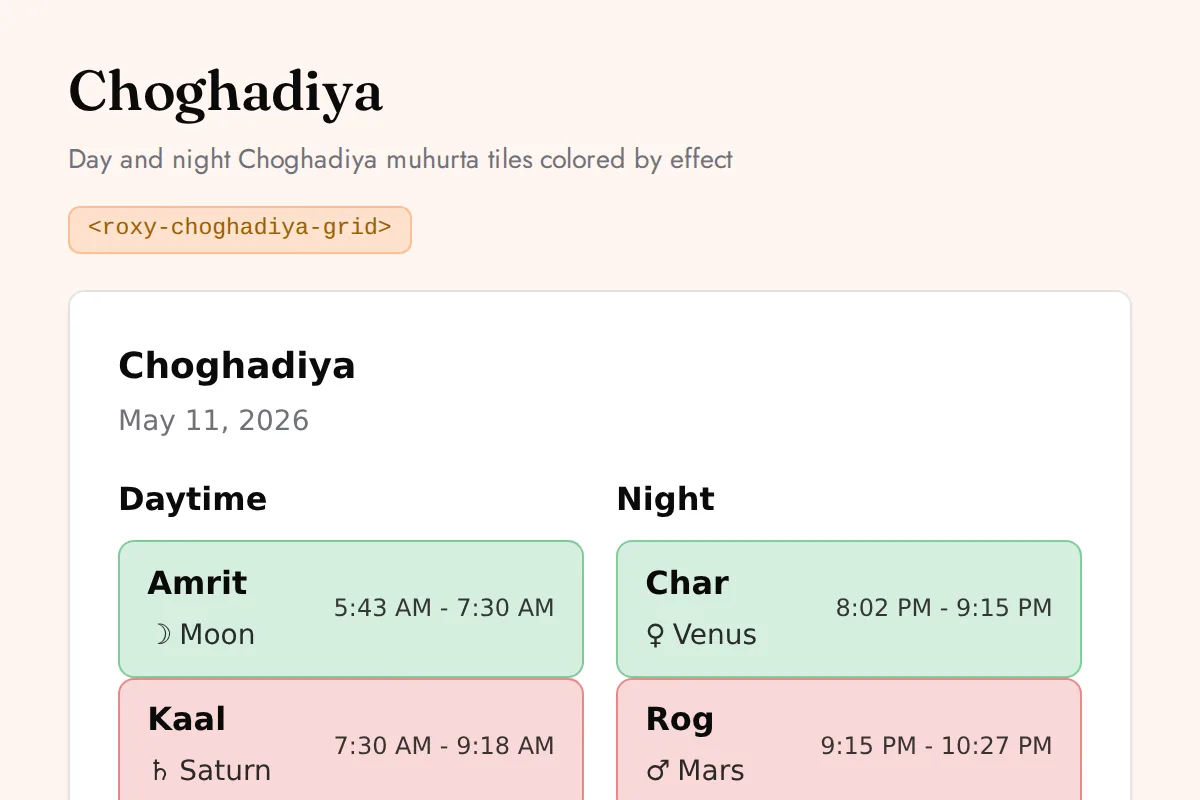
Calculate Choghadiya (Chaughadia) muhurta timings for any date and location. Divides day (sunrise to sunset) and night (sunset to next sunrise) into 8 equal auspicious/inauspicious periods. Each period ruled by a planet: Udveg (Sun, bad), Amrit (Moon, good), Rog (Mars, bad), Labh (Mercury, good), Shubh (Jupiter, good), Char (Venus, good), Kaal (Saturn, bad). Essential for muhurta selection, daily planning, and traditional Hindu timekeeping. Choghadiya calculator API, daily muhurat timings, auspicious time finder.
Try it liveGet detailed Panchang with Rahu Kaal, Yamaganda, Gulika
Complete daily panchang with all five limbs (Tithi, Nakshatra, Yoga, Karana, Vara) plus sunrise, sunset, moonrise, moonset times. Includes inauspicious periods (Rahu Kaal, Yamaganda, Gulika Kaal) and auspicious windows (Abhijit Muhurta, Brahma Muhurta). Current planetary hora with start/end times. Essential for muhurta selection, daily horoscope apps, Hindu calendar integration, and electional astrology. Accurate calculations based on observer location.
Try it liveGet Hora - 24 Planetary Hours (12 day + 12 night)
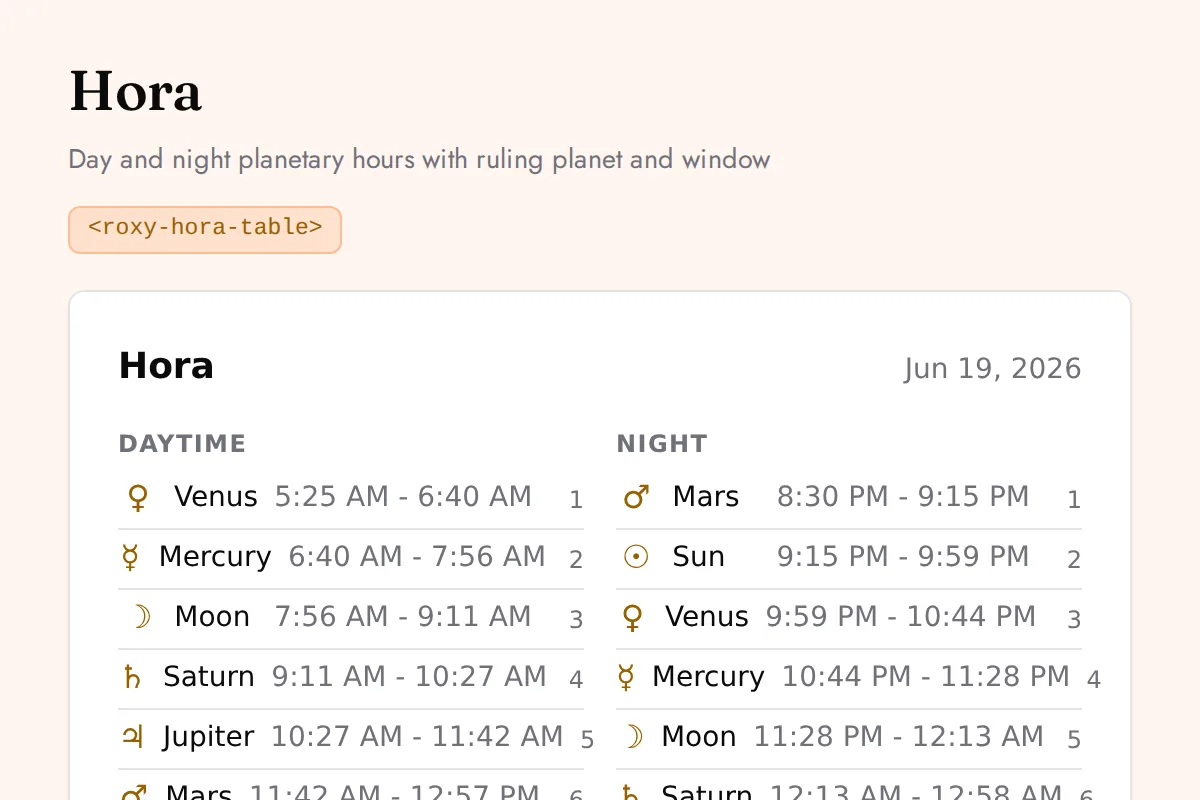
Calculate all 24 Hora (planetary hour) periods for any date and location. Day is divided into 12 equal horas from sunrise to sunset, night into 12 equal horas from sunset to next sunrise. Each hora is ruled by a planet in the Chaldean sequence starting from the day lord. Hora timings API, planetary hours calculator, Vedic hora chart, electional astrology timing.
Try it liveRemote MCP for AI agents
Every Vedic Astrology endpoint is a callable tool on the Remote MCP server over Streamable HTTP. No local setup, no Docker. Claude, ChatGPT, Cursor, and any MCP client auto-discover the tools and ground their answers in verified data.
claude mcp add --transport http \
  roxy-vedic-astrology https://roxyapi.com/mcp/vedic-astrology \
  --header "X-API-Key: YOUR_KEY"
Tool name for POST /vedic-astrology/panchang/basic: post_vedic_astrology_panchang_basic. Full MCP setup guide
What you can build
Kundli generation and PDF report services - combine D1/D9 charts, planetary positions, Dasha timelines, yoga detection, and dosha analysis into automated birth chart reports
Matrimonial matchmaking platforms - automate Gun Milan compatibility scoring, the South Indian ten porutham sheet with its Rajju and Vedha vetoes, Papasamyam malefic balance, Manglik dosha checks, Navamsa spouse analysis, and generate match reports with remedies for Shaadi.com-style features
Daily horoscope and prediction apps - one call composes the gochara verdicts, the panchang limbs with their validity windows, the running Dasha chain and the per-native tarabala and chandrabala into a single dated reading with a reproducible strength score, so a consumer-app daily screen is one request rather than five stitched together
AI astrology chatbots and virtual consultants - power conversational AI with structured Vedic calculations, compatibility queries, Dasha predictions, and remedy suggestions via ChatGPT plugins or MCP integration
Spiritual wellness and calendar apps - integrate Panchang for Hindu festival dates, fasting calendars, temple muhurat selection, and Nakshatra-based meditation schedules
KP horary and event prediction apps - build stellar astrology software with significator analysis, cusp sub-lords, and 249-level precision for answering when/yes-no questions
Drop-in UI components and no-code widgets.
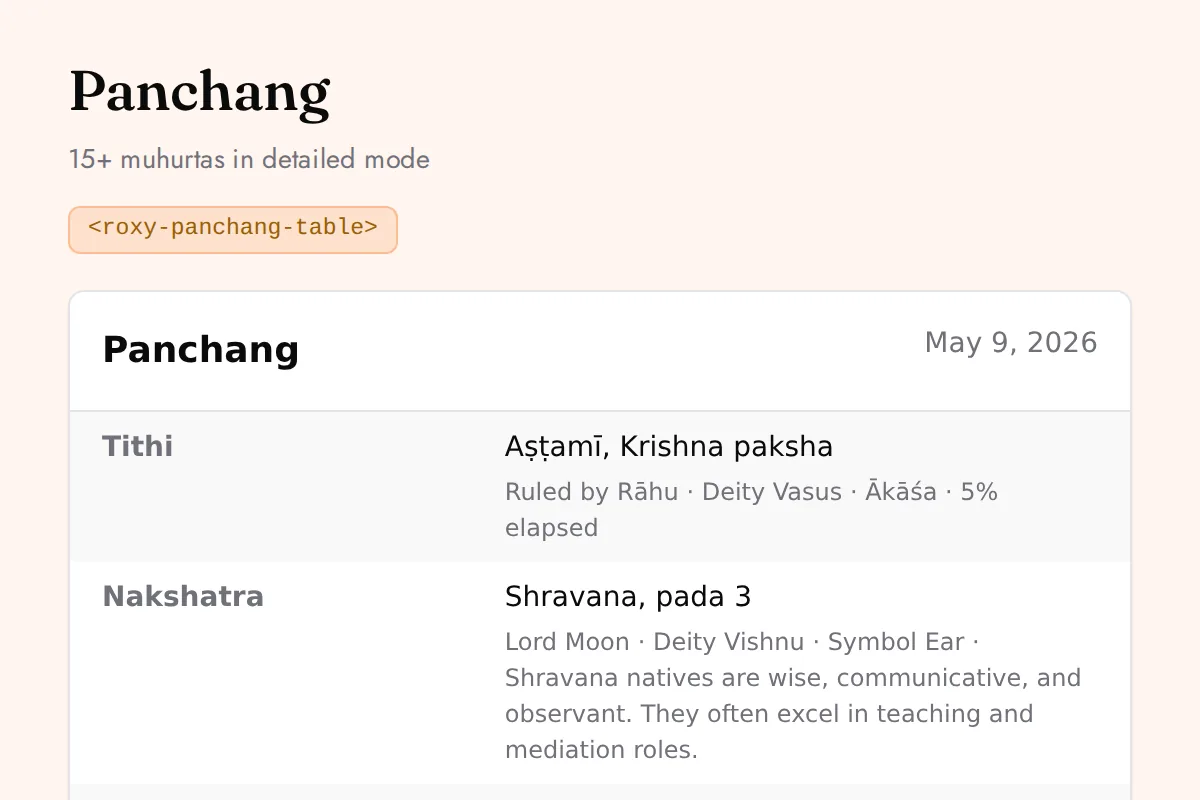
Render Panchang API responses without building charts yourself. Install the npm package and drop these into Next.js, React, Vue, Svelte, Angular, or plain HTML, or embed the very same component on Squarespace, Wix, or WordPress by pasting one snippet, with no backend and no build step. They belong to one library that covers the entire spiritual stack rather than astrology alone, MIT licensed and included in every plan at no extra cost, never a separate product and never an upsell. The Panchang API calculations, the interface that renders them, and the Remote MCP your agent calls, all behind one key, end to end.
 Hora table widget snippet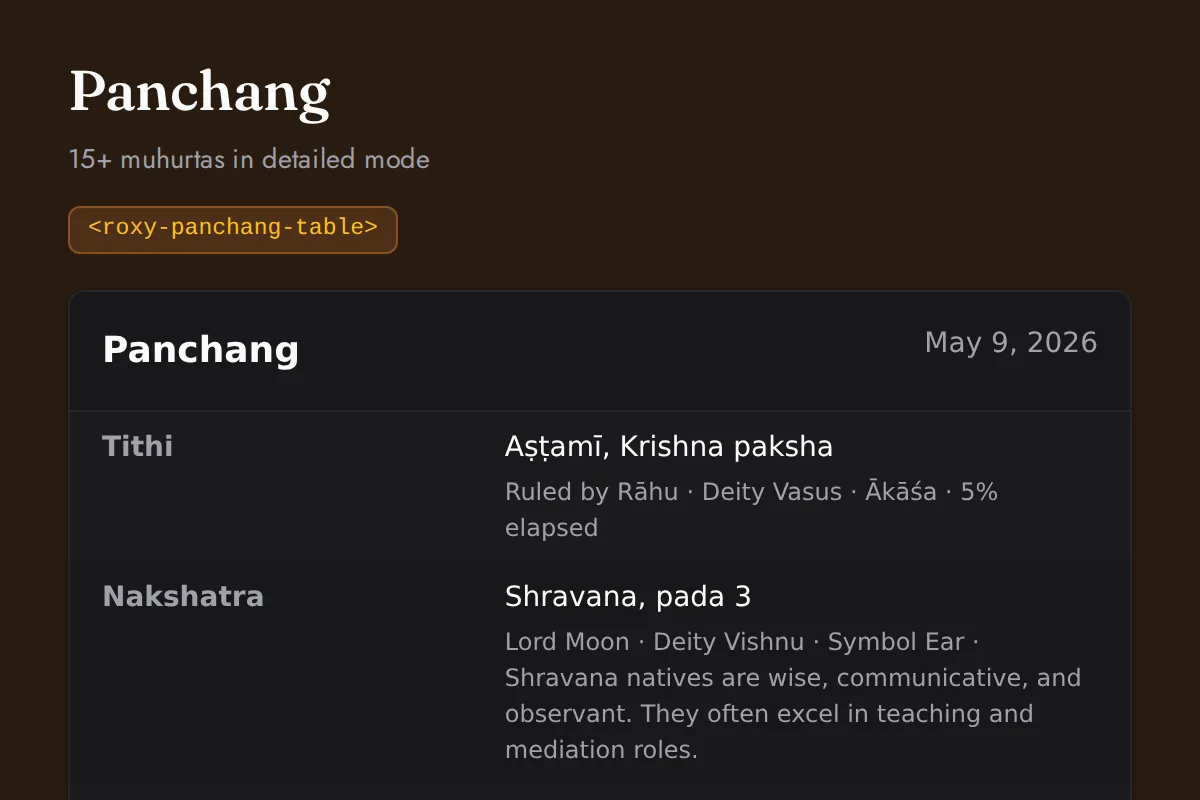
 Choghadiya grid widget snippet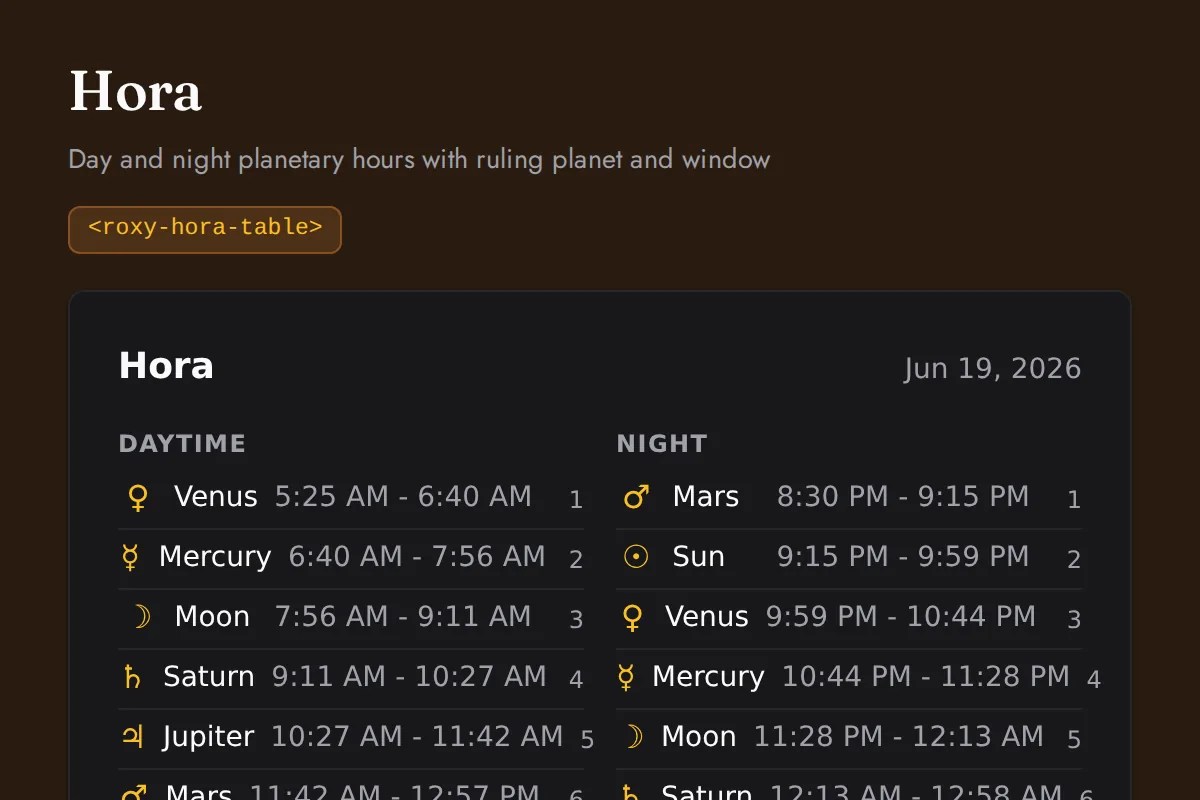
 The complete UI libraryExplore Roxy UI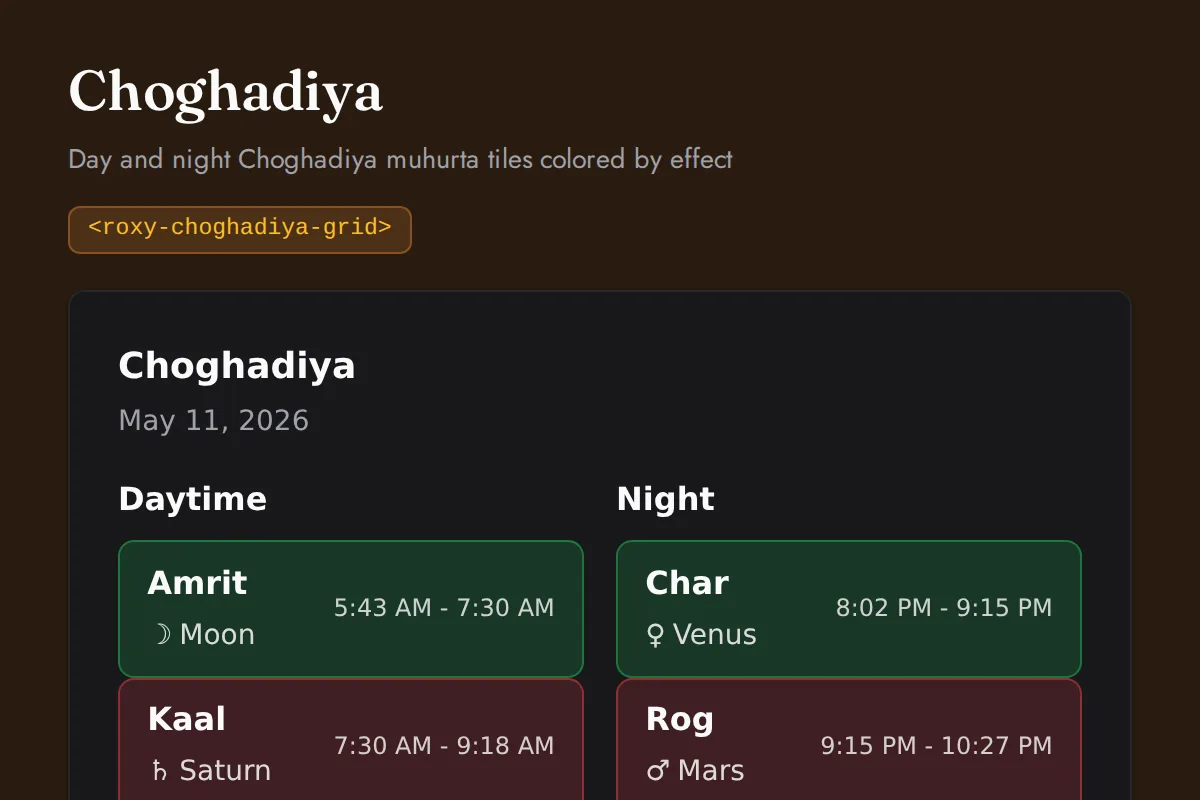
Show all Panchang UI componentsShow fewer Panchang UI components
| Element | Renders |
|---|---|
| <roxy-panchang-table> | 15+ muhurtas in detailed mode |
| <roxy-hora-table> | Day and night planetary hours with ruling planet and window |
| <roxy-choghadiya-grid> | Day and night Choghadiya muhurta tiles colored by effect |
Related capabilities
Panchang API FAQ
What does the Panchang API return?
Calculate Panchang elements (Hindu calendar) for any date: Tithi (lunar day), Nakshatra (lunar mansion), Yoga, and Karana. Every response is structured JSON with documented fields, not free text, so you map it straight into your product.
How do I authenticate with the Panchang API?
Pass your key in the X-API-Key header on every request. Keys are delivered instantly at checkout with no approval queue. Use a secret sk key server side, or mint a publishable pk key locked to your origins for browser and no-code use.
Does the Panchang API support multiple languages?
Yes. Append the lang query parameter to any endpoint for responses in English, German, Spanish, French, Hindi, Portuguese, Russian and Turkish. The translated payload includes the full interpretation text, not just field labels.
Do I need coordinates to call the Panchang API?
No. Call GET /location/search with a city name first, then pass latitude, longitude, and timezone from the first result into the request. Never ask users to type coordinates. Timezone accepts a decimal offset or an IANA name.
Is the Panchang API available over Remote MCP for AI agents?
Yes. Every endpoint is exposed as a callable tool on the Remote MCP server at https://roxyapi.com/mcp/vedic-astrology over Streamable HTTP, so Claude, ChatGPT, Cursor, and any MCP client auto-discover it with no local setup or Docker.
How is the Panchang API billed?
Flat pricing: 1 request equals 1 quota unit, REST and MCP identical, with no credit weighting or per-token markup. Every plan includes all 18 domains, so the Panchang API is included at no extra cost.
Start using Panchang API today.
Kundli, panchang and KP charts that state the ayanamsa they used and the classical rule behind each verdict.
All 18 domains included with every plan. Every endpoint, MCP server, SDK, and templates.
Plans from $39/mo, starting at $1.80 per domain on annual billing. No credit card required for testing.
View Pricing & Get API Key