Synastry API
Relationship compatibility analysis API
Included with every plan (at no extra cost)
Calculate complete synastry (relationship compatibility) between two natal charts using Western tropical astrology. Analyzes inter-chart aspects between all planets to determine romantic, friendship, and karmic compatibility. Returns compatibility score (0-100), detailed inter-aspects with strength ratings, harmonious vs challenging aspect counts, and relationship dynamics analysis. Perfect for dating apps, matrimonial sites, relationship counseling tools, and astrology compatibility features. Based on professional astrological techniques.
Location first, chart second
The Synastry API needs latitude, longitude, and timezone. Never ask users to type coordinates. Resolve a city with the Location endpoint first, then feed the result into the request. Timezone accepts a decimal offset or an IANA name.
1 Resolve the location
curl "https://roxyapi.com/api/v2/location/search?q=New York" \
  -H "X-API-Key: YOUR_KEY"
# -> cities[0]: { latitude, longitude, timezone: "America/New_York" }
2 Call the Synastry endpoint
# feed latitude, longitude and timezone from step 1
POST https://roxyapi.com/api/v2/astrology/synastry
Request
POST /api/v2/astrology/synastry
Parameters
| Parameter | Type | Description |
|---|---|---|
| langquery | string enum | Response language (BCP 47). Supported: en, tr, de, es, hi, pt, fr, ru, zh-Hans, zh-Hant. Defaults to en. Coverage varies by domain, and a field with no translation in the requested language returns English. Default en. |
Request body
| Field | Type | Description |
|---|---|---|
| person1* | object | |
| person1.date* | string (date) | Birth date in YYYY-MM-DD format. Determines planetary positions for the specific calendar day. |
| person1.time* | string (time) | Birth time in 24-hour HH:MM:SS format. Determines the Ascendant (rising sign) and house cusps. Use 12:00:00 if unknown. |
| person1.latitude* | number | Birth location latitude in decimal degrees (-90 to 90). Positive = North, negative = South. |
| person1.longitude* | number | Birth location longitude in decimal degrees (-180 to 180). Positive = East, negative = West. |
| person1.timezone* | number or string | Timezone: an IANA name (e.g. "America/New_York", "Europe/London", or `cities[0].timezone` from /location/search) or decimal hours from UTC (e.g. -5 for EST, 5.5 for IST). An IANA name is resolved to the offset in force at the given date and time. |
| person1.nodeType | string enum | Lunar node convention. "mean" is the smoothed average node, which always moves retrograde; "true" is the osculating node, which tracks the real perturbed node, oscillates up to about 1.5 degrees either side of the mean on a 173-day cycle, and can briefly turn direct. Neither is more correct and they almost always fall in the same sign. Applies to the North and South Node. True is the osculating node and the default, because it is what most Western chart software reports; mean is the smoothed node preferred by several evolutionary schools, so pass "mean" to match one. Nothing else in the chart changes, and the two agree on the sign except when the node sits within about 1.8 degrees of a cusp. Defaults to "true". |
| person1.name | string | Optional display name for this person. Included in the response for easy identification. |
| person2* | object | |
| person2.date* | string (date) | Birth date in YYYY-MM-DD format. Determines planetary positions for the specific calendar day. |
| person2.time* | string (time) | Birth time in 24-hour HH:MM:SS format. Determines the Ascendant (rising sign) and house cusps. Use 12:00:00 if unknown. |
| person2.latitude* | number | Birth location latitude in decimal degrees (-90 to 90). Positive = North, negative = South. |
| person2.longitude* | number | Birth location longitude in decimal degrees (-180 to 180). Positive = East, negative = West. |
| person2.timezone* | number or string | Timezone: an IANA name (e.g. "America/New_York", "Europe/London", or `cities[0].timezone` from /location/search) or decimal hours from UTC (e.g. -5 for EST, 5.5 for IST). An IANA name is resolved to the offset in force at the given date and time. |
Show all fieldsShow fewer fields
| Field | Type | Description |
|---|---|---|
| person2.nodeType | string enum | Lunar node convention. "mean" is the smoothed average node, which always moves retrograde; "true" is the osculating node, which tracks the real perturbed node, oscillates up to about 1.5 degrees either side of the mean on a 173-day cycle, and can briefly turn direct. Neither is more correct and they almost always fall in the same sign. Applies to the North and South Node. True is the osculating node and the default, because it is what most Western chart software reports; mean is the smoothed node preferred by several evolutionary schools, so pass "mean" to match one. Nothing else in the chart changes, and the two agree on the sign except when the node sits within about 1.8 degrees of a cusp. Defaults to "true". |
| person2.name | string | Optional display name for this person. Included in the response for easy identification. |
| houseSystem | string enum | House system for both natal charts. Placidus (default), Whole Sign, Equal, or Koch. |
Example request
{
  "person1": {
    "date": "1990-07-15",
    "time": "14:30:00",
    "latitude": 40.7128,
    "longitude": -74.006,
    "timezone": "America/New_York",
    "nodeType": "true",
    "name": "Alex"
  },
  "person2": {
    "date": "1990-07-15",
    "time": "14:30:00",
    "latitude": 40.7128,
    "longitude": -74.006,
    "timezone": "America/New_York",
    "nodeType": "true",
    "name": "Alex"
  },
  "houseSystem": "placidus"
}
Response
Structured JSON with documented fields, covered by 13,405 automated tests per deploy, 3,620 of them gold-standard tests verified against NASA JPL Horizons. Not hallucinated text.
{
"person1": {
"name": "Alex",
"ascendant": {
"sign": "Scorpio",
"degree": 6.947368350486414
},
"sunSign": "Cancer",
"moonSign": "Aries",
"planets": [
{
"name": "Sun",
"longitude": 113.00452053215861,
"sign": "Cancer",
"degree": 23.004520532158608,
"house": 9,
"houseInOtherChart": 9,
"isRetrograde": false
},
{
"name": "Moon",
"longitude": 27.068938674158613,
"sign": "Aries",
"degree": 27.068938674158613,
"house": 6,
"houseInOtherChart": 6,
"isRetrograde": false
},
{
"name": "Mercury",
"longitude": 127.2804483512056,
"sign": "Leo",
"degree": 7.280448351205607,
"house": 9,
"houseInOtherChart": 9,
"isRetrograde": false
},
{
"name": "Venus",
"longitude": 84.73608276357183,
"sign": "Gemini",
"degree": 24.73608276357183,
"house": 8,
"houseInOtherChart": 8,
"isRetrograde": false
},
{
"name": "Mars",
"longitude": 32.12342925796031,
"sign": "Taurus",
"degree": 2.1234292579603107,
"house": 6,
"houseInOtherChart": 6,
"isRetrograde": false
},
{
"name": "Jupiter",
"longitude": 112.60994571682349,
"sign": "Cancer",
"degree": 22.60994571682349,
"house": 9,
"houseInOtherChart": 9,
"isRetrograde": false
},
{
"name": "Saturn",
"longitude": 291.94353953255387,
"sign": "Capricorn",
"degree": 21.94353953255387,
"house": 3,
"houseInOtherChart": 3,
"isRetrograde": true
},
{
"name": "Uranus",
"longitude": 276.956281802796,
"sign": "Capricorn",
"degree": 6.956281802796013,
"house": 2,
"houseInOtherChart": 2,
"isRetrograde": true
},
{
"name": "Neptune",
"longitude": 282.9139975022088,
"sign": "Capricorn",
"degree": 12.913997502208815,
"house": 3,
"houseInOtherChart": 3,
"isRetrograde": true
},
{
"name": "Pluto",
"longitude": 224.99788103667183,
"sign": "Scorpio",
"degree": 14.997881036671828,
"house": 1,
"houseInOtherChart": 1,
"isRetrograde": true
},
{
"name": "North Node",
"longitude": 307.35871686645265,
"sign": "Aquarius",
"degree": 7.358716866452653,
"house": 3,
"houseInOtherChart": 3,
"isRetrograde": true
},
{
"name": "South Node",
"longitude": 127.35871686645265,
"sign": "Leo",
"degree": 7.358716866452653,
"house": 9,
"houseInOtherChart": 9,
"isRetrograde": true
},
{
"name": "Chiron",
"longitude": 109.25705196871604,
"sign": "Cancer",
"degree": 19.25705196871604,
"house": 9,
"houseInOtherChart": 9,
"isRetrograde": false
},
{
"name": "Black Moon Lilith",
"longitude": 238.3402727210398,
"sign": "Scorpio",
"degree": 28.34027272103981,
"house": 1,
"houseInOtherChart": 1,
"isRetrograde": false
}
]
},
"person2": {
"name": "Alex",
"ascendant": {
"sign": "Scorpio",
"degree": 6.947368350486414
},
"sunSign": "Cancer",
"moonSign": "Aries",
"planets": [
{
"name": "Sun",
"longitude": 113.00452053215861,
"sign": "Cancer",
"degree": 23.004520532158608,
"house": 9,
"houseInOtherChart": 9,
"isRetrograde": false
},
{
"name": "Moon",
"longitude": 27.068938674158613,
"sign": "Aries",
"degree": 27.068938674158613,
"house": 6,
"houseInOtherChart": 6,
"isRetrograde": false
},
{
"name": "Mercury",
"longitude": 127.2804483512056,
"sign": "Leo",
"degree": 7.280448351205607,
"house": 9,
"houseInOtherChart": 9,
"isRetrograde": false
},
{
"name": "Venus",
"longitude": 84.73608276357183,
"sign": "Gemini",
"degree": 24.73608276357183,
"house": 8,
"houseInOtherChart": 8,
"isRetrograde": false
},
{
"name": "Mars",
"longitude": 32.12342925796031,
"sign": "Taurus",
"degree": 2.1234292579603107,
"house": 6,
"houseInOtherChart": 6,
"isRetrograde": false
},
{
"name": "Jupiter",
"longitude": 112.60994571682349,
"sign": "Cancer",
"degree": 22.60994571682349,
"house": 9,
"houseInOtherChart": 9,
"isRetrograde": false
},
{
"name": "Saturn",
"longitude": 291.94353953255387,
"sign": "Capricorn",
"degree": 21.94353953255387,
"house": 3,
"houseInOtherChart": 3,
"isRetrograde": true
},
{
"name": "Uranus",
"longitude": 276.956281802796,
"sign": "Capricorn",
"degree": 6.956281802796013,
"house": 2,
"houseInOtherChart": 2,
"isRetrograde": true
},
{
"name": "Neptune",
"longitude": 282.9139975022088,
"sign": "Capricorn",
"degree": 12.913997502208815,
"house": 3,
"houseInOtherChart": 3,
"isRetrograde": true
},
{
"name": "Pluto",
"longitude": 224.99788103667183,
"sign": "Scorpio",
"degree": 14.997881036671828,
"house": 1,
"houseInOtherChart": 1,
"isRetrograde": true
},
{
"name": "North Node",
"longitude": 307.35871686645265,
"sign": "Aquarius",
"degree": 7.358716866452653,
"house": 3,
"houseInOtherChart": 3,
"isRetrograde": true
},
{
"name": "South Node",
"longitude": 127.35871686645265,
"sign": "Leo",
"degree": 7.358716866452653,
"house": 9,
"houseInOtherChart": 9,
"isRetrograde": true
},
{
"name": "Chiron",
"longitude": 109.25705196871604,
"sign": "Cancer",
"degree": 19.25705196871604,
"house": 9,
"houseInOtherChart": 9,
"isRetrograde": false
},
{
"name": "Black Moon Lilith",
"longitude": 238.3402727210398,
"sign": "Scorpio",
"degree": 28.34027272103981,
"house": 1,
"houseInOtherChart": 1,
"isRetrograde": false
}
]
},
"compatibilityScore": 55.11793596192124,
"interAspects": [
{
"planet1": "Sun",
"planet2": "Sun",
"type": "CONJUNCTION",
"angle": 0,
"orb": 0,
"isApplying": false,
"strength": 100,
"interpretation": "neutral",
"meaning": {
"name": "Conjunction",
"description": {
"short": "Planets and points that form a conjunction are energies that are united. They are blended; therefore, they act together. The closer they are to conjunction, the more subjective these combined energies are. They don't stand alone, and they have a difficult time truly acknowledging each other as distinct or separate.",
"long": "Planets and points that form a conjunction are energies that are united. They are blended; therefore, they act together. The closer they are to conjunction, the more subjective these combined energies are. They don't stand alone, and they have a difficult time truly acknowledging each other as distinct or separate."
},
"keywords": [
"blend",
"difficult",
"unite",
"united"
],
"nature": "neutral",
"relationshipContext": "Sun and Sun create dynamic tension between self-awareness and ego and self-awareness and ego. Conscious effort transforms this friction into growth."
}
},
{
"planet1": "Moon",
"planet2": "Moon",
"type": "CONJUNCTION",
"angle": 0,
"orb": 0,
"isApplying": false,
"strength": 100,
"interpretation": "neutral",
"meaning": {
"name": "Conjunction",
"description": {
"short": "Planets and points that form a conjunction are energies that are united. They are blended; therefore, they act together. The closer they are to conjunction, the more subjective these combined energies are. They don't stand alone, and they have a difficult time truly acknowledging each other as distinct or separate.",
"long": "Planets and points that form a conjunction are energies that are united. They are blended; therefore, they act together. The closer they are to conjunction, the more subjective these combined energies are. They don't stand alone, and they have a difficult time truly acknowledging each other as distinct or separate."
},
"keywords": [
"blend",
"difficult",
"unite",
"united"
],
"nature": "neutral",
"relationshipContext": "Emotional reactions may clash or feel overwhelming. Building emotional security requires conscious effort."
}
},
{
"planet1": "Mercury",
"planet2": "Mercury",
"type": "CONJUNCTION",
"angle": 0,
"orb": 0,
"isApplying": false,
"strength": 100,
"interpretation": "neutral",
"meaning": {
"name": "Conjunction",
"description": {
"short": "Planets and points that form a conjunction are energies that are united. They are blended; therefore, they act together. The closer they are to conjunction, the more subjective these combined energies are. They don't stand alone, and they have a difficult time truly acknowledging each other as distinct or separate.",
"long": "Planets and points that form a conjunction are energies that are united. They are blended; therefore, they act together. The closer they are to conjunction, the more subjective these combined energies are. They don't stand alone, and they have a difficult time truly acknowledging each other as distinct or separate."
},
"keywords": [
"blend",
"difficult",
"unite",
"united"
],
"nature": "neutral",
"relationshipContext": "Communication misunderstandings or different mental approaches. Clarity and patience improve dialogue."
}
},
{
"planet1": "Venus",
"planet2": "Venus",
"type": "CONJUNCTION",
"angle": 0,
"orb": 0,
"isApplying": false,
"strength": 100,
"interpretation": "neutral",
"meaning": {
"name": "Conjunction",
"description": {
"short": "Planets and points that form a conjunction are energies that are united. They are blended; therefore, they act together. The closer they are to conjunction, the more subjective these combined energies are. They don't stand alone, and they have a difficult time truly acknowledging each other as distinct or separate.",
"long": "Planets and points that form a conjunction are energies that are united. They are blended; therefore, they act together. The closer they are to conjunction, the more subjective these combined energies are. They don't stand alone, and they have a difficult time truly acknowledging each other as distinct or separate."
},
"keywords": [
"blend",
"difficult",
"unite",
"united"
],
"nature": "neutral",
"relationshipContext": "Different love languages or values may cause hurt feelings. Learning each other needs builds stronger connection."
}
},
{
"planet1": "Mars",
"planet2": "Mars",
"type": "CONJUNCTION",
"angle": 0,
"orb": 0,
"isApplying": false,
"strength": 100,
"interpretation": "neutral",
"meaning": {
"name": "Conjunction",
"description": {
"short": "Planets and points that form a conjunction are energies that are united. They are blended; therefore, they act together. The closer they are to conjunction, the more subjective these combined energies are. They don't stand alone, and they have a difficult time truly acknowledging each other as distinct or separate.",
"long": "Planets and points that form a conjunction are energies that are united. They are blended; therefore, they act together. The closer they are to conjunction, the more subjective these combined energies are. They don't stand alone, and they have a difficult time truly acknowledging each other as distinct or separate."
},
"keywords": [
"blend",
"difficult",
"unite",
"united"
],
"nature": "neutral",
"relationshipContext": "Mars and Mars create dynamic tension between assertiveness and aggression and assertiveness and aggression. Conscious effort transforms this friction into growth."
}
},
{
"planet1": "Jupiter",
"planet2": "Jupiter",
"type": "CONJUNCTION",
"angle": 0,
"orb": 0,
"isApplying": false,
"strength": 100,
"interpretation": "neutral",
"meaning": {
"name": "Conjunction",
"description": {
"short": "Planets and points that form a conjunction are energies that are united. They are blended; therefore, they act together. The closer they are to conjunction, the more subjective these combined energies are. They don't stand alone, and they have a difficult time truly acknowledging each other as distinct or separate.",
"long": "Planets and points that form a conjunction are energies that are united. They are blended; therefore, they act together. The closer they are to conjunction, the more subjective these combined energies are. They don't stand alone, and they have a difficult time truly acknowledging each other as distinct or separate."
},
"keywords": [
"blend",
"difficult",
"unite",
"united"
],
"nature": "neutral",
"relationshipContext": "Different philosophies or over-enthusiasm may cause friction. Balancing perspectives creates wisdom."
}
},
{
"planet1": "Saturn",
"planet2": "Saturn",
"type": "CONJUNCTION",
"angle": 0,
"orb": 0,
"isApplying": false,
"strength": 100,
"interpretation": "neutral",
"meaning": {
"name": "Conjunction",
"description": {
"short": "Planets and points that form a conjunction are energies that are united. They are blended; therefore, they act together. The closer they are to conjunction, the more subjective these combined energies are. They don't stand alone, and they have a difficult time truly acknowledging each other as distinct or separate.",
"long": "Planets and points that form a conjunction are energies that are united. They are blended; therefore, they act together. The closer they are to conjunction, the more subjective these combined energies are. They don't stand alone, and they have a difficult time truly acknowledging each other as distinct or separate."
},
"keywords": [
"blend",
"difficult",
"unite",
"united"
],
"nature": "neutral",
"relationshipContext": "One may feel restricted or criticized by the other. Maturity and respect transform challenges into strength."
}
},
{
"planet1": "Uranus",
"planet2": "Uranus",
"type": "CONJUNCTION",
"angle": 0,
"orb": 0,
"isApplying": false,
"strength": 100,
"interpretation": "neutral",
"meaning": {
"name": "Conjunction",
"description": {
"short": "Planets and points that form a conjunction are energies that are united. They are blended; therefore, they act together. The closer they are to conjunction, the more subjective these combined energies are. They don't stand alone, and they have a difficult time truly acknowledging each other as distinct or separate.",
"long": "Planets and points that form a conjunction are energies that are united. They are blended; therefore, they act together. The closer they are to conjunction, the more subjective these combined energies are. They don't stand alone, and they have a difficult time truly acknowledging each other as distinct or separate."
},
"keywords": [
"blend",
"difficult",
"unite",
"united"
],
"nature": "neutral",
"relationshipContext": "Uranus and Uranus create dynamic tension between individuality and revolution and individuality and revolution. Conscious effort transforms this friction into growth."
}
},
{
"planet1": "Neptune",
"planet2": "Neptune",
"type": "CONJUNCTION",
"angle": 0,
"orb": 0,
"isApplying": false,
"strength": 100,
"interpretation": "neutral",
"meaning": {
"name": "Conjunction",
"description": {
"short": "Planets and points that form a conjunction are energies that are united. They are blended; therefore, they act together. The closer they are to conjunction, the more subjective these combined energies are. They don't stand alone, and they have a difficult time truly acknowledging each other as distinct or separate.",
"long": "Planets and points that form a conjunction are energies that are united. They are blended; therefore, they act together. The closer they are to conjunction, the more subjective these combined energies are. They don't stand alone, and they have a difficult time truly acknowledging each other as distinct or separate."
},
"keywords": [
"blend",
"difficult",
"unite",
"united"
],
"nature": "neutral",
"relationshipContext": "Neptune and Neptune create dynamic tension between dreams, healing, and intuition and dreams, healing, and intuition. Conscious effort transforms this friction into growth."
}
},
{
"planet1": "Pluto",
"planet2": "Pluto",
"type": "CONJUNCTION",
"angle": 0,
"orb": 0,
"isApplying": false,
"strength": 100,
"interpretation": "neutral",
"meaning": {
"name": "Conjunction",
"description": {
"short": "Planets and points that form a conjunction are energies that are united. They are blended; therefore, they act together. The closer they are to conjunction, the more subjective these combined energies are. They don't stand alone, and they have a difficult time truly acknowledging each other as distinct or separate.",
"long": "Planets and points that form a conjunction are energies that are united. They are blended; therefore, they act together. The closer they are to conjunction, the more subjective these combined energies are. They don't stand alone, and they have a difficult time truly acknowledging each other as distinct or separate."
},
"keywords": [
"blend",
"difficult",
"unite",
"united"
],
"nature": "neutral",
"relationshipContext": "Pluto and Pluto create dynamic tension between sex, death, and transformation and sex, death, and transformation. Conscious effort transforms this friction into growth."
}
},
{
"planet1": "North Node",
"planet2": "North Node",
"type": "CONJUNCTION",
"angle": 0,
"orb": 0,
"isApplying": false,
"strength": 100,
"interpretation": "neutral",
"meaning": {
"name": "Conjunction",
"description": {
"short": "Planets and points that form a conjunction are energies that are united. They are blended; therefore, they act together. The closer they are to conjunction, the more subjective these combined energies are. They don't stand alone, and they have a difficult time truly acknowledging each other as distinct or separate.",
"long": "Planets and points that form a conjunction are energies that are united. They are blended; therefore, they act together. The closer they are to conjunction, the more subjective these combined energies are. They don't stand alone, and they have a difficult time truly acknowledging each other as distinct or separate."
},
"keywords": [
"blend",
"difficult",
"unite",
"united"
],
"nature": "neutral",
"relationshipContext": "North Node and North Node create dynamic tension between life purpose and destiny and life purpose and destiny. Conscious effort transforms this friction into growth."
}
},
{
"planet1": "North Node",
"planet2": "South Node",
"type": "OPPOSITION",
"angle": 180,
"orb": 0,
"isApplying": false,
"strength": 100,
"interpretation": "challenging",
"meaning": {
"name": "Opposition",
"description": {
"short": "\"It takes two\" is the expression, and the opposition is created by dividing the circle by 2. Therein lies the key to the meaning of this aspect: relationship. People with oppositions seek out others as if to mirror their own internal struggles. They learn about themselves through interactions with others. Very often, oppositions cause us to swing from one side to the other and we feel torn.",
"long": "Oppositions represent a state of divided loyalties. Inner discontent, uncertainty, and insecurity can be a result. While a square is urgent and courageous, an opposition is unsure and wavering. When we use our oppositions correctly, we are more willing to consider the other side and we can be adept negotiators. Unlike squares, which demand direct action, oppositions drive us to seek balance through relationships and external mirrors. People with strong oppositions tend to be insightful and seek meaning through their connections with others, sometimes projecting their own qualities onto partners. The key to working with oppositions is developing objectivity: learning to hold two seemingly contradictory truths at once and finding the creative synthesis between them."
},
"keywords": [
"accept",
"accepting",
"balance",
"challenge",
"complacent",
"easy",
"growth",
"obstacle",
"relationship",
"struggle",
"talent",
"tension"
],
"nature": "challenging",
"relationshipContext": "North Node and South Node create dynamic tension between life purpose and destiny and past life gifts and comfort zone. Conscious effort transforms this friction into growth."
}
},
{
"planet1": "South Node",
"planet2": "North Node",
"type": "OPPOSITION",
"angle": 180,
"orb": 0,
"isApplying": false,
"strength": 100,
"interpretation": "challenging",
"meaning": {
"name": "Opposition",
"description": {
"short": "\"It takes two\" is the expression, and the opposition is created by dividing the circle by 2. Therein lies the key to the meaning of this aspect: relationship. People with oppositions seek out others as if to mirror their own internal struggles. They learn about themselves through interactions with others. Very often, oppositions cause us to swing from one side to the other and we feel torn.",
"long": "Oppositions represent a state of divided loyalties. Inner discontent, uncertainty, and insecurity can be a result. While a square is urgent and courageous, an opposition is unsure and wavering. When we use our oppositions correctly, we are more willing to consider the other side and we can be adept negotiators. Unlike squares, which demand direct action, oppositions drive us to seek balance through relationships and external mirrors. People with strong oppositions tend to be insightful and seek meaning through their connections with others, sometimes projecting their own qualities onto partners. The key to working with oppositions is developing objectivity: learning to hold two seemingly contradictory truths at once and finding the creative synthesis between them."
},
"keywords": [
"accept",
"accepting",
"balance",
"challenge",
"complacent",
"easy",
"growth",
"obstacle",
"relationship",
"struggle",
"talent",
"tension"
],
"nature": "challenging",
"relationshipContext": "South Node and North Node create dynamic tension between past life gifts and comfort zone and life purpose and destiny. Conscious effort transforms this friction into growth."
}
},
{
"planet1": "South Node",
"planet2": "South Node",
"type": "CONJUNCTION",
"angle": 0,
"orb": 0,
"isApplying": false,
"strength": 100,
"interpretation": "neutral",
"meaning": {
"name": "Conjunction",
"description": {
"short": "Planets and points that form a conjunction are energies that are united. They are blended; therefore, they act together. The closer they are to conjunction, the more subjective these combined energies are. They don't stand alone, and they have a difficult time truly acknowledging each other as distinct or separate.",
"long": "Planets and points that form a conjunction are energies that are united. They are blended; therefore, they act together. The closer they are to conjunction, the more subjective these combined energies are. They don't stand alone, and they have a difficult time truly acknowledging each other as distinct or separate."
},
"keywords": [
"blend",
"difficult",
"unite",
"united"
],
"nature": "neutral",
"relationshipContext": "South Node and South Node create dynamic tension between past life gifts and comfort zone and past life gifts and comfort zone. Conscious effort transforms this friction into growth."
}
},
{
"planet1": "Chiron",
"planet2": "Chiron",
"type": "CONJUNCTION",
"angle": 0,
"orb": 0,
"isApplying": false,
"strength": 100,
"interpretation": "neutral",
"meaning": {
"name": "Conjunction",
"description": {
"short": "Planets and points that form a conjunction are energies that are united. They are blended; therefore, they act together. The closer they are to conjunction, the more subjective these combined energies are. They don't stand alone, and they have a difficult time truly acknowledging each other as distinct or separate.",
"long": "Planets and points that form a conjunction are energies that are united. They are blended; therefore, they act together. The closer they are to conjunction, the more subjective these combined energies are. They don't stand alone, and they have a difficult time truly acknowledging each other as distinct or separate."
},
"keywords": [
"blend",
"difficult",
"unite",
"united"
],
"nature": "neutral",
"relationshipContext": "Chiron and Chiron create dynamic tension between healing and inner wounds and healing and inner wounds. Conscious effort transforms this friction into growth."
}
},
{
"planet1": "Black Moon Lilith",
"planet2": "Black Moon Lilith",
"type": "CONJUNCTION",
"angle": 0,
"orb": 0,
"isApplying": false,
"strength": 100,
"interpretation": "neutral",
"meaning": {
"name": "Conjunction",
"description": {
"short": "Planets and points that form a conjunction are energies that are united. They are blended; therefore, they act together. The closer they are to conjunction, the more subjective these combined energies are. They don't stand alone, and they have a difficult time truly acknowledging each other as distinct or separate.",
"long": "Planets and points that form a conjunction are energies that are united. They are blended; therefore, they act together. The closer they are to conjunction, the more subjective these combined energies are. They don't stand alone, and they have a difficult time truly acknowledging each other as distinct or separate."
},
"keywords": [
"blend",
"difficult",
"unite",
"united"
],
"nature": "neutral",
"relationshipContext": "Black Moon Lilith and Black Moon Lilith create dynamic tension between primal instinct and the reclaimed self and primal instinct and the reclaimed self. Conscious effort transforms this friction into growth."
}
},
{
"planet1": "Mercury",
"planet2": "North Node",
"type": "OPPOSITION",
"angle": 180,
"orb": 0.07826851524703216,
"isApplying": true,
"strength": 99.0216435594121,
"interpretation": "challenging",
"meaning": {
"name": "Opposition",
"description": {
"short": "\"It takes two\" is the expression, and the opposition is created by dividing the circle by 2. Therein lies the key to the meaning of this aspect: relationship. People with oppositions seek out others as if to mirror their own internal struggles. They learn about themselves through interactions with others. Very often, oppositions cause us to swing from one side to the other and we feel torn.",
"long": "Oppositions represent a state of divided loyalties. Inner discontent, uncertainty, and insecurity can be a result. While a square is urgent and courageous, an opposition is unsure and wavering. When we use our oppositions correctly, we are more willing to consider the other side and we can be adept negotiators. Unlike squares, which demand direct action, oppositions drive us to seek balance through relationships and external mirrors. People with strong oppositions tend to be insightful and seek meaning through their connections with others, sometimes projecting their own qualities onto partners. The key to working with oppositions is developing objectivity: learning to hold two seemingly contradictory truths at once and finding the creative synthesis between them."
},
"keywords": [
"accept",
"accepting",
"balance",
"challenge",
"complacent",
"easy",
"growth",
"obstacle",
"relationship",
"struggle",
"talent",
"tension"
],
"nature": "challenging",
"relationshipContext": "Mercury and North Node create dynamic tension between communication and life purpose and destiny. Conscious effort transforms this friction into growth."
}
},
{
"planet1": "North Node",
"planet2": "Mercury",
"type": "OPPOSITION",
"angle": 180,
"orb": 0.07826851524703216,
"isApplying": true,
"strength": 99.0216435594121,
"interpretation": "challenging",
"meaning": {
"name": "Opposition",
"description": {
"short": "\"It takes two\" is the expression, and the opposition is created by dividing the circle by 2. Therein lies the key to the meaning of this aspect: relationship. People with oppositions seek out others as if to mirror their own internal struggles. They learn about themselves through interactions with others. Very often, oppositions cause us to swing from one side to the other and we feel torn.",
"long": "Oppositions represent a state of divided loyalties. Inner discontent, uncertainty, and insecurity can be a result. While a square is urgent and courageous, an opposition is unsure and wavering. When we use our oppositions correctly, we are more willing to consider the other side and we can be adept negotiators. Unlike squares, which demand direct action, oppositions drive us to seek balance through relationships and external mirrors. People with strong oppositions tend to be insightful and seek meaning through their connections with others, sometimes projecting their own qualities onto partners. The key to working with oppositions is developing objectivity: learning to hold two seemingly contradictory truths at once and finding the creative synthesis between them."
},
"keywords": [
"accept",
"accepting",
"balance",
"challenge",
"complacent",
"easy",
"growth",
"obstacle",
"relationship",
"struggle",
"talent",
"tension"
],
"nature": "challenging",
"relationshipContext": "North Node and Mercury create dynamic tension between life purpose and destiny and communication. Conscious effort transforms this friction into growth."
}
},
{
"planet1": "Mercury",
"planet2": "South Node",
"type": "CONJUNCTION",
"angle": 0,
"orb": 0.07826851524704637,
"isApplying": true,
"strength": 99.02164355941193,
"interpretation": "neutral",
"meaning": {
"name": "Conjunction",
"description": {
"short": "Planets and points that form a conjunction are energies that are united. They are blended; therefore, they act together. The closer they are to conjunction, the more subjective these combined energies are. They don't stand alone, and they have a difficult time truly acknowledging each other as distinct or separate.",
"long": "Planets and points that form a conjunction are energies that are united. They are blended; therefore, they act together. The closer they are to conjunction, the more subjective these combined energies are. They don't stand alone, and they have a difficult time truly acknowledging each other as distinct or separate."
},
"keywords": [
"blend",
"difficult",
"unite",
"united"
],
"nature": "neutral",
"relationshipContext": "Mercury and South Node create dynamic tension between communication and past life gifts and comfort zone. Conscious effort transforms this friction into growth."
}
},
{
"planet1": "South Node",
"planet2": "Mercury",
"type": "CONJUNCTION",
"angle": 0,
"orb": 0.07826851524704637,
"isApplying": true,
"strength": 99.02164355941193,
"interpretation": "neutral",
"meaning": {
"name": "Conjunction",
"description": {
"short": "Planets and points that form a conjunction are energies that are united. They are blended; therefore, they act together. The closer they are to conjunction, the more subjective these combined energies are. They don't stand alone, and they have a difficult time truly acknowledging each other as distinct or separate.",
"long": "Planets and points that form a conjunction are energies that are united. They are blended; therefore, they act together. The closer they are to conjunction, the more subjective these combined energies are. They don't stand alone, and they have a difficult time truly acknowledging each other as distinct or separate."
},
"keywords": [
"blend",
"difficult",
"unite",
"united"
],
"nature": "neutral",
"relationshipContext": "South Node and Mercury create dynamic tension between past life gifts and comfort zone and communication. Conscious effort transforms this friction into growth."
}
},
{
"planet1": "Sun",
"planet2": "Jupiter",
"type": "CONJUNCTION",
"angle": 0,
"orb": 0.39457481533511896,
"isApplying": false,
"strength": 95.06781480831101,
"interpretation": "neutral",
"meaning": {
"name": "Conjunction",
"description": {
"short": "Planets and points that form a conjunction are energies that are united. They are blended; therefore, they act together. The closer they are to conjunction, the more subjective these combined energies are. They don't stand alone, and they have a difficult time truly acknowledging each other as distinct or separate.",
"long": "Planets and points that form a conjunction are energies that are united. They are blended; therefore, they act together. The closer they are to conjunction, the more subjective these combined energies are. They don't stand alone, and they have a difficult time truly acknowledging each other as distinct or separate."
},
"keywords": [
"blend",
"difficult",
"unite",
"united"
],
"nature": "neutral",
"relationshipContext": "Different philosophies or over-enthusiasm may cause friction. Balancing perspectives creates wisdom."
}
},
{
"planet1": "Jupiter",
"planet2": "Sun",
"type": "CONJUNCTION",
"angle": 0,
"orb": 0.39457481533511896,
"isApplying": false,
"strength": 95.06781480831101,
"interpretation": "neutral",
"meaning": {
"name": "Conjunction",
"description": {
"short": "Planets and points that form a conjunction are energies that are united. They are blended; therefore, they act together. The closer they are to conjunction, the more subjective these combined energies are. They don't stand alone, and they have a difficult time truly acknowledging each other as distinct or separate.",
"long": "Planets and points that form a conjunction are energies that are united. They are blended; therefore, they act together. The closer they are to conjunction, the more subjective these combined energies are. They don't stand alone, and they have a difficult time truly acknowledging each other as distinct or separate."
},
"keywords": [
"blend",
"difficult",
"unite",
"united"
],
"nature": "neutral",
"relationshipContext": "Different philosophies or over-enthusiasm may cause friction. Balancing perspectives creates wisdom."
}
},
{
"planet1": "Jupiter",
"planet2": "Saturn",
"type": "OPPOSITION",
"angle": 180,
"orb": 0.6664061842696185,
"isApplying": false,
"strength": 91.66992269662977,
"interpretation": "challenging",
"meaning": {
"name": "Opposition",
"description": {
"short": "\"It takes two\" is the expression, and the opposition is created by dividing the circle by 2. Therein lies the key to the meaning of this aspect: relationship. People with oppositions seek out others as if to mirror their own internal struggles. They learn about themselves through interactions with others. Very often, oppositions cause us to swing from one side to the other and we feel torn.",
"long": "Oppositions represent a state of divided loyalties. Inner discontent, uncertainty, and insecurity can be a result. While a square is urgent and courageous, an opposition is unsure and wavering. When we use our oppositions correctly, we are more willing to consider the other side and we can be adept negotiators. Unlike squares, which demand direct action, oppositions drive us to seek balance through relationships and external mirrors. People with strong oppositions tend to be insightful and seek meaning through their connections with others, sometimes projecting their own qualities onto partners. The key to working with oppositions is developing objectivity: learning to hold two seemingly contradictory truths at once and finding the creative synthesis between them."
},
"keywords": [
"accept",
"accepting",
"balance",
"challenge",
"complacent",
"easy",
"growth",
"obstacle",
"relationship",
"struggle",
"talent",
"tension"
],
"nature": "challenging",
"relationshipContext": "Jupiter and Saturn create dynamic tension between luck and opportunity and responsibility, time, and routine. Conscious effort transforms this friction into growth."
}
},
{
"planet1": "Saturn",
"planet2": "Jupiter",
"type": "OPPOSITION",
"angle": 180,
"orb": 0.6664061842696185,
"isApplying": false,
"strength": 91.66992269662977,
"interpretation": "challenging",
"meaning": {
"name": "Opposition",
"description": {
"short": "\"It takes two\" is the expression, and the opposition is created by dividing the circle by 2. Therein lies the key to the meaning of this aspect: relationship. People with oppositions seek out others as if to mirror their own internal struggles. They learn about themselves through interactions with others. Very often, oppositions cause us to swing from one side to the other and we feel torn.",
"long": "Oppositions represent a state of divided loyalties. Inner discontent, uncertainty, and insecurity can be a result. While a square is urgent and courageous, an opposition is unsure and wavering. When we use our oppositions correctly, we are more willing to consider the other side and we can be adept negotiators. Unlike squares, which demand direct action, oppositions drive us to seek balance through relationships and external mirrors. People with strong oppositions tend to be insightful and seek meaning through their connections with others, sometimes projecting their own qualities onto partners. The key to working with oppositions is developing objectivity: learning to hold two seemingly contradictory truths at once and finding the creative synthesis between them."
},
"keywords": [
"accept",
"accepting",
"balance",
"challenge",
"complacent",
"easy",
"growth",
"obstacle",
"relationship",
"struggle",
"talent",
"tension"
],
"nature": "challenging",
"relationshipContext": "Saturn and Jupiter create dynamic tension between responsibility, time, and routine and luck and opportunity. Conscious effort transforms this friction into growth."
}
},
{
"planet1": "Mercury",
"planet2": "Uranus",
"type": "QUINCUNX",
"angle": 150,
"orb": 0.32416654840960746,
"isApplying": false,
"strength": 89.19444838634641,
"interpretation": "challenging",
"meaning": {
"name": "Quincunx",
"description": {
"short": "The quincunx (also called inconjunct) is a challenging minor aspect of 150 degrees. It connects signs with nothing in common by element, modality, or polarity, creating an uneasy sense that something needs to change without a clear path forward.",
"long": "The quincunx (also called inconjunct) is a challenging minor aspect of 150 degrees. It connects signs with nothing in common by element, modality, or polarity, creating an uneasy sense that something needs to change without a clear path forward. Unlike squares, which provoke direct confrontation, or oppositions, which create a tug of war, the quincunx produces a nagging feeling of misalignment. The two planets involved seem to operate in completely different worlds, requiring constant adjustment and compromise. Health issues, compulsive habits, and situations that demand adaptation are classic quincunx themes. When handled well, this aspect fosters resourcefulness and the ability to bridge seemingly incompatible parts of life."
},
"keywords": [
"adjustment",
"tension",
"adaptation",
"redirection"
],
"nature": "challenging",
"relationshipContext": "Mercury and Uranus create dynamic tension between communication and individuality and revolution. Conscious effort transforms this friction into growth."
}
},
{
"planet1": "Uranus",
"planet2": "Mercury",
"type": "QUINCUNX",
"angle": 150,
"orb": 0.32416654840960746,
"isApplying": false,
"strength": 89.19444838634641,
"interpretation": "challenging",
"meaning": {
"name": "Quincunx",
"description": {
"short": "The quincunx (also called inconjunct) is a challenging minor aspect of 150 degrees. It connects signs with nothing in common by element, modality, or polarity, creating an uneasy sense that something needs to change without a clear path forward.",
"long": "The quincunx (also called inconjunct) is a challenging minor aspect of 150 degrees. It connects signs with nothing in common by element, modality, or polarity, creating an uneasy sense that something needs to change without a clear path forward. Unlike squares, which provoke direct confrontation, or oppositions, which create a tug of war, the quincunx produces a nagging feeling of misalignment. The two planets involved seem to operate in completely different worlds, requiring constant adjustment and compromise. Health issues, compulsive habits, and situations that demand adaptation are classic quincunx themes. When handled well, this aspect fosters resourcefulness and the ability to bridge seemingly incompatible parts of life."
},
"keywords": [
"adjustment",
"tension",
"adaptation",
"redirection"
],
"nature": "challenging",
"relationshipContext": "Uranus and Mercury create dynamic tension between individuality and revolution and communication. Conscious effort transforms this friction into growth."
}
},
{
"planet1": "Sun",
"planet2": "Saturn",
"type": "OPPOSITION",
"angle": 180,
"orb": 1.0609809996047375,
"isApplying": false,
"strength": 86.73773750494078,
"interpretation": "challenging",
"meaning": {
"name": "Opposition",
"description": {
"short": "\"It takes two\" is the expression, and the opposition is created by dividing the circle by 2. Therein lies the key to the meaning of this aspect: relationship. People with oppositions seek out others as if to mirror their own internal struggles. They learn about themselves through interactions with others. Very often, oppositions cause us to swing from one side to the other and we feel torn.",
"long": "Oppositions represent a state of divided loyalties. Inner discontent, uncertainty, and insecurity can be a result. While a square is urgent and courageous, an opposition is unsure and wavering. When we use our oppositions correctly, we are more willing to consider the other side and we can be adept negotiators. Unlike squares, which demand direct action, oppositions drive us to seek balance through relationships and external mirrors. People with strong oppositions tend to be insightful and seek meaning through their connections with others, sometimes projecting their own qualities onto partners. The key to working with oppositions is developing objectivity: learning to hold two seemingly contradictory truths at once and finding the creative synthesis between them."
},
"keywords": [
"accept",
"accepting",
"balance",
"challenge",
"complacent",
"easy",
"growth",
"obstacle",
"relationship",
"struggle",
"talent",
"tension"
],
"nature": "challenging",
"relationshipContext": "One may feel restricted or criticized by the other. Maturity and respect transform challenges into strength."
}
},
{
"planet1": "Saturn",
"planet2": "Sun",
"type": "OPPOSITION",
"angle": 180,
"orb": 1.0609809996047375,
"isApplying": false,
"strength": 86.73773750494078,
"interpretation": "challenging",
"meaning": {
"name": "Opposition",
"description": {
"short": "\"It takes two\" is the expression, and the opposition is created by dividing the circle by 2. Therein lies the key to the meaning of this aspect: relationship. People with oppositions seek out others as if to mirror their own internal struggles. They learn about themselves through interactions with others. Very often, oppositions cause us to swing from one side to the other and we feel torn.",
"long": "Oppositions represent a state of divided loyalties. Inner discontent, uncertainty, and insecurity can be a result. While a square is urgent and courageous, an opposition is unsure and wavering. When we use our oppositions correctly, we are more willing to consider the other side and we can be adept negotiators. Unlike squares, which demand direct action, oppositions drive us to seek balance through relationships and external mirrors. People with strong oppositions tend to be insightful and seek meaning through their connections with others, sometimes projecting their own qualities onto partners. The key to working with oppositions is developing objectivity: learning to hold two seemingly contradictory truths at once and finding the creative synthesis between them."
},
"keywords": [
"accept",
"accepting",
"balance",
"challenge",
"complacent",
"easy",
"growth",
"obstacle",
"relationship",
"struggle",
"talent",
"tension"
],
"nature": "challenging",
"relationshipContext": "One may feel restricted or criticized by the other. Maturity and respect transform challenges into strength."
}
},
{
"planet1": "Uranus",
"planet2": "North Node",
"type": "SEMI_SEXTILE",
"angle": 30,
"orb": 0.4024350636566396,
"isApplying": false,
"strength": 86.58549787811202,
"interpretation": "neutral",
"meaning": {
"name": "Semi-Sextile",
"description": {
"short": "The semi-sextile is a minor aspect of 30 degrees connecting adjacent signs. It creates a subtle, sometimes irritating awareness between planets that encourages small but meaningful adjustments and growth.",
"long": "The semi-sextile is a minor aspect of 30 degrees connecting adjacent signs. It creates a subtle, sometimes irritating awareness between planets that encourages small but meaningful adjustments and growth. Because adjacent signs share neither element nor modality, the semi-sextile asks us to integrate energies that do not naturally understand each other. While easy to overlook, this aspect quietly nudges personal development by highlighting blind spots and encouraging flexibility. It is often described as a background tension that, once acknowledged, becomes a source of gradual but steady self-improvement."
},
"keywords": [
"growth",
"subtle",
"adjustment",
"awareness"
],
"nature": "neutral",
"relationshipContext": "Uranus and North Node create dynamic tension between individuality and revolution and life purpose and destiny. Conscious effort transforms this friction into growth."
}
},
{
"planet1": "Uranus",
"planet2": "South Node",
"type": "QUINCUNX",
"angle": 150,
"orb": 0.4024350636566396,
"isApplying": false,
"strength": 86.58549787811202,
"interpretation": "challenging",
"meaning": {
"name": "Quincunx",
"description": {
"short": "The quincunx (also called inconjunct) is a challenging minor aspect of 150 degrees. It connects signs with nothing in common by element, modality, or polarity, creating an uneasy sense that something needs to change without a clear path forward.",
"long": "The quincunx (also called inconjunct) is a challenging minor aspect of 150 degrees. It connects signs with nothing in common by element, modality, or polarity, creating an uneasy sense that something needs to change without a clear path forward. Unlike squares, which provoke direct confrontation, or oppositions, which create a tug of war, the quincunx produces a nagging feeling of misalignment. The two planets involved seem to operate in completely different worlds, requiring constant adjustment and compromise. Health issues, compulsive habits, and situations that demand adaptation are classic quincunx themes. When handled well, this aspect fosters resourcefulness and the ability to bridge seemingly incompatible parts of life."
},
"keywords": [
"adjustment",
"tension",
"adaptation",
"redirection"
],
"nature": "challenging",
"relationshipContext": "Uranus and South Node create dynamic tension between individuality and revolution and past life gifts and comfort zone. Conscious effort transforms this friction into growth."
}
},
{
"planet1": "North Node",
"planet2": "Uranus",
"type": "SEMI_SEXTILE",
"angle": 30,
"orb": 0.4024350636566396,
"isApplying": false,
"strength": 86.58549787811202,
"interpretation": "neutral",
"meaning": {
"name": "Semi-Sextile",
"description": {
"short": "The semi-sextile is a minor aspect of 30 degrees connecting adjacent signs. It creates a subtle, sometimes irritating awareness between planets that encourages small but meaningful adjustments and growth.",
"long": "The semi-sextile is a minor aspect of 30 degrees connecting adjacent signs. It creates a subtle, sometimes irritating awareness between planets that encourages small but meaningful adjustments and growth. Because adjacent signs share neither element nor modality, the semi-sextile asks us to integrate energies that do not naturally understand each other. While easy to overlook, this aspect quietly nudges personal development by highlighting blind spots and encouraging flexibility. It is often described as a background tension that, once acknowledged, becomes a source of gradual but steady self-improvement."
},
"keywords": [
"growth",
"subtle",
"adjustment",
"awareness"
],
"nature": "neutral",
"relationshipContext": "North Node and Uranus create dynamic tension between life purpose and destiny and individuality and revolution. Conscious effort transforms this friction into growth."
}
},
{
"planet1": "South Node",
"planet2": "Uranus",
"type": "QUINCUNX",
"angle": 150,
"orb": 0.4024350636566396,
"isApplying": false,
"strength": 86.58549787811202,
"interpretation": "challenging",
"meaning": {
"name": "Quincunx",
"description": {
"short": "The quincunx (also called inconjunct) is a challenging minor aspect of 150 degrees. It connects signs with nothing in common by element, modality, or polarity, creating an uneasy sense that something needs to change without a clear path forward.",
"long": "The quincunx (also called inconjunct) is a challenging minor aspect of 150 degrees. It connects signs with nothing in common by element, modality, or polarity, creating an uneasy sense that something needs to change without a clear path forward. Unlike squares, which provoke direct confrontation, or oppositions, which create a tug of war, the quincunx produces a nagging feeling of misalignment. The two planets involved seem to operate in completely different worlds, requiring constant adjustment and compromise. Health issues, compulsive habits, and situations that demand adaptation are classic quincunx themes. When handled well, this aspect fosters resourcefulness and the ability to bridge seemingly incompatible parts of life."
},
"keywords": [
"adjustment",
"tension",
"adaptation",
"redirection"
],
"nature": "challenging",
"relationshipContext": "South Node and Uranus create dynamic tension between past life gifts and comfort zone and individuality and revolution. Conscious effort transforms this friction into growth."
}
},
{
"planet1": "Neptune",
"planet2": "Black Moon Lilith",
"type": "SEMI_SQUARE",
"angle": 45,
"orb": 0.4262752188309946,
"isApplying": false,
"strength": 78.68623905845027,
"interpretation": "challenging",
"meaning": {
"name": "Semi-Square",
"description": {
"short": "The Semi-Square is a minor hard aspect of 45 degrees that creates low-grade friction and irritation between planets. It produces a nagging tension that is easy to overlook but subtly drives action.",
"long": "The Semi-Square (45 degrees) is half of a square, carrying a similar but less intense quality of tension. It represents internal agitation, minor frustrations, and the kind of low-grade irritation that eventually forces adjustments. Unlike the square, which demands immediate confrontation, the semi-square builds pressure gradually. It often manifests as restlessness, impatience, or dissatisfaction with the status quo. When consciously worked with, this aspect motivates incremental changes that prevent larger crises from developing."
},
"keywords": [
"friction",
"irritation",
"agitation",
"minor tension"
],
"nature": "challenging",
"relationshipContext": "Neptune and Black Moon Lilith create dynamic tension between dreams, healing, and intuition and primal instinct and the reclaimed self. Conscious effort transforms this friction into growth."
}
},
{
"planet1": "Black Moon Lilith",
"planet2": "Neptune",
"type": "SEMI_SQUARE",
"angle": 45,
"orb": 0.4262752188309946,
"isApplying": false,
"strength": 78.68623905845027,
"interpretation": "challenging",
"meaning": {
"name": "Semi-Square",
"description": {
"short": "The Semi-Square is a minor hard aspect of 45 degrees that creates low-grade friction and irritation between planets. It produces a nagging tension that is easy to overlook but subtly drives action.",
"long": "The Semi-Square (45 degrees) is half of a square, carrying a similar but less intense quality of tension. It represents internal agitation, minor frustrations, and the kind of low-grade irritation that eventually forces adjustments. Unlike the square, which demands immediate confrontation, the semi-square builds pressure gradually. It often manifests as restlessness, impatience, or dissatisfaction with the status quo. When consciously worked with, this aspect motivates incremental changes that prevent larger crises from developing."
},
"keywords": [
"friction",
"irritation",
"agitation",
"minor tension"
],
"nature": "challenging",
"relationshipContext": "Black Moon Lilith and Neptune create dynamic tension between primal instinct and the reclaimed self and dreams, healing, and intuition. Conscious effort transforms this friction into growth."
}
},
{
"planet1": "Saturn",
"planet2": "Chiron",
"type": "OPPOSITION",
"angle": 180,
"orb": 2.6864875638378294,
"isApplying": true,
"strength": 66.41890545202713,
"interpretation": "challenging",
"meaning": {
"name": "Opposition",
"description": {
"short": "\"It takes two\" is the expression, and the opposition is created by dividing the circle by 2. Therein lies the key to the meaning of this aspect: relationship. People with oppositions seek out others as if to mirror their own internal struggles. They learn about themselves through interactions with others. Very often, oppositions cause us to swing from one side to the other and we feel torn.",
"long": "Oppositions represent a state of divided loyalties. Inner discontent, uncertainty, and insecurity can be a result. While a square is urgent and courageous, an opposition is unsure and wavering. When we use our oppositions correctly, we are more willing to consider the other side and we can be adept negotiators. Unlike squares, which demand direct action, oppositions drive us to seek balance through relationships and external mirrors. People with strong oppositions tend to be insightful and seek meaning through their connections with others, sometimes projecting their own qualities onto partners. The key to working with oppositions is developing objectivity: learning to hold two seemingly contradictory truths at once and finding the creative synthesis between them."
},
"keywords": [
"accept",
"accepting",
"balance",
"challenge",
"complacent",
"easy",
"growth",
"obstacle",
"relationship",
"struggle",
"talent",
"tension"
],
"nature": "challenging",
"relationshipContext": "Saturn and Chiron create dynamic tension between responsibility, time, and routine and healing and inner wounds. Conscious effort transforms this friction into growth."
}
},
{
"planet1": "Chiron",
"planet2": "Saturn",
"type": "OPPOSITION",
"angle": 180,
"orb": 2.6864875638378294,
"isApplying": true,
"strength": 66.41890545202713,
"interpretation": "challenging",
"meaning": {
"name": "Opposition",
"description": {
"short": "\"It takes two\" is the expression, and the opposition is created by dividing the circle by 2. Therein lies the key to the meaning of this aspect: relationship. People with oppositions seek out others as if to mirror their own internal struggles. They learn about themselves through interactions with others. Very often, oppositions cause us to swing from one side to the other and we feel torn.",
"long": "Oppositions represent a state of divided loyalties. Inner discontent, uncertainty, and insecurity can be a result. While a square is urgent and courageous, an opposition is unsure and wavering. When we use our oppositions correctly, we are more willing to consider the other side and we can be adept negotiators. Unlike squares, which demand direct action, oppositions drive us to seek balance through relationships and external mirrors. People with strong oppositions tend to be insightful and seek meaning through their connections with others, sometimes projecting their own qualities onto partners. The key to working with oppositions is developing objectivity: learning to hold two seemingly contradictory truths at once and finding the creative synthesis between them."
},
"keywords": [
"accept",
"accepting",
"balance",
"challenge",
"complacent",
"easy",
"growth",
"obstacle",
"relationship",
"struggle",
"talent",
"tension"
],
"nature": "challenging",
"relationshipContext": "Chiron and Saturn create dynamic tension between healing and inner wounds and responsibility, time, and routine. Conscious effort transforms this friction into growth."
}
},
{
"planet1": "Neptune",
"planet2": "Pluto",
"type": "SEXTILE",
"angle": 60,
"orb": 2.0838835344630127,
"isApplying": false,
"strength": 65.26860775894978,
"interpretation": "harmonious",
"meaning": {
"name": "Sextile",
"description": {
"short": "The sextile is often read quite like a trine, although there is a distinction between the two aspects. Sextiles, like trines, point to some talent and ease. However, sextiles have a little more \"oomph\" to them. While trines come so naturally to people that they might have to be reminded of their own talents or tendencies, sextiles are a little more overt to the native. These are the talents that people appreciate in themselves. They may be more inclined to notice and work on these talents.",
"long": "Sextiles are communicative and relationship-friendly aspects. They point to energies that are capable of being directed. Sextiles reveal the potential for intelligent use of the energies."
},
"keywords": [
"ease",
"natural",
"relationship",
"talent"
],
"nature": "harmonious",
"relationshipContext": "Neptune and Pluto connect harmoniously, creating natural ease in how dreams, healing, and intuition blends with sex, death, and transformation."
}
},
{
"planet1": "Pluto",
"planet2": "Neptune",
"type": "SEXTILE",
"angle": 60,
"orb": 2.0838835344630127,
"isApplying": false,
"strength": 65.26860775894978,
"interpretation": "harmonious",
"meaning": {
"name": "Sextile",
"description": {
"short": "The sextile is often read quite like a trine, although there is a distinction between the two aspects. Sextiles, like trines, point to some talent and ease. However, sextiles have a little more \"oomph\" to them. While trines come so naturally to people that they might have to be reminded of their own talents or tendencies, sextiles are a little more overt to the native. These are the talents that people appreciate in themselves. They may be more inclined to notice and work on these talents.",
"long": "Sextiles are communicative and relationship-friendly aspects. They point to energies that are capable of being directed. Sextiles reveal the potential for intelligent use of the energies."
},
"keywords": [
"ease",
"natural",
"relationship",
"talent"
],
"nature": "harmonious",
"relationshipContext": "Pluto and Neptune connect harmoniously, creating natural ease in how sex, death, and transformation blends with dreams, healing, and intuition."
}
},
{
"planet1": "Moon",
"planet2": "Venus",
"type": "SEXTILE",
"angle": 60,
"orb": 2.3328559105867868,
"isApplying": false,
"strength": 61.11906815688688,
"interpretation": "harmonious",
"meaning": {
"name": "Sextile",
"description": {
"short": "The sextile is often read quite like a trine, although there is a distinction between the two aspects. Sextiles, like trines, point to some talent and ease. However, sextiles have a little more \"oomph\" to them. While trines come so naturally to people that they might have to be reminded of their own talents or tendencies, sextiles are a little more overt to the native. These are the talents that people appreciate in themselves. They may be more inclined to notice and work on these talents.",
"long": "Sextiles are communicative and relationship-friendly aspects. They point to energies that are capable of being directed. Sextiles reveal the potential for intelligent use of the energies."
},
"keywords": [
"ease",
"natural",
"relationship",
"talent"
],
"nature": "harmonious",
"relationshipContext": "Mutual appreciation and shared values create affectionate bond. Easy expression of love and appreciation."
}
},
{
"planet1": "Venus",
"planet2": "Moon",
"type": "SEXTILE",
"angle": 60,
"orb": 2.3328559105867868,
"isApplying": false,
"strength": 61.11906815688688,
"interpretation": "harmonious",
"meaning": {
"name": "Sextile",
"description": {
"short": "The sextile is often read quite like a trine, although there is a distinction between the two aspects. Sextiles, like trines, point to some talent and ease. However, sextiles have a little more \"oomph\" to them. While trines come so naturally to people that they might have to be reminded of their own talents or tendencies, sextiles are a little more overt to the native. These are the talents that people appreciate in themselves. They may be more inclined to notice and work on these talents.",
"long": "Sextiles are communicative and relationship-friendly aspects. They point to energies that are capable of being directed. Sextiles reveal the potential for intelligent use of the energies."
},
"keywords": [
"ease",
"natural",
"relationship",
"talent"
],
"nature": "harmonious",
"relationshipContext": "Mutual appreciation and shared values create affectionate bond. Easy expression of love and appreciation."
}
},
{
"planet1": "Jupiter",
"planet2": "Chiron",
"type": "CONJUNCTION",
"angle": 0,
"orb": 3.352893748107448,
"isApplying": false,
"strength": 58.0888281486569,
"interpretation": "neutral",
"meaning": {
"name": "Conjunction",
"description": {
"short": "Planets and points that form a conjunction are energies that are united. They are blended; therefore, they act together. The closer they are to conjunction, the more subjective these combined energies are. They don't stand alone, and they have a difficult time truly acknowledging each other as distinct or separate.",
"long": "Planets and points that form a conjunction are energies that are united. They are blended; therefore, they act together. The closer they are to conjunction, the more subjective these combined energies are. They don't stand alone, and they have a difficult time truly acknowledging each other as distinct or separate."
},
"keywords": [
"blend",
"difficult",
"unite",
"united"
],
"nature": "neutral",
"relationshipContext": "Jupiter and Chiron create dynamic tension between luck and opportunity and healing and inner wounds. Conscious effort transforms this friction into growth."
}
},
{
"planet1": "Chiron",
"planet2": "Jupiter",
"type": "CONJUNCTION",
"angle": 0,
"orb": 3.352893748107448,
"isApplying": false,
"strength": 58.0888281486569,
"interpretation": "neutral",
"meaning": {
"name": "Conjunction",
"description": {
"short": "Planets and points that form a conjunction are energies that are united. They are blended; therefore, they act together. The closer they are to conjunction, the more subjective these combined energies are. They don't stand alone, and they have a difficult time truly acknowledging each other as distinct or separate.",
"long": "Planets and points that form a conjunction are energies that are united. They are blended; therefore, they act together. The closer they are to conjunction, the more subjective these combined energies are. They don't stand alone, and they have a difficult time truly acknowledging each other as distinct or separate."
},
"keywords": [
"blend",
"difficult",
"unite",
"united"
],
"nature": "neutral",
"relationshipContext": "Chiron and Jupiter create dynamic tension between healing and inner wounds and luck and opportunity. Conscious effort transforms this friction into growth."
}
},
{
"planet1": "Moon",
"planet2": "Black Moon Lilith",
"type": "QUINCUNX",
"angle": 150,
"orb": 1.2713340468812078,
"isApplying": true,
"strength": 57.62219843729308,
"interpretation": "challenging",
"meaning": {
"name": "Quincunx",
"description": {
"short": "The quincunx (also called inconjunct) is a challenging minor aspect of 150 degrees. It connects signs with nothing in common by element, modality, or polarity, creating an uneasy sense that something needs to change without a clear path forward.",
"long": "The quincunx (also called inconjunct) is a challenging minor aspect of 150 degrees. It connects signs with nothing in common by element, modality, or polarity, creating an uneasy sense that something needs to change without a clear path forward. Unlike squares, which provoke direct confrontation, or oppositions, which create a tug of war, the quincunx produces a nagging feeling of misalignment. The two planets involved seem to operate in completely different worlds, requiring constant adjustment and compromise. Health issues, compulsive habits, and situations that demand adaptation are classic quincunx themes. When handled well, this aspect fosters resourcefulness and the ability to bridge seemingly incompatible parts of life."
},
"keywords": [
"adjustment",
"tension",
"adaptation",
"redirection"
],
"nature": "challenging",
"relationshipContext": "Moon and Black Moon Lilith create dynamic tension between inner emotional life and primal instinct and the reclaimed self. Conscious effort transforms this friction into growth."
}
},
{
"planet1": "Black Moon Lilith",
"planet2": "Moon",
"type": "QUINCUNX",
"angle": 150,
"orb": 1.2713340468812078,
"isApplying": true,
"strength": 57.62219843729308,
"interpretation": "challenging",
"meaning": {
"name": "Quincunx",
"description": {
"short": "The quincunx (also called inconjunct) is a challenging minor aspect of 150 degrees. It connects signs with nothing in common by element, modality, or polarity, creating an uneasy sense that something needs to change without a clear path forward.",
"long": "The quincunx (also called inconjunct) is a challenging minor aspect of 150 degrees. It connects signs with nothing in common by element, modality, or polarity, creating an uneasy sense that something needs to change without a clear path forward. Unlike squares, which provoke direct confrontation, or oppositions, which create a tug of war, the quincunx produces a nagging feeling of misalignment. The two planets involved seem to operate in completely different worlds, requiring constant adjustment and compromise. Health issues, compulsive habits, and situations that demand adaptation are classic quincunx themes. When handled well, this aspect fosters resourcefulness and the ability to bridge seemingly incompatible parts of life."
},
"keywords": [
"adjustment",
"tension",
"adaptation",
"redirection"
],
"nature": "challenging",
"relationshipContext": "Black Moon Lilith and Moon create dynamic tension between primal instinct and the reclaimed self and inner emotional life. Conscious effort transforms this friction into growth."
}
},
{
"planet1": "Sun",
"planet2": "Chiron",
"type": "CONJUNCTION",
"angle": 0,
"orb": 3.747468563442567,
"isApplying": false,
"strength": 53.156642956967914,
"interpretation": "neutral",
"meaning": {
"name": "Conjunction",
"description": {
"short": "Planets and points that form a conjunction are energies that are united. They are blended; therefore, they act together. The closer they are to conjunction, the more subjective these combined energies are. They don't stand alone, and they have a difficult time truly acknowledging each other as distinct or separate.",
"long": "Planets and points that form a conjunction are energies that are united. They are blended; therefore, they act together. The closer they are to conjunction, the more subjective these combined energies are. They don't stand alone, and they have a difficult time truly acknowledging each other as distinct or separate."
},
"keywords": [
"blend",
"difficult",
"unite",
"united"
],
"nature": "neutral",
"relationshipContext": "Sun and Chiron create dynamic tension between self-awareness and ego and healing and inner wounds. Conscious effort transforms this friction into growth."
}
},
{
"planet1": "Chiron",
"planet2": "Sun",
"type": "CONJUNCTION",
"angle": 0,
"orb": 3.747468563442567,
"isApplying": false,
"strength": 53.156642956967914,
"interpretation": "neutral",
"meaning": {
"name": "Conjunction",
"description": {
"short": "Planets and points that form a conjunction are energies that are united. They are blended; therefore, they act together. The closer they are to conjunction, the more subjective these combined energies are. They don't stand alone, and they have a difficult time truly acknowledging each other as distinct or separate.",
"long": "Planets and points that form a conjunction are energies that are united. They are blended; therefore, they act together. The closer they are to conjunction, the more subjective these combined energies are. They don't stand alone, and they have a difficult time truly acknowledging each other as distinct or separate."
},
"keywords": [
"blend",
"difficult",
"unite",
"united"
],
"nature": "neutral",
"relationshipContext": "Chiron and Sun create dynamic tension between healing and inner wounds and self-awareness and ego. Conscious effort transforms this friction into growth."
}
},
{
"planet1": "Pluto",
"planet2": "Chiron",
"type": "TRINE",
"angle": 120,
"orb": 4.2591709320442135,
"isApplying": false,
"strength": 46.76036334944733,
"interpretation": "harmonious",
"meaning": {
"name": "Trine",
"description": {
"short": "Planets in trine support each other. Trines, by nature, are accepting. They allow us to accept others, ourselves, and situations. The talents that trines offer a native are so natural that they are almost unconscious. Often enough, natives don't truly appreciate the talents these trines offer them, and they may not try to develop them.",
"long": "However, these talents are second nature and completely natural. So, for example, if a man has Venus trine Neptune, he may be poetic, romantic, or artistic, and he may easily accept his romantic partner for who he/she is. Another man with Venus square Neptune may have similar qualities and may possess a strong desire to accept his partner blindly, but doing so is not as natural as the first man. He has to work on it and might come up against difficult situations in which he feels duped or abused by his partners as a result of that acceptance."
},
"keywords": [
"accept",
"accepting",
"difficult",
"natural",
"support",
"talent"
],
"nature": "harmonious",
"relationshipContext": "Pluto and Chiron connect harmoniously, creating natural ease in how sex, death, and transformation blends with healing and inner wounds."
}
},
{
"planet1": "Chiron",
"planet2": "Pluto",
"type": "TRINE",
"angle": 120,
"orb": 4.2591709320442135,
"isApplying": false,
"strength": 46.76036334944733,
"interpretation": "harmonious",
"meaning": {
"name": "Trine",
"description": {
"short": "Planets in trine support each other. Trines, by nature, are accepting. They allow us to accept others, ourselves, and situations. The talents that trines offer a native are so natural that they are almost unconscious. Often enough, natives don't truly appreciate the talents these trines offer them, and they may not try to develop them.",
"long": "However, these talents are second nature and completely natural. So, for example, if a man has Venus trine Neptune, he may be poetic, romantic, or artistic, and he may easily accept his romantic partner for who he/she is. Another man with Venus square Neptune may have similar qualities and may possess a strong desire to accept his partner blindly, but doing so is not as natural as the first man. He has to work on it and might come up against difficult situations in which he feels duped or abused by his partners as a result of that acceptance."
},
"keywords": [
"accept",
"accepting",
"difficult",
"natural",
"support",
"talent"
],
"nature": "harmonious",
"relationshipContext": "Chiron and Pluto connect harmoniously, creating natural ease in how healing and inner wounds blends with sex, death, and transformation."
}
},
{
"planet1": "Sun",
"planet2": "Venus",
"type": "SEMI_SEXTILE",
"angle": 30,
"orb": 1.7315622314132213,
"isApplying": false,
"strength": 42.28125895289262,
"interpretation": "neutral",
"meaning": {
"name": "Semi-Sextile",
"description": {
"short": "The semi-sextile is a minor aspect of 30 degrees connecting adjacent signs. It creates a subtle, sometimes irritating awareness between planets that encourages small but meaningful adjustments and growth.",
"long": "The semi-sextile is a minor aspect of 30 degrees connecting adjacent signs. It creates a subtle, sometimes irritating awareness between planets that encourages small but meaningful adjustments and growth. Because adjacent signs share neither element nor modality, the semi-sextile asks us to integrate energies that do not naturally understand each other. While easy to overlook, this aspect quietly nudges personal development by highlighting blind spots and encouraging flexibility. It is often described as a background tension that, once acknowledged, becomes a source of gradual but steady self-improvement."
},
"keywords": [
"growth",
"subtle",
"adjustment",
"awareness"
],
"nature": "neutral",
"relationshipContext": "Sun and Venus create dynamic tension between self-awareness and ego and love, beauty, and money. Conscious effort transforms this friction into growth."
}
},
{
"planet1": "Venus",
"planet2": "Sun",
"type": "SEMI_SEXTILE",
"angle": 30,
"orb": 1.7315622314132213,
"isApplying": false,
"strength": 42.28125895289262,
"interpretation": "neutral",
"meaning": {
"name": "Semi-Sextile",
"description": {
"short": "The semi-sextile is a minor aspect of 30 degrees connecting adjacent signs. It creates a subtle, sometimes irritating awareness between planets that encourages small but meaningful adjustments and growth.",
"long": "The semi-sextile is a minor aspect of 30 degrees connecting adjacent signs. It creates a subtle, sometimes irritating awareness between planets that encourages small but meaningful adjustments and growth. Because adjacent signs share neither element nor modality, the semi-sextile asks us to integrate energies that do not naturally understand each other. While easy to overlook, this aspect quietly nudges personal development by highlighting blind spots and encouraging flexibility. It is often described as a background tension that, once acknowledged, becomes a source of gradual but steady self-improvement."
},
"keywords": [
"growth",
"subtle",
"adjustment",
"awareness"
],
"nature": "neutral",
"relationshipContext": "Venus and Sun create dynamic tension between love, beauty, and money and self-awareness and ego. Conscious effort transforms this friction into growth."
}
},
{
"planet1": "Sun",
"planet2": "Moon",
"type": "SQUARE",
"angle": 90,
"orb": 4.064418142000008,
"isApplying": false,
"strength": 41.936883685714164,
"interpretation": "challenging",
"meaning": {
"name": "Square",
"description": {
"short": "This aspect creates tension between the planets and points involved. Tension is necessary in order to stimulate action, but too much tension translates to stress. The planets involved in a square are acting at cross purposes. With squares, we may overdo and run into countless obstacles before we \"get it right\". However, squares force us out of complacency and get the ball rolling. Squares are often more difficult when we are young, as these aspects force us to grow and learn our lessons.",
"long": "This aspect creates tension between the planets and points involved. Tension is necessary in order to stimulate action, but too much tension translates to stress. The planets involved in a square are acting at cross purposes. With squares, we may overdo and run into countless obstacles before we \"get it right\". However, squares force us out of complacency and get the ball rolling. Squares are often more difficult when we are young, as these aspects force us to grow and learn our lessons."
},
"keywords": [
"difficult",
"obstacle",
"stress",
"tension"
],
"nature": "challenging",
"relationshipContext": "Different emotional needs may cause misunderstandings. Requires patience to harmonize inner worlds."
}
},
{
"planet1": "Moon",
"planet2": "Sun",
"type": "SQUARE",
"angle": 90,
"orb": 4.064418142000008,
"isApplying": false,
"strength": 41.936883685714164,
"interpretation": "challenging",
"meaning": {
"name": "Square",
"description": {
"short": "This aspect creates tension between the planets and points involved. Tension is necessary in order to stimulate action, but too much tension translates to stress. The planets involved in a square are acting at cross purposes. With squares, we may overdo and run into countless obstacles before we \"get it right\". However, squares force us out of complacency and get the ball rolling. Squares are often more difficult when we are young, as these aspects force us to grow and learn our lessons.",
"long": "This aspect creates tension between the planets and points involved. Tension is necessary in order to stimulate action, but too much tension translates to stress. The planets involved in a square are acting at cross purposes. With squares, we may overdo and run into countless obstacles before we \"get it right\". However, squares force us out of complacency and get the ball rolling. Squares are often more difficult when we are young, as these aspects force us to grow and learn our lessons."
},
"keywords": [
"difficult",
"obstacle",
"stress",
"tension"
],
"nature": "challenging",
"relationshipContext": "Different emotional needs may cause misunderstandings. Requires patience to harmonize inner worlds."
}
},
{
"planet1": "Mars",
"planet2": "Uranus",
"type": "TRINE",
"angle": 120,
"orb": 4.832852544835703,
"isApplying": true,
"strength": 39.589343189553716,
"interpretation": "harmonious",
"meaning": {
"name": "Trine",
"description": {
"short": "Planets in trine support each other. Trines, by nature, are accepting. They allow us to accept others, ourselves, and situations. The talents that trines offer a native are so natural that they are almost unconscious. Often enough, natives don't truly appreciate the talents these trines offer them, and they may not try to develop them.",
"long": "However, these talents are second nature and completely natural. So, for example, if a man has Venus trine Neptune, he may be poetic, romantic, or artistic, and he may easily accept his romantic partner for who he/she is. Another man with Venus square Neptune may have similar qualities and may possess a strong desire to accept his partner blindly, but doing so is not as natural as the first man. He has to work on it and might come up against difficult situations in which he feels duped or abused by his partners as a result of that acceptance."
},
"keywords": [
"accept",
"accepting",
"difficult",
"natural",
"support",
"talent"
],
"nature": "harmonious",
"relationshipContext": "Mars and Uranus connect harmoniously, creating natural ease in how assertiveness and aggression blends with individuality and revolution."
}
},
{
"planet1": "Uranus",
"planet2": "Mars",
"type": "TRINE",
"angle": 120,
"orb": 4.832852544835703,
"isApplying": true,
"strength": 39.589343189553716,
"interpretation": "harmonious",
"meaning": {
"name": "Trine",
"description": {
"short": "Planets in trine support each other. Trines, by nature, are accepting. They allow us to accept others, ourselves, and situations. The talents that trines offer a native are so natural that they are almost unconscious. Often enough, natives don't truly appreciate the talents these trines offer them, and they may not try to develop them.",
"long": "However, these talents are second nature and completely natural. So, for example, if a man has Venus trine Neptune, he may be poetic, romantic, or artistic, and he may easily accept his romantic partner for who he/she is. Another man with Venus square Neptune may have similar qualities and may possess a strong desire to accept his partner blindly, but doing so is not as natural as the first man. He has to work on it and might come up against difficult situations in which he feels duped or abused by his partners as a result of that acceptance."
},
"keywords": [
"accept",
"accepting",
"difficult",
"natural",
"support",
"talent"
],
"nature": "harmonious",
"relationshipContext": "Uranus and Mars connect harmoniously, creating natural ease in how individuality and revolution blends with assertiveness and aggression."
}
},
{
"planet1": "Moon",
"planet2": "Mars",
"type": "CONJUNCTION",
"angle": 0,
"orb": 5.054490583801698,
"isApplying": true,
"strength": 36.81886770247878,
"interpretation": "neutral",
"meaning": {
"name": "Conjunction",
"description": {
"short": "Planets and points that form a conjunction are energies that are united. They are blended; therefore, they act together. The closer they are to conjunction, the more subjective these combined energies are. They don't stand alone, and they have a difficult time truly acknowledging each other as distinct or separate.",
"long": "Planets and points that form a conjunction are energies that are united. They are blended; therefore, they act together. The closer they are to conjunction, the more subjective these combined energies are. They don't stand alone, and they have a difficult time truly acknowledging each other as distinct or separate."
},
"keywords": [
"blend",
"difficult",
"unite",
"united"
],
"nature": "neutral",
"relationshipContext": "Moon and Mars create dynamic tension between inner emotional life and assertiveness and aggression. Conscious effort transforms this friction into growth."
}
},
{
"planet1": "Mars",
"planet2": "Moon",
"type": "CONJUNCTION",
"angle": 0,
"orb": 5.054490583801698,
"isApplying": true,
"strength": 36.81886770247878,
"interpretation": "neutral",
"meaning": {
"name": "Conjunction",
"description": {
"short": "Planets and points that form a conjunction are energies that are united. They are blended; therefore, they act together. The closer they are to conjunction, the more subjective these combined energies are. They don't stand alone, and they have a difficult time truly acknowledging each other as distinct or separate.",
"long": "Planets and points that form a conjunction are energies that are united. They are blended; therefore, they act together. The closer they are to conjunction, the more subjective these combined energies are. They don't stand alone, and they have a difficult time truly acknowledging each other as distinct or separate."
},
"keywords": [
"blend",
"difficult",
"unite",
"united"
],
"nature": "neutral",
"relationshipContext": "Mars and Moon create dynamic tension between assertiveness and aggression and inner emotional life. Conscious effort transforms this friction into growth."
}
},
{
"planet1": "Moon",
"planet2": "Jupiter",
"type": "SQUARE",
"angle": 90,
"orb": 4.458992957335127,
"isApplying": false,
"strength": 36.30010060949819,
"interpretation": "challenging",
"meaning": {
"name": "Square",
"description": {
"short": "This aspect creates tension between the planets and points involved. Tension is necessary in order to stimulate action, but too much tension translates to stress. The planets involved in a square are acting at cross purposes. With squares, we may overdo and run into countless obstacles before we \"get it right\". However, squares force us out of complacency and get the ball rolling. Squares are often more difficult when we are young, as these aspects force us to grow and learn our lessons.",
"long": "This aspect creates tension between the planets and points involved. Tension is necessary in order to stimulate action, but too much tension translates to stress. The planets involved in a square are acting at cross purposes. With squares, we may overdo and run into countless obstacles before we \"get it right\". However, squares force us out of complacency and get the ball rolling. Squares are often more difficult when we are young, as these aspects force us to grow and learn our lessons."
},
"keywords": [
"difficult",
"obstacle",
"stress",
"tension"
],
"nature": "challenging",
"relationshipContext": "Moon and Jupiter create dynamic tension between inner emotional life and luck and opportunity. Conscious effort transforms this friction into growth."
}
},
{
"planet1": "Jupiter",
"planet2": "Moon",
"type": "SQUARE",
"angle": 90,
"orb": 4.458992957335127,
"isApplying": false,
"strength": 36.30010060949819,
"interpretation": "challenging",
"meaning": {
"name": "Square",
"description": {
"short": "This aspect creates tension between the planets and points involved. Tension is necessary in order to stimulate action, but too much tension translates to stress. The planets involved in a square are acting at cross purposes. With squares, we may overdo and run into countless obstacles before we \"get it right\". However, squares force us out of complacency and get the ball rolling. Squares are often more difficult when we are young, as these aspects force us to grow and learn our lessons.",
"long": "This aspect creates tension between the planets and points involved. Tension is necessary in order to stimulate action, but too much tension translates to stress. The planets involved in a square are acting at cross purposes. With squares, we may overdo and run into countless obstacles before we \"get it right\". However, squares force us out of complacency and get the ball rolling. Squares are often more difficult when we are young, as these aspects force us to grow and learn our lessons."
},
"keywords": [
"difficult",
"obstacle",
"stress",
"tension"
],
"nature": "challenging",
"relationshipContext": "Jupiter and Moon create dynamic tension between luck and opportunity and inner emotional life. Conscious effort transforms this friction into growth."
}
},
{
"planet1": "Sun",
"planet2": "Black Moon Lilith",
"type": "TRINE",
"angle": 120,
"orb": 5.335752188881202,
"isApplying": true,
"strength": 33.30309763898498,
"interpretation": "harmonious",
"meaning": {
"name": "Trine",
"description": {
"short": "Planets in trine support each other. Trines, by nature, are accepting. They allow us to accept others, ourselves, and situations. The talents that trines offer a native are so natural that they are almost unconscious. Often enough, natives don't truly appreciate the talents these trines offer them, and they may not try to develop them.",
"long": "However, these talents are second nature and completely natural. So, for example, if a man has Venus trine Neptune, he may be poetic, romantic, or artistic, and he may easily accept his romantic partner for who he/she is. Another man with Venus square Neptune may have similar qualities and may possess a strong desire to accept his partner blindly, but doing so is not as natural as the first man. He has to work on it and might come up against difficult situations in which he feels duped or abused by his partners as a result of that acceptance."
},
"keywords": [
"accept",
"accepting",
"difficult",
"natural",
"support",
"talent"
],
"nature": "harmonious",
"relationshipContext": "Sun and Black Moon Lilith connect harmoniously, creating natural ease in how self-awareness and ego blends with primal instinct and the reclaimed self."
}
},
{
"planet1": "Black Moon Lilith",
"planet2": "Sun",
"type": "TRINE",
"angle": 120,
"orb": 5.335752188881202,
"isApplying": true,
"strength": 33.30309763898498,
"interpretation": "harmonious",
"meaning": {
"name": "Trine",
"description": {
"short": "Planets in trine support each other. Trines, by nature, are accepting. They allow us to accept others, ourselves, and situations. The talents that trines offer a native are so natural that they are almost unconscious. Often enough, natives don't truly appreciate the talents these trines offer them, and they may not try to develop them.",
"long": "However, these talents are second nature and completely natural. So, for example, if a man has Venus trine Neptune, he may be poetic, romantic, or artistic, and he may easily accept his romantic partner for who he/she is. Another man with Venus square Neptune may have similar qualities and may possess a strong desire to accept his partner blindly, but doing so is not as natural as the first man. He has to work on it and might come up against difficult situations in which he feels duped or abused by his partners as a result of that acceptance."
},
"keywords": [
"accept",
"accepting",
"difficult",
"natural",
"support",
"talent"
],
"nature": "harmonious",
"relationshipContext": "Black Moon Lilith and Sun connect harmoniously, creating natural ease in how primal instinct and the reclaimed self blends with self-awareness and ego."
}
},
{
"planet1": "Venus",
"planet2": "Jupiter",
"type": "SEMI_SEXTILE",
"angle": 30,
"orb": 2.1261370467483403,
"isApplying": false,
"strength": 29.128765108388656,
"interpretation": "neutral",
"meaning": {
"name": "Semi-Sextile",
"description": {
"short": "The semi-sextile is a minor aspect of 30 degrees connecting adjacent signs. It creates a subtle, sometimes irritating awareness between planets that encourages small but meaningful adjustments and growth.",
"long": "The semi-sextile is a minor aspect of 30 degrees connecting adjacent signs. It creates a subtle, sometimes irritating awareness between planets that encourages small but meaningful adjustments and growth. Because adjacent signs share neither element nor modality, the semi-sextile asks us to integrate energies that do not naturally understand each other. While easy to overlook, this aspect quietly nudges personal development by highlighting blind spots and encouraging flexibility. It is often described as a background tension that, once acknowledged, becomes a source of gradual but steady self-improvement."
},
"keywords": [
"growth",
"subtle",
"adjustment",
"awareness"
],
"nature": "neutral",
"relationshipContext": "Venus and Jupiter create dynamic tension between love, beauty, and money and luck and opportunity. Conscious effort transforms this friction into growth."
}
},
{
"planet1": "Jupiter",
"planet2": "Venus",
"type": "SEMI_SEXTILE",
"angle": 30,
"orb": 2.1261370467483403,
"isApplying": false,
"strength": 29.128765108388656,
"interpretation": "neutral",
"meaning": {
"name": "Semi-Sextile",
"description": {
"short": "The semi-sextile is a minor aspect of 30 degrees connecting adjacent signs. It creates a subtle, sometimes irritating awareness between planets that encourages small but meaningful adjustments and growth.",
"long": "The semi-sextile is a minor aspect of 30 degrees connecting adjacent signs. It creates a subtle, sometimes irritating awareness between planets that encourages small but meaningful adjustments and growth. Because adjacent signs share neither element nor modality, the semi-sextile asks us to integrate energies that do not naturally understand each other. While easy to overlook, this aspect quietly nudges personal development by highlighting blind spots and encouraging flexibility. It is often described as a background tension that, once acknowledged, becomes a source of gradual but steady self-improvement."
},
"keywords": [
"growth",
"subtle",
"adjustment",
"awareness"
],
"nature": "neutral",
"relationshipContext": "Jupiter and Venus create dynamic tension between luck and opportunity and love, beauty, and money. Conscious effort transforms this friction into growth."
}
},
{
"planet1": "Jupiter",
"planet2": "Black Moon Lilith",
"type": "TRINE",
"angle": 120,
"orb": 5.730327004216321,
"isApplying": true,
"strength": 28.370912447295993,
"interpretation": "harmonious",
"meaning": {
"name": "Trine",
"description": {
"short": "Planets in trine support each other. Trines, by nature, are accepting. They allow us to accept others, ourselves, and situations. The talents that trines offer a native are so natural that they are almost unconscious. Often enough, natives don't truly appreciate the talents these trines offer them, and they may not try to develop them.",
"long": "However, these talents are second nature and completely natural. So, for example, if a man has Venus trine Neptune, he may be poetic, romantic, or artistic, and he may easily accept his romantic partner for who he/she is. Another man with Venus square Neptune may have similar qualities and may possess a strong desire to accept his partner blindly, but doing so is not as natural as the first man. He has to work on it and might come up against difficult situations in which he feels duped or abused by his partners as a result of that acceptance."
},
"keywords": [
"accept",
"accepting",
"difficult",
"natural",
"support",
"talent"
],
"nature": "harmonious",
"relationshipContext": "Jupiter and Black Moon Lilith connect harmoniously, creating natural ease in how luck and opportunity blends with primal instinct and the reclaimed self."
}
},
{
"planet1": "Black Moon Lilith",
"planet2": "Jupiter",
"type": "TRINE",
"angle": 120,
"orb": 5.730327004216321,
"isApplying": true,
"strength": 28.370912447295993,
"interpretation": "harmonious",
"meaning": {
"name": "Trine",
"description": {
"short": "Planets in trine support each other. Trines, by nature, are accepting. They allow us to accept others, ourselves, and situations. The talents that trines offer a native are so natural that they are almost unconscious. Often enough, natives don't truly appreciate the talents these trines offer them, and they may not try to develop them.",
"long": "However, these talents are second nature and completely natural. So, for example, if a man has Venus trine Neptune, he may be poetic, romantic, or artistic, and he may easily accept his romantic partner for who he/she is. Another man with Venus square Neptune may have similar qualities and may possess a strong desire to accept his partner blindly, but doing so is not as natural as the first man. He has to work on it and might come up against difficult situations in which he feels duped or abused by his partners as a result of that acceptance."
},
"keywords": [
"accept",
"accepting",
"difficult",
"natural",
"support",
"talent"
],
"nature": "harmonious",
"relationshipContext": "Black Moon Lilith and Jupiter connect harmoniously, creating natural ease in how primal instinct and the reclaimed self blends with luck and opportunity."
}
},
{
"planet1": "Moon",
"planet2": "Saturn",
"type": "SQUARE",
"angle": 90,
"orb": 5.12539914160476,
"isApplying": false,
"strength": 26.780012262789143,
"interpretation": "challenging",
"meaning": {
"name": "Square",
"description": {
"short": "This aspect creates tension between the planets and points involved. Tension is necessary in order to stimulate action, but too much tension translates to stress. The planets involved in a square are acting at cross purposes. With squares, we may overdo and run into countless obstacles before we \"get it right\". However, squares force us out of complacency and get the ball rolling. Squares are often more difficult when we are young, as these aspects force us to grow and learn our lessons.",
"long": "This aspect creates tension between the planets and points involved. Tension is necessary in order to stimulate action, but too much tension translates to stress. The planets involved in a square are acting at cross purposes. With squares, we may overdo and run into countless obstacles before we \"get it right\". However, squares force us out of complacency and get the ball rolling. Squares are often more difficult when we are young, as these aspects force us to grow and learn our lessons."
},
"keywords": [
"difficult",
"obstacle",
"stress",
"tension"
],
"nature": "challenging",
"relationshipContext": "Moon and Saturn create dynamic tension between inner emotional life and responsibility, time, and routine. Conscious effort transforms this friction into growth."
}
},
{
"planet1": "Saturn",
"planet2": "Moon",
"type": "SQUARE",
"angle": 90,
"orb": 5.12539914160476,
"isApplying": false,
"strength": 26.780012262789143,
"interpretation": "challenging",
"meaning": {
"name": "Square",
"description": {
"short": "This aspect creates tension between the planets and points involved. Tension is necessary in order to stimulate action, but too much tension translates to stress. The planets involved in a square are acting at cross purposes. With squares, we may overdo and run into countless obstacles before we \"get it right\". However, squares force us out of complacency and get the ball rolling. Squares are often more difficult when we are young, as these aspects force us to grow and learn our lessons.",
"long": "This aspect creates tension between the planets and points involved. Tension is necessary in order to stimulate action, but too much tension translates to stress. The planets involved in a square are acting at cross purposes. With squares, we may overdo and run into countless obstacles before we \"get it right\". However, squares force us out of complacency and get the ball rolling. Squares are often more difficult when we are young, as these aspects force us to grow and learn our lessons."
},
"keywords": [
"difficult",
"obstacle",
"stress",
"tension"
],
"nature": "challenging",
"relationshipContext": "Saturn and Moon create dynamic tension between responsibility, time, and routine and inner emotional life. Conscious effort transforms this friction into growth."
}
},
{
"planet1": "Mercury",
"planet2": "Mars",
"type": "SQUARE",
"angle": 90,
"orb": 5.157019093245296,
"isApplying": false,
"strength": 26.328298667924344,
"interpretation": "challenging",
"meaning": {
"name": "Square",
"description": {
"short": "This aspect creates tension between the planets and points involved. Tension is necessary in order to stimulate action, but too much tension translates to stress. The planets involved in a square are acting at cross purposes. With squares, we may overdo and run into countless obstacles before we \"get it right\". However, squares force us out of complacency and get the ball rolling. Squares are often more difficult when we are young, as these aspects force us to grow and learn our lessons.",
"long": "This aspect creates tension between the planets and points involved. Tension is necessary in order to stimulate action, but too much tension translates to stress. The planets involved in a square are acting at cross purposes. With squares, we may overdo and run into countless obstacles before we \"get it right\". However, squares force us out of complacency and get the ball rolling. Squares are often more difficult when we are young, as these aspects force us to grow and learn our lessons."
},
"keywords": [
"difficult",
"obstacle",
"stress",
"tension"
],
"nature": "challenging",
"relationshipContext": "Mercury and Mars create dynamic tension between communication and assertiveness and aggression. Conscious effort transforms this friction into growth."
}
},
{
"planet1": "Mars",
"planet2": "Mercury",
"type": "SQUARE",
"angle": 90,
"orb": 5.157019093245296,
"isApplying": false,
"strength": 26.328298667924344,
"interpretation": "challenging",
"meaning": {
"name": "Square",
"description": {
"short": "This aspect creates tension between the planets and points involved. Tension is necessary in order to stimulate action, but too much tension translates to stress. The planets involved in a square are acting at cross purposes. With squares, we may overdo and run into countless obstacles before we \"get it right\". However, squares force us out of complacency and get the ball rolling. Squares are often more difficult when we are young, as these aspects force us to grow and learn our lessons.",
"long": "This aspect creates tension between the planets and points involved. Tension is necessary in order to stimulate action, but too much tension translates to stress. The planets involved in a square are acting at cross purposes. With squares, we may overdo and run into countless obstacles before we \"get it right\". However, squares force us out of complacency and get the ball rolling. Squares are often more difficult when we are young, as these aspects force us to grow and learn our lessons."
},
"keywords": [
"difficult",
"obstacle",
"stress",
"tension"
],
"nature": "challenging",
"relationshipContext": "Mars and Mercury create dynamic tension between assertiveness and aggression and communication. Conscious effort transforms this friction into growth."
}
},
{
"planet1": "Uranus",
"planet2": "Neptune",
"type": "CONJUNCTION",
"angle": 0,
"orb": 5.957715699412802,
"isApplying": false,
"strength": 25.528553757339978,
"interpretation": "neutral",
"meaning": {
"name": "Conjunction",
"description": {
"short": "Planets and points that form a conjunction are energies that are united. They are blended; therefore, they act together. The closer they are to conjunction, the more subjective these combined energies are. They don't stand alone, and they have a difficult time truly acknowledging each other as distinct or separate.",
"long": "Planets and points that form a conjunction are energies that are united. They are blended; therefore, they act together. The closer they are to conjunction, the more subjective these combined energies are. They don't stand alone, and they have a difficult time truly acknowledging each other as distinct or separate."
},
"keywords": [
"blend",
"difficult",
"unite",
"united"
],
"nature": "neutral",
"relationshipContext": "Uranus and Neptune create dynamic tension between individuality and revolution and dreams, healing, and intuition. Conscious effort transforms this friction into growth."
}
},
{
"planet1": "Neptune",
"planet2": "Uranus",
"type": "CONJUNCTION",
"angle": 0,
"orb": 5.957715699412802,
"isApplying": false,
"strength": 25.528553757339978,
"interpretation": "neutral",
"meaning": {
"name": "Conjunction",
"description": {
"short": "Planets and points that form a conjunction are energies that are united. They are blended; therefore, they act together. The closer they are to conjunction, the more subjective these combined energies are. They don't stand alone, and they have a difficult time truly acknowledging each other as distinct or separate.",
"long": "Planets and points that form a conjunction are energies that are united. They are blended; therefore, they act together. The closer they are to conjunction, the more subjective these combined energies are. They don't stand alone, and they have a difficult time truly acknowledging each other as distinct or separate."
},
"keywords": [
"blend",
"difficult",
"unite",
"united"
],
"nature": "neutral",
"relationshipContext": "Neptune and Uranus create dynamic tension between dreams, healing, and intuition and individuality and revolution. Conscious effort transforms this friction into growth."
}
},
{
"planet1": "Mars",
"planet2": "North Node",
"type": "SQUARE",
"angle": 90,
"orb": 5.235287608492342,
"isApplying": true,
"strength": 25.210177021537973,
"interpretation": "challenging",
"meaning": {
"name": "Square",
"description": {
"short": "This aspect creates tension between the planets and points involved. Tension is necessary in order to stimulate action, but too much tension translates to stress. The planets involved in a square are acting at cross purposes. With squares, we may overdo and run into countless obstacles before we \"get it right\". However, squares force us out of complacency and get the ball rolling. Squares are often more difficult when we are young, as these aspects force us to grow and learn our lessons.",
"long": "This aspect creates tension between the planets and points involved. Tension is necessary in order to stimulate action, but too much tension translates to stress. The planets involved in a square are acting at cross purposes. With squares, we may overdo and run into countless obstacles before we \"get it right\". However, squares force us out of complacency and get the ball rolling. Squares are often more difficult when we are young, as these aspects force us to grow and learn our lessons."
},
"keywords": [
"difficult",
"obstacle",
"stress",
"tension"
],
"nature": "challenging",
"relationshipContext": "Mars and North Node create dynamic tension between assertiveness and aggression and life purpose and destiny. Conscious effort transforms this friction into growth."
}
},
{
"planet1": "Mars",
"planet2": "South Node",
"type": "SQUARE",
"angle": 90,
"orb": 5.235287608492342,
"isApplying": true,
"strength": 25.210177021537973,
"interpretation": "challenging",
"meaning": {
"name": "Square",
"description": {
"short": "This aspect creates tension between the planets and points involved. Tension is necessary in order to stimulate action, but too much tension translates to stress. The planets involved in a square are acting at cross purposes. With squares, we may overdo and run into countless obstacles before we \"get it right\". However, squares force us out of complacency and get the ball rolling. Squares are often more difficult when we are young, as these aspects force us to grow and learn our lessons.",
"long": "This aspect creates tension between the planets and points involved. Tension is necessary in order to stimulate action, but too much tension translates to stress. The planets involved in a square are acting at cross purposes. With squares, we may overdo and run into countless obstacles before we \"get it right\". However, squares force us out of complacency and get the ball rolling. Squares are often more difficult when we are young, as these aspects force us to grow and learn our lessons."
},
"keywords": [
"difficult",
"obstacle",
"stress",
"tension"
],
"nature": "challenging",
"relationshipContext": "Mars and South Node create dynamic tension between assertiveness and aggression and past life gifts and comfort zone. Conscious effort transforms this friction into growth."
}
},
{
"planet1": "North Node",
"planet2": "Mars",
"type": "SQUARE",
"angle": 90,
"orb": 5.235287608492342,
"isApplying": true,
"strength": 25.210177021537973,
"interpretation": "challenging",
"meaning": {
"name": "Square",
"description": {
"short": "This aspect creates tension between the planets and points involved. Tension is necessary in order to stimulate action, but too much tension translates to stress. The planets involved in a square are acting at cross purposes. With squares, we may overdo and run into countless obstacles before we \"get it right\". However, squares force us out of complacency and get the ball rolling. Squares are often more difficult when we are young, as these aspects force us to grow and learn our lessons.",
"long": "This aspect creates tension between the planets and points involved. Tension is necessary in order to stimulate action, but too much tension translates to stress. The planets involved in a square are acting at cross purposes. With squares, we may overdo and run into countless obstacles before we \"get it right\". However, squares force us out of complacency and get the ball rolling. Squares are often more difficult when we are young, as these aspects force us to grow and learn our lessons."
},
"keywords": [
"difficult",
"obstacle",
"stress",
"tension"
],
"nature": "challenging",
"relationshipContext": "North Node and Mars create dynamic tension between life purpose and destiny and assertiveness and aggression. Conscious effort transforms this friction into growth."
}
},
{
"planet1": "South Node",
"planet2": "Mars",
"type": "SQUARE",
"angle": 90,
"orb": 5.235287608492342,
"isApplying": true,
"strength": 25.210177021537973,
"interpretation": "challenging",
"meaning": {
"name": "Square",
"description": {
"short": "This aspect creates tension between the planets and points involved. Tension is necessary in order to stimulate action, but too much tension translates to stress. The planets involved in a square are acting at cross purposes. With squares, we may overdo and run into countless obstacles before we \"get it right\". However, squares force us out of complacency and get the ball rolling. Squares are often more difficult when we are young, as these aspects force us to grow and learn our lessons.",
"long": "This aspect creates tension between the planets and points involved. Tension is necessary in order to stimulate action, but too much tension translates to stress. The planets involved in a square are acting at cross purposes. With squares, we may overdo and run into countless obstacles before we \"get it right\". However, squares force us out of complacency and get the ball rolling. Squares are often more difficult when we are young, as these aspects force us to grow and learn our lessons."
},
"keywords": [
"difficult",
"obstacle",
"stress",
"tension"
],
"nature": "challenging",
"relationshipContext": "South Node and Mars create dynamic tension between past life gifts and comfort zone and assertiveness and aggression. Conscious effort transforms this friction into growth."
}
},
{
"planet1": "Neptune",
"planet2": "Chiron",
"type": "OPPOSITION",
"angle": 180,
"orb": 6.343054466507226,
"isApplying": false,
"strength": 20.711819168659673,
"interpretation": "challenging",
"meaning": {
"name": "Opposition",
"description": {
"short": "\"It takes two\" is the expression, and the opposition is created by dividing the circle by 2. Therein lies the key to the meaning of this aspect: relationship. People with oppositions seek out others as if to mirror their own internal struggles. They learn about themselves through interactions with others. Very often, oppositions cause us to swing from one side to the other and we feel torn.",
"long": "Oppositions represent a state of divided loyalties. Inner discontent, uncertainty, and insecurity can be a result. While a square is urgent and courageous, an opposition is unsure and wavering. When we use our oppositions correctly, we are more willing to consider the other side and we can be adept negotiators. Unlike squares, which demand direct action, oppositions drive us to seek balance through relationships and external mirrors. People with strong oppositions tend to be insightful and seek meaning through their connections with others, sometimes projecting their own qualities onto partners. The key to working with oppositions is developing objectivity: learning to hold two seemingly contradictory truths at once and finding the creative synthesis between them."
},
"keywords": [
"accept",
"accepting",
"balance",
"challenge",
"complacent",
"easy",
"growth",
"obstacle",
"relationship",
"struggle",
"talent",
"tension"
],
"nature": "challenging",
"relationshipContext": "Neptune and Chiron create dynamic tension between dreams, healing, and intuition and healing and inner wounds. Conscious effort transforms this friction into growth."
}
},
{
"planet1": "Chiron",
"planet2": "Neptune",
"type": "OPPOSITION",
"angle": 180,
"orb": 6.343054466507226,
"isApplying": false,
"strength": 20.711819168659673,
"interpretation": "challenging",
"meaning": {
"name": "Opposition",
"description": {
"short": "\"It takes two\" is the expression, and the opposition is created by dividing the circle by 2. Therein lies the key to the meaning of this aspect: relationship. People with oppositions seek out others as if to mirror their own internal struggles. They learn about themselves through interactions with others. Very often, oppositions cause us to swing from one side to the other and we feel torn.",
"long": "Oppositions represent a state of divided loyalties. Inner discontent, uncertainty, and insecurity can be a result. While a square is urgent and courageous, an opposition is unsure and wavering. When we use our oppositions correctly, we are more willing to consider the other side and we can be adept negotiators. Unlike squares, which demand direct action, oppositions drive us to seek balance through relationships and external mirrors. People with strong oppositions tend to be insightful and seek meaning through their connections with others, sometimes projecting their own qualities onto partners. The key to working with oppositions is developing objectivity: learning to hold two seemingly contradictory truths at once and finding the creative synthesis between them."
},
"keywords": [
"accept",
"accepting",
"balance",
"challenge",
"complacent",
"easy",
"growth",
"obstacle",
"relationship",
"struggle",
"talent",
"tension"
],
"nature": "challenging",
"relationshipContext": "Chiron and Neptune create dynamic tension between healing and inner wounds and dreams, healing, and intuition. Conscious effort transforms this friction into growth."
}
},
{
"planet1": "Venus",
"planet2": "Saturn",
"type": "QUINCUNX",
"angle": 150,
"orb": 2.7925432310179588,
"isApplying": false,
"strength": 6.915225632734712,
"interpretation": "challenging",
"meaning": {
"name": "Quincunx",
"description": {
"short": "The quincunx (also called inconjunct) is a challenging minor aspect of 150 degrees. It connects signs with nothing in common by element, modality, or polarity, creating an uneasy sense that something needs to change without a clear path forward.",
"long": "The quincunx (also called inconjunct) is a challenging minor aspect of 150 degrees. It connects signs with nothing in common by element, modality, or polarity, creating an uneasy sense that something needs to change without a clear path forward. Unlike squares, which provoke direct confrontation, or oppositions, which create a tug of war, the quincunx produces a nagging feeling of misalignment. The two planets involved seem to operate in completely different worlds, requiring constant adjustment and compromise. Health issues, compulsive habits, and situations that demand adaptation are classic quincunx themes. When handled well, this aspect fosters resourcefulness and the ability to bridge seemingly incompatible parts of life."
},
"keywords": [
"adjustment",
"tension",
"adaptation",
"redirection"
],
"nature": "challenging",
"relationshipContext": "Venus and Saturn create dynamic tension between love, beauty, and money and responsibility, time, and routine. Conscious effort transforms this friction into growth."
}
},
{
"planet1": "Saturn",
"planet2": "Venus",
"type": "QUINCUNX",
"angle": 150,
"orb": 2.7925432310179588,
"isApplying": false,
"strength": 6.915225632734712,
"interpretation": "challenging",
"meaning": {
"name": "Quincunx",
"description": {
"short": "The quincunx (also called inconjunct) is a challenging minor aspect of 150 degrees. It connects signs with nothing in common by element, modality, or polarity, creating an uneasy sense that something needs to change without a clear path forward.",
"long": "The quincunx (also called inconjunct) is a challenging minor aspect of 150 degrees. It connects signs with nothing in common by element, modality, or polarity, creating an uneasy sense that something needs to change without a clear path forward. Unlike squares, which provoke direct confrontation, or oppositions, which create a tug of war, the quincunx produces a nagging feeling of misalignment. The two planets involved seem to operate in completely different worlds, requiring constant adjustment and compromise. Health issues, compulsive habits, and situations that demand adaptation are classic quincunx themes. When handled well, this aspect fosters resourcefulness and the ability to bridge seemingly incompatible parts of life."
},
"keywords": [
"adjustment",
"tension",
"adaptation",
"redirection"
],
"nature": "challenging",
"relationshipContext": "Saturn and Venus create dynamic tension between responsibility, time, and routine and love, beauty, and money. Conscious effort transforms this friction into growth."
}
},
{
"planet1": "Jupiter",
"planet2": "Pluto",
"type": "TRINE",
"angle": 120,
"orb": 7.612064680151661,
"isApplying": false,
"strength": 4.849191498104233,
"interpretation": "harmonious",
"meaning": {
"name": "Trine",
"description": {
"short": "Planets in trine support each other. Trines, by nature, are accepting. They allow us to accept others, ourselves, and situations. The talents that trines offer a native are so natural that they are almost unconscious. Often enough, natives don't truly appreciate the talents these trines offer them, and they may not try to develop them.",
"long": "However, these talents are second nature and completely natural. So, for example, if a man has Venus trine Neptune, he may be poetic, romantic, or artistic, and he may easily accept his romantic partner for who he/she is. Another man with Venus square Neptune may have similar qualities and may possess a strong desire to accept his partner blindly, but doing so is not as natural as the first man. He has to work on it and might come up against difficult situations in which he feels duped or abused by his partners as a result of that acceptance."
},
"keywords": [
"accept",
"accepting",
"difficult",
"natural",
"support",
"talent"
],
"nature": "harmonious",
"relationshipContext": "Jupiter and Pluto connect harmoniously, creating natural ease in how luck and opportunity blends with sex, death, and transformation."
}
},
{
"planet1": "Pluto",
"planet2": "Jupiter",
"type": "TRINE",
"angle": 120,
"orb": 7.612064680151661,
"isApplying": false,
"strength": 4.849191498104233,
"interpretation": "harmonious",
"meaning": {
"name": "Trine",
"description": {
"short": "Planets in trine support each other. Trines, by nature, are accepting. They allow us to accept others, ourselves, and situations. The talents that trines offer a native are so natural that they are almost unconscious. Often enough, natives don't truly appreciate the talents these trines offer them, and they may not try to develop them.",
"long": "However, these talents are second nature and completely natural. So, for example, if a man has Venus trine Neptune, he may be poetic, romantic, or artistic, and he may easily accept his romantic partner for who he/she is. Another man with Venus square Neptune may have similar qualities and may possess a strong desire to accept his partner blindly, but doing so is not as natural as the first man. He has to work on it and might come up against difficult situations in which he feels duped or abused by his partners as a result of that acceptance."
},
"keywords": [
"accept",
"accepting",
"difficult",
"natural",
"support",
"talent"
],
"nature": "harmonious",
"relationshipContext": "Pluto and Jupiter connect harmoniously, creating natural ease in how sex, death, and transformation blends with luck and opportunity."
}
}
],
"summary": {
"total": 80,
"harmonious": 14,
"challenging": 34,
"neutral": 32,
"byType": {
"CONJUNCTION": 26,
"OPPOSITION": 12,
"QUINCUNX": 8,
"SEMI_SEXTILE": 6,
"SEMI_SQUARE": 2,
"SEXTILE": 4,
"TRINE": 10,
"SQUARE": 12
}
},
"analysis": {
"overall": "This pairing has solid compatibility with a productive balance of harmony and creative tension. The relationship requires active effort in some areas but rewards that investment generously. Strengths in certain categories compensate for friction in others, creating a dynamic that keeps both partners engaged and growing.",
"strengths": [
"Positive Sun aspects promote mutual respect and shared life goals.",
"Harmonious Moon aspects indicate emotional understanding and nurturing.",
"Favorable Venus aspects bring affection, appreciation, and romantic chemistry."
],
"challenges": [
"More challenging aspects than harmonious require patience and understanding.",
"Challenging Sun aspects may create ego conflicts or competing life directions.",
"Difficult Moon aspects can cause emotional misunderstandings or different needs.",
"Challenging Mars aspects may bring tension, arguments, or competing desires."
]
}
}Response fields
| Field | Type | Description |
|---|---|---|
| person1* | object | Person 1 chart highlights: Ascendant, Sun sign, Moon sign, and plotting positions. |
| person1.name | string | Display name if provided in the request. |
| person1.ascendant* | object | Ascendant position for person 1. Determines first house cusp and outward personality. |
| person1.ascendant.sign* | string | Ascendant (rising sign) of this person. Always English, whatever the lang parameter says. Use signLocalized for anything a reader sees. |
| person1.ascendant.signLocalized | string | Ascendant sign name in the requested language, for display only. Present only when lang is set to a language other than English, since in English it would repeat its canonical partner field exactly. Never compare against this value, compare against the canonical field beside it. |
| person1.ascendant.degree* | number | Degree within the Ascendant sign (0-29.999). |
| person1.sunSign* | string | Sun sign (zodiac sign) of this person. Core identity and ego expression. Always English, whatever the lang parameter says. Use sunSignLocalized for anything a reader sees. |
| person1.sunSignLocalized | string | Sun sign name in the requested language, for display only. Present only when lang is set to a language other than English, since in English it would repeat its canonical partner field exactly. Never compare against this value, compare against the canonical field beside it. |
| person1.moonSign* | string | Moon sign of this person. Emotional nature and inner needs. Always English, whatever the lang parameter says. Use moonSignLocalized for anything a reader sees. |
| person1.moonSignLocalized | string | Moon sign name in the requested language, for display only. Present only when lang is set to a language other than English, since in English it would repeat its canonical partner field exactly. Never compare against this value, compare against the canonical field beside it. |
| person1.planets* | array of object | Planet positions for person 1, enough to render this side of a dual wheel without a second request. Per-planet interpretations are not repeated here; call the natal chart endpoint for an individual reading. |
| person1.planets[].name* | string | Planet or point name. Matches the names used in interAspects. Always English, whatever the lang parameter says. Use nameLocalized for anything a reader sees. |
| person1.planets[].nameLocalized | string | Planet or point name in the requested language, for display only. Present only when lang is set to a language other than English, since in English it would repeat its canonical partner field exactly. Never compare against this value, compare against the canonical field beside it. |
| person1.planets[].longitude* | number | Ecliptic longitude in degrees (0-360) measured from 0 Aries. This is the value a wheel plots. |
Show all fieldsShow fewer fields
| Field | Type | Description |
|---|---|---|
| person1.planets[].sign* | string | Zodiac sign containing the planet. Always English, whatever the lang parameter says. Use signLocalized for anything a reader sees. |
| person1.planets[].signLocalized | string | Zodiac sign name in the requested language, for display only. Present only when lang is set to a language other than English, since in English it would repeat its canonical partner field exactly. Never compare against this value, compare against the canonical field beside it. |
| person1.planets[].degree* | number | Degree within the sign (0-29.999). |
| person1.planets[].house* | number | House this planet occupies in the person 1 chart (1-12). This is the placement in this person OWN chart. For the house overlay a synastry reading is built on, read houseInOtherChart. |
| person1.planets[].houseInOtherChart* | number | Which of person 2 houses this planet of person 1 falls into (1-12), counted on that person cusps in the same house system. This is the house OVERLAY, the half of synastry the inter-aspects do not cover: an aspect says two bodies are in relationship, an overlay says which area of the other person life this body lands in. Both people get their own overlay, so person 2 planets carry the reverse reading. |
| person1.planets[].isRetrograde* | boolean | True when the planet is retrograde at this moment. |
| person2* | object | Person 2 chart highlights: Ascendant, Sun sign, Moon sign, and plotting positions. |
| person2.name | string | Display name if provided in the request. |
| person2.ascendant* | object | Ascendant position for person 2. Determines first house cusp and outward personality. |
| person2.ascendant.sign* | string | Ascendant (rising sign) of this person. Always English, whatever the lang parameter says. Use signLocalized for anything a reader sees. |
| person2.ascendant.signLocalized | string | Ascendant sign name in the requested language, for display only. Present only when lang is set to a language other than English, since in English it would repeat its canonical partner field exactly. Never compare against this value, compare against the canonical field beside it. |
| person2.ascendant.degree* | number | Degree within the Ascendant sign (0-29.999). |
| person2.sunSign* | string | Sun sign (zodiac sign) of this person. Core identity and ego expression. Always English, whatever the lang parameter says. Use sunSignLocalized for anything a reader sees. |
| person2.sunSignLocalized | string | Sun sign name in the requested language, for display only. Present only when lang is set to a language other than English, since in English it would repeat its canonical partner field exactly. Never compare against this value, compare against the canonical field beside it. |
| person2.moonSign* | string | Moon sign of this person. Emotional nature and inner needs. Always English, whatever the lang parameter says. Use moonSignLocalized for anything a reader sees. |
| person2.moonSignLocalized | string | Moon sign name in the requested language, for display only. Present only when lang is set to a language other than English, since in English it would repeat its canonical partner field exactly. Never compare against this value, compare against the canonical field beside it. |
| person2.planets* | array of object | Planet positions for person 2, enough to render this side of a dual wheel without a second request. Per-planet interpretations are not repeated here; call the natal chart endpoint for an individual reading. |
| person2.planets[].name* | string | Planet or point name. Matches the names used in interAspects. Always English, whatever the lang parameter says. Use nameLocalized for anything a reader sees. |
| person2.planets[].nameLocalized | string | Planet or point name in the requested language, for display only. Present only when lang is set to a language other than English, since in English it would repeat its canonical partner field exactly. Never compare against this value, compare against the canonical field beside it. |
| person2.planets[].longitude* | number | Ecliptic longitude in degrees (0-360) measured from 0 Aries. This is the value a wheel plots. |
| person2.planets[].sign* | string | Zodiac sign containing the planet. Always English, whatever the lang parameter says. Use signLocalized for anything a reader sees. |
| person2.planets[].signLocalized | string | Zodiac sign name in the requested language, for display only. Present only when lang is set to a language other than English, since in English it would repeat its canonical partner field exactly. Never compare against this value, compare against the canonical field beside it. |
| person2.planets[].degree* | number | Degree within the sign (0-29.999). |
| person2.planets[].house* | number | House this planet occupies in the person 2 chart (1-12). This is the placement in this person OWN chart. For the house overlay a synastry reading is built on, read houseInOtherChart. |
| person2.planets[].houseInOtherChart* | number | Which of person 1 houses this planet of person 2 falls into (1-12), counted on that person cusps in the same house system. This is the house OVERLAY, the half of synastry the inter-aspects do not cover: an aspect says two bodies are in relationship, an overlay says which area of the other person life this body lands in. Both people get their own overlay, so person 1 planets carry the reverse reading. |
| person2.planets[].isRetrograde* | boolean | True when the planet is retrograde at this moment. |
| compatibilityScore* | number | Overall compatibility score (0-100). Calculated from the balance of harmonious vs challenging inter-chart aspects weighted by planet importance. |
| interAspects* | array of object | All inter-chart (synastry) aspects between person 1 and person 2 planets. Each aspect reveals a specific dynamic in the relationship. |
| interAspects[].planet1* | string | Planet from person 1 chart. Always English, whatever the lang parameter says. Use planet1Localized for anything a reader sees. |
| interAspects[].planet1Localized | string | Person 1 planet name in the requested language, for display only. Present only when lang is set to a language other than English, since in English it would repeat its canonical partner field exactly. Never compare against this value, compare against the canonical field beside it. |
| interAspects[].planet2* | string | Planet from person 2 chart. Always English, whatever the lang parameter says. Use planet2Localized for anything a reader sees. |
| interAspects[].planet2Localized | string | Person 2 planet name in the requested language, for display only. Present only when lang is set to a language other than English, since in English it would repeat its canonical partner field exactly. Never compare against this value, compare against the canonical field beside it. |
| interAspects[].type* | string | Aspect type (CONJUNCTION, OPPOSITION, TRINE, SQUARE, SEXTILE, etc.). Always English, whatever the lang parameter says. Use typeLocalized for anything a reader sees. |
| interAspects[].typeLocalized | string | Aspect type name in the requested language, for display only. Present only when lang is set to a language other than English, since in English it would repeat its canonical partner field exactly. Never compare against this value, compare against the canonical field beside it. |
| interAspects[].angle* | number | Exact angle of this aspect type in degrees. |
| interAspects[].orb* | number | Distance from exact aspect in degrees. Tighter orb means stronger influence. |
| interAspects[].strength* | number | Aspect strength percentage (0-100) based on orb tightness. |
| interAspects[].interpretation* | string | Aspect nature: harmonious, challenging, or neutral. |
| interAspects[].meaning | object | Aspect meaning with relationship-specific context for this planet pair. |
| interAspects[].meaning.name* | string | Aspect display name. |
| interAspects[].meaning.description* | object | Aspect meaning in short and long form. |
| interAspects[].meaning.description.short* | string | Brief aspect description. |
| interAspects[].meaning.description.long* | string | Detailed aspect description. |
| interAspects[].meaning.keywords* | array of string | Keywords associated with this aspect type. |
| interAspects[].meaning.nature* | string | How this aspect type is characterised in its reference card, in the requested language, exactly like the name, description and keywords beside it. Branch on the aspect-level interpretation field instead, which is always English. |
| interAspects[].meaning.relationshipContext* | string | How this specific planetary pair aspect manifests in relationships. |
| summary* | object | Synastry aspect summary showing the balance of harmonious vs challenging inter-chart connections. |
| summary.total* | number | Total number of inter-chart aspects found. |
| summary.harmonious* | number | Count of harmonious aspects (trine, sextile). Natural ease and flow. |
| summary.challenging* | number | Count of challenging aspects (square, opposition). Dynamic tension and growth. |
| summary.neutral* | number | Count of neutral aspects (conjunction). Outcome depends on planets involved. |
| summary.byType* | object | Aspect count grouped by type. Shows which aspect patterns dominate the relationship. |
| analysis* | object | Relationship analysis with strengths, challenges, and overall assessment. |
| analysis.overall* | string | Overall relationship analysis narrative based on aspect patterns. |
| analysis.strengths* | array of string | Areas where the relationship naturally thrives based on harmonious aspects. |
| analysis.challenges* | array of string | Potential friction points and growth opportunities from challenging aspects. |
Supported options
lang
houseSystem
Call it in your language.
Every snippet is generated from the live OpenAPI spec, so method names, parameters, and fields always match production.
import { createRoxy } from '@roxyapi/sdk'

const roxy = createRoxy(process.env.ROXY_API_KEY!)
const { data } = await roxy.astrology.calculateSynastry({ body: { person1: { date: '1990-07-15', time: '14:30:00', latitude: 40.7128, longitude: -74.006, timezone: 'America/New_York', nodeType: 'true', name: 'Alex' }, person2: { date: '1990-07-15', time: '14:30:00', latitude: 40.7128, longitude: -74.006, timezone: 'America/New_York', nodeType: 'true', name: 'Alex' } } })
Install: npm install @roxyapi/sdk
from roxy_sdk import create_roxy

roxy = create_roxy("YOUR_API_KEY")
result = roxy.astrology.calculate_synastry(person1={'date': '1990-07-15', 'time': '14:30:00', 'latitude': 40.7128, 'longitude': -74.006, 'timezone': 'America/New_York', 'nodeType': 'true', 'name': 'Alex'}, person2={'date': '1990-07-15', 'time': '14:30:00', 'latitude': 40.7128, 'longitude': -74.006, 'timezone': 'America/New_York', 'nodeType': 'true', 'name': 'Alex'})
Install: pip install roxy-sdk
use function RoxyAPI\Sdk\createRoxy;

$roxy = createRoxy(getenv('ROXY_API_KEY'));
$result = $roxy->astrology->calculateSynastry(person1: ['date' => '1990-07-15', 'time' => '14:30:00', 'latitude' => 40.7128, 'longitude' => -74.006, 'timezone' => 'America/New_York', 'nodeType' => 'true', 'name' => 'Alex'], person2: ['date' => '1990-07-15', 'time' => '14:30:00', 'latitude' => 40.7128, 'longitude' => -74.006, 'timezone' => 'America/New_York', 'nodeType' => 'true', 'name' => 'Alex']);
Install: composer require roxyapi/sdk
using RoxyApi;

var roxy = new RoxyClient(Environment.GetEnvironmentVariable("ROXY_API_KEY")!);
var result = await roxy.Astrology.Synastry.PostAsync(new() { /* request fields above */ });
Install: dotnet add package RoxyApi.Sdk
import roxyapi "github.com/RoxyAPI/sdk-go"

roxy, _ := roxyapi.NewRoxy(os.Getenv("ROXY_API_KEY"))
resp, _ := roxy.Astrology.CalculateSynastry(ctx, nil, roxyapi.CalculateSynastryJSONRequestBody{ /* request fields above */ })
Install: go get github.com/RoxyAPI/sdk-go
curl -X POST "https://roxyapi.com/api/v2/astrology/synastry" \
  -H "X-API-Key: YOUR_KEY" \
  -H "Content-Type: application/json" \
  -d '{"person1":{"date":"1990-07-15","time":"14:30:00","latitude":40.7128,"longitude":-74.006,"timezone":"America/New_York","nodeType":"true","name":"Alex"},"person2":{"date":"1990-07-15","time":"14:30:00","latitude":40.7128,"longitude":-74.006,"timezone":"America/New_York","nodeType":"true","name":"Alex"}}'
Prefer to try before you write code? Run this Western Astrology endpoint live in the API playground and inspect a real production response.
More Synastry endpoints
The Synastry API bundles these related endpoints under one key.
Compatibility score - Relationship compatibility API
Calculate a detailed compatibility score between two birth charts using Western synastry (inter-chart aspects). Returns overall score (0-100) plus category breakdowns for romantic, emotional, intellectual, physical, and spiritual compatibility. Each category analyzes specific planetary pairs: Venus-Mars for romance, Moon-Moon for emotions, Mercury-Mercury for intellect. Includes Sun, Moon, Venus, and Mars sign compatibility narratives, element balance analysis, relationship archetype classification, and the most significant inter-chart aspects with relationship-specific interpretations.
Try it liveRemote MCP for AI agents
Every Western Astrology endpoint is a callable tool on the Remote MCP server over Streamable HTTP. No local setup, no Docker. Claude, ChatGPT, Cursor, and any MCP client auto-discover the tools and ground their answers in verified data.
claude mcp add --transport http \
  roxy-astrology https://roxyapi.com/mcp/astrology \
  --header "X-API-Key: YOUR_KEY"
Tool name for POST /astrology/synastry: post_astrology_synastry. Full MCP setup guide
What you can build
Launch natal chart apps with professional-grade accuracy: birth charts, planet positions, house placements, aspects, and element analysis ready for your UI
Add zodiac compatibility scoring to dating apps: synastry analysis, composite charts, and compatibility scores with detailed relationship dynamics
Ship personalized horoscope platforms: editorial daily, weekly, monthly, and yearly columns with unique content per sign, the dated events each one rests on returned beside the prose for fact-checking, active transit metadata, Moon phase data, and any past or future period on request for editorial pre-publishing
Build AI astrology chatbots with MCP: your OpenAI, Claude, or Gemini agent auto-discovers and calls every astrology endpoint with zero integration code
Power wellness and lifestyle apps with real-time transits, moon phase calendars, solar returns, and planetary movement alerts for self-discovery features
Create astrology content engines: automated zodiac content with house-based uniqueness per sign, horoscope newsletters with real lunar event dates, transit alerts, and year-ahead pages built from every eclipse and every retrograde and direct station of the year with the house each one falls in for that sign
Drop-in UI components and no-code widgets.
Render Synastry API responses without building charts yourself. Install the npm package and drop these into Next.js, React, Vue, Svelte, Angular, or plain HTML, or embed the very same component on Squarespace, Wix, or WordPress by pasting one snippet, with no backend and no build step. They belong to one library that covers the entire spiritual stack rather than astrology alone, MIT licensed and included in every plan at no extra cost, never a separate product and never an upsell. The Synastry API calculations, the interface that renders them, and the Remote MCP your agent calls, all behind one key, end to end.
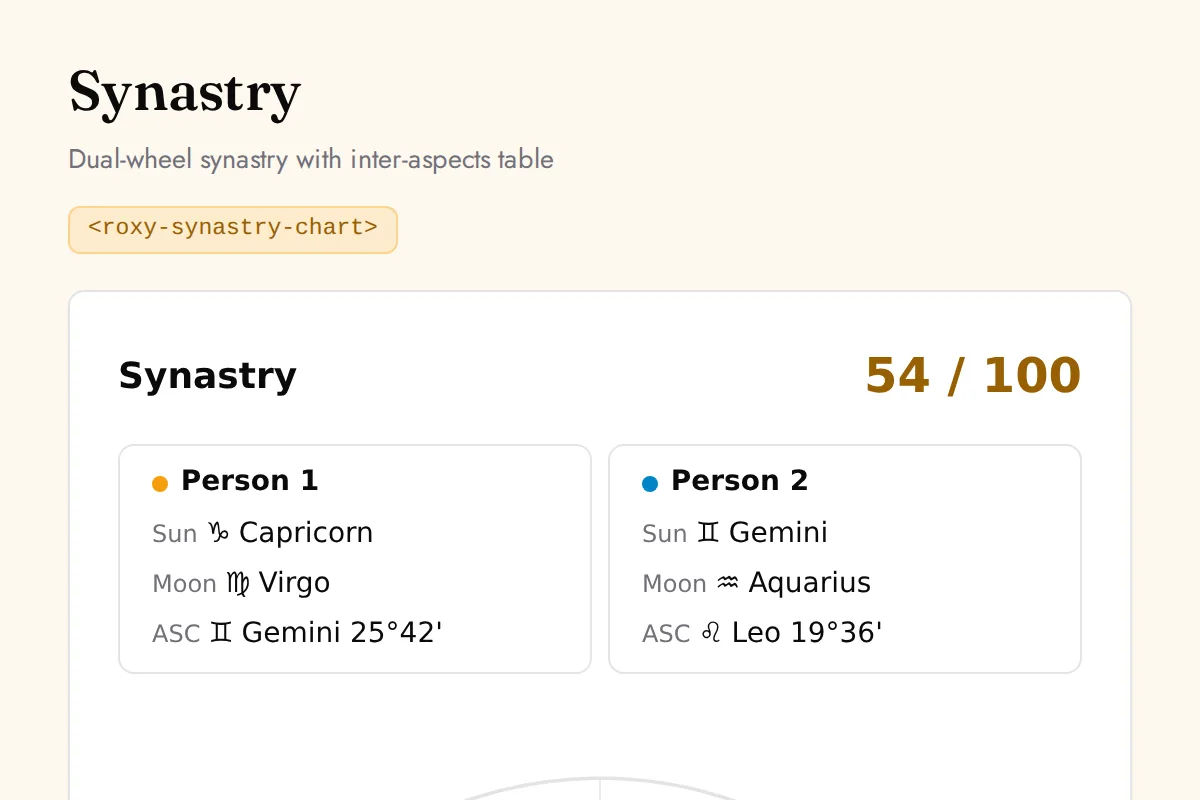 Compatibility card widget snippet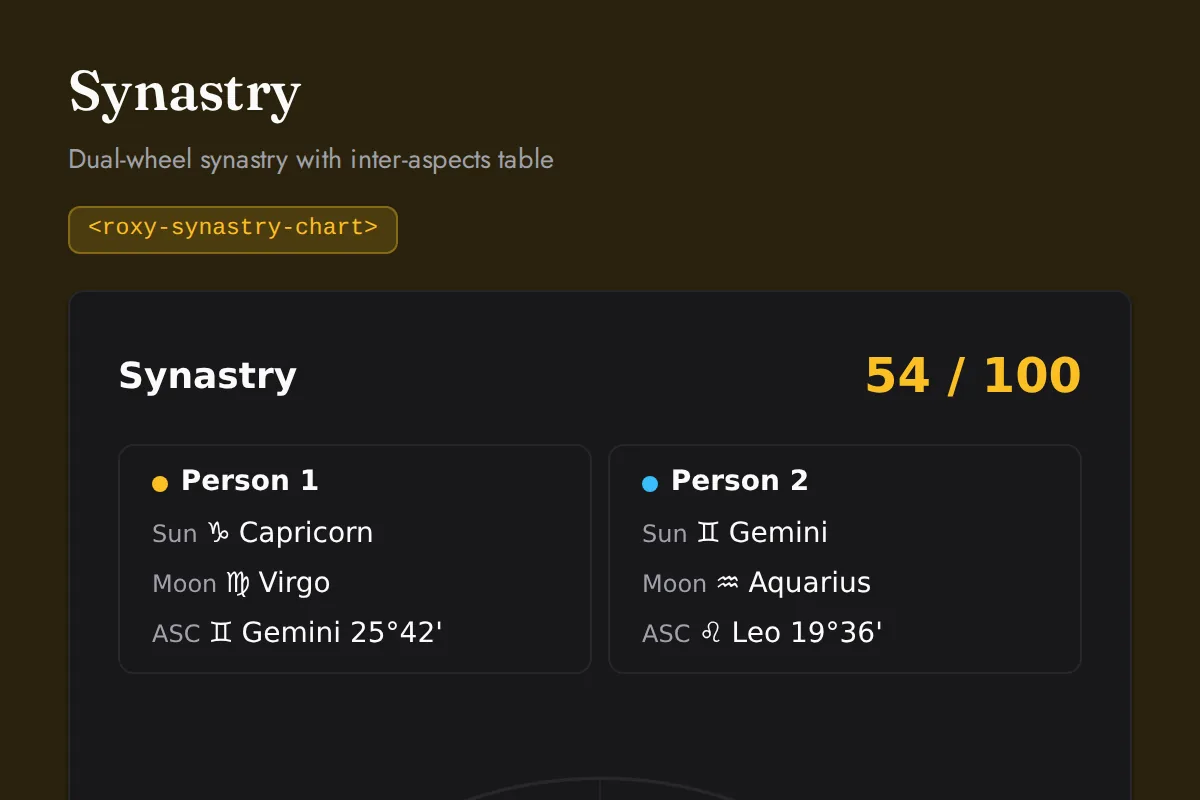
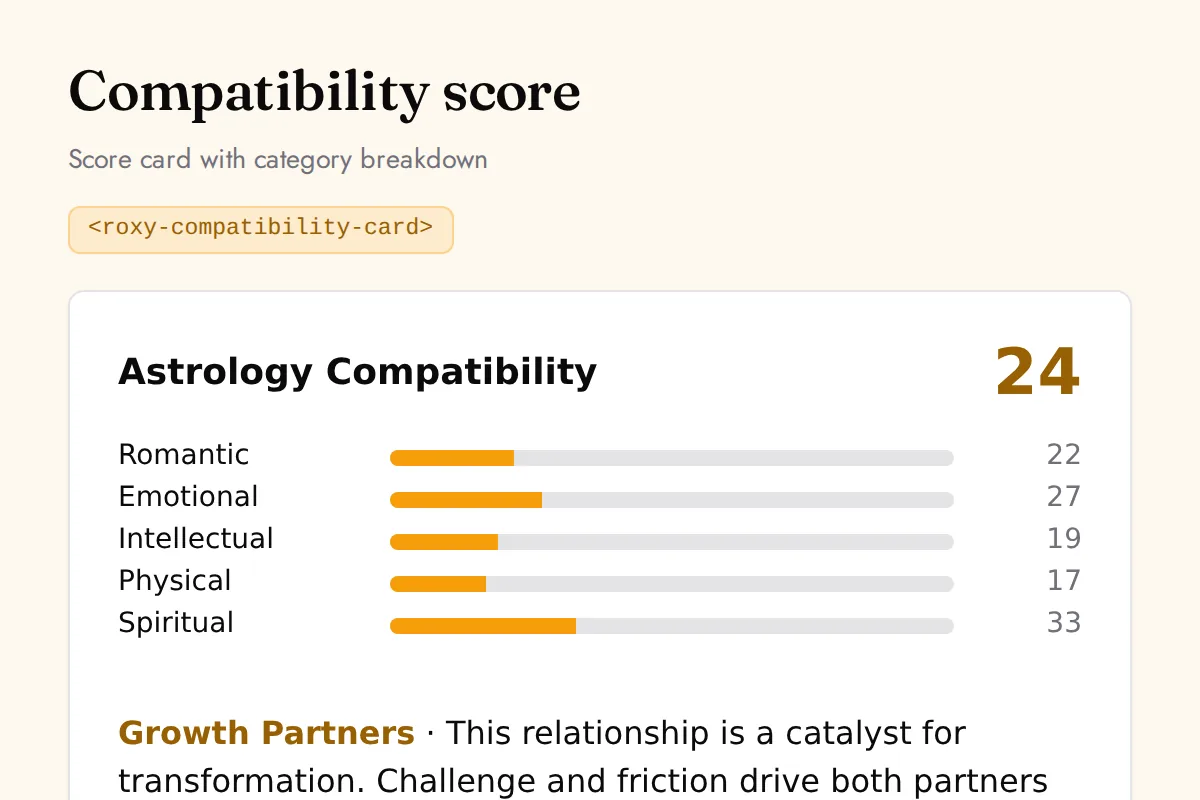 The complete UI libraryExplore Roxy UI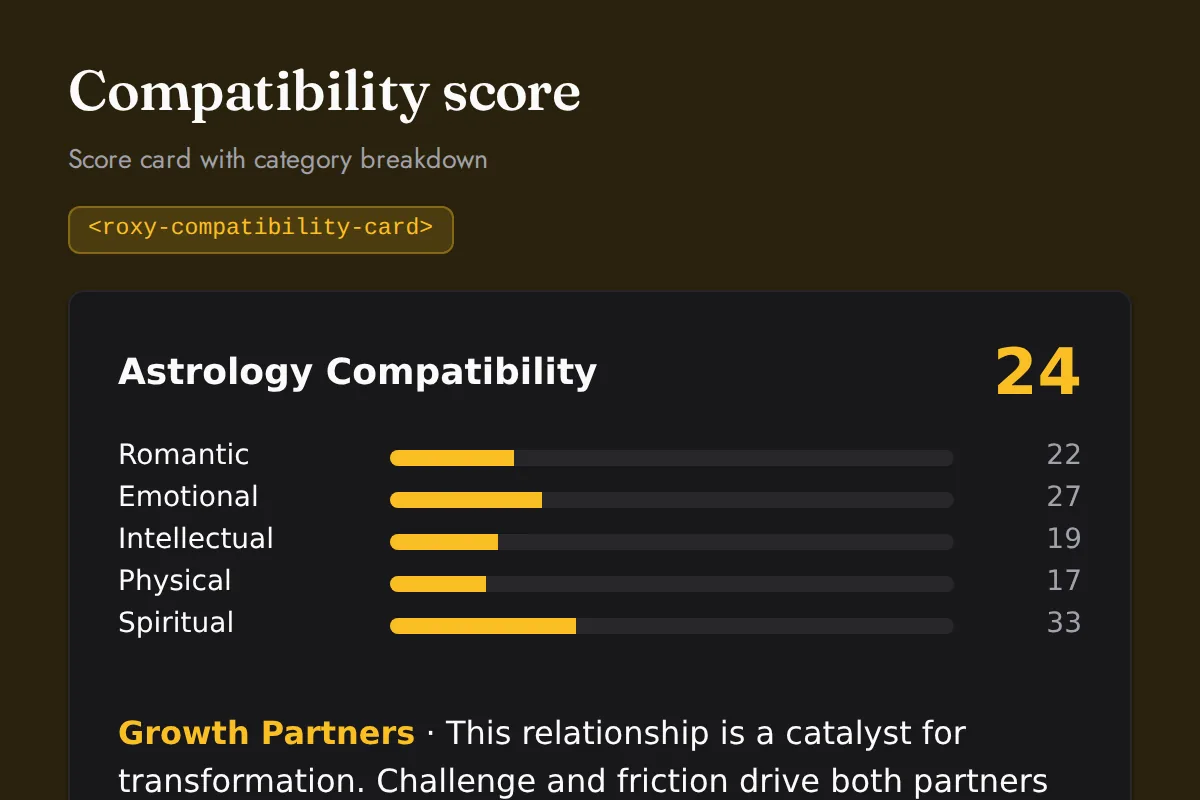
Show all Synastry UI componentsShow fewer Synastry UI components
| Element | Renders |
|---|---|
| <roxy-synastry-chart> | Dual-wheel synastry with inter-aspects table |
| <roxy-compatibility-card> | Score card with category breakdown |
Related capabilities
Synastry API FAQ
What does the Synastry API return?
Calculate complete synastry (relationship compatibility) between two natal charts using Western tropical astrology. Every response is structured JSON with documented fields, not free text, so you map it straight into your product.
How do I authenticate with the Synastry API?
Pass your key in the X-API-Key header on every request. Keys are delivered instantly at checkout with no approval queue. Use a secret sk key server side, or mint a publishable pk key locked to your origins for browser and no-code use.
Does the Synastry API support multiple languages?
Yes. Append the lang query parameter to any endpoint for responses in English, German, Spanish, French, Hindi, Portuguese, Russian and Turkish. The translated payload includes the full interpretation text, not just field labels.
Do I need coordinates to call the Synastry API?
No. Call GET /location/search with a city name first, then pass latitude, longitude, and timezone from the first result into the request. Never ask users to type coordinates. Timezone accepts a decimal offset or an IANA name.
Is the Synastry API available over Remote MCP for AI agents?
Yes. Every endpoint is exposed as a callable tool on the Remote MCP server at https://roxyapi.com/mcp/astrology over Streamable HTTP, so Claude, ChatGPT, Cursor, and any MCP client auto-discover it with no local setup or Docker.
How is the Synastry API billed?
Flat pricing: 1 request equals 1 quota unit, REST and MCP identical, with no credit weighting or per-token markup. Every plan includes all 18 domains, so the Synastry API is included at no extra cost.
What houseSystem values does the Synastry API accept?
The houseSystem parameter accepts placidus, whole-sign, equal, koch. Case-insensitive where it is a path value.
Start using Synastry API today.
Birth charts checked cusp by cusp, and horoscopes that name the dated sky events behind each reading.
All 18 domains included with every plan. Every endpoint, MCP server, SDK, and templates.
Plans from $39/mo, starting at $1.80 per domain on annual billing. No credit card required for testing.
View Pricing & Get API Key