Astrology Transits API
Current transits with natal chart comparison
Included with every plan (at no extra cost)
Calculate current or future planetary transits (positions of all bodies now). Optionally compare transits to natal chart to find transit-to-natal aspects. Returns all 14 celestial bodies (the 10 classical planets, the lunar nodes, Chiron, and Black Moon Lilith) with signs, degrees, and speeds. When natal chart provided, includes transit aspects (transiting Sun conjunct natal Mars, etc.) with orbs and applying/separating status. Perfect for daily transit forecasts, aspect alerts, and personalized transit reports.
Location first, chart second
The Astrology Transits API needs latitude, longitude, and timezone. Never ask users to type coordinates. Resolve a city with the Location endpoint first, then feed the result into the request. Timezone accepts a decimal offset or an IANA name.
1 Resolve the location
curl "https://roxyapi.com/api/v2/location/search?q=New York" \
  -H "X-API-Key: YOUR_KEY"
# -> cities[0]: { latitude, longitude, timezone: "America/New_York" }
2 Call the Astrology Transits endpoint
# feed latitude, longitude and timezone from step 1
POST https://roxyapi.com/api/v2/astrology/transits
Request
POST /api/v2/astrology/transits
Parameters
| Parameter | Type | Description |
|---|---|---|
| langquery | string enum | Response language (BCP 47). Supported: en, tr, de, es, hi, pt, fr, ru, zh-Hans, zh-Hant. Defaults to en. Coverage varies by domain, and a field with no translation in the requested language returns English. Default en. |
Request body
| Field | Type | Description |
|---|---|---|
| date | string (date) | Transit date in YYYY-MM-DD format (defaults to current date) |
| time | string (time) | Transit time in HH:MM:SS format (defaults to current time) |
| timezone | number or string | Transit timezone: decimal hours from UTC OR IANA name (e.g. "America/New_York"). IANA resolved to the DST-correct offset for the transit date. Defaults to 0 (UTC). |
| nodeType | string enum | Lunar node convention. "mean" is the smoothed average node, which always moves retrograde; "true" is the osculating node, which tracks the real perturbed node, oscillates up to about 1.5 degrees either side of the mean on a 173-day cycle, and can briefly turn direct. Neither is more correct and they almost always fall in the same sign. Applies to the North and South Node. True is the osculating node and the default, because it is what most Western chart software reports; mean is the smoothed node preferred by several evolutionary schools, so pass "mean" to match one. Nothing else in the chart changes, and the two agree on the sign except when the node sits within about 1.8 degrees of a cusp. Defaults to "true". |
| natalChart | object | Optional natal chart data to compare transits against |
| natalChart.date* | string (date) | Date in YYYY-MM-DD format. A single-digit month or day is accepted and zero-padded (2026-3-5 becomes 2026-03-05). Impossible calendar dates are rejected. Calculations that read planetary positions support 1550-01-02 to 2650-01-22; outside that span they answer 400 with code date_out_of_range, and a calculation that reads a window around the date (a sunrise search, a run of days) may answer the same 400 for a date within a few days of either end. |
| natalChart.time* | string (time) | Time in 24-hour format. Seconds are optional and default to 00 (14:30 becomes 14:30:00); a single-digit hour is zero-padded. Out-of-range values are rejected. |
| natalChart.latitude* | number | Natal birth latitude in decimal degrees, positive north. Sets the local sidereal time behind the natal Ascendant and house cusps that the transits are measured against. |
| natalChart.longitude* | number | Natal birth longitude in decimal degrees, positive east and negative west. Example: New York -74.0060, London -0.1276, Sydney 151.2093. |
| natalChart.timezone* | number or string | Natal timezone: decimal hours OR IANA name (e.g. "America/New_York"). IANA resolved to the DST-correct offset for the natal date. |
Example request
{
  "date": "2025-12-19",
  "time": "12:00:00",
  "timezone": 0,
  "nodeType": "true",
  "natalChart": {
    "date": "1990-07-15",
    "time": "14:30:00",
    "latitude": 40.7128,
    "longitude": -74.006,
    "timezone": "America/New_York"
  }
}
Response
Structured JSON with documented fields, covered by 13,405 automated tests per deploy, 3,620 of them gold-standard tests verified against NASA JPL Horizons. Not hallucinated text.
{
"transitDate": "2025-12-19",
"transitTime": "12:00:00",
"timezone": 0,
"transitPlanets": [
{
"name": "Sun",
"longitude": 267.83341316978124,
"latitude": -0.0001290616365685517,
"sign": "Sagittarius",
"degree": 27.833413169781238,
"speed": 1.0183777937005516,
"isRetrograde": false
},
{
"name": "Moon",
"longitude": 261.54128684325576,
"latitude": -4.9328571221274355,
"sign": "Sagittarius",
"degree": 21.54128684325576,
"speed": 11.998854157208058,
"isRetrograde": false
},
{
"name": "Mercury",
"longitude": 250.1368587738245,
"latitude": 0.9613345775032028,
"sign": "Sagittarius",
"degree": 10.136858773824514,
"speed": 1.4201108843761858,
"isRetrograde": false
},
{
"name": "Venus",
"longitude": 263.47333030659996,
"latitude": -0.016561542392099327,
"sign": "Sagittarius",
"degree": 23.473330306599962,
"speed": 1.2588508536551615,
"isRetrograde": false
},
{
"name": "Mars",
"longitude": 273.16277125817714,
"latitude": -0.8071715834104695,
"sign": "Capricorn",
"degree": 3.1627712581771448,
"speed": 0.7574686818239513,
"isRetrograde": false
},
{
"name": "Jupiter",
"longitude": 112.88797066361049,
"latitude": 0.20749677053554685,
"sign": "Cancer",
"degree": 22.88797066361049,
"speed": -0.11182289195561168,
"isRetrograde": true
},
{
"name": "Saturn",
"longitude": 355.5642543764682,
"latitude": -2.301472329824395,
"sign": "Pisces",
"degree": 25.564254376468227,
"speed": 0.03784814507946521,
"isRetrograde": false
},
{
"name": "Uranus",
"longitude": 58.34075218369576,
"latitude": -0.20091002212522224,
"sign": "Taurus",
"degree": 28.340752183695763,
"speed": -0.03477611802759384,
"isRetrograde": true
},
{
"name": "Neptune",
"longitude": 359.39617038004684,
"latitude": -1.3405480085173482,
"sign": "Pisces",
"degree": 29.39617038004684,
"speed": 0.005271195351411961,
"isRetrograde": false
},
{
"name": "Pluto",
"longitude": 302.35800022295814,
"latitude": -3.764623583993941,
"sign": "Aquarius",
"degree": 2.3580002229581396,
"speed": 0.027429513821857654,
"isRetrograde": false
},
{
"name": "North Node",
"longitude": 342.07473448550354,
"latitude": 0,
"sign": "Pisces",
"degree": 12.07473448550354,
"speed": -0.23847512411572325,
"isRetrograde": true
},
{
"name": "South Node",
"longitude": 162.07473448550354,
"latitude": 0,
"sign": "Virgo",
"degree": 12.07473448550354,
"speed": -0.23847512411572325,
"isRetrograde": true
},
{
"name": "Chiron",
"longitude": 22.692929155018955,
"latitude": 0.5229884383386785,
"sign": "Aries",
"degree": 22.692929155018955,
"speed": -0.013190683437514394,
"isRetrograde": true
},
{
"name": "Black Moon Lilith",
"longitude": 239.85445733452696,
"latitude": -5.014256800561727,
"sign": "Scorpio",
"degree": 29.854457334526955,
"speed": 0.11204162809940499,
"isRetrograde": false
}
],
"transitAspects": [
{
"transitPlanet": "Uranus",
"natalPlanet": "Black Moon Lilith",
"type": "OPPOSITION",
"angle": 180,
"orb": 0.0004794626559601056,
"isApplying": true,
"strength": 99.9940067168005,
"nature": "challenging",
"interpretation": {
"summary": "Uranus challenges your natal Black Moon Lilith dynamically",
"timing": "Active for extended period",
"impact": "Individuality and revolution creates tension with Primal instinct and the reclaimed self. Growth through friction.",
"guidance": "Work consciously with this tension. Challenges bring growth if handled with awareness.",
"keywords": [
"accept",
"accepting",
"balance",
"challenge",
"complacent",
"easy",
"growth",
"obstacle"
]
}
},
{
"transitPlanet": "North Node",
"natalPlanet": "Moon",
"type": "SEMI_SQUARE",
"angle": 45,
"orb": 0.005795811344910362,
"isApplying": true,
"strength": 99.71020943275448,
"nature": "challenging",
"interpretation": {
"summary": "North Node challenges your natal Moon dynamically",
"timing": "Active for extended period",
"impact": "Life purpose and destiny creates tension with Inner emotional life. Growth through friction.",
"guidance": "Work consciously with this tension. Challenges bring growth if handled with awareness.",
"keywords": [
"friction",
"irritation",
"agitation",
"minor tension"
]
}
},
{
"transitPlanet": "South Node",
"natalPlanet": "Moon",
"type": "SESQUIQUADRATE",
"angle": 135,
"orb": 0.005795811344938784,
"isApplying": true,
"strength": 99.71020943275306,
"nature": "challenging",
"interpretation": {
"summary": "South Node challenges your natal Moon dynamically",
"timing": "Active for extended period",
"impact": "Past life gifts and comfort zone creates tension with Inner emotional life. Growth through friction.",
"guidance": "Work consciously with this tension. Challenges bring growth if handled with awareness.",
"keywords": [
"frustration",
"adjustment",
"external tension",
"redirection"
]
}
},
{
"transitPlanet": "Chiron",
"natalPlanet": "Jupiter",
"type": "SQUARE",
"angle": 90,
"orb": 0.08298343819546972,
"isApplying": true,
"strength": 98.81452231149329,
"nature": "challenging",
"interpretation": {
"summary": "Chiron challenges your natal Jupiter dynamically",
"timing": "Active for extended period",
"impact": "Healing and inner wounds creates tension with Luck and opportunity. Growth through friction.",
"guidance": "Work consciously with this tension. Challenges bring growth if handled with awareness.",
"keywords": [
"difficult",
"obstacle",
"stress",
"tension"
]
}
},
{
"transitPlanet": "Jupiter",
"natalPlanet": "Sun",
"type": "CONJUNCTION",
"angle": 0,
"orb": 0.11654986854811966,
"isApplying": false,
"strength": 98.5431266431485,
"nature": "neutral",
"interpretation": {
"summary": "Jupiter activates your natal Sun neutrally",
"timing": "Active for 1-2 weeks",
"impact": "Luck and opportunity merges with Self-awareness and ego. Intensifies this energy.",
"guidance": "Pay attention to how this combination manifests. Strong energy requires conscious direction.",
"keywords": [
"blend",
"difficult",
"unite",
"united"
]
}
},
{
"transitPlanet": "Pluto",
"natalPlanet": "Mars",
"type": "SQUARE",
"angle": 90,
"orb": 0.23457096499782892,
"isApplying": false,
"strength": 96.64898621431674,
"nature": "challenging",
"interpretation": {
"summary": "Pluto challenges your natal Mars dynamically",
"timing": "Active for extended period",
"impact": "Sex, death, and transformation creates tension with Assertiveness and aggression. Growth through friction.",
"guidance": "Work consciously with this tension. Challenges bring growth if handled with awareness.",
"keywords": [
"difficult",
"obstacle",
"stress",
"tension"
]
}
},
{
"transitPlanet": "Jupiter",
"natalPlanet": "Jupiter",
"type": "CONJUNCTION",
"angle": 0,
"orb": 0.2780249467869993,
"isApplying": true,
"strength": 96.5246881651625,
"nature": "neutral",
"interpretation": {
"summary": "Jupiter activates your natal Jupiter neutrally",
"timing": "Active for 1-2 weeks",
"impact": "Luck and opportunity merges with Luck and opportunity. Intensifies this energy.",
"guidance": "Pay attention to how this combination manifests. Strong energy requires conscious direction.",
"keywords": [
"blend",
"difficult",
"unite",
"united"
]
}
},
{
"transitPlanet": "Chiron",
"natalPlanet": "Sun",
"type": "SQUARE",
"angle": 90,
"orb": 0.31159137713964924,
"isApplying": false,
"strength": 95.54869461229073,
"nature": "challenging",
"interpretation": {
"summary": "Chiron challenges your natal Sun dynamically",
"timing": "Active for extended period",
"impact": "Healing and inner wounds creates tension with Self-awareness and ego. Growth through friction.",
"guidance": "Work consciously with this tension. Challenges bring growth if handled with awareness.",
"keywords": [
"difficult",
"obstacle",
"stress",
"tension"
]
}
},
{
"transitPlanet": "Sun",
"natalPlanet": "Moon",
"type": "TRINE",
"angle": 120,
"orb": 0.7644744956226361,
"isApplying": false,
"strength": 90.44406880471705,
"nature": "harmonious",
"interpretation": {
"summary": "Sun supports your natal Moon harmoniously",
"timing": "Active for a few days",
"impact": "Self-awareness and ego flows easily with Inner emotional life. Opportunities arise naturally in this area.",
"guidance": "Take advantage of this supportive energy. Things flow easily - act on opportunities.",
"keywords": [
"accept",
"accepting",
"difficult",
"natural",
"support",
"talent"
]
}
},
{
"transitPlanet": "South Node",
"natalPlanet": "Neptune",
"type": "TRINE",
"angle": 120,
"orb": 0.8392630167052744,
"isApplying": false,
"strength": 89.50921229118407,
"nature": "harmonious",
"interpretation": {
"summary": "South Node supports your natal Neptune harmoniously",
"timing": "Active for extended period",
"impact": "Past life gifts and comfort zone flows easily with Dreams, healing, and intuition. Opportunities arise naturally in this area.",
"guidance": "Take advantage of this supportive energy. Things flow easily - act on opportunities.",
"keywords": [
"accept",
"accepting",
"difficult",
"natural",
"support",
"talent"
]
}
},
{
"transitPlanet": "Chiron",
"natalPlanet": "Saturn",
"type": "SQUARE",
"angle": 90,
"orb": 0.7493896224650598,
"isApplying": true,
"strength": 89.29443396478486,
"nature": "challenging",
"interpretation": {
"summary": "Chiron challenges your natal Saturn dynamically",
"timing": "Active for extended period",
"impact": "Healing and inner wounds creates tension with Responsibility, time, and routine. Growth through friction.",
"guidance": "Work consciously with this tension. Challenges bring growth if handled with awareness.",
"keywords": [
"difficult",
"obstacle",
"stress",
"tension"
]
}
},
{
"transitPlanet": "Jupiter",
"natalPlanet": "Saturn",
"type": "OPPOSITION",
"angle": 180,
"orb": 0.9444311310566036,
"isApplying": true,
"strength": 88.19461086179246,
"nature": "challenging",
"interpretation": {
"summary": "Jupiter challenges your natal Saturn dynamically",
"timing": "Active for 1-2 weeks",
"impact": "Luck and opportunity creates tension with Responsibility, time, and routine. Growth through friction.",
"guidance": "Work consciously with this tension. Challenges bring growth if handled with awareness.",
"keywords": [
"accept",
"accepting",
"balance",
"challenge",
"complacent",
"easy",
"growth",
"obstacle"
]
}
},
{
"transitPlanet": "Saturn",
"natalPlanet": "Venus",
"type": "SQUARE",
"angle": 90,
"orb": 0.8281716128964263,
"isApplying": false,
"strength": 88.16897695862248,
"nature": "challenging",
"interpretation": {
"summary": "Saturn challenges your natal Venus dynamically",
"timing": "Active for several weeks",
"impact": "Responsibility, time, and routine creates tension with Love, beauty, and money. Growth through friction.",
"guidance": "Work consciously with this tension. Challenges bring growth if handled with awareness.",
"keywords": [
"difficult",
"obstacle",
"stress",
"tension"
]
}
},
{
"transitPlanet": "Mars",
"natalPlanet": "Mars",
"type": "TRINE",
"angle": 120,
"orb": 1.039342000216834,
"isApplying": false,
"strength": 87.00822499728957,
"nature": "harmonious",
"interpretation": {
"summary": "Mars supports your natal Mars harmoniously",
"timing": "Active for a few days",
"impact": "Assertiveness and aggression flows easily with Assertiveness and aggression. Opportunities arise naturally in this area.",
"guidance": "Take advantage of this supportive energy. Things flow easily - act on opportunities.",
"keywords": [
"accept",
"accepting",
"difficult",
"natural",
"support",
"talent"
]
}
},
{
"transitPlanet": "Neptune",
"natalPlanet": "Black Moon Lilith",
"type": "TRINE",
"angle": 120,
"orb": 1.0558976590070301,
"isApplying": false,
"strength": 86.80127926241212,
"nature": "harmonious",
"interpretation": {
"summary": "Neptune supports your natal Black Moon Lilith harmoniously",
"timing": "Active for extended period",
"impact": "Dreams, healing, and intuition flows easily with Primal instinct and the reclaimed self. Opportunities arise naturally in this area.",
"guidance": "Take advantage of this supportive energy. Things flow easily - act on opportunities.",
"keywords": [
"accept",
"accepting",
"difficult",
"natural",
"support",
"talent"
]
}
},
{
"transitPlanet": "Moon",
"natalPlanet": "Saturn",
"type": "SEMI_SEXTILE",
"angle": 30,
"orb": 0.4022526892981091,
"isApplying": true,
"strength": 86.59157702339635,
"nature": "neutral",
"interpretation": {
"summary": "Moon activates your natal Saturn neutrally",
"timing": "Active for a few hours",
"impact": "Inner emotional life merges with Responsibility, time, and routine. Intensifies this energy.",
"guidance": "Pay attention to how this combination manifests. Strong energy requires conscious direction.",
"keywords": [
"growth",
"subtle",
"adjustment",
"awareness"
]
}
},
{
"transitPlanet": "North Node",
"natalPlanet": "Neptune",
"type": "SEXTILE",
"angle": 60,
"orb": 0.8392630167052744,
"isApplying": false,
"strength": 86.0122830549121,
"nature": "harmonious",
"interpretation": {
"summary": "North Node supports your natal Neptune harmoniously",
"timing": "Active for extended period",
"impact": "Life purpose and destiny flows easily with Dreams, healing, and intuition. Opportunities arise naturally in this area.",
"guidance": "Take advantage of this supportive energy. Things flow easily - act on opportunities.",
"keywords": [
"ease",
"natural",
"relationship",
"talent"
]
}
},
{
"transitPlanet": "Venus",
"natalPlanet": "Sun",
"type": "QUINCUNX",
"angle": 150,
"orb": 0.46880977444135397,
"isApplying": false,
"strength": 84.37300751862153,
"nature": "challenging",
"interpretation": {
"summary": "Venus challenges your natal Sun dynamically",
"timing": "Active for a few days",
"impact": "Love, beauty, and money creates tension with Self-awareness and ego. Growth through friction.",
"guidance": "Work consciously with this tension. Challenges bring growth if handled with awareness.",
"keywords": [
"adjustment",
"tension",
"adaptation",
"redirection"
]
}
},
{
"transitPlanet": "Venus",
"natalPlanet": "Venus",
"type": "OPPOSITION",
"angle": 180,
"orb": 1.2627524569718673,
"isApplying": true,
"strength": 84.21559428785166,
"nature": "challenging",
"interpretation": {
"summary": "Venus challenges your natal Venus dynamically",
"timing": "Active for a few days",
"impact": "Love, beauty, and money creates tension with Love, beauty, and money. Growth through friction.",
"guidance": "Work consciously with this tension. Challenges bring growth if handled with awareness.",
"keywords": [
"accept",
"accepting",
"balance",
"challenge",
"complacent",
"easy",
"growth",
"obstacle"
]
}
},
{
"transitPlanet": "Sun",
"natalPlanet": "Black Moon Lilith",
"type": "SEMI_SEXTILE",
"angle": 30,
"orb": 0.5068595512585716,
"isApplying": true,
"strength": 83.10468162471429,
"nature": "neutral",
"interpretation": {
"summary": "Sun activates your natal Black Moon Lilith neutrally",
"timing": "Active for a few days",
"impact": "Self-awareness and ego merges with Primal instinct and the reclaimed self. Intensifies this energy.",
"guidance": "Pay attention to how this combination manifests. Strong energy requires conscious direction.",
"keywords": [
"growth",
"subtle",
"adjustment",
"awareness"
]
}
},
{
"transitPlanet": "Black Moon Lilith",
"natalPlanet": "Black Moon Lilith",
"type": "CONJUNCTION",
"angle": 0,
"orb": 1.5141846134871457,
"isApplying": false,
"strength": 81.07269233141068,
"nature": "neutral",
"interpretation": {
"summary": "Black Moon Lilith activates your natal Black Moon Lilith neutrally",
"timing": "Active for extended period",
"impact": "Primal instinct and the reclaimed self merges with Primal instinct and the reclaimed self. Intensifies this energy.",
"guidance": "Pay attention to how this combination manifests. Strong energy requires conscious direction.",
"keywords": [
"blend",
"difficult",
"unite",
"united"
]
}
},
{
"transitPlanet": "Uranus",
"natalPlanet": "Neptune",
"type": "SESQUIQUADRATE",
"angle": 135,
"orb": 0.4267546814869547,
"isApplying": true,
"strength": 78.66226592565226,
"nature": "challenging",
"interpretation": {
"summary": "Uranus challenges your natal Neptune dynamically",
"timing": "Active for extended period",
"impact": "Individuality and revolution creates tension with Dreams, healing, and intuition. Growth through friction.",
"guidance": "Work consciously with this tension. Challenges bring growth if handled with awareness.",
"keywords": [
"frustration",
"adjustment",
"external tension",
"redirection"
]
}
},
{
"transitPlanet": "Venus",
"natalPlanet": "Jupiter",
"type": "QUINCUNX",
"angle": 150,
"orb": 0.8633845897764729,
"isApplying": false,
"strength": 71.22051367411757,
"nature": "challenging",
"interpretation": {
"summary": "Venus challenges your natal Jupiter dynamically",
"timing": "Active for a few days",
"impact": "Love, beauty, and money creates tension with Luck and opportunity. Growth through friction.",
"guidance": "Work consciously with this tension. Challenges bring growth if handled with awareness.",
"keywords": [
"adjustment",
"tension",
"adaptation",
"redirection"
]
}
},
{
"transitPlanet": "Neptune",
"natalPlanet": "Pluto",
"type": "SESQUIQUADRATE",
"angle": 135,
"orb": 0.6017106566249879,
"isApplying": true,
"strength": 69.9144671687506,
"nature": "challenging",
"interpretation": {
"summary": "Neptune challenges your natal Pluto dynamically",
"timing": "Active for extended period",
"impact": "Dreams, healing, and intuition creates tension with Sex, death, and transformation. Growth through friction.",
"guidance": "Work consciously with this tension. Challenges bring growth if handled with awareness.",
"keywords": [
"frustration",
"adjustment",
"external tension",
"redirection"
]
}
},
{
"transitPlanet": "Saturn",
"natalPlanet": "Sun",
"type": "TRINE",
"angle": 120,
"orb": 2.559733844309619,
"isApplying": false,
"strength": 68.00332694612976,
"nature": "harmonious",
"interpretation": {
"summary": "Saturn supports your natal Sun harmoniously",
"timing": "Active for several weeks",
"impact": "Responsibility, time, and routine flows easily with Self-awareness and ego. Opportunities arise naturally in this area.",
"guidance": "Take advantage of this supportive energy. Things flow easily - act on opportunities.",
"keywords": [
"accept",
"accepting",
"difficult",
"natural",
"support",
"talent"
]
}
},
{
"transitPlanet": "Chiron",
"natalPlanet": "Venus",
"type": "SEXTILE",
"angle": 60,
"orb": 2.0431536085528705,
"isApplying": false,
"strength": 65.94743985745215,
"nature": "harmonious",
"interpretation": {
"summary": "Chiron supports your natal Venus harmoniously",
"timing": "Active for extended period",
"impact": "Healing and inner wounds flows easily with Love, beauty, and money. Opportunities arise naturally in this area.",
"guidance": "Take advantage of this supportive energy. Things flow easily - act on opportunities.",
"keywords": [
"ease",
"natural",
"relationship",
"talent"
]
}
},
{
"transitPlanet": "Saturn",
"natalPlanet": "Black Moon Lilith",
"type": "TRINE",
"angle": 120,
"orb": 2.7760183445715825,
"isApplying": true,
"strength": 65.29977069285522,
"nature": "harmonious",
"interpretation": {
"summary": "Saturn supports your natal Black Moon Lilith harmoniously",
"timing": "Active for several weeks",
"impact": "Responsibility, time, and routine flows easily with Primal instinct and the reclaimed self. Opportunities arise naturally in this area.",
"guidance": "Take advantage of this supportive energy. Things flow easily - act on opportunities.",
"keywords": [
"accept",
"accepting",
"difficult",
"natural",
"support",
"talent"
]
}
},
{
"transitPlanet": "Mercury",
"natalPlanet": "South Node",
"type": "TRINE",
"angle": 120,
"orb": 2.778141907371861,
"isApplying": false,
"strength": 65.27322615785174,
"nature": "harmonious",
"interpretation": {
"summary": "Mercury supports your natal South Node harmoniously",
"timing": "Active for a few days",
"impact": "Communication flows easily with Past life gifts and comfort zone. Opportunities arise naturally in this area.",
"guidance": "Take advantage of this supportive energy. Things flow easily - act on opportunities.",
"keywords": [
"accept",
"accepting",
"difficult",
"natural",
"support",
"talent"
]
}
},
{
"transitPlanet": "Moon",
"natalPlanet": "Jupiter",
"type": "QUINCUNX",
"angle": 150,
"orb": 1.0686588735677276,
"isApplying": true,
"strength": 64.37803754774241,
"nature": "challenging",
"interpretation": {
"summary": "Moon challenges your natal Jupiter dynamically",
"timing": "Active for a few hours",
"impact": "Inner emotional life creates tension with Luck and opportunity. Growth through friction.",
"guidance": "Work consciously with this tension. Challenges bring growth if handled with awareness.",
"keywords": [
"adjustment",
"tension",
"adaptation",
"redirection"
]
}
},
{
"transitPlanet": "Mercury",
"natalPlanet": "Mercury",
"type": "TRINE",
"angle": 120,
"orb": 2.8564104226189073,
"isApplying": false,
"strength": 64.29486971726365,
"nature": "harmonious",
"interpretation": {
"summary": "Mercury supports your natal Mercury harmoniously",
"timing": "Active for a few days",
"impact": "Communication flows easily with Communication. Opportunities arise naturally in this area.",
"guidance": "Take advantage of this supportive energy. Things flow easily - act on opportunities.",
"keywords": [
"accept",
"accepting",
"difficult",
"natural",
"support",
"talent"
]
}
},
{
"transitPlanet": "North Node",
"natalPlanet": "Pluto",
"type": "TRINE",
"angle": 120,
"orb": 2.923146551168287,
"isApplying": false,
"strength": 63.46066811039641,
"nature": "harmonious",
"interpretation": {
"summary": "North Node supports your natal Pluto harmoniously",
"timing": "Active for extended period",
"impact": "Life purpose and destiny flows easily with Sex, death, and transformation. Opportunities arise naturally in this area.",
"guidance": "Take advantage of this supportive energy. Things flow easily - act on opportunities.",
"keywords": [
"accept",
"accepting",
"difficult",
"natural",
"support",
"talent"
]
}
},
{
"transitPlanet": "Saturn",
"natalPlanet": "Jupiter",
"type": "TRINE",
"angle": 120,
"orb": 2.954308659644738,
"isApplying": false,
"strength": 63.071141754440774,
"nature": "harmonious",
"interpretation": {
"summary": "Saturn supports your natal Jupiter harmoniously",
"timing": "Active for several weeks",
"impact": "Responsibility, time, and routine flows easily with Luck and opportunity. Opportunities arise naturally in this area.",
"guidance": "Take advantage of this supportive energy. Things flow easily - act on opportunities.",
"keywords": [
"accept",
"accepting",
"difficult",
"natural",
"support",
"talent"
]
}
},
{
"transitPlanet": "Moon",
"natalPlanet": "Mercury",
"type": "SESQUIQUADRATE",
"angle": 135,
"orb": 0.7391615079498592,
"isApplying": true,
"strength": 63.04192460250704,
"nature": "challenging",
"interpretation": {
"summary": "Moon challenges your natal Mercury dynamically",
"timing": "Active for a few hours",
"impact": "Inner emotional life creates tension with Communication. Growth through friction.",
"guidance": "Work consciously with this tension. Challenges bring growth if handled with awareness.",
"keywords": [
"frustration",
"adjustment",
"external tension",
"redirection"
]
}
},
{
"transitPlanet": "Sun",
"natalPlanet": "Venus",
"type": "OPPOSITION",
"angle": 180,
"orb": 3.0973304062094087,
"isApplying": false,
"strength": 61.28336992238239,
"nature": "challenging",
"interpretation": {
"summary": "Sun challenges your natal Venus dynamically",
"timing": "Active for a few days",
"impact": "Self-awareness and ego creates tension with Love, beauty, and money. Growth through friction.",
"guidance": "Work consciously with this tension. Challenges bring growth if handled with awareness.",
"keywords": [
"accept",
"accepting",
"balance",
"challenge",
"complacent",
"easy",
"growth",
"obstacle"
]
}
},
{
"transitPlanet": "Moon",
"natalPlanet": "Venus",
"type": "OPPOSITION",
"angle": 180,
"orb": 3.194795920316068,
"isApplying": true,
"strength": 60.06505099604915,
"nature": "challenging",
"interpretation": {
"summary": "Moon challenges your natal Venus dynamically",
"timing": "Active for a few hours",
"impact": "Inner emotional life creates tension with Love, beauty, and money. Growth through friction.",
"guidance": "Work consciously with this tension. Challenges bring growth if handled with awareness.",
"keywords": [
"accept",
"accepting",
"balance",
"challenge",
"complacent",
"easy",
"growth",
"obstacle"
]
}
},
{
"transitPlanet": "Moon",
"natalPlanet": "North Node",
"type": "SEMI_SQUARE",
"angle": 45,
"orb": 0.8174300231968914,
"isApplying": true,
"strength": 59.12849884015543,
"nature": "challenging",
"interpretation": {
"summary": "Moon challenges your natal North Node dynamically",
"timing": "Active for a few hours",
"impact": "Inner emotional life creates tension with Life purpose and destiny. Growth through friction.",
"guidance": "Work consciously with this tension. Challenges bring growth if handled with awareness.",
"keywords": [
"friction",
"irritation",
"agitation",
"minor tension"
]
}
},
{
"transitPlanet": "Moon",
"natalPlanet": "South Node",
"type": "SESQUIQUADRATE",
"angle": 135,
"orb": 0.8174300231968914,
"isApplying": true,
"strength": 59.12849884015543,
"nature": "challenging",
"interpretation": {
"summary": "Moon challenges your natal South Node dynamically",
"timing": "Active for a few hours",
"impact": "Inner emotional life creates tension with Past life gifts and comfort zone. Growth through friction.",
"guidance": "Work consciously with this tension. Challenges bring growth if handled with awareness.",
"keywords": [
"frustration",
"adjustment",
"external tension",
"redirection"
]
}
},
{
"transitPlanet": "Uranus",
"natalPlanet": "Moon",
"type": "SEMI_SEXTILE",
"angle": 30,
"orb": 1.27181350953715,
"isApplying": true,
"strength": 57.60621634876166,
"nature": "neutral",
"interpretation": {
"summary": "Uranus activates your natal Moon neutrally",
"timing": "Active for extended period",
"impact": "Individuality and revolution merges with Inner emotional life. Intensifies this energy.",
"guidance": "Pay attention to how this combination manifests. Strong energy requires conscious direction.",
"keywords": [
"growth",
"subtle",
"adjustment",
"awareness"
]
}
},
{
"transitPlanet": "Venus",
"natalPlanet": "Moon",
"type": "TRINE",
"angle": 120,
"orb": 3.59560836755864,
"isApplying": true,
"strength": 55.054895405517,
"nature": "harmonious",
"interpretation": {
"summary": "Venus supports your natal Moon harmoniously",
"timing": "Active for a few days",
"impact": "Love, beauty, and money flows easily with Inner emotional life. Opportunities arise naturally in this area.",
"guidance": "Take advantage of this supportive energy. Things flow easily - act on opportunities.",
"keywords": [
"accept",
"accepting",
"difficult",
"natural",
"support",
"talent"
]
}
},
{
"transitPlanet": "Jupiter",
"natalPlanet": "Chiron",
"type": "CONJUNCTION",
"angle": 0,
"orb": 3.630918694894447,
"isApplying": true,
"strength": 54.61351631381941,
"nature": "neutral",
"interpretation": {
"summary": "Jupiter activates your natal Chiron neutrally",
"timing": "Active for 1-2 weeks",
"impact": "Luck and opportunity merges with Healing and inner wounds. Intensifies this energy.",
"guidance": "Pay attention to how this combination manifests. Strong energy requires conscious direction.",
"keywords": [
"blend",
"difficult",
"unite",
"united"
]
}
},
{
"transitPlanet": "Mercury",
"natalPlanet": "North Node",
"type": "SEXTILE",
"angle": 60,
"orb": 2.778141907371861,
"isApplying": false,
"strength": 53.697634877135656,
"nature": "harmonious",
"interpretation": {
"summary": "Mercury supports your natal North Node harmoniously",
"timing": "Active for a few days",
"impact": "Communication flows easily with Life purpose and destiny. Opportunities arise naturally in this area.",
"guidance": "Take advantage of this supportive energy. Things flow easily - act on opportunities.",
"keywords": [
"ease",
"natural",
"relationship",
"talent"
]
}
},
{
"transitPlanet": "Mars",
"natalPlanet": "Uranus",
"type": "CONJUNCTION",
"angle": 0,
"orb": 3.7935105446188686,
"isApplying": true,
"strength": 52.58111819226414,
"nature": "neutral",
"interpretation": {
"summary": "Mars activates your natal Uranus neutrally",
"timing": "Active for a few days",
"impact": "Assertiveness and aggression merges with Individuality and revolution. Intensifies this energy.",
"guidance": "Pay attention to how this combination manifests. Strong energy requires conscious direction.",
"keywords": [
"blend",
"difficult",
"unite",
"united"
]
}
},
{
"transitPlanet": "South Node",
"natalPlanet": "Pluto",
"type": "SEXTILE",
"angle": 60,
"orb": 2.923146551168287,
"isApplying": false,
"strength": 51.28089081386189,
"nature": "harmonious",
"interpretation": {
"summary": "South Node supports your natal Pluto harmoniously",
"timing": "Active for extended period",
"impact": "Past life gifts and comfort zone flows easily with Sex, death, and transformation. Opportunities arise naturally in this area.",
"guidance": "Take advantage of this supportive energy. Things flow easily - act on opportunities.",
"keywords": [
"ease",
"natural",
"relationship",
"talent"
]
}
},
{
"transitPlanet": "Moon",
"natalPlanet": "Sun",
"type": "QUINCUNX",
"angle": 150,
"orb": 1.4632336889028466,
"isApplying": true,
"strength": 51.22554370323844,
"nature": "challenging",
"interpretation": {
"summary": "Moon challenges your natal Sun dynamically",
"timing": "Active for a few hours",
"impact": "Inner emotional life creates tension with Self-awareness and ego. Growth through friction.",
"guidance": "Work consciously with this tension. Challenges bring growth if handled with awareness.",
"keywords": [
"adjustment",
"tension",
"adaptation",
"redirection"
]
}
},
{
"transitPlanet": "Chiron",
"natalPlanet": "Chiron",
"type": "SQUARE",
"angle": 90,
"orb": 3.4358771863029176,
"isApplying": true,
"strength": 50.91604019567261,
"nature": "challenging",
"interpretation": {
"summary": "Chiron challenges your natal Chiron dynamically",
"timing": "Active for extended period",
"impact": "Healing and inner wounds creates tension with Healing and inner wounds. Growth through friction.",
"guidance": "Work consciously with this tension. Challenges bring growth if handled with awareness.",
"keywords": [
"difficult",
"obstacle",
"stress",
"tension"
]
}
},
{
"transitPlanet": "Saturn",
"natalPlanet": "Moon",
"type": "SEMI_SEXTILE",
"angle": 30,
"orb": 1.5046842976904031,
"isApplying": true,
"strength": 49.84385674365323,
"nature": "neutral",
"interpretation": {
"summary": "Saturn activates your natal Moon neutrally",
"timing": "Active for several weeks",
"impact": "Responsibility, time, and routine merges with Inner emotional life. Intensifies this energy.",
"guidance": "Pay attention to how this combination manifests. Strong energy requires conscious direction.",
"keywords": [
"growth",
"subtle",
"adjustment",
"awareness"
]
}
},
{
"transitPlanet": "Venus",
"natalPlanet": "Saturn",
"type": "SEMI_SEXTILE",
"angle": 30,
"orb": 1.5297907740460914,
"isApplying": false,
"strength": 49.00697419846362,
"nature": "neutral",
"interpretation": {
"summary": "Venus activates your natal Saturn neutrally",
"timing": "Active for a few days",
"impact": "Love, beauty, and money merges with Responsibility, time, and routine. Intensifies this energy.",
"guidance": "Pay attention to how this combination manifests. Strong energy requires conscious direction.",
"keywords": [
"growth",
"subtle",
"adjustment",
"awareness"
]
}
},
{
"transitPlanet": "Sun",
"natalPlanet": "Mars",
"type": "TRINE",
"angle": 120,
"orb": 4.2900160881790725,
"isApplying": true,
"strength": 46.37479889776159,
"nature": "harmonious",
"interpretation": {
"summary": "Sun supports your natal Mars harmoniously",
"timing": "Active for a few days",
"impact": "Self-awareness and ego flows easily with Assertiveness and aggression. Opportunities arise naturally in this area.",
"guidance": "Take advantage of this supportive energy. Things flow easily - act on opportunities.",
"keywords": [
"accept",
"accepting",
"difficult",
"natural",
"support",
"talent"
]
}
},
{
"transitPlanet": "Chiron",
"natalPlanet": "Moon",
"type": "CONJUNCTION",
"angle": 0,
"orb": 4.376009519139657,
"isApplying": false,
"strength": 45.299881010754284,
"nature": "neutral",
"interpretation": {
"summary": "Chiron activates your natal Moon neutrally",
"timing": "Active for extended period",
"impact": "Healing and inner wounds merges with Inner emotional life. Intensifies this energy.",
"guidance": "Pay attention to how this combination manifests. Strong energy requires conscious direction.",
"keywords": [
"blend",
"difficult",
"unite",
"united"
]
}
},
{
"transitPlanet": "Venus",
"natalPlanet": "North Node",
"type": "SEMI_SQUARE",
"angle": 45,
"orb": 1.1146134401473091,
"isApplying": false,
"strength": 44.269327992634544,
"nature": "challenging",
"interpretation": {
"summary": "Venus challenges your natal North Node dynamically",
"timing": "Active for a few days",
"impact": "Love, beauty, and money creates tension with Life purpose and destiny. Growth through friction.",
"guidance": "Work consciously with this tension. Challenges bring growth if handled with awareness.",
"keywords": [
"friction",
"irritation",
"agitation",
"minor tension"
]
}
},
{
"transitPlanet": "Venus",
"natalPlanet": "South Node",
"type": "SESQUIQUADRATE",
"angle": 135,
"orb": 1.1146134401473091,
"isApplying": false,
"strength": 44.269327992634544,
"nature": "challenging",
"interpretation": {
"summary": "Venus challenges your natal South Node dynamically",
"timing": "Active for a few days",
"impact": "Love, beauty, and money creates tension with Past life gifts and comfort zone. Growth through friction.",
"guidance": "Work consciously with this tension. Challenges bring growth if handled with awareness.",
"keywords": [
"frustration",
"adjustment",
"external tension",
"redirection"
]
}
},
{
"transitPlanet": "Venus",
"natalPlanet": "Mercury",
"type": "SESQUIQUADRATE",
"angle": 135,
"orb": 1.1928819553943413,
"isApplying": false,
"strength": 40.355902230282936,
"nature": "challenging",
"interpretation": {
"summary": "Venus challenges your natal Mercury dynamically",
"timing": "Active for a few days",
"impact": "Love, beauty, and money creates tension with Communication. Growth through friction.",
"guidance": "Work consciously with this tension. Challenges bring growth if handled with awareness.",
"keywords": [
"frustration",
"adjustment",
"external tension",
"redirection"
]
}
},
{
"transitPlanet": "Jupiter",
"natalPlanet": "Moon",
"type": "SQUARE",
"angle": 90,
"orb": 4.180968010548128,
"isApplying": false,
"strength": 40.271885563598175,
"nature": "challenging",
"interpretation": {
"summary": "Jupiter challenges your natal Moon dynamically",
"timing": "Active for 1-2 weeks",
"impact": "Luck and opportunity creates tension with Inner emotional life. Growth through friction.",
"guidance": "Work consciously with this tension. Challenges bring growth if handled with awareness.",
"keywords": [
"difficult",
"obstacle",
"stress",
"tension"
]
}
},
{
"transitPlanet": "Saturn",
"natalPlanet": "Saturn",
"type": "SEXTILE",
"angle": 60,
"orb": 3.6207148439143566,
"isApplying": false,
"strength": 39.65475260142739,
"nature": "harmonious",
"interpretation": {
"summary": "Saturn supports your natal Saturn harmoniously",
"timing": "Active for several weeks",
"impact": "Responsibility, time, and routine flows easily with Responsibility, time, and routine. Opportunities arise naturally in this area.",
"guidance": "Take advantage of this supportive energy. Things flow easily - act on opportunities.",
"keywords": [
"ease",
"natural",
"relationship",
"talent"
]
}
},
{
"transitPlanet": "Pluto",
"natalPlanet": "Mercury",
"type": "OPPOSITION",
"angle": 180,
"orb": 4.922448128247481,
"isApplying": true,
"strength": 38.469398396906485,
"nature": "challenging",
"interpretation": {
"summary": "Pluto challenges your natal Mercury dynamically",
"timing": "Active for extended period",
"impact": "Sex, death, and transformation creates tension with Communication. Growth through friction.",
"guidance": "Work consciously with this tension. Challenges bring growth if handled with awareness.",
"keywords": [
"accept",
"accepting",
"balance",
"challenge",
"complacent",
"easy",
"growth",
"obstacle"
]
}
},
{
"transitPlanet": "Jupiter",
"natalPlanet": "Venus",
"type": "SEMI_SEXTILE",
"angle": 30,
"orb": 1.848112099961341,
"isApplying": false,
"strength": 38.39626333462197,
"nature": "neutral",
"interpretation": {
"summary": "Jupiter activates your natal Venus neutrally",
"timing": "Active for 1-2 weeks",
"impact": "Luck and opportunity merges with Love, beauty, and money. Intensifies this energy.",
"guidance": "Pay attention to how this combination manifests. Strong energy requires conscious direction.",
"keywords": [
"growth",
"subtle",
"adjustment",
"awareness"
]
}
},
{
"transitPlanet": "Pluto",
"natalPlanet": "North Node",
"type": "CONJUNCTION",
"angle": 0,
"orb": 5.000716643494513,
"isApplying": true,
"strength": 37.49104195631858,
"nature": "neutral",
"interpretation": {
"summary": "Pluto activates your natal North Node neutrally",
"timing": "Active for extended period",
"impact": "Sex, death, and transformation merges with Life purpose and destiny. Intensifies this energy.",
"guidance": "Pay attention to how this combination manifests. Strong energy requires conscious direction.",
"keywords": [
"blend",
"difficult",
"unite",
"united"
]
}
},
{
"transitPlanet": "Pluto",
"natalPlanet": "South Node",
"type": "OPPOSITION",
"angle": 180,
"orb": 5.000716643494513,
"isApplying": true,
"strength": 37.49104195631858,
"nature": "challenging",
"interpretation": {
"summary": "Pluto challenges your natal South Node dynamically",
"timing": "Active for extended period",
"impact": "Sex, death, and transformation creates tension with Past life gifts and comfort zone. Growth through friction.",
"guidance": "Work consciously with this tension. Challenges bring growth if handled with awareness.",
"keywords": [
"accept",
"accepting",
"balance",
"challenge",
"complacent",
"easy",
"growth",
"obstacle"
]
}
},
{
"transitPlanet": "South Node",
"natalPlanet": "Uranus",
"type": "TRINE",
"angle": 120,
"orb": 5.118452682707527,
"isApplying": true,
"strength": 36.01934146615591,
"nature": "harmonious",
"interpretation": {
"summary": "South Node supports your natal Uranus harmoniously",
"timing": "Active for extended period",
"impact": "Past life gifts and comfort zone flows easily with Individuality and revolution. Opportunities arise naturally in this area.",
"guidance": "Take advantage of this supportive energy. Things flow easily - act on opportunities.",
"keywords": [
"accept",
"accepting",
"difficult",
"natural",
"support",
"talent"
]
}
},
{
"transitPlanet": "Neptune",
"natalPlanet": "Venus",
"type": "SQUARE",
"angle": 90,
"orb": 4.660087616475039,
"isApplying": false,
"strength": 33.427319764642306,
"nature": "challenging",
"interpretation": {
"summary": "Neptune challenges your natal Venus dynamically",
"timing": "Active for extended period",
"impact": "Dreams, healing, and intuition creates tension with Love, beauty, and money. Growth through friction.",
"guidance": "Work consciously with this tension. Challenges bring growth if handled with awareness.",
"keywords": [
"difficult",
"obstacle",
"stress",
"tension"
]
}
},
{
"transitPlanet": "Pluto",
"natalPlanet": "Black Moon Lilith",
"type": "SEXTILE",
"angle": 60,
"orb": 4.01772750191833,
"isApplying": false,
"strength": 33.037874968027836,
"nature": "harmonious",
"interpretation": {
"summary": "Pluto supports your natal Black Moon Lilith harmoniously",
"timing": "Active for extended period",
"impact": "Sex, death, and transformation flows easily with Primal instinct and the reclaimed self. Opportunities arise naturally in this area.",
"guidance": "Take advantage of this supportive energy. Things flow easily - act on opportunities.",
"keywords": [
"ease",
"natural",
"relationship",
"talent"
]
}
},
{
"transitPlanet": "Jupiter",
"natalPlanet": "Black Moon Lilith",
"type": "TRINE",
"angle": 120,
"orb": 5.452302057429321,
"isApplying": false,
"strength": 31.846224282133484,
"nature": "harmonious",
"interpretation": {
"summary": "Jupiter supports your natal Black Moon Lilith harmoniously",
"timing": "Active for 1-2 weeks",
"impact": "Luck and opportunity flows easily with Primal instinct and the reclaimed self. Opportunities arise naturally in this area.",
"guidance": "Take advantage of this supportive energy. Things flow easily - act on opportunities.",
"keywords": [
"accept",
"accepting",
"difficult",
"natural",
"support",
"talent"
]
}
},
{
"transitPlanet": "Moon",
"natalPlanet": "Moon",
"type": "TRINE",
"angle": 120,
"orb": 5.52765183090284,
"isApplying": true,
"strength": 30.904352113714495,
"nature": "harmonious",
"interpretation": {
"summary": "Moon supports your natal Moon harmoniously",
"timing": "Active for a few hours",
"impact": "Inner emotional life flows easily with Inner emotional life. Opportunities arise naturally in this area.",
"guidance": "Take advantage of this supportive energy. Things flow easily - act on opportunities.",
"keywords": [
"accept",
"accepting",
"difficult",
"natural",
"support",
"talent"
]
}
},
{
"transitPlanet": "Pluto",
"natalPlanet": "Moon",
"type": "SQUARE",
"angle": 90,
"orb": 5.289061548799509,
"isApplying": false,
"strength": 24.441977874292732,
"nature": "challenging",
"interpretation": {
"summary": "Pluto challenges your natal Moon dynamically",
"timing": "Active for extended period",
"impact": "Sex, death, and transformation creates tension with Inner emotional life. Growth through friction.",
"guidance": "Work consciously with this tension. Challenges bring growth if handled with awareness.",
"keywords": [
"difficult",
"obstacle",
"stress",
"tension"
]
}
},
{
"transitPlanet": "Black Moon Lilith",
"natalPlanet": "Mars",
"type": "QUINCUNX",
"angle": 150,
"orb": 2.268971923433355,
"isApplying": true,
"strength": 24.36760255222149,
"nature": "challenging",
"interpretation": {
"summary": "Black Moon Lilith challenges your natal Mars dynamically",
"timing": "Active for extended period",
"impact": "Primal instinct and the reclaimed self creates tension with Assertiveness and aggression. Growth through friction.",
"guidance": "Work consciously with this tension. Challenges bring growth if handled with awareness.",
"keywords": [
"adjustment",
"tension",
"adaptation",
"redirection"
]
}
},
{
"transitPlanet": "Moon",
"natalPlanet": "Chiron",
"type": "QUINCUNX",
"angle": 150,
"orb": 2.2842348745397203,
"isApplying": false,
"strength": 23.858837515342657,
"nature": "challenging",
"interpretation": {
"summary": "Moon challenges your natal Chiron dynamically",
"timing": "Active for a few hours",
"impact": "Inner emotional life creates tension with Healing and inner wounds. Growth through friction.",
"guidance": "Work consciously with this tension. Challenges bring growth if handled with awareness.",
"keywords": [
"adjustment",
"tension",
"adaptation",
"redirection"
]
}
},
{
"transitPlanet": "Mars",
"natalPlanet": "Moon",
"type": "TRINE",
"angle": 120,
"orb": 6.093832584018543,
"isApplying": false,
"strength": 23.827092699768215,
"nature": "harmonious",
"interpretation": {
"summary": "Mars supports your natal Moon harmoniously",
"timing": "Active for a few days",
"impact": "Assertiveness and aggression flows easily with Inner emotional life. Opportunities arise naturally in this area.",
"guidance": "Take advantage of this supportive energy. Things flow easily - act on opportunities.",
"keywords": [
"accept",
"accepting",
"difficult",
"natural",
"support",
"talent"
]
}
},
{
"transitPlanet": "Neptune",
"natalPlanet": "Moon",
"type": "SEMI_SEXTILE",
"angle": 30,
"orb": 2.3272317058882095,
"isApplying": false,
"strength": 22.425609803726353,
"nature": "neutral",
"interpretation": {
"summary": "Neptune activates your natal Moon neutrally",
"timing": "Active for extended period",
"impact": "Dreams, healing, and intuition merges with Inner emotional life. Intensifies this energy.",
"guidance": "Pay attention to how this combination manifests. Strong energy requires conscious direction.",
"keywords": [
"growth",
"subtle",
"adjustment",
"awareness"
]
}
},
{
"transitPlanet": "Saturn",
"natalPlanet": "Chiron",
"type": "TRINE",
"angle": 120,
"orb": 6.307202407752186,
"isApplying": false,
"strength": 21.159969903097675,
"nature": "harmonious",
"interpretation": {
"summary": "Saturn supports your natal Chiron harmoniously",
"timing": "Active for several weeks",
"impact": "Responsibility, time, and routine flows easily with Healing and inner wounds. Opportunities arise naturally in this area.",
"guidance": "Take advantage of this supportive energy. Things flow easily - act on opportunities.",
"keywords": [
"accept",
"accepting",
"difficult",
"natural",
"support",
"talent"
]
}
},
{
"transitPlanet": "Neptune",
"natalPlanet": "Sun",
"type": "TRINE",
"angle": 120,
"orb": 6.391649847888232,
"isApplying": false,
"strength": 20.104376901397103,
"nature": "harmonious",
"interpretation": {
"summary": "Neptune supports your natal Sun harmoniously",
"timing": "Active for extended period",
"impact": "Dreams, healing, and intuition flows easily with Self-awareness and ego. Opportunities arise naturally in this area.",
"guidance": "Take advantage of this supportive energy. Things flow easily - act on opportunities.",
"keywords": [
"accept",
"accepting",
"difficult",
"natural",
"support",
"talent"
]
}
},
{
"transitPlanet": "Uranus",
"natalPlanet": "Saturn",
"type": "TRINE",
"angle": 120,
"orb": 6.397212651141899,
"isApplying": true,
"strength": 20.03484186072626,
"nature": "harmonious",
"interpretation": {
"summary": "Uranus supports your natal Saturn harmoniously",
"timing": "Active for extended period",
"impact": "Individuality and revolution flows easily with Responsibility, time, and routine. Opportunities arise naturally in this area.",
"guidance": "Take advantage of this supportive energy. Things flow easily - act on opportunities.",
"keywords": [
"accept",
"accepting",
"difficult",
"natural",
"support",
"talent"
]
}
},
{
"transitPlanet": "Neptune",
"natalPlanet": "Jupiter",
"type": "TRINE",
"angle": 120,
"orb": 6.786224663223351,
"isApplying": false,
"strength": 15.172191709708116,
"nature": "harmonious",
"interpretation": {
"summary": "Neptune supports your natal Jupiter harmoniously",
"timing": "Active for extended period",
"impact": "Dreams, healing, and intuition flows easily with Luck and opportunity. Opportunities arise naturally in this area.",
"guidance": "Take advantage of this supportive energy. Things flow easily - act on opportunities.",
"keywords": [
"accept",
"accepting",
"difficult",
"natural",
"support",
"talent"
]
}
}
],
"summary": {
"totalAspects": 72,
"harmonious": 26,
"challenging": 32,
"neutral": 14
}
}Response fields
| Field | Type | Description |
|---|---|---|
| transitDate* | string | Date of the transit calculation (YYYY-MM-DD). |
| transitTime* | string | Time of the transit calculation (HH:MM:SS, 24-hour). |
| timezone* | number | Timezone offset from UTC in hours used for this calculation. |
| transitPlanets* | array of object | Current positions of all 14 celestial bodies (10 classical planets, lunar nodes, Chiron, Black Moon Lilith) in the tropical zodiac. Use for daily transit tracking, horoscope generation, and aspect monitoring. |
| transitPlanets[].name* | string | Planet name (Sun, Moon, Mercury, Venus, Mars, Jupiter, Saturn, Uranus, Neptune, Pluto, North Node, South Node, Chiron, Black Moon Lilith). Always English, whatever the lang parameter says, so it stays safe to compare against in code. Use nameLocalized for anything a reader sees. The lunar nodes follow the request nodeType, which defaults to the true (osculating) node; pass "mean" for the smoothed node. The two differ by up to about 1.8 degrees and no other body is affected. |
| transitPlanets[].nameLocalized | string | Planet name in the requested language, for display only. Present only when lang is set to a language other than English, since in English it would repeat its canonical partner field exactly. Never compare against this value, compare against the canonical field beside it. |
| transitPlanets[].longitude* | number | Apparent geocentric tropical longitude on the true ecliptic of date, in degrees (0-360): light time and aberration applied, nutation included, the convention desktop chart software and the NASA JPL Horizons observer tables print, so it compares directly with either. Primary coordinate for sign and aspect calculation. |
| transitPlanets[].latitude* | number | Apparent geocentric ecliptic latitude of date, in degrees. Near zero for most planets except Moon and Pluto. |
| transitPlanets[].sign* | string | Tropical zodiac sign the planet currently occupies. Changes when longitude crosses a 30-degree boundary. Always English, whatever the lang parameter says. Use signLocalized for anything a reader sees. |
| transitPlanets[].signLocalized | string | Zodiac sign name in the requested language, for display only. Present only when lang is set to a language other than English, since in English it would repeat its canonical partner field exactly. Never compare against this value, compare against the canonical field beside it. |
| transitPlanets[].degree* | number | Degree within the current zodiac sign (0-29.999). Indicates how far into the sign the planet has progressed. |
| transitPlanets[].speed* | number | Daily motion in degrees per day. Negative values indicate retrograde motion. |
| transitPlanets[].isRetrograde* | boolean | Whether the planet is currently in apparent retrograde motion. Retrograde transits are considered more introspective and revisionary. |
| transitAspects | array of object | Transit-to-natal aspects (only included when natalChart is provided in the request). Shows which transiting planets are aspecting natal planets. |
Show all fieldsShow fewer fields
| Field | Type | Description |
|---|---|---|
| transitAspects[].transitPlanet* | string | Transiting planet forming the aspect. Always English, whatever the lang parameter says. Use transitPlanetLocalized for anything a reader sees. |
| transitAspects[].transitPlanetLocalized | string | Transiting planet name in the requested language, for display only. Present only when lang is set to a language other than English, since in English it would repeat its canonical partner field exactly. Never compare against this value, compare against the canonical field beside it. |
| transitAspects[].natalPlanet* | string | Natal planet being aspected. Always English, whatever the lang parameter says. Use natalPlanetLocalized for anything a reader sees. |
| transitAspects[].natalPlanetLocalized | string | Natal planet name in the requested language, for display only. Present only when lang is set to a language other than English, since in English it would repeat its canonical partner field exactly. Never compare against this value, compare against the canonical field beside it. |
| transitAspects[].type* | string | Aspect type (CONJUNCTION, OPPOSITION, TRINE, SQUARE, SEXTILE, etc.). Always English, whatever the lang parameter says. Use typeLocalized for anything a reader sees. |
| transitAspects[].typeLocalized | string | Aspect type name in the requested language, for display only. Present only when lang is set to a language other than English, since in English it would repeat its canonical partner field exactly. Never compare against this value, compare against the canonical field beside it. |
| transitAspects[].angle* | number | Exact angle of this aspect type in degrees. |
| transitAspects[].orb* | number | Distance from exact aspect in degrees. Tighter orb = stronger influence. |
| transitAspects[].isApplying* | boolean | Whether the transiting planet is moving toward exactitude (applying) or away from it (separating). Applying aspects grow stronger. |
| transitAspects[].strength* | number | Aspect strength percentage (0-100) based on orb tightness, where 100 is exact. |
| transitAspects[].nature* | string | Aspect nature: harmonious (trine, sextile), challenging (square, opposition), or neutral (conjunction). |
| transitAspects[].interpretation* | object | Rich interpretation of the transit aspect including narrative summary, timing, impact assessment, practical guidance, and keywords. |
| transitAspects[].interpretation.summary* | string | Narrative interpretation of what this transit aspect means and how it manifests. |
| transitAspects[].interpretation.timing* | string | How long this transit influence lasts, localized. The bucket follows the speed of the transiting body: a few hours for the Moon, a few days for the Sun, Mercury, Venus and Mars, one to two weeks for Jupiter, several weeks for Saturn, and an extended period for Uranus, Neptune and Pluto. |
| transitAspects[].interpretation.impact* | string | Strength and nature of the transit impact on your natal chart. |
| transitAspects[].interpretation.guidance* | string | Practical advice for working with or navigating this transit energy. |
| transitAspects[].interpretation.keywords* | array of string | Key themes activated by this transit aspect. |
| summary | object | Transit aspect summary counts (only included when natalChart is provided). Quick overview of the current transit weather. |
| summary.totalAspects* | number | Total transit-to-natal aspects found. |
| summary.harmonious* | number | Count of harmonious aspects (trine, sextile). |
| summary.challenging* | number | Count of challenging aspects (square, opposition). |
| summary.neutral* | number | Count of neutral aspects (conjunction). |
Supported options
lang
nodeType
Call it in your language.
Every snippet is generated from the live OpenAPI spec, so method names, parameters, and fields always match production.
import { createRoxy } from '@roxyapi/sdk'

const roxy = createRoxy(process.env.ROXY_API_KEY!)
const { data } = await roxy.astrology.calculateTransits({ body: { date: '2025-12-19', time: '12:00:00', timezone: 0, nodeType: 'true' } })
Install: npm install @roxyapi/sdk
from roxy_sdk import create_roxy

roxy = create_roxy("YOUR_API_KEY")
result = roxy.astrology.calculate_transits(date='2025-12-19', time='12:00:00', timezone='America/New_York', node_type='true')
Install: pip install roxy-sdk
use function RoxyAPI\Sdk\createRoxy;

$roxy = createRoxy(getenv('ROXY_API_KEY'));
$result = $roxy->astrology->calculateTransits(date: '2025-12-19', time: '12:00:00', timezone: 0, nodeType: 'true');
Install: composer require roxyapi/sdk
using RoxyApi;

var roxy = new RoxyClient(Environment.GetEnvironmentVariable("ROXY_API_KEY")!);
var result = await roxy.Astrology.Transits.PostAsync(new() { /* request fields above */ });
Install: dotnet add package RoxyApi.Sdk
import roxyapi "github.com/RoxyAPI/sdk-go"

roxy, _ := roxyapi.NewRoxy(os.Getenv("ROXY_API_KEY"))
resp, _ := roxy.Astrology.CalculateTransits(ctx, nil, roxyapi.CalculateTransitsJSONRequestBody{ /* request fields above */ })
Install: go get github.com/RoxyAPI/sdk-go
curl -X POST "https://roxyapi.com/api/v2/astrology/transits" \
  -H "X-API-Key: YOUR_KEY" \
  -H "Content-Type: application/json" \
  -d '{"date":"2025-12-19","time":"12:00:00","timezone":0,"nodeType":"true"}'
Prefer to try before you write code? Run this Western Astrology endpoint live in the API playground and inspect a real production response.
More Astrology Transits endpoints
The Astrology Transits API bundles these related endpoints under one key.
Monthly Transits - Tropical sign ingresses for an entire month
Get every tropical sign change for a given month, for all 14 Western bodies: the Sun through Pluto, both lunar nodes, Chiron and Black Moon Lilith. Returns the starting sign of each body on the first of the month and then each ingress with its exact date and time in your timezone. Omit year and month to get the month in progress, so a published transit calendar stays current without a redeploy. Essential for transit calendars, monthly forecast copy, retrograde and ingress tracking, and newsletter automation. Monthly transit API, planetary ingress calendar, sign change dates, tropical transit table. Verified against NASA JPL Horizons, with the four cardinal ingresses cross-checked against published equinox and solstice times.
Try it liveRemote MCP for AI agents
Every Western Astrology endpoint is a callable tool on the Remote MCP server over Streamable HTTP. No local setup, no Docker. Claude, ChatGPT, Cursor, and any MCP client auto-discover the tools and ground their answers in verified data.
claude mcp add --transport http \
  roxy-astrology https://roxyapi.com/mcp/astrology \
  --header "X-API-Key: YOUR_KEY"
Tool name for POST /astrology/transits: post_astrology_transits. Full MCP setup guide
What you can build
Launch natal chart apps with professional-grade accuracy: birth charts, planet positions, house placements, aspects, and element analysis ready for your UI
Add zodiac compatibility scoring to dating apps: synastry analysis, composite charts, and compatibility scores with detailed relationship dynamics
Ship personalized horoscope platforms: editorial daily, weekly, monthly, and yearly columns with unique content per sign, the dated events each one rests on returned beside the prose for fact-checking, active transit metadata, Moon phase data, and any past or future period on request for editorial pre-publishing
Build AI astrology chatbots with MCP: your OpenAI, Claude, or Gemini agent auto-discovers and calls every astrology endpoint with zero integration code
Power wellness and lifestyle apps with real-time transits, moon phase calendars, solar returns, and planetary movement alerts for self-discovery features
Create astrology content engines: automated zodiac content with house-based uniqueness per sign, horoscope newsletters with real lunar event dates, transit alerts, and year-ahead pages built from every eclipse and every retrograde and direct station of the year with the house each one falls in for that sign
Drop-in UI components and no-code widgets.
Render Astrology Transits API responses without building charts yourself. Install the npm package and drop these into Next.js, React, Vue, Svelte, Angular, or plain HTML, or embed the very same component on Squarespace, Wix, or WordPress by pasting one snippet, with no backend and no build step. They belong to one library that covers the entire spiritual stack rather than astrology alone, MIT licensed and included in every plan at no extra cost, never a separate product and never an upsell. The Astrology Transits API calculations, the interface that renders them, and the Remote MCP your agent calls, all behind one key, end to end.
Show all Astrology Transits UI componentsShow fewer Astrology Transits UI components
| Element | Renders |
|---|---|
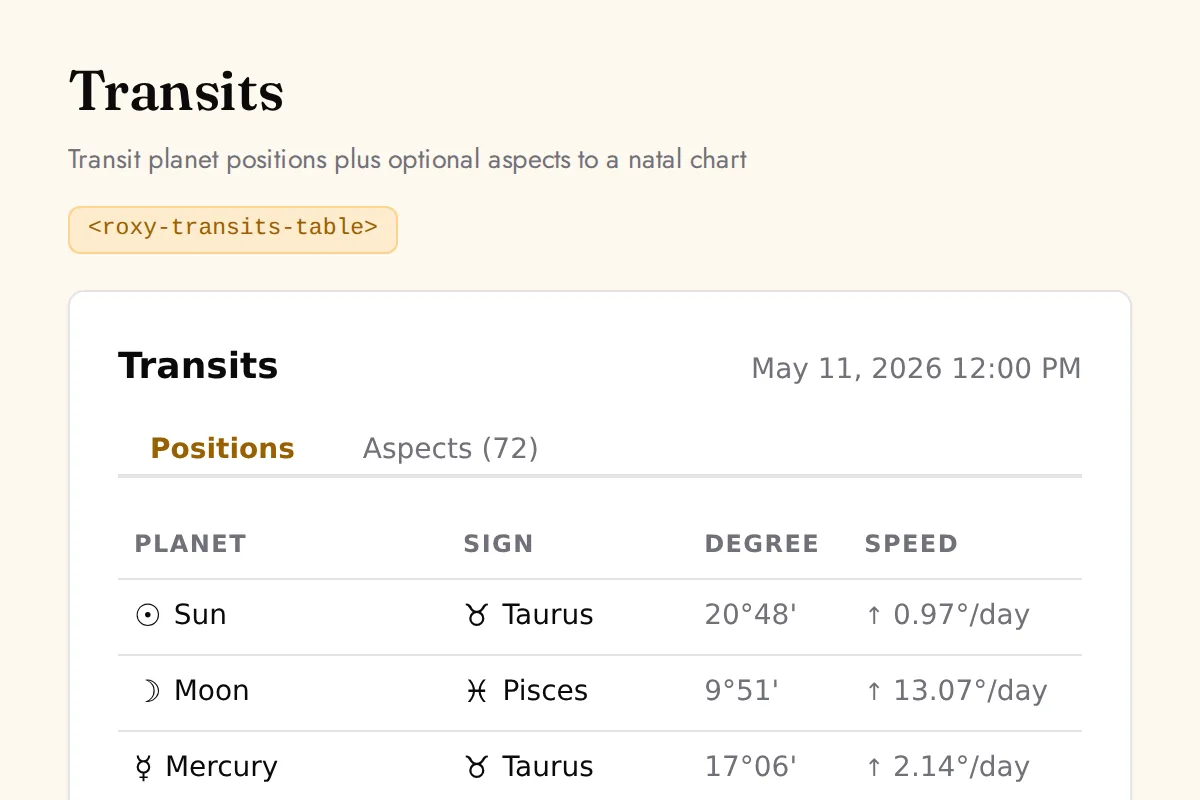
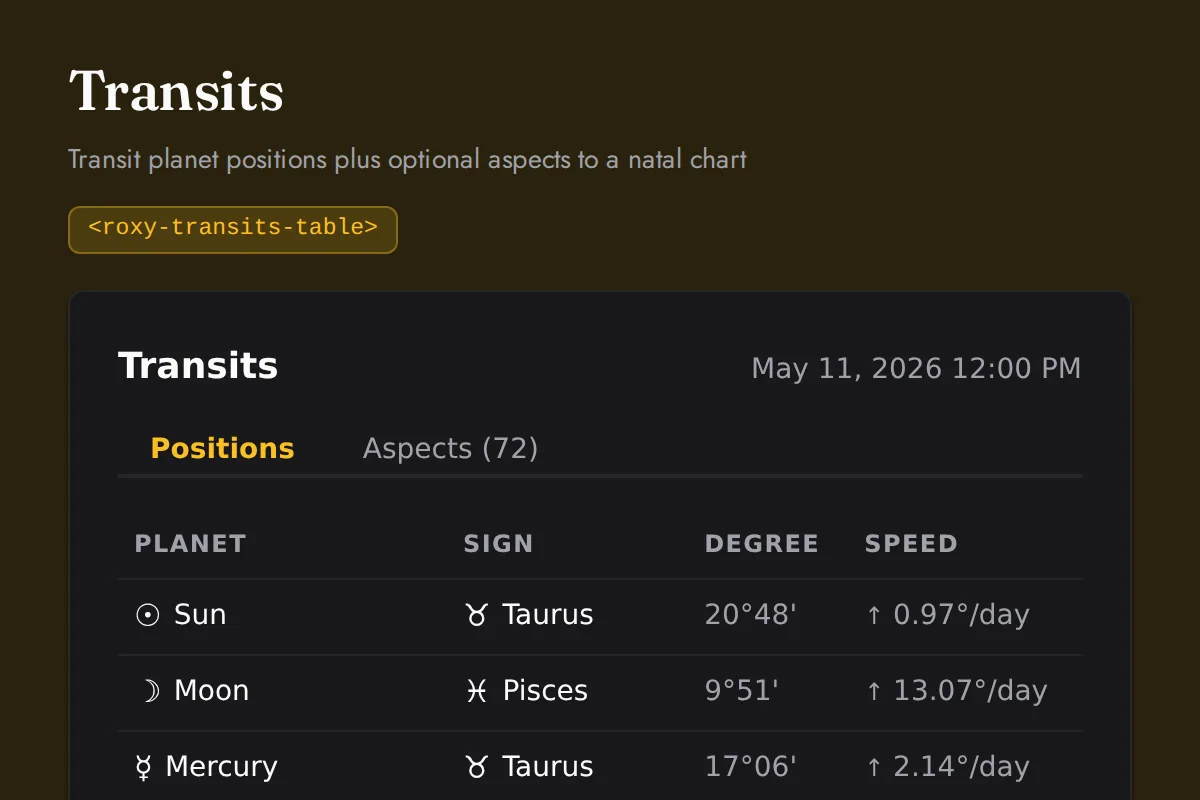
| <roxy-transits-table> | Transit planet positions plus optional aspects to a natal chart |
Related capabilities
Astrology Transits API FAQ
What does the Astrology Transits API return?
Calculate current or future planetary transits (positions of all bodies now). Every response is structured JSON with documented fields, not free text, so you map it straight into your product.
How do I authenticate with the Astrology Transits API?
Pass your key in the X-API-Key header on every request. Keys are delivered instantly at checkout with no approval queue. Use a secret sk key server side, or mint a publishable pk key locked to your origins for browser and no-code use.
Does the Astrology Transits API support multiple languages?
Yes. Append the lang query parameter to any endpoint for responses in English, German, Spanish, French, Hindi, Portuguese, Russian and Turkish. The translated payload includes the full interpretation text, not just field labels.
Do I need coordinates to call the Astrology Transits API?
No. Call GET /location/search with a city name first, then pass latitude, longitude, and timezone from the first result into the request. Never ask users to type coordinates. Timezone accepts a decimal offset or an IANA name.
Is the Astrology Transits API available over Remote MCP for AI agents?
Yes. Every endpoint is exposed as a callable tool on the Remote MCP server at https://roxyapi.com/mcp/astrology over Streamable HTTP, so Claude, ChatGPT, Cursor, and any MCP client auto-discover it with no local setup or Docker.
How is the Astrology Transits API billed?
Flat pricing: 1 request equals 1 quota unit, REST and MCP identical, with no credit weighting or per-token markup. Every plan includes all 18 domains, so the Astrology Transits API is included at no extra cost.
What nodeType values does the Astrology Transits API accept?
The nodeType parameter accepts mean, true. Case-insensitive where it is a path value.
Start using Astrology Transits API today.
Birth charts checked cusp by cusp, and horoscopes that name the dated sky events behind each reading.
All 18 domains included with every plan. Every endpoint, MCP server, SDK, and templates.
Plans from $39/mo, starting at $1.80 per domain on annual billing. No credit card required for testing.
View Pricing & Get API Key